This comprehensive analysis examines whether PundiX (PUNDIX) represents a viable investment opportunity in 2024-2031. The article evaluates PUNDIX's market position as a payment infrastructure token, currently trading at $0.2405 with a market capitalization of $62.14 million. It analyzes the token's real-world utility through Pundi X's deployment of XPOS devices across 25+ countries and XWallet adoption exceeding 100,000 users. The guide reviews historical price performance, including a 52.17% year-over-year decline, while presenting price forecasts ranging from $0.13 to $0.56 through 2031 under various scenarios. Investment strategies for different risk profiles and comprehensive risk management frameworks are provided, including asset allocation guidelines and secure storage solutions. The article concludes that PUNDIX suits investors believing in cryptocurrency payment adoption, while emphasizing regulatory risks, market volatility, and the importance of thorough due diligence before investment decisions.
Introduction: PundiX (PUNDIX) Investment Position and Market Outlook
PUNDIX is a notable asset in the cryptocurrency sector, having launched in 2021 through a token swap from the original Pundi X (NPXS) with a 1000:1 conversion ratio. As of January 2026, PUNDIX maintains a market capitalization of approximately $62.14 million, with a circulating supply of around 258.39 million tokens, and a current price hovering near $0.24. The token ranks 471st by market capitalization and holds a market share of 0.0018%. PUNDIX serves the Pundi X ecosystem, which aims to facilitate cryptocurrency adoption in everyday transactions through physical point-of-sale devices (XPOS) and the XWallet mobile application. The platform has deployed XPOS devices across more than 25 countries globally. With its positioning in the cryptocurrency payment infrastructure space, PUNDIX has drawn attention from investors evaluating "Is PundiX (PUNDIX) a good investment?" This article provides a comprehensive analysis of PUNDIX's investment characteristics, historical price movements, future price projections, and associated risks to serve as a reference for investors.
I. PUNDIX Price History Review and Current Investment Value
- 2021: PUNDIX reached significant price levels in March → Investors experienced considerable volatility during this period
- 2019-2021: Token migration from NPXS to PUNDIX with 1000:1 consolidation → Price structure underwent fundamental transformation
- 2025: Market cycle downturn → Price declined from higher levels to around 0.21 USD range
Current PUNDIX Investment Market Status (January 2026)
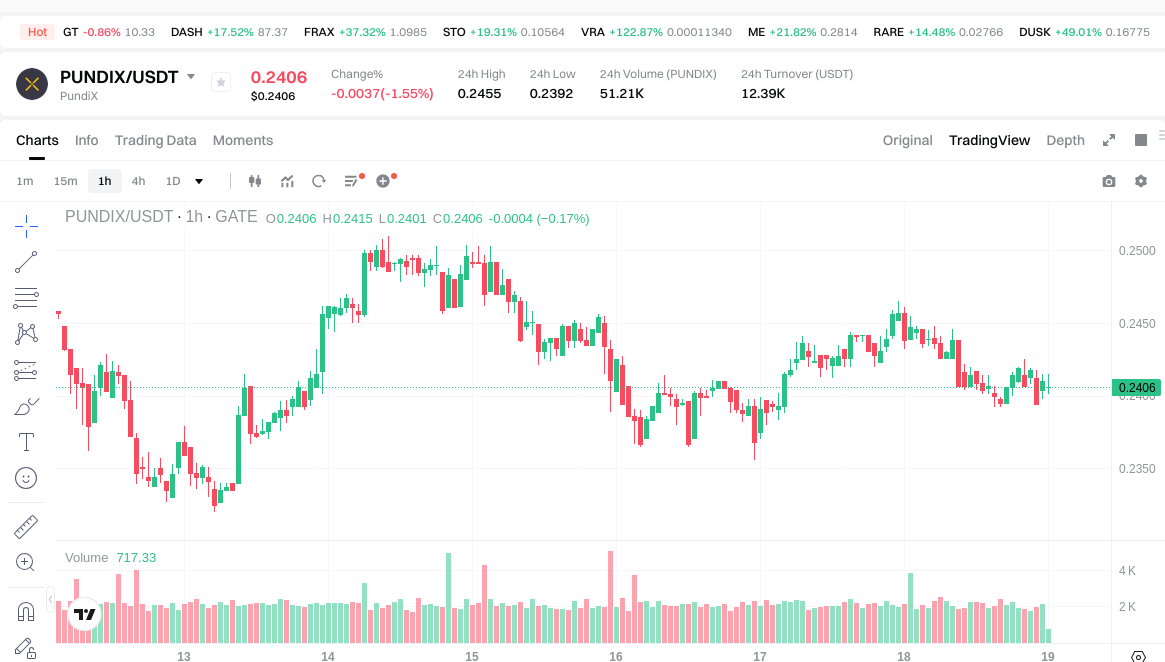
- PUNDIX current price: 0.2405 USD
- Market sentiment: Recent 24-hour change shows -1.54%, indicating cautious market positioning
- 24-hour trading volume: 12,393.80 USD
- Circulating supply concentration: 258.39 million tokens representing 99.95% of maximum supply
Click to view real-time PUNDIX market price
II. Core Factors Affecting Whether PUNDIX is a Good Investment (Is PundiX(PUNDIX) a Good Investment)
Supply Mechanism and Scarcity (PUNDIX investment scarcity)
- Token Supply Structure → Influences Price and Investment Value
- According to the provided data, PUNDIX has a maximum supply of 258,526,640 tokens with a circulating supply of 258,386,541 tokens, representing approximately 99.95% of the total supply. This high circulation ratio suggests limited scarcity potential from supply constraints.
- The token originated from a 1000:1 conversion from the old Pundi X (NPXS) smart contract, which fundamentally altered the token supply dynamics and may have impacted historical price patterns.
- Investment Consideration: The near-complete circulation of tokens means future price movements may depend more on demand factors rather than supply restrictions.
Institutional Investment and Mainstream Adoption (Institutional investment in PUNDIX)
- Holder Distribution: As of the latest data, PUNDIX has 18,412 token holders, indicating a moderate level of retail and institutional participation.
- Real-World Application: Pundi X has deployed XPOS devices to over 25 countries and issued more than 50,000 cryptocurrency recharge cards. The XWallet mobile payment application exceeded 100,000 registered users within three months of launch, demonstrating tangible adoption in physical retail environments.
- Platform Utility: PUNDIX serves the Pundi XPOS ecosystem for transaction fees, member rewards, and consumer incentives, which may provide fundamental support for its investment value through real-world utility.
Macroeconomic Environment Impact on PUNDIX Investment
- Market Performance: PUNDIX currently ranks 471st by market capitalization with a total market cap of approximately $62.14 million and a market dominance of 0.0018%, indicating it is a relatively small-cap cryptocurrency asset.
- Price Volatility: The token has experienced significant price fluctuations, with a one-year decline of 52.17% from $0.50 to $0.24, reflecting sensitivity to broader market conditions and cryptocurrency sector trends.
- Trading Activity: The 24-hour trading volume of approximately $12,393 suggests moderate liquidity, which may affect investment execution and price stability during volatile market periods.
Technology and Ecosystem Development (Technology & Ecosystem for PUNDIX investment)
- Infrastructure Foundation: The Pundi X ecosystem operates through XPOS point-of-sale devices at physical retail locations, creating a decentralized offline cryptocurrency network. This positions PUNDIX as a practical payment solution rather than solely a speculative asset.
- Blockchain Integration: PUNDIX operates with a contract address on the Ethereum network (0x0FD10b9899882a6f2fcb5c371E17e70FdEe00C38), allowing for integration with Ethereum-based DeFi applications and services.
- Platform Functionality: The token serves multiple utility functions including payment of transaction fees, merchant revenue enhancement, and customer satisfaction improvement within the Pundi X platform, which may provide ongoing demand drivers for the token.
- Ecosystem Expansion: With over 100,000 XWallet users and deployment across 25+ countries, the platform demonstrates ongoing geographic and user base expansion that could support long-term ecosystem development.
III. PUNDIX Future Investment Forecast and Price Outlook (Is PundiX(PUNDIX) worth investing in 2026-2031)
Short-term Investment Forecast (2026, short-term PUNDIX investment outlook)
- Conservative forecast: $0.13233 - $0.2406
- Neutral forecast: $0.2406 - $0.34887
- Optimistic forecast: $0.2406 - $0.34887
Mid-term Investment Outlook (2027-2029, mid-term PundiX(PUNDIX) investment forecast)
- Market phase expectation: Price movements may reflect gradual ecosystem development and merchant adoption trends, with potential fluctuations based on integration progress and market conditions.
- Investment return forecast:
- 2027: $0.16210425 - $0.3418926
- 2028: $0.248284764 - $0.346962042
- 2029: $0.18627723576 - $0.48565136466
- Key catalysts: Merchant integration dynamics, chain integration developments, and broader crypto payment adoption trends.
Long-term Investment Outlook (Is PUNDIX a good long-term investment?)
- Base scenario: $0.3764130714036 - $0.5523452678205 (under conditions of steady merchant growth and maintained exchange liquidity)
- Optimistic scenario: $0.451900258005735 - $0.562471597730542 (under conditions of successful chain integration and accelerated retail adoption)
- Risk scenario: Below $0.13233 (under conditions of adoption slowdown or significant regulatory challenges)
Click to view PUNDIX long-term investment and price prediction: Price Prediction
2026-01-19 to 2031 Long-term Outlook
- Base scenario: $0.3764130714036 - $0.5523452678205 (corresponding to steady progress and gradual mainstream application growth)
- Optimistic scenario: $0.451900258005735 - $0.562471597730542 (corresponding to large-scale adoption and favorable market conditions)
- Transformative scenario: Above $0.562471597730542 (if ecosystem achieves breakthrough progress and mainstream popularization)
- 2031-12-31 predicted high: $0.562471597730542 (based on optimistic development assumptions)
Disclaimer: Price predictions are based on historical data analysis and market forecasts, which involve uncertainties and risks. Past performance does not guarantee future results. Market conditions, regulatory changes, technological developments, and adoption rates may significantly impact actual prices. This information should not be construed as investment advice.
| Year |
Predicted High Price |
Predicted Average Price |
Predicted Low Price |
Price Change |
| 2026 |
0.34887 |
0.2406 |
0.13233 |
0 |
| 2027 |
0.3418926 |
0.294735 |
0.16210425 |
22 |
| 2028 |
0.346962042 |
0.3183138 |
0.248284764 |
31 |
| 2029 |
0.48565136466 |
0.332637921 |
0.18627723576 |
37 |
| 2030 |
0.5523452678205 |
0.40914464283 |
0.3764130714036 |
69 |
| 2031 |
0.562471597730542 |
0.48074495532525 |
0.451900258005735 |
99 |
IV. PUNDIX Investment Strategy and Risk Management (How to invest in PUNDIX)
Investment Strategy (PUNDIX investment strategy)
Long-term Holding (HODL PUNDIX)
Long-term holding may be suitable for investors who believe in Pundi X's mission to make cryptocurrency accessible for everyday transactions. This approach involves purchasing PUNDIX tokens and holding them through market fluctuations, focusing on the project's fundamental development rather than short-term price movements. Investors adopting this strategy should monitor Pundi X's expansion of XPOS devices across different countries and the adoption rate of their XWallet mobile application.
Active Trading
Active trading strategies rely on technical analysis and market timing. Given PUNDIX's price volatility, traders may identify opportunities through:
- Technical indicators such as moving averages, RSI, and volume analysis
- Monitoring the token's 24-hour trading range (recent data shows fluctuations between $0.2392 and $0.2457)
- Tracking short-term price movements across the 1-hour, 24-hour, and 7-day timeframes
- Analyzing trading volumes across the 17 exchanges where PUNDIX is listed
Risk Management (Risk management for PUNDIX investment)
Asset Allocation
Conservative Investors: May consider allocating 1-3% of their cryptocurrency portfolio to PUNDIX, focusing on established projects with larger market capitalizations for the remaining allocation.
Moderate Investors: Could allocate 3-7% to PUNDIX as part of a diversified cryptocurrency portfolio, balancing between major cryptocurrencies and smaller market cap tokens.
Aggressive Investors: Might allocate 7-15% to PUNDIX, accepting higher volatility in exchange for potential growth opportunities in the payment processing sector.
Risk Hedging Strategies
- Multi-asset Portfolio: Combine PUNDIX holdings with different cryptocurrency categories (store of value, DeFi, payment tokens) to reduce concentration risk
- Stablecoin Reserves: Maintain a portion of portfolio in stablecoins for quick reallocation during market corrections
- Regular Rebalancing: Adjust portfolio weights periodically based on market conditions and PUNDIX's performance relative to the broader market
Secure Storage
Hot Wallets: Suitable for small amounts needed for frequent transactions
- MetaMask (compatible with PUNDIX's Ethereum contract address: 0x0FD10b9899882a6f2fcb5c371E17e70FdEe00C38)
- Trust Wallet
- XWallet (Pundi X's native mobile application)
Cold Storage Solutions: Recommended for larger holdings
- Hardware Wallets: Ledger Nano X, Ledger Nano S Plus, Trezor Model T
- Paper Wallets: For long-term storage without active management needs
Security Best Practices:
- Never share private keys or seed phrases
- Enable two-factor authentication on exchange accounts
- Verify contract addresses before transactions
- Use dedicated devices for cryptocurrency management
V. PUNDIX Investment Risks and Challenges (Risks of investing in PUNDIX)
Market Risks
High Volatility: PUNDIX has demonstrated significant price volatility, with recent data showing:
- 1-hour price change: +0.37%
- 24-hour price change: -1.54%
- 7-day price change: -1.87%
- 30-day price change: +8.34%
- 1-year price change: -52.17%
The token's price currently sits at $0.2405, representing a substantial decline from its previous levels. Such volatility can result in rapid gains or losses, making timing crucial for investors.
Market Capitalization Considerations: With a market capitalization of approximately $62.14 million and a market dominance of 0.0018%, PUNDIX represents a relatively smaller cryptocurrency project. This lower liquidity may contribute to higher price volatility and potentially larger price swings on significant buy or sell orders.
Trading Volume: The 24-hour trading volume of $12,393.80 indicates moderate market activity, which may affect the ability to execute large trades without impacting the price.
Regulatory Risks
Global Policy Uncertainty: As a payment-focused cryptocurrency project operating across more than 25 countries, Pundi X faces varying regulatory frameworks:
- Different jurisdictions maintain distinct approaches to cryptocurrency payments and point-of-sale systems
- Regulatory changes in key markets could impact XPOS device deployment and usage
- Payment processing regulations may evolve, potentially affecting Pundi X's business model
- Cross-border transaction regulations could influence the project's expansion capabilities
Compliance Requirements: Physical point-of-sale devices (XPOS) may need to comply with local financial regulations, licensing requirements, and consumer protection laws, which vary significantly across different regions.
Technical Risks
Smart Contract Risks: PUNDIX operates as an Ethereum-based token (ERC-20), with the contract address at 0x0FD10b9899882a6f2fcb5c371E17e70FdEe00C38. Smart contract vulnerabilities could potentially expose token holders to security risks.
Network Dependencies: As an Ethereum-based token, PUNDIX's performance and transaction costs are influenced by Ethereum network congestion and gas fees, which can fluctuate significantly during periods of high activity.
Technology Adoption: The success of Pundi X depends on:
- Continued adoption of XPOS devices by merchants
- User engagement with XWallet mobile application
- Technical reliability of payment processing infrastructure
- Integration with existing payment systems
Infrastructure Challenges: Operating physical point-of-sale devices across multiple countries presents ongoing maintenance, support, and upgrade challenges that could affect the platform's reliability and user experience.
VI. Conclusion: Is PUNDIX a Good Investment?
Investment Value Summary
PUNDIX represents a cryptocurrency project focused on making digital assets accessible for everyday transactions through physical point-of-sale devices and mobile applications. The token has experienced significant price fluctuations, with a notable decline of 52.17% over the past year, though showing some recovery with an 8.34% increase over the past 30 days.
The project's infrastructure includes deployment across more than 25 countries, over 50,000 cryptocurrency recharge cards issued, and a mobile application (XWallet) that has attracted over 100,000 registered users. The circulating supply of 258,386,541 tokens represents approximately 99.95% of the maximum supply of 258,526,640 tokens, indicating minimal future dilution concerns.
Investor Recommendations
✅ Beginners:
- Consider starting with small allocations to understand PUNDIX's price behavior
- Use dollar-cost averaging (DCA) approach to minimize timing risk
- Store tokens in secure wallets such as hardware wallets (Ledger, Trezor) or the project's native XWallet
- Research Pundi X's fundamental developments before making investment decisions
- Avoid investing amounts you cannot afford to lose
✅ Experienced Investors:
- Monitor technical indicators and trading ranges for potential entry and exit points
- Consider PUNDIX as part of a diversified cryptocurrency portfolio, particularly within the payment processing sector
- Track project developments, merchant adoption rates, and user growth metrics
- Set clear stop-loss levels to manage downside risk
- Evaluate correlation with broader cryptocurrency market trends
✅ Institutional Investors:
- Conduct thorough due diligence on Pundi X's business model and competitive positioning
- Assess the regulatory environment in target markets where XPOS devices are deployed
- Evaluate the token's role within the broader payment processing ecosystem
- Consider strategic allocation as part of blockchain payment infrastructure exposure
- Monitor liquidity conditions and trading volumes across multiple exchanges
⚠️ Disclaimer: Cryptocurrency investments involve substantial risk and high volatility. PUNDIX's significant price decline over the past year demonstrates the potential for considerable losses. This content is for informational purposes only and does not constitute financial advice, investment recommendations, or an offer to buy or sell securities. Always conduct your own research and consult with qualified financial advisors before making investment decisions. Past performance does not guarantee future results.
VII. FAQ
Q1: What is the difference between PUNDIX and the original Pundi X (NPXS) token?
PUNDIX was created through a 1000:1 token swap from the original Pundi X (NPXS) in 2021, meaning every 1000 NPXS tokens were converted into 1 PUNDIX token. This consolidation fundamentally transformed the token's supply structure and price dynamics. While both tokens serve the same Pundi X ecosystem, the new PUNDIX contract operates on Ethereum (contract address: 0x0FD10b9899882a6f2fcb5c371E17e70FdEe00C38) with a maximum supply of 258,526,640 tokens. The token swap was designed to provide a more manageable token supply structure, with nearly 100% of the maximum supply already in circulation (258,386,541 tokens or 99.95%), eliminating concerns about future token inflation or dilution.
Q2: How does PUNDIX's low trading volume affect investment liquidity?
With a 24-hour trading volume of approximately $12,393.80, PUNDIX demonstrates moderate market liquidity that impacts investment execution. This relatively low trading volume means that large buy or sell orders can significantly affect the token's price, potentially causing larger price swings than more liquid cryptocurrencies. Investors attempting to execute substantial trades may experience slippage or difficulty finding counterparties at desired prices. However, PUNDIX is listed on 17 exchanges, which provides multiple trading venues for investors. For smaller retail investors, the current liquidity may be sufficient for regular trading activities, but institutional investors or those managing larger positions should be aware of potential execution challenges and consider splitting large orders across multiple exchanges or time periods.
Q3: What utility does the PUNDIX token provide within the ecosystem?
PUNDIX serves as the primary utility token for the Pundi X ecosystem, providing several practical functions that support its investment value. The token is used to pay transaction fees on XPOS point-of-sale devices deployed across more than 25 countries, allowing merchants to accept cryptocurrency payments in physical retail environments. PUNDIX also functions as a reward mechanism for ecosystem participants, including member rewards and consumer incentives, encouraging adoption and usage of Pundi X services. Merchants can use PUNDIX to enhance revenue opportunities, while customers benefit from satisfaction improvement programs. Additionally, the token operates within the XWallet mobile application, which has over 100,000 registered users, providing a practical payment solution for everyday transactions rather than serving solely as a speculative asset.
Q4: How do regulatory risks affect PUNDIX's investment potential?
PUNDIX faces significant regulatory uncertainties due to its operation across more than 25 countries with varying cryptocurrency payment frameworks. Each jurisdiction maintains distinct approaches to cryptocurrency point-of-sale systems, payment processing regulations, and consumer protection laws. Physical XPOS devices must comply with local financial regulations and licensing requirements that differ substantially across regions. Regulatory changes in key markets could directly impact the deployment and usage of XPOS devices, potentially affecting the ecosystem's growth trajectory. Cross-border transaction regulations may also influence Pundi X's expansion capabilities into new markets. Investors should monitor regulatory developments in major markets where PUNDIX operates, as policy changes could materially affect the token's utility, adoption rates, and ultimately its investment value. The project's multi-jurisdictional exposure creates both diversification benefits and compliance challenges.
Q5: Is PUNDIX suitable for long-term holding or short-term trading?
The suitability of PUNDIX for long-term holding versus short-term trading depends on investor objectives and risk tolerance. For long-term holding, PUNDIX may appeal to investors who believe in the project's mission to make cryptocurrency accessible for everyday transactions through physical infrastructure. The token's utility within a growing ecosystem of 100,000+ XWallet users and deployment across 25+ countries provides fundamental support. However, the significant 52.17% decline over the past year demonstrates considerable downside risk that long-term holders must accept. For short-term trading, PUNDIX's price volatility presents opportunities, with recent data showing fluctuations between $0.2392 and $0.2457 within 24 hours. Traders can potentially capitalize on these movements using technical analysis and careful timing. The token's moderate liquidity across 17 exchanges provides sufficient trading venues, though lower trading volumes may result in price slippage on larger orders. Ultimately, the investment approach should align with individual financial goals, risk capacity, and market outlook.
Q6: What are the main risks associated with storing PUNDIX tokens?
PUNDIX storage risks primarily relate to security vulnerabilities and technical dependencies. As an Ethereum-based ERC-20 token, PUNDIX is subject to smart contract risks associated with its contract address (0x0FD10b9899882a6f2fcb5c371E17e70FdEe00C38). While the contract has been operational since 2021, potential vulnerabilities could expose token holders to security threats. Storage method selection significantly impacts risk exposure: hot wallets (MetaMask, Trust Wallet, XWallet) offer convenience for frequent transactions but present higher security risks from online exposure, while cold storage solutions (Ledger Nano X, Trezor Model T) provide superior security for larger holdings but less accessibility. Investors must implement security best practices including never sharing private keys or seed phrases, enabling two-factor authentication, verifying contract addresses before transactions, and using dedicated devices for cryptocurrency management. Additionally, network dependencies on Ethereum mean that transaction costs and confirmation times fluctuate with network congestion, potentially affecting the ability to move tokens during critical market moments.
Q7: How does PUNDIX's small market capitalization affect investment risk?
PUNDIX's market capitalization of approximately $62.14 million and market dominance of 0.0018% classify it as a relatively small-cap cryptocurrency, which significantly influences investment risk characteristics. Smaller market capitalizations typically correlate with higher price volatility, as demonstrated by PUNDIX's substantial price movements including the 52.17% decline over the past year. Lower market caps also mean that proportionally smaller capital inflows or outflows can cause larger percentage price changes compared to established cryptocurrencies. This size factor affects liquidity, potentially making it more difficult to execute large trades without price impact. The ranking of 471st by market capitalization indicates limited mainstream awareness and adoption compared to top-tier cryptocurrencies. However, smaller market caps also present greater upside potential if the project successfully achieves widespread adoption and ecosystem growth. Investors should position PUNDIX holdings appropriately within their portfolio risk tolerance, with conservative investors potentially limiting allocation to 1-3%, moderate investors to 3-7%, and aggressive investors to 7-15% of their cryptocurrency portfolio.
Q8: What factors could drive PUNDIX price appreciation in the future?
Several key factors could positively influence PUNDIX's future price trajectory. Merchant adoption remains the primary driver, with expanded deployment of XPOS devices beyond the current 25+ countries potentially increasing token utility and demand. Growing user engagement with the XWallet mobile application, which already has over 100,000 registered users, could drive transaction volume and ecosystem activity. Successful blockchain integration and partnerships with payment processors, financial institutions, or retail chains could significantly enhance credibility and adoption rates. Broader cryptocurrency market trends, particularly increased acceptance of digital assets for everyday transactions, would benefit payment-focused projects like Pundi X. Technical developments improving transaction speed, reducing costs, or enhancing user experience could strengthen competitive positioning. Favorable regulatory frameworks in key markets that support cryptocurrency payments could accelerate deployment and usage. Additionally, the high circulation rate (99.95% of maximum supply) means future price movements depend primarily on demand factors rather than supply inflation, potentially creating clearer price dynamics driven by fundamental adoption metrics.
* The information is not intended to be and does not constitute financial advice or any other recommendation of any sort offered or endorsed by Gate.