This comprehensive analysis evaluates Quack AI (Q) as an investment opportunity, examining the AI-native governance token's technology, market position, and potential. Q, launched in 2025, operates as a multi-chain governance infrastructure across BNB Chain, Arbitrum, Base, Linea, and Polygon, currently trading at $0.016576 with a $26.79 million market cap. The article explores Q's price history, supply mechanics, institutional adoption potential, and detailed forecasts through 2031. Key sections address investment strategies for different investor profiles, comprehensive risk assessments including market volatility and regulatory challenges, and security considerations for token holders. Featuring price predictions ranging from conservative to optimistic scenarios, risk management approaches, and practical FAQ answers, this guide provides investors with essential insights for evaluating Q's long-term viability within the evolving Web3 governance landscape.
Introduction: Quack AI (Q) Investment Position and Market Outlook
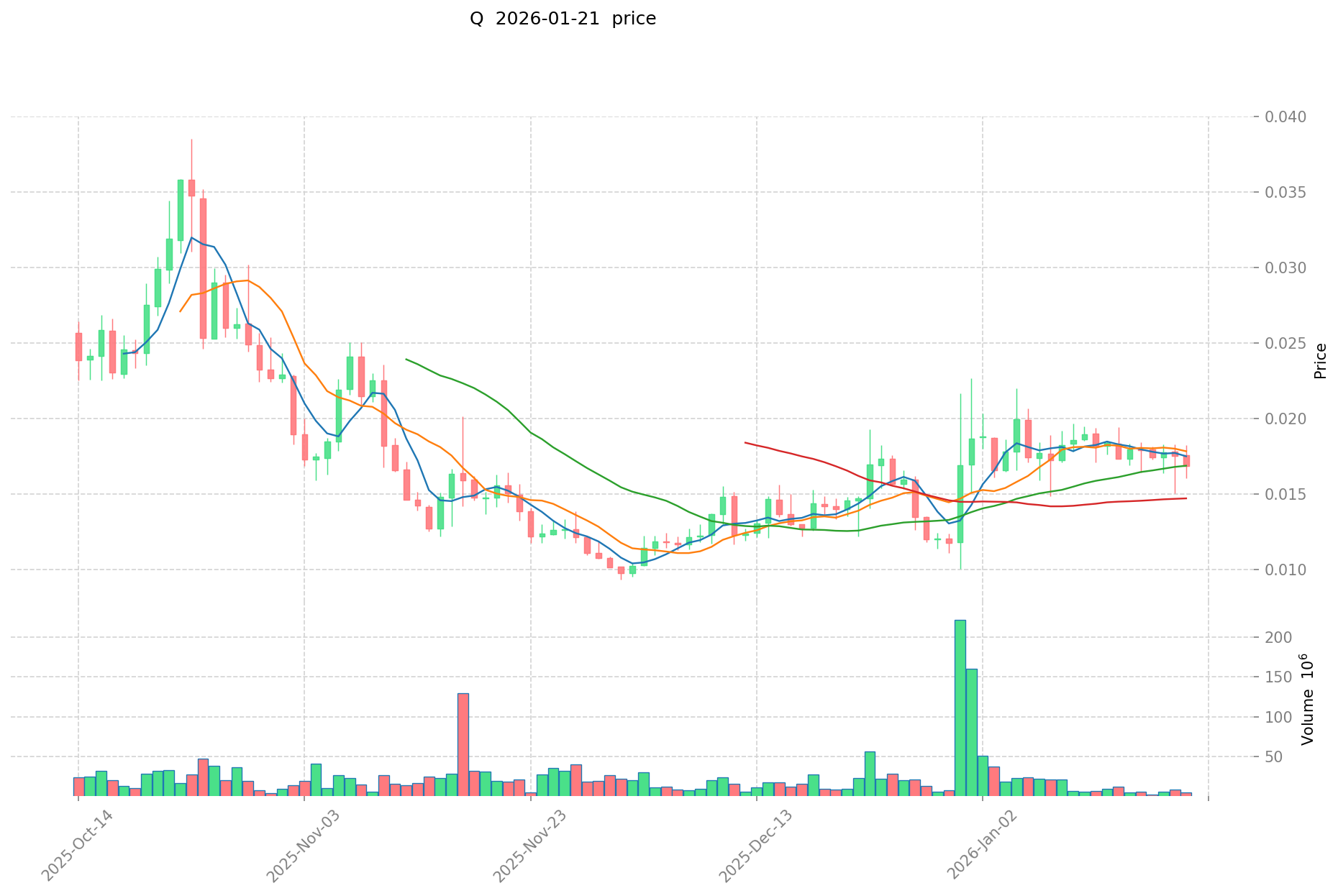
Quack AI (Q) is an emerging asset in the cryptocurrency sector, launched in 2025 as an AI-native governance layer for Web3. As of January 22, 2026, Q has achieved a market capitalization of approximately $26.79 million, with a circulating supply of 1.616 billion tokens and a current price around $0.016576. Ranked #749 by market cap and holding a 0.0053% market dominance, Q has positioned itself within the decentralized governance infrastructure space. The token operates across multiple blockchain networks including BNB Chain, Arbitrum, Base, Linea, and Polygon, facilitating automated and auditable governance workflows for DAOs and RWA projects. With 23,380 holders and trading availability on 14 exchanges, Q has developed a presence in the market. When investors evaluate "Is Quack AI (Q) a good investment?", they examine factors including its governance automation technology, multi-chain compatibility, market performance trends, and adoption metrics. This article provides a comprehensive analysis of Q's investment characteristics, historical price movements, future price outlook, and associated investment risks to serve as a reference for market participants.
I. Quack AI (Q) Price History Review and Current Investment Value
- 2025: Token launch in September → Price established initial trading range from $0.002 to early price levels
- 2025: October market activity → Q price experienced upward movement, reaching elevated levels during this period
- 2025-2026: Market adjustment phase → Price experienced fluctuations from higher trading levels back toward current valuations
Current Q Investment Market Status (January 2026)
- Q current price: $0.016576
- 24-hour trading volume: $86,403.71
- Total holders: 23,380 addresses
- Circulating supply: 1.616 billion Q tokens (16.16% of total supply)
Click to view real-time Q market price
II. Core Factors Influencing Whether Q is a Good Investment
Supply Mechanism and Scarcity (Q investment scarcity)
- Supply Structure → Impacts price and investment value
- Total Supply: 10,000,000,000 Q tokens
- Circulating Supply: 1,616,000,000 Q tokens (16.16% of total supply)
- Max Supply: 10,000,000,000 Q tokens
- Price Performance Context: Q has experienced price fluctuations, with historical data showing a range from $0.002 to $0.053205
- Investment Implication: The current circulation ratio of 16.16% suggests substantial tokens remain outside circulation, which may influence future supply dynamics and long-term investment considerations
Institutional Investment and Mainstream Adoption (Institutional investment in Q)
- Holder Distribution: The token currently has 23,380 holders as of the latest data
- Exchange Presence: Q is listed on 14 exchanges, indicating a moderate level of market accessibility
- Multi-chain Support: QuackAI operates across multiple blockchain networks including BNB Chain, Arbitrum, Base, Linea, and Polygon, which may facilitate broader adoption across different ecosystems
Macroeconomic Environment's Impact on Q Investment
- Market Positioning: As a governance-focused token in the Web3 space, Q's investment appeal may be influenced by broader trends in decentralized autonomous organizations (DAOs) and real-world asset (RWA) tokenization
- Market Capitalization Context: With a market cap of $26,786,816 and a dominance of 0.0053%, Q represents a smaller-cap investment within the cryptocurrency market
- Volatility Considerations: Recent price movements show fluctuations, with a 24-hour change of -1.73%, 7-day change of -8.21%, and 30-day change of +13.76%
Technology and Ecosystem Development (Technology & Ecosystem for Q investment)
- AI-Native Governance Layer: QuackAI positions itself as an AI-native governance infrastructure for Web3, automating governance workflows including on-chain and off-chain data ingestion, proposal drafting and refinement, and impact analysis
- Automation Features: The platform provides automated capabilities for voting, delegation, and treasury operations, potentially enhancing governance efficiency for DAOs and RWA projects
- Multi-chain Architecture: Support for multiple blockchain networks (BNB Chain, Arbitrum, Base, Linea, Polygon) may provide flexibility for diverse governance use cases
- Policy Controls and Compliance: QuackAI emphasizes transparent, compliant, and scalable decision-making processes, which could appeal to projects requiring auditable governance mechanisms
III. Q Future Investment Outlook and Price Forecast (Is Quack AI(Q) worth investing in 2026-2031)
Short-term Q Investment Outlook (2026)
- Conservative forecast: $0.012414 - $0.016552
- Neutral forecast: $0.014483 - $0.019360
- Optimistic forecast: $0.016552 - $0.02168312
Mid-term Quack AI(Q) Investment Forecast (2027-2028)
- Market stage expectation: Following the early deployment phase, Q may enter a period of ecosystem expansion and multi-chain governance adoption. The integration with platforms such as BNB Chain, Arbitrum, Base, Linea, and Polygon could support broader DAO and RWA project engagement.
- Investment return forecast:
- 2027: $0.017205804 - $0.0279116376
- 2028: $0.0176359491 - $0.024455182752
- Key catalysts: Expansion of governance automation use cases, adoption by DAOs and RWA projects, multi-chain ecosystem development, and enhancements to AI-driven proposal workflows.
Long-term Investment Outlook (Is Q a good long-term investment?)
- Base scenario: $0.015542209222848 - $0.042021528639552 (assuming steady ecosystem growth and moderate adoption in Web3 governance)
- Optimistic scenario: $0.020887002283371 - $0.051686480226648 (assuming accelerated adoption across multiple chains, increased DAO participation, and favorable market conditions)
- Risk scenario: $0.012414 - $0.015542209222848 (under conditions of limited adoption, competitive pressures, or adverse market sentiment)
View Q long-term investment and price prediction: Price Prediction
2026-01-22 - 2031 Long-term Outlook
- Base scenario: $0.015542209222848 - $0.042021528639552 (corresponding to steady progress and gradual mainstream application uptake)
- Optimistic scenario: $0.020887002283371 - $0.051686480226648 (corresponding to large-scale adoption and favorable market environment)
- Transformative scenario: Above $0.051686480226648 (such as breakthrough ecosystem developments and mainstream adoption)
- 2031-12-31 predicted high: $0.051686480226648 (based on optimistic development assumptions)
Disclaimer: The above forecasts are for reference only and do not constitute investment advice. Cryptocurrency markets are highly volatile, and actual prices may differ significantly from predictions.
| Year |
Predicted High Price |
Predicted Average Price |
Predicted Low Price |
Price Change |
| 2026 |
0.02168312 |
0.016552 |
0.012414 |
0 |
| 2027 |
0.0279116376 |
0.01911756 |
0.017205804 |
15 |
| 2028 |
0.024455182752 |
0.0235145988 |
0.0176359491 |
41 |
| 2029 |
0.0335788470864 |
0.023984890776 |
0.01391123665008 |
44 |
| 2030 |
0.042021528639552 |
0.0287818689312 |
0.015542209222848 |
73 |
| 2031 |
0.051686480226648 |
0.035401698785376 |
0.020887002283371 |
113 |
IV. Quack AI (Q) Investment Strategy and Risk Management (How to invest in AI-native governance tokens)
Investment Methodology (Q investment strategy)
Long-term Holding (HODL Q): This approach may suit investors who believe in the long-term development of AI-driven governance infrastructure in Web3. Given Q's focus on automating DAO and RWA project governance across multiple chains (BNB Chain, Arbitrum, Base, Linea, Polygon), long-term holders would be betting on increasing adoption of AI-native governance solutions. However, with a circulating supply of only 16.16% of the total supply, investors should consider potential future token releases that may impact price dynamics.
Active Trading: Traders employing technical analysis might focus on Q's price movements and trading patterns. Recent data shows the token experienced an 8.21% decline over 7 days, while posting a 13.76% gain over 30 days, suggesting potential volatility that active traders could seek to capitalize on. The token's 24-hour trading volume of approximately $86,403 indicates relatively modest liquidity, which traders should factor into their position sizing and exit strategies.
Risk Management (Risk management for Q investment)
Asset Allocation Ratios:
- Conservative investors: Consider limiting Q exposure to 1-3% of crypto portfolio due to its ranking (#749) and relatively low market cap
- Aggressive investors: May allocate 5-10% while maintaining diversification across different crypto sectors
- Professional investors: Could incorporate Q as part of a broader AI and governance token thesis, with position sizing based on conviction and portfolio strategy
Risk Hedging Approaches: Investors might consider diversifying across multiple AI and governance-focused tokens rather than concentrating solely in Q. Multi-asset portfolios combining established cryptocurrencies with emerging tokens like Q can help balance potential upside with downside protection. The use of stablecoins for periodic rebalancing may also serve as a hedging mechanism.
Secure Storage: Given Q operates as a BEP-20 token on BSC, investors should utilize:
- Hardware wallets compatible with BEP-20 tokens for long-term holdings
- Reputable hot wallets for trading positions, ensuring proper security practices
- Multi-signature solutions for larger holdings
V. Quack AI (Q) Investment Risks and Challenges (Risks of investing in AI-native governance tokens)
Market Risks: Q demonstrates notable price volatility, with its price ranging from a low of $0.002 to a high of $0.053205 during its trading history. The current market cap of approximately $26.79 million represents a relatively small position in the overall crypto market (0.0053% dominance), which may subject the token to greater price swings. Limited liquidity, as evidenced by modest 24-hour trading volumes, could amplify price movements during periods of significant buying or selling activity.
Regulatory Risks: As an AI-driven governance solution operating across multiple blockchain networks, Q faces evolving regulatory landscapes in different jurisdictions. The intersection of AI technology, decentralized governance, and cryptocurrency creates regulatory uncertainty, as various governments develop frameworks for these emerging sectors. Changes in regulations affecting DAOs, RWA projects, or AI applications could impact Q's adoption and utility.
Technology Risks: The integration of AI with blockchain governance systems introduces technical complexity. Potential risks include smart contract vulnerabilities, AI model reliability issues, or challenges in maintaining seamless multi-chain operations across BNB Chain, Arbitrum, Base, Linea, and Polygon. The project's ability to deliver on its automation and audit capabilities while maintaining security remains a consideration for potential investors. With only 14 exchanges listing Q, limited trading venue options may also pose liquidity risks.
VI. Conclusion: Is AI-native governance tokens a Good Investment?
Investment Value Summary: Quack AI (Q) represents an emerging approach to blockchain governance through AI integration, targeting the growing DAO and RWA sectors. The token's support for multiple chains and focus on automated, transparent governance workflows addresses real needs in the Web3 ecosystem. However, with a market cap ranking of #749 and a low circulating supply ratio of 16.16%, the token faces challenges related to liquidity, price volatility, and competition from established governance solutions. The 30-day performance showing a 13.76% increase suggests some market interest, though recent 7-day declines of 8.21% highlight ongoing volatility.
Investor Recommendations:
✅ Beginners: Consider starting with small, regular investments (dollar-cost averaging) if interested in AI-governance tokens. Prioritize security by using hardware wallets compatible with BEP-20 tokens. Avoid allocating significant portions of capital to early-stage projects like Q until gaining more experience with crypto market dynamics.
✅ Experienced Investors: May incorporate Q as part of a diversified portfolio focused on AI and governance infrastructure themes. Consider employing technical analysis for entry and exit points, given the token's volatility patterns. Monitor project development milestones and adoption metrics across supported chains.
✅ Institutional Investors: Could evaluate Q as a potential component of thematic exposure to AI-blockchain convergence and governance innovation. Conduct thorough due diligence on the project's technology, team, and competitive positioning. Consider the token's low float and potential token release schedule in position sizing decisions.
⚠️ Disclaimer: Cryptocurrency investments carry substantial risks, including potential complete loss of capital. This content is provided for informational purposes only and does not constitute investment advice, financial advice, trading advice, or recommendations. Investors should conduct their own research and consult with qualified financial advisors before making investment decisions.
VII. FAQ
Q1: What is Quack AI (Q) and what makes it different from other governance tokens?
Quack AI (Q) is an AI-native governance layer for Web3, launched in September 2025, that automates governance workflows for DAOs and RWA projects. Unlike traditional governance tokens, Q integrates artificial intelligence to automate on-chain and off-chain data ingestion, proposal drafting and refinement, voting, delegation, and treasury operations. The token operates across multiple blockchain networks including BNB Chain, Arbitrum, Base, Linea, and Polygon, providing cross-chain governance capabilities. With a current market cap of approximately $26.79 million and trading at around $0.016576, Q positions itself as infrastructure for transparent, compliant, and scalable decision-making processes in the Web3 ecosystem.
Q2: Is Quack AI (Q) a good short-term investment in 2026?
Short-term investment in Q carries considerable volatility risks. Recent performance shows mixed signals: a 13.76% gain over 30 days but an 8.21% decline over 7 days, indicating significant price swings. The token ranks #749 by market cap with only $86,403 in 24-hour trading volume, suggesting limited liquidity that could amplify price movements. Conservative short-term forecasts for 2026 range from $0.012414 to $0.016552, while optimistic scenarios project $0.016552 to $0.02168312. Short-term traders should be aware of the risks associated with low liquidity and employ appropriate position sizing. For conservative investors, Q may be better suited as a small allocation (1-3% of portfolio) in a diversified strategy rather than a primary short-term trading vehicle.
Q3: What are the main risks of investing in Quack AI (Q)?
Three primary risk categories affect Q investments. Market risks include high volatility (historical price range from $0.002 to $0.053205), small market cap ($26.79 million with 0.0053% market dominance), and limited liquidity across only 14 exchanges. Regulatory risks stem from the evolving legal frameworks surrounding AI technology, decentralized governance, and cryptocurrency across multiple jurisdictions where Q operates. Technology risks involve smart contract vulnerabilities, AI model reliability concerns, and the complexity of maintaining operations across five blockchain networks (BNB Chain, Arbitrum, Base, Linea, Polygon). Additionally, the low circulating supply ratio of 16.16% means substantial tokens remain outside circulation, potentially impacting future price dynamics through token releases.
Q4: How should different types of investors approach Quack AI (Q)?
Investment approaches vary by experience level. Beginners should start with small, regular investments using dollar-cost averaging, allocate no more than 1-3% of their crypto portfolio to Q, and prioritize security through hardware wallets compatible with BEP-20 tokens. Experienced investors might allocate 5-10% as part of a diversified AI and governance infrastructure thesis, employing technical analysis for entry and exit points while monitoring development milestones and adoption metrics across supported chains. Institutional investors could evaluate Q for thematic exposure to AI-blockchain convergence, conducting thorough due diligence on technology, team, and competitive positioning, with careful consideration of the low float and potential token release schedules. All investors should maintain diversification and avoid concentrating significant capital in early-stage projects.
Q5: What is the long-term investment outlook for Quack AI (Q) through 2031?
Long-term projections for Q show multiple scenarios based on adoption and market conditions. The base scenario forecasts a range of $0.015542 to $0.042022 by 2030, assuming steady ecosystem growth and moderate adoption in Web3 governance. An optimistic scenario projects $0.020887 to $0.051686 by 2031, contingent on accelerated multi-chain adoption and increased DAO participation. Price predictions suggest potential growth from the current $0.016576 to a predicted high of $0.051686 by 2031, representing a possible 213% increase. However, these forecasts depend on factors including successful ecosystem expansion, widespread adoption of AI-driven governance solutions, continued development across multiple chains, and favorable macroeconomic conditions. Investors should note that cryptocurrency markets are highly volatile and actual results may differ significantly from predictions.
Q6: What factors could drive Quack AI (Q) price appreciation?
Several catalysts could positively impact Q's valuation. Technology adoption remains the primary driver: increased usage of AI-native governance by DAOs and RWA projects across BNB Chain, Arbitrum, Base, Linea, and Polygon could expand utility and demand. Ecosystem development through partnerships with major DAOs, integration with leading DeFi protocols, and enhancements to automated proposal workflows may strengthen the platform's value proposition. Market expansion factors include growing institutional interest in decentralized governance solutions, broader acceptance of AI-blockchain convergence, and increased trading availability beyond the current 14 exchanges. Supply dynamics also play a role, as only 16.16% of total supply currently circulates. The maturation of the RWA tokenization sector and regulatory clarity around DAO governance could create favorable tailwinds for Q's adoption and price performance.
Q7: How does Quack AI (Q) compare to other AI and governance tokens in terms of investment potential?
Q occupies a niche position in the intersection of AI and blockchain governance, differentiating itself through multi-chain support and automation capabilities. However, compared to established governance tokens, Q currently holds a smaller market presence with its #749 ranking and $26.79 million market cap. The token's 23,380 holders represent a growing but relatively modest community compared to leading governance protocols. Q's competitive advantages include its AI-native approach to automating governance workflows and cross-chain compatibility across five networks. Disadvantages include limited liquidity, lower exchange availability (14 exchanges), and the challenges of competing against established governance solutions with larger networks and proven track records. Investment potential depends on Q's ability to gain traction in the evolving DAO and RWA sectors while demonstrating the practical value of AI-driven governance automation.
Q8: What security considerations should investors keep in mind when holding Quack AI (Q)?
Security practices are critical for Q token holders given its operation as a BEP-20 token on multiple chains. For long-term holdings, investors should utilize hardware wallets compatible with BEP-20 tokens, ensuring private keys remain offline and protected from online threats. Active traders may use reputable hot wallets but should implement strong security practices including two-factor authentication, unique passwords, and regular security audits. For larger holdings, multi-signature wallet solutions provide additional protection through distributed control. Investors should verify official contract addresses across all supported chains (BNB Chain, Arbitrum, Base, Linea, Polygon) to avoid scams. Given the token's presence on 14 exchanges, users should prioritize platforms with strong security reputations and consider diversifying holdings across both self-custody solutions and trusted exchanges to balance accessibility with security.
* The information is not intended to be and does not constitute financial advice or any other recommendation of any sort offered or endorsed by Gate.