This comprehensive guide evaluates whether Quai Network (QUAI) represents a viable investment opportunity, analyzing the proof-of-work Layer 1 blockchain's features, market dynamics, and growth potential through 2031. QUAI, currently trading at $0.10604 with a $50.68 million market cap, operates as a next-generation blockchain merging currency with energy through its dual-token system and innovative SOAP protocol for market buybacks. The article examines QUAI's price history, revealing significant volatility from $0.01801 to $0.37141, alongside detailed forecasts projecting 2026-2031 price ranges from conservative ($0.069-$0.089) to optimistic scenarios ($0.115-$0.160+). Key investment considerations include limited liquidity ($248,195 daily volume on 5 exchanges), substantial token supply expansion potential (only 15.93% circulating), technological scalability claims exceeding 50,000 TPS, and regulatory uncertainties surrounding proof-of-work mechanisms. The guide provides tailored strategies for different i
Introduction: Quai Network (QUAI)'s Investment Position and Market Outlook
QUAI is a notable asset in the cryptocurrency space. As of January 2026, Quai Network holds a market capitalization of approximately $50.68 million, with a circulating supply of around 477.9 million tokens, and the current price stands at approximately $0.106. Positioned as a next-generation proof-of-work Layer 1 blockchain, QUAI aims to establish a decentralized global monetary system by merging currency with energy. The project describes itself as delivering a decentralized energy dollar designed for real-world commerce and DeFi applications. With its focus on scalability, sustainability, and decentralized finance integration on a single platform, QUAI has become a subject of interest when investors discuss "Is Quai Network (QUAI) a good investment?" This article provides a comprehensive analysis of QUAI's investment value, historical price trends, future price forecasts, and associated investment risks to serve as a reference for potential investors.
I. Quai Network (QUAI) Price History Review and Current Investment Value
- February 2025: QUAI recorded a price level of $0.37141 → Early participants observed notable gains during this period
- November 2025: The token experienced significant downward price movement → QUAI declined to approximately $0.01801
- 2025 Market Cycle: The asset fluctuated between elevated levels in early 2025 and lower valuations by the latter part of the year
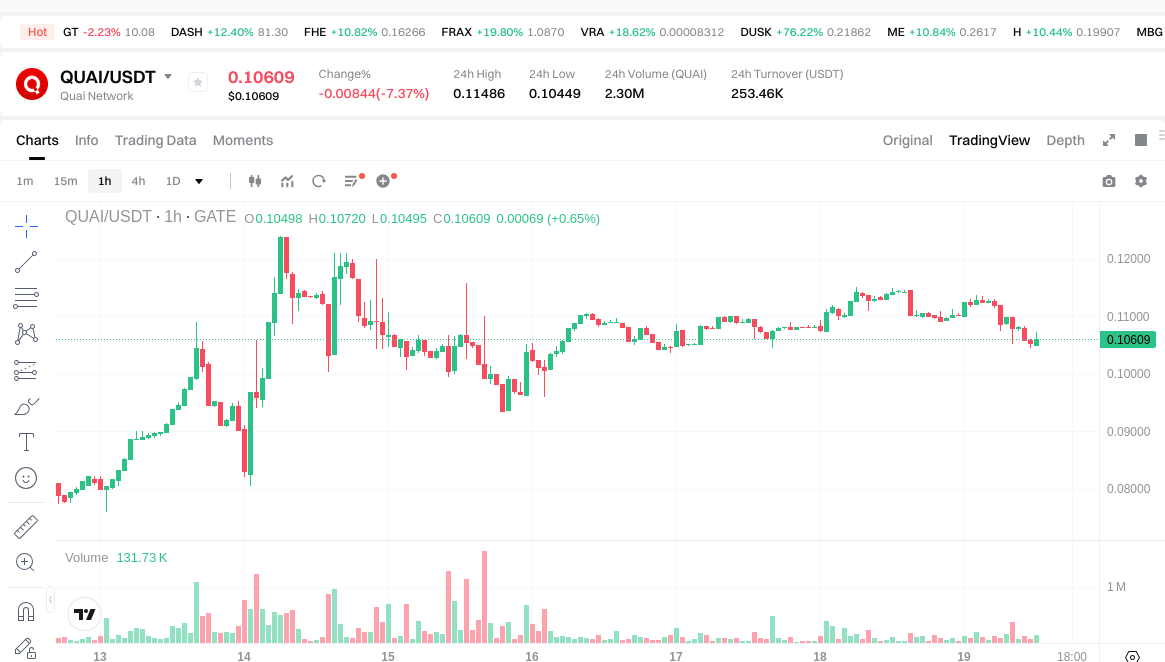
Current QUAI Investment Market Status (January 2026)
- QUAI current price: $0.10604
- 24-hour trading volume: $248,195.67
- Market capitalization: $50,676,516
- Circulating supply: 477,900,000 QUAI
- Total supply: 3,000,000,000 QUAI
- Circulating supply ratio: 15.93%
- Recent price changes:
- 1-hour: +0.86%
- 24-hour: -7.02%
- 7-day: +39.89%
- 30-day: +317.81%
- 1-year: +20.44%
Click to view real-time QUAI market price
II. Core Factors Influencing Whether QUAI Is a Good Investment
Supply Mechanism and Scarcity
- Total supply of 3,000,000,000 QUAI tokens with current circulating supply of 477,900,000 tokens (approximately 15.93% circulation ratio) suggests significant future supply expansion potential, which may impact scarcity dynamics
- The dual-token system featuring QUAI and Qi introduces a unique economic model where QUAI serves as the programmable foundation while Qi functions as a decentralized energy dollar, creating interconnected supply mechanisms
- Investment consideration: The relatively low circulation ratio indicates substantial token unlocks may occur over time, which could affect price stability and long-term scarcity value
Technological Architecture and Ecosystem Development
- Proof-of-Work Layer 1 blockchain utilizing horizontal sharding technology reportedly enables throughput capacity exceeding 50,000 transactions per second
- EVM-compatible smart contracting capabilities facilitate ecosystem expansion and developer adoption
- The Subsidized Open-market Acquisition Protocol (SOAP), which reportedly became operational in November 2025, redirects merge-mining rewards to create structural demand through market buybacks
- Integration with merged mining from networks such as Litecoin and Dogecoin may provide additional demand mechanisms
- Trading at approximately $0.10604 as of January 19, 2026, representing notable growth from certain prior periods
- Market capitalization stands at approximately $50.68 million with fully diluted valuation of approximately $318.12 million
- 24-hour trading volume of approximately $248,195.67 reflects current market liquidity levels
- Listed on 5 exchanges with availability on Gate.com platform
Macroeconomic and Competitive Positioning
- As a Proof-of-Work blockchain, QUAI operates within a market segment that includes established networks and emerging alternatives
- The concept of linking token economics to energy costs through the Qi stablecoin represents a differentiated approach within the Layer 1 blockchain landscape
- Market positioning emphasizes scalability and DeFi application potential within the broader cryptocurrency ecosystem
III. QUAI Future Investment Prediction and Price Outlook (Is Quai Network(QUAI) worth investing in 2026-2031)
Short-term Investment Outlook (2026, short-term QUAI investment outlook)
- Conservative forecast: $0.069 - $0.089
- Neutral forecast: $0.095 - $0.112
- Optimistic forecast: $0.115 - $0.126
Based on current market data, QUAI is trading at approximately $0.106 with circulating supply of 477.9 million tokens. The token has demonstrated notable volatility, with 24-hour fluctuations ranging from $0.104 to $0.115. Short-term projections suggest the asset may continue to consolidate within these ranges as the market assesses the project's technical developments and broader cryptocurrency market sentiment.
Mid-term Investment Forecast (2027-2029, mid-term Quai Network(QUAI) investment forecast)
- Market stage expectation: Network maturation phase with potential ecosystem expansion and increased adoption of the proof-of-work Layer 1 infrastructure
- Investment return prediction:
- 2027: $0.082 - $0.127
- 2028: $0.061 - $0.126
- 2029: $0.071 - $0.144
- Key catalysts: Implementation of SOAP Protocol (Subsidized Open-market Acquisition Protocol) for merged mining, potential increase in decentralized finance applications built on the network, and evolution of the energy-backed currency model
The mid-term outlook incorporates the project's unique approach to merging currency with energy through its proof-of-work mechanism. However, price projections reflect uncertainty regarding adoption rates and competitive positioning within the Layer 1 blockchain landscape.
Long-term Investment Outlook (Is QUAI a good long-term investment?)
- Baseline scenario: $0.072 - $0.143 (assuming moderate network growth and sustained development activity)
- Optimistic scenario: $0.112 - $0.160 (assuming successful ecosystem expansion and favorable cryptocurrency market conditions)
- Risk scenario: Below $0.061 (under conditions of reduced adoption, increased competition, or adverse market environment)
Click to view QUAI long-term investment and price prediction: Price Prediction
2026-01-19 to 2031 Long-term Outlook
- Base scenario: $0.072 - $0.133 USD (corresponding to steady progress and gradual mainstream application enhancement)
- Optimistic scenario: $0.112 - $0.160 USD (corresponding to large-scale adoption and favorable market environment)
- Transformative scenario: Above $0.160 USD (if the ecosystem achieves breakthrough developments and mainstream popularization)
- 2031-12-31 predicted high: $0.160 USD (based on optimistic development assumptions)
Disclaimer: Cryptocurrency investments carry substantial risk. Price predictions are speculative and based on available data as of January 2026. Actual performance may differ materially from projections due to market volatility, regulatory changes, technological developments, and other unforeseen factors. This analysis does not constitute investment advice, and investors should conduct independent research and risk assessment before making investment decisions.
| Year |
Predicted High Price |
Predicted Average Price |
Predicted Low Price |
Price Change |
| 2026 |
0.1124766 |
0.10611 |
0.0689715 |
0 |
| 2027 |
0.126780228 |
0.1092933 |
0.081969975 |
3 |
| 2028 |
0.12629933748 |
0.118036764 |
0.06137911728 |
11 |
| 2029 |
0.1441582998732 |
0.12216805074 |
0.0708574694292 |
15 |
| 2030 |
0.142484597578062 |
0.1331631753066 |
0.111857067257544 |
25 |
| 2031 |
0.159875708273103 |
0.137823886442331 |
0.071668420950012 |
29 |
IV. QUAI Investment Strategy and Risk Management (How to invest in Quai Network)
Investment Strategy (QUAI investment strategy)
Long-term Holding (HODL QUAI)
For conservative investors seeking exposure to next-generation proof-of-work blockchain technology, a long-term holding strategy may be considered. This approach focuses on the project's fundamental development and its vision of creating a decentralized global monetary system. Given QUAI's relatively recent launch in February 2025, long-term holders may observe the project's technological progress and ecosystem development over time.
Active Trading
Active traders may utilize technical analysis and market timing strategies when trading QUAI. With a 24-hour trading volume of approximately $248,195 and availability on 5 exchanges, traders should consider liquidity conditions when executing positions. The token has demonstrated notable price movements, with a 7-day change of 39.89% and a 30-day change of 317.81%, indicating potential opportunities for swing trading strategies.
Risk Management (Risk management for QUAI investment)
Asset Allocation Ratios
- Conservative Investors: Consider allocating 1-3% of crypto portfolio to QUAI, given its early-stage nature and market volatility
- Aggressive Investors: May allocate 5-10% depending on risk tolerance and conviction in the project's long-term vision
- Professional Investors: Should conduct thorough due diligence and consider strategic positioning based on comprehensive risk assessment
Risk Hedging Strategies
Implementing a diversified portfolio approach is recommended, combining QUAI exposure with established cryptocurrencies and traditional assets. Portfolio rebalancing should be conducted regularly to maintain target allocation percentages, particularly given QUAI's price volatility.
Secure Storage Solutions
- Hot Wallets: Suitable for active trading amounts only
- Cold Wallets: Recommended for long-term holdings
- Hardware Wallets: Consider established hardware wallet providers that support QUAI network compatibility
V. QUAI Investment Risks and Challenges (Risks of investing in Quai Network)
Market Risks
High Volatility: QUAI has experienced significant price fluctuations, with a 30-day change of 317.81%. The token's price has ranged from $0.01801 to $0.37141 since launch, demonstrating substantial volatility. With a current circulating supply of 477.9 million tokens representing only 15.93% of the total supply, future token releases may impact price dynamics.
Liquidity Considerations: With a 24-hour trading volume of approximately $248,195 and availability on 5 exchanges, liquidity may be limited compared to major cryptocurrencies, potentially affecting execution prices for larger trades.
Regulatory Risks
As a proof-of-work blockchain project operating in the evolving cryptocurrency regulatory landscape, QUAI may face varying regulatory treatment across different jurisdictions. Changes in cryptocurrency regulations, particularly regarding proof-of-work consensus mechanisms and energy consumption considerations, could impact the project's operations and token valuation.
Technical Risks
Network Development Stage: As a next-generation Layer 1 blockchain launched in early 2025, QUAI is in its early operational phase. The project's technical infrastructure may face challenges related to network stability, security vulnerabilities, or implementation difficulties as it scales.
Protocol Upgrades: Future protocol updates and technical developments carry inherent risks of implementation issues or community disagreements that could affect network functionality and token value.
VI. Conclusion: Is Quai Network a Good Investment?
Investment Value Summary
Quai Network represents an early-stage proof-of-work Layer 1 blockchain project with an ambitious vision of creating a decentralized global monetary system. The project's concept of merging currency with energy to create a decentralized energy dollar presents an interesting value proposition. However, with only 15.93% of tokens currently in circulation and the project being in its early operational phase since February 2025, the investment carries considerable development and execution risks alongside its growth potential.
Investor Recommendations
✅ Beginners: Consider starting with small position sizes and dollar-cost averaging approach. Prioritize secure wallet storage and avoid allocating significant portfolio percentages to early-stage projects.
✅ Experienced Investors: May explore swing trading opportunities given the token's volatility patterns while maintaining strict risk management protocols. Consider portfolio diversification with established cryptocurrencies.
✅ Institutional Investors: Should conduct comprehensive due diligence on the project's technical roadmap, team, and competitive positioning before considering strategic allocation.
⚠️ Notice: Cryptocurrency investments involve substantial risks, including potential loss of principal. This content is for informational purposes only and does not constitute investment advice. Conduct thorough research and consider your financial situation before making investment decisions.
VII. FAQ
Q1: What is the current circulating supply of QUAI tokens and how does it impact investment value?
As of January 2026, QUAI has a circulating supply of approximately 477.9 million tokens, representing only 15.93% of the total supply of 3 billion tokens. This relatively low circulation ratio indicates that a substantial portion of tokens (over 84%) remains to be released into the market, which could significantly impact price dynamics and scarcity value over time. The gradual token unlock schedule may create downward pressure on prices as supply increases, making this an important consideration for investors evaluating QUAI's long-term investment potential and price stability.
Q2: How does the SOAP Protocol affect QUAI's investment outlook?
The Subsidized Open-market Acquisition Protocol (SOAP), which became operational in November 2025, represents a key mechanism in QUAI's economic model. SOAP redirects merge-mining rewards to create structural demand through market buybacks, potentially establishing a consistent buying pressure on QUAI tokens. Combined with merged mining integration from established networks like Litecoin and Dogecoin, this protocol could provide additional demand mechanisms that support price stability. However, the actual effectiveness of SOAP in maintaining token value will depend on adoption rates and the volume of merged mining activity, making it a critical factor to monitor for investment decision-making.
Q3: What are the main risks associated with investing in QUAI?
QUAI presents several significant investment risks: (1) High volatility, with the token experiencing price swings from $0.01801 to $0.37141 since launch and a 30-day change of 317.81%; (2) Limited liquidity with a 24-hour trading volume of approximately $248,195 across 5 exchanges, which may affect execution for larger trades; (3) Early-stage development risks, as the project only launched in February 2025 and faces potential technical implementation challenges; (4) Token supply expansion risk, with 84% of tokens yet to enter circulation; (5) Regulatory uncertainty surrounding proof-of-work consensus mechanisms and energy consumption considerations. Conservative investors should limit QUAI allocation to 1-3% of their crypto portfolio due to these risk factors.
Q4: Is QUAI suitable for long-term holding (HODL) strategy?
QUAI may be considered for a long-term holding strategy by investors who believe in its fundamental vision of creating a decentralized global monetary system backed by energy. The project's proof-of-work Layer 1 blockchain infrastructure and unique dual-token system (QUAI and Qi) present differentiated positioning in the cryptocurrency landscape. However, given the early-stage nature of the project (launched February 2025), substantial token supply yet to be circulated (84.07%), and limited operational track record, long-term holders should maintain realistic expectations and practice strict risk management. This strategy is more appropriate for experienced investors with high risk tolerance who can withstand significant price volatility and potential prolonged development periods before mainstream adoption materializes.
Q5: How does QUAI's price prediction for 2026-2031 look for potential investors?
Based on current analysis, QUAI's price projections show moderate growth potential with substantial uncertainty. For 2026, predictions range from a conservative $0.069-$0.089 to an optimistic $0.115-$0.126, with current price at approximately $0.106. Long-term forecasts through 2031 present a base scenario of $0.072-$0.133, an optimistic scenario of $0.112-$0.160, and a transformative scenario above $0.160. The predicted high for 2031 stands at $0.160, representing roughly 50% potential upside from current levels under favorable conditions. However, these projections carry significant uncertainty due to the project's early stage, competitive Layer 1 blockchain landscape, and dependency on successful ecosystem development and adoption. Risk scenarios also indicate potential downside below $0.061, emphasizing the importance of thorough due diligence and appropriate position sizing.
Q6: What trading volume and liquidity considerations should investors be aware of for QUAI?
QUAI currently demonstrates limited liquidity with a 24-hour trading volume of approximately $248,195 and availability on only 5 exchanges. This relatively low trading volume compared to major cryptocurrencies may result in wider bid-ask spreads and potential slippage for larger orders. The limited exchange availability may also restrict market access for some investors and potentially contribute to price volatility. Active traders should consider these liquidity constraints when planning entry and exit strategies, potentially using limit orders and splitting larger positions across multiple transactions. The concentration of trading activity across a small number of exchanges also presents counterparty risk considerations. Investors should monitor exchange listings and trading volume trends as indicators of growing market adoption and improved liquidity conditions over time.
Q7: How does QUAI's proof-of-work consensus mechanism affect its investment value proposition?
QUAI's proof-of-work consensus mechanism positions it within a specific segment of the Layer 1 blockchain market, differentiating it from the increasingly dominant proof-of-stake networks. The project's merge-mining compatibility with established networks like Litecoin and Dogecoin could provide security benefits and miner incentives, potentially supporting network resilience. However, proof-of-work mechanisms face growing scrutiny regarding energy consumption and environmental impact, which may affect regulatory treatment and institutional adoption in certain jurisdictions. The project's concept of linking token economics to energy costs through the Qi stablecoin represents an attempt to address these concerns by framing energy usage as foundational to monetary value. Investors should consider both the potential security advantages of proof-of-work and the evolving regulatory and market sentiment toward energy-intensive consensus mechanisms when evaluating QUAI's long-term viability and investment potential.
Q8: What portfolio allocation strategy is recommended for different investor types considering QUAI?
Portfolio allocation recommendations for QUAI vary significantly based on investor experience and risk tolerance: Conservative investors should limit QUAI exposure to 1-3% of their crypto portfolio, given the project's early-stage nature, high volatility, and substantial development risks. Aggressive investors with higher risk tolerance may consider allocating 5-10%, though this should still represent only a portion of overall cryptocurrency holdings. Professional and institutional investors should conduct comprehensive due diligence and consider strategic positioning based on thorough risk assessment before any allocation. All investor types should implement diversification strategies, combining QUAI exposure with established cryptocurrencies and potentially traditional assets. Regular portfolio rebalancing is recommended to maintain target allocations, particularly given QUAI's demonstrated price volatility. A dollar-cost averaging approach may be appropriate for building positions over time while managing entry price risk.
* The information is not intended to be and does not constitute financial advice or any other recommendation of any sort offered or endorsed by Gate.