This comprehensive analysis examines whether Quai Network (QUAI) represents a viable investment opportunity as a proof-of-work Layer 1 blockchain. The article evaluates QUAI's tokenomics—with 477.9 million tokens (15.93%) circulating from a 3 billion supply—alongside its technology designed to merge currency with energy for global monetary systems. Key sections review historical price performance ranging from $0.37141 to $0.01801, current market status at $0.10833, and trading availability on Gate and four other exchanges. The analysis presents investment forecasts across short, mid, and long-term horizons, contrasts holding versus active trading strategies, and details risk management approaches. Critical examination addresses market volatility, regulatory uncertainty, and technical execution risks. Designed for newcomers, experienced traders, and institutional investors, this guide provides actionable frameworks for assessing QUAI's position within the emerging Layer 1 blockchain landscape.
Introduction: Quai Network (QUAI)'s Investment Position and Market Prospects
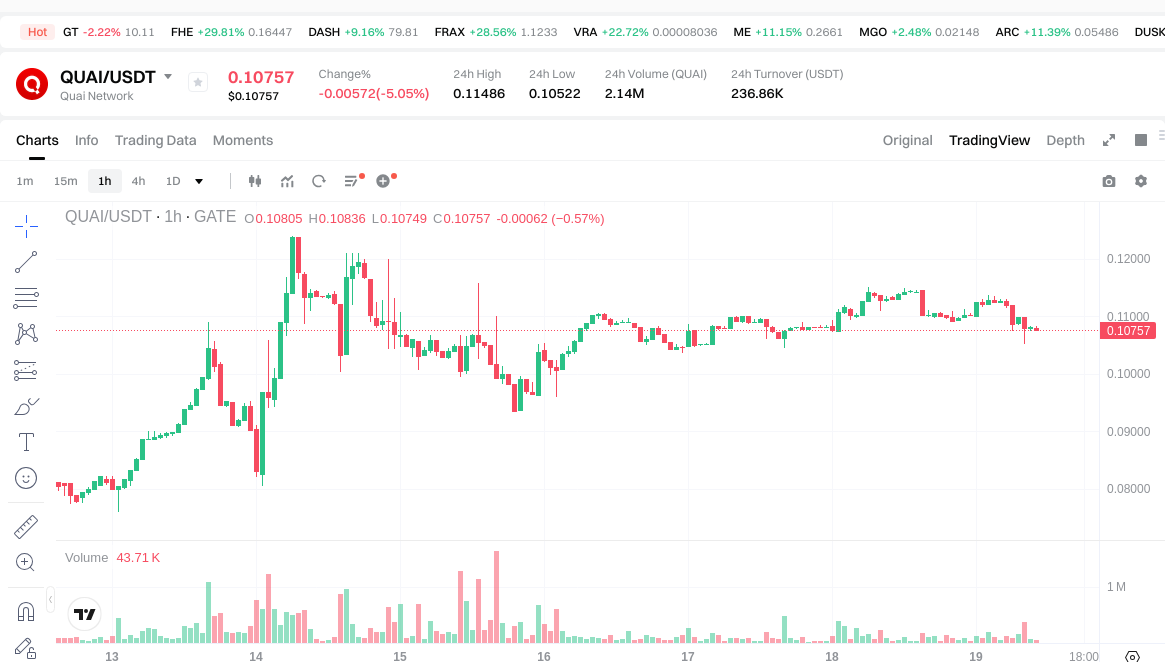
Quai Network (QUAI) represents a notable Layer 1 blockchain project in the cryptocurrency sector, utilizing proof-of-work consensus mechanism. As of January 19, 2026, QUAI holds a market ranking of 513, with a market capitalization of approximately $51.77 million and a fully diluted valuation of $324.99 million. The circulating supply stands at 477.9 million tokens out of a total supply of 3 billion, representing a circulation ratio of 15.93%. The current trading price is $0.10833, with a 24-hour trading volume of $232,742.73.
Quai Network positions itself as a next-generation proof-of-work Layer 1 blockchain designed to build a decentralized global monetary system by merging currency with energy. The project aims to deliver scalable and stable infrastructure for real-world commerce and DeFi applications. Over the past year, QUAI has demonstrated notable price volatility, with a 30-day performance showing significant upward movement and a 7-day increase of 42.22%. However, the token experienced a 4.36% decline in the 24-hour period as of the data timestamp.
The project's market share currently represents 0.0099% of the total cryptocurrency market, indicating its position as an emerging asset in the ecosystem. QUAI is listed on 5 exchanges and has established its presence with official channels including its website, blockchain explorer, and social media platforms. As investors evaluate whether Quai Network (QUAI) presents a viable investment opportunity, this article provides a comprehensive analysis of its investment characteristics, historical price movements, future price projections, and associated risks to serve as a reference for decision-making.
I. Quai Network (QUAI) Historical Price Review and Current Investment Value
- February 2025: QUAI reached a price peak of $0.37141 → early participants observed notable returns
- November 2025: QUAI recorded a low of $0.01801 → price experienced significant volatility
- Past 30 days (December 2025 - January 2026): Market cycle witnessed recovery → price increased from lower levels to current trading range
Current QUAI Investment Market Status (January 2026)
- QUAI current price: $0.10833
- 24-hour trading volume: $232,742.73
- Market capitalization: $51,770,907
- Circulating supply: 477,900,000 QUAI (15.93% of total supply)
Click to view real-time QUAI market price
II. Core Factors Affecting Whether QUAI is a Good Investment (Is Quai Network(QUAI) a Good Investment)
Supply Mechanism and Scarcity (QUAI investment scarcity)
- Token Supply Structure → Impact on Price and Investment Value
- Total Supply: 3,000,000,000 QUAI
- Circulating Supply: 477,900,000 QUAI (approximately 15.93% of total supply)
- Market Cap to FDV Ratio: 15.93%, indicating significant token unlock potential
- Supply Dynamics and Investment Implications
- The current circulating supply represents a relatively small portion of the total supply, which may influence long-term price dynamics as additional tokens enter circulation
- Scarcity considerations should account for the phased release mechanism of the remaining 84.07% of tokens
- Investment Significance: The controlled supply release and proof-of-work consensus mechanism form part of the network's value proposition for long-term investors
Institutional Investment and Mainstream Adoption (Institutional investment in QUAI)
- Market Positioning and Trading Activity
- Listed on 5 exchanges, with Gate.com being a confirmed trading venue
- 24-hour trading volume of approximately $232,742, indicating early-stage market liquidity
- Market capitalization ranking at #513 suggests emerging market positioning
- Adoption Trajectory
- The network positions itself as a next-generation proof-of-work Layer 1 blockchain designed for decentralized global monetary systems
- Integration of currency, DeFi, and sustainability features aims to attract commercial adoption
Macroeconomic Environment's Impact on QUAI Investment
- Energy-Currency Integration
- Quai Network's concept of merging currency with energy creates a unique value proposition that may respond differently to macroeconomic conditions compared to traditional cryptocurrencies
- The "energy dollar" concept positions the network to potentially benefit from discussions around energy-backed financial systems
- Market Uncertainty and Digital Asset Positioning
- As a proof-of-work blockchain, Quai Network may appeal to investors seeking alternatives to proof-of-stake systems during periods of regulatory or technological uncertainty
- The network's focus on scalability and real-world commerce applications could influence its sensitivity to broader economic conditions
Technology and Ecosystem Development (Technology & Ecosystem for QUAI investment)
- Core Technical Architecture
- Proof-of-work consensus mechanism utilizing "Mainnet" algorithm
- Designed to enable scalable global transactions and support next-generation DeFi solutions
- Infrastructure built to integrate monetary functions, DeFi applications, and sustainability features on a single platform
- Ecosystem and Application Development
- The network aims to support real-world commerce applications through its scalable architecture
- DeFi capabilities integrated into the base layer protocol, potentially reducing friction for developers and users
- The combination of currency stability features with DeFi functionality represents a differentiated approach in the Layer 1 landscape
- Development Resources and Community
- Official website and block explorer (QuaiScan) provide network transparency
- Litepaper available for technical documentation
- Active social media presence on X (Twitter) for community engagement and updates
III. QUAI Future Investment Forecast and Price Outlook (Is Quai Network(QUAI) worth investing in 2026-2031)
Short-term Investment Forecast (2026, short-term QUAI investment outlook)
- Conservative estimate: $0.0810 - $0.1080
- Neutral estimate: $0.1080 - $0.1370
- Optimistic estimate: $0.1370 - $0.1500
Mid-term Investment Outlook (2027-2029, mid-term Quai Network(QUAI) investment forecast)
-
Market phase expectation: Based on available data, QUAI may experience gradual growth momentum as the Proof-of-Work Layer 1 blockchain ecosystem evolves and adoption increases. The token demonstrated volatility with a 30-day increase of 328.36%, reflecting heightened market interest.
-
Investment return forecast:
- 2027: $0.1029 - $0.1666
- 2028: $0.1055 - $0.1764
- 2029: $0.1412 - $0.1749
-
Key catalysts: Network development milestones, ecosystem expansion, market sentiment towards energy-backed decentralized currency systems, and broader adoption of DeFi solutions on the platform.
Long-term Investment Outlook (Is QUAI a good long-term investment?)
- Base scenario: $0.1090 - $0.2089 (assuming steady network growth and sustainable ecosystem development)
- Optimistic scenario: $0.1837 - $0.2631 (assuming accelerated adoption, strategic partnerships, and favorable market conditions)
- Risk scenario: Below $0.0810 (under adverse market conditions or unexpected technical challenges)
View QUAI long-term investment and price forecast: Price Prediction
2026-01-19 - 2031 Long-term Outlook
- Base scenario: $0.1090 - $0.2089 (corresponding to steady progress and gradual mainstream application advancement)
- Optimistic scenario: $0.1837 - $0.2631 (corresponding to large-scale adoption and favorable market environment)
- Transformative scenario: Above $0.2631 (if ecosystem achieves breakthrough progress and mainstream popularization)
- 2031-12-31 predicted high: $0.2631 (based on optimistic development assumptions)
Disclaimer: Cryptocurrency markets are highly volatile and unpredictable. The forecasts presented are based on current data and historical trends and should not be considered as financial advice. Investors should conduct thorough research and consider their risk tolerance before making investment decisions.
| Year |
Predicted High Price |
Predicted Average Price |
Predicted Low Price |
Price Change |
| 2026 |
0.1370965 |
0.10795 |
0.0809625 |
0 |
| 2027 |
0.16663162 |
0.12252325 |
0.10291953 |
13 |
| 2028 |
0.1763844707 |
0.144577435 |
0.10554152755 |
33 |
| 2029 |
0.1749242386065 |
0.16048095285 |
0.141223238508 |
48 |
| 2030 |
0.249876867635092 |
0.16770259572825 |
0.109006687223362 |
54 |
| 2031 |
0.263075061918905 |
0.208789731681671 |
0.18373496387987 |
92 |
IV. QUAI Investment Strategy and Risk Management (How to invest in Quai Network)
Investment Methodology (QUAI investment strategy)
Long-term Holding (HODL QUAI): Suitable for conservative investors
Long-term holding represents a passive investment approach centered on accumulating QUAI tokens over extended periods. This strategy relies on the fundamental value proposition of Quai Network's proof-of-work blockchain infrastructure and its vision for a decentralized global monetary system. Investors adopting this method typically focus on the project's technological foundations and long-term adoption potential rather than short-term price movements.
Active Trading: Relies on technical analysis and swing trading operations
Active trading of QUAI involves utilizing technical indicators, chart patterns, and market sentiment analysis to identify entry and exit points. Given the token's demonstrated volatility—with 24-hour fluctuations and significant price movements over various timeframes—this approach requires continuous market monitoring and disciplined execution. Traders may employ strategies such as swing trading to capitalize on price movements within specific time horizons.
Risk Management (Risk management for QUAI investment)
Asset Allocation Ratios: Conservative / Aggressive / Professional investors
- Conservative investors: May consider allocating 1-3% of their cryptocurrency portfolio to QUAI, balancing potential growth with established digital assets
- Aggressive investors: Could allocate 5-10% to QUAI, accepting higher volatility for potential returns associated with emerging blockchain projects
- Professional investors: May implement dynamic allocation strategies ranging from 3-15%, adjusting positions based on market conditions, technical developments, and risk metrics
Risk Hedging Solutions: Multi-asset portfolio + hedging instruments
Investors can implement diversification strategies by combining QUAI holdings with assets exhibiting different correlation patterns. Portfolio construction may include established cryptocurrencies, stablecoins, and traditional assets to reduce overall portfolio volatility. Advanced investors might explore derivative instruments or options strategies where available to hedge against downside risk.
Secure Storage: Hot and cold wallets + hardware wallet recommendations
Proper storage infrastructure is fundamental to QUAI investment security:
- Cold wallets: Hardware wallet solutions provide offline storage for long-term holdings, protecting assets from online threats
- Hot wallets: Convenient for active trading but require enhanced security measures including two-factor authentication and strong passwords
- Multi-signature solutions: Advanced users may implement multi-signature configurations for additional security layers
- Regular security audits: Periodic verification of wallet security settings and backup procedures
V. QUAI Investment Risks and Challenges (Risks of investing in Quai Network)
Market Risk: High volatility and price manipulation concerns
QUAI exhibits characteristics common to emerging cryptocurrency projects, including notable price fluctuations across various timeframes. The token's relatively recent market presence and trading volume levels may contribute to price volatility. Market participants should recognize that lower liquidity environments can amplify price movements in both directions, creating both opportunities and risks for investors.
Regulatory Risk: Policy uncertainty across different jurisdictions
The cryptocurrency sector continues to evolve within a complex and changing regulatory landscape. Quai Network, as a proof-of-work blockchain project, may face regulatory considerations that vary significantly across jurisdictions. Potential regulatory developments could impact trading accessibility, taxation frameworks, and operational requirements. Investors should monitor regulatory developments in their respective jurisdictions and globally, as policy changes may influence project operations and token value.
Technical Risk: Network security vulnerabilities and upgrade failures
As with any blockchain infrastructure, Quai Network faces inherent technical considerations:
- Network security: Proof-of-work networks require ongoing security maintenance and monitoring for potential vulnerabilities
- Protocol upgrades: Technical implementations and network upgrades carry execution risks that could temporarily affect network operations
- Smart contract risks: If applicable, smart contract functionality requires thorough auditing and testing to prevent potential exploits
- Scalability challenges: The project's ability to deliver on its scalability objectives remains subject to technical execution and adoption dynamics
VI. Conclusion: Is Quai Network a Good Investment?
Investment Value Summary: QUAI presents characteristics of an emerging blockchain project with long-term infrastructure ambitions, while experiencing significant short-term price fluctuations.
Quai Network's proof-of-work architecture and positioning within the decentralized finance landscape represent an approach to blockchain scalability and monetary systems. The project's technical vision encompasses integration of currency, DeFi, and sustainability objectives. However, investors should recognize that the token's market performance exhibits volatility patterns typical of newer cryptocurrency projects, with price movements reflecting both market sentiment and broader sector dynamics.
Investor Recommendations:
✅ Newcomers: Consider dollar-cost averaging strategies combined with secure wallet storage solutions. Focus on understanding the project fundamentals and blockchain technology before significant capital allocation.
✅ Experienced Investors: May explore swing trading opportunities within defined risk parameters while maintaining diversified portfolio configurations across multiple digital assets.
✅ Institutional Investors: Could evaluate strategic long-term allocation possibilities as part of broader cryptocurrency infrastructure exposure, subject to comprehensive due diligence and risk assessment frameworks.
⚠️ Notice: Cryptocurrency investments carry substantial risk, including the potential loss of principal. This content is provided for informational purposes only and does not constitute investment advice. Prospective investors should conduct independent research, consider their risk tolerance, and consult qualified financial advisors before making investment decisions.
VII. FAQ
Q1: What is Quai Network's core technical advantage in the Layer 1 blockchain space?
Quai Network distinguishes itself through a unique proof-of-work architecture designed to merge currency with energy, creating what the project terms an "energy dollar" system. Unlike many modern Layer 1 blockchains that utilize proof-of-stake consensus, Quai maintains a PoW mechanism while addressing scalability challenges through its innovative infrastructure. The network aims to support global-scale transactions and DeFi applications on a single platform, integrating monetary stability features with decentralized finance functionality. This combination positions Quai as an alternative approach in the Layer 1 landscape, particularly for users and developers seeking proof-of-work security models with enhanced scalability capabilities.
Q2: How does QUAI's current tokenomics structure affect investment considerations?
QUAI's tokenomics present a notable consideration for investors: with only 477.9 million tokens (15.93%) of the 3 billion total supply currently in circulation, the project maintains significant token unlock potential. This 15.93% circulation ratio indicates that approximately 84% of tokens remain to be released into the market over time. The phased supply release mechanism could influence long-term price dynamics as additional tokens enter circulation. Investors should carefully evaluate this supply structure when making allocation decisions, considering both the potential dilution effects from future unlocks and the project's controlled release strategy designed to support sustainable network growth.
Q3: What are the primary risks associated with investing in QUAI in 2026?
QUAI investment carries multiple risk dimensions that prospective investors should evaluate. Market risk manifests through significant price volatility, with the token demonstrating movements ranging from historical highs of $0.37141 to lows of $0.01801. The relatively modest 24-hour trading volume of $232,742 suggests liquidity constraints that may amplify price fluctuations. Regulatory risk remains present as cryptocurrency frameworks continue evolving globally, particularly for proof-of-work networks. Technical risk encompasses network security maintenance, protocol upgrade execution, and the challenge of delivering on scalability objectives. Additionally, the project's market ranking of #513 indicates emerging status, which typically correlates with higher volatility and execution uncertainty compared to established blockchain projects.
Q4: Is QUAI suitable for long-term holding strategies?
QUAI may appeal to long-term investors who align with the project's vision for a decentralized global monetary system and proof-of-work blockchain infrastructure. The long-term holding approach suits investors who prioritize fundamental value propositions over short-term price movements. Conservative investors might consider allocating 1-3% of their cryptocurrency portfolio to QUAI, while more aggressive participants could explore 5-10% allocations depending on risk tolerance. However, potential long-term holders should recognize several considerations: the substantial remaining token supply yet to be released (84%), the project's relatively early stage with a market cap of approximately $51.77 million, and the inherent uncertainties associated with blockchain technology execution. Long-term investment viability ultimately depends on Quai Network's ability to deliver on its technical roadmap, achieve meaningful adoption, and navigate evolving market conditions.
Q5: How does QUAI's price performance compare to broader market trends?
QUAI's recent price behavior demonstrates amplified volatility relative to broader cryptocurrency markets. The token recorded a 328.36% increase over a 30-day period and a 42.22% gain over 7 days, significantly exceeding typical market movements. However, this was followed by a 4.36% decline in the 24-hour period as of January 19, 2026, illustrating the rapid directional changes characteristic of lower market cap tokens. With a market share of 0.0099% of the total cryptocurrency market, QUAI exhibits pricing patterns typical of emerging projects where smaller capital flows can generate substantial percentage movements. Investors should recognize that while such volatility creates potential trading opportunities, it simultaneously elevates risk exposure compared to more established digital assets with deeper liquidity and broader market participation.
Q6: What factors could drive QUAI adoption and price appreciation in 2026-2027?
Several catalysts could influence QUAI's adoption trajectory and valuation. Network development milestones, including successful implementation of scalability features and DeFi infrastructure, represent primary technical drivers. Ecosystem expansion through developer adoption, commercial partnerships, and real-world application integrations could enhance network utility and demand. Broader market sentiment toward energy-backed decentralized currency systems may benefit Quai's unique positioning. The evolution of regulatory frameworks for proof-of-work blockchains could also impact adoption dynamics. Additionally, macroeconomic discussions around energy-backed financial systems might direct attention toward Quai's "energy dollar" concept. However, investors should maintain realistic expectations, recognizing that adoption acceleration depends on successful execution across technical, business development, and marketing dimensions while competing within a crowded Layer 1 blockchain landscape.
Q7: What trading venues and liquidity options exist for QUAI investors?
QUAI currently maintains trading presence on 5 exchanges, with Gate.com confirmed as a listed venue providing access to the token. The 24-hour trading volume of approximately $232,742 reflects early-stage market liquidity, which investors should consider when planning entry and exit strategies. Lower liquidity environments can result in wider bid-ask spreads and increased slippage, particularly for larger transaction sizes. Active traders should evaluate order book depth and historical volume patterns on their preferred exchanges before executing significant positions. For optimal liquidity access, investors may benefit from concentrating trading activity on platforms demonstrating consistent volume and tight spreads. Those planning long-term holdings should prioritize secure storage solutions over immediate liquidity considerations, transferring assets to hardware wallets or cold storage configurations after purchase completion.
Q8: How should investors approach position sizing and risk management with QUAI?
Position sizing for QUAI should reflect individual risk tolerance, investment objectives, and portfolio composition. Conservative investors focused on capital preservation might limit QUAI allocation to 1-3% of their cryptocurrency holdings, treating the position as a speculative allocation within a diversified digital asset portfolio. Aggressive investors comfortable with elevated volatility could consider 5-10% allocations, accepting higher risk for potential returns associated with emerging blockchain infrastructure. Professional investors may implement dynamic strategies ranging from 3-15%, adjusting exposure based on technical indicators, development milestones, and market conditions. Regardless of allocation size, investors should employ risk management practices including defined entry and exit criteria, stop-loss mechanisms where appropriate, secure storage protocols, and regular portfolio rebalancing to maintain desired risk exposure levels.
* The information is not intended to be and does not constitute financial advice or any other recommendation of any sort offered or endorsed by Gate.