This comprehensive analysis evaluates whether Quickswap (QUICK) represents a viable investment opportunity for cryptocurrency investors. The article examines QUICK's market position, currently trading at $0.01123 with an $8.85 million market cap, alongside its price history spanning from February 2021 launch to January 2026. As a Uniswap fork deployed on Polygon offering near-zero gas fees, QUICK enables staking rewards and DAO governance participation. The analysis covers price forecasts through 2031, investment strategies across conservative-to-aggressive allocations, and critical risks including market volatility (65.25% annual decline), regulatory uncertainty, and technical dependencies. Suitable for experienced DeFi investors via Gate exchange, QUICK demands careful risk management and secure storage solutions despite long-term growth potential within the Polygon ecosystem.
Introduction: Quickswap (QUICK) Investment Position and Market Prospects
QUICK is a notable asset in the cryptocurrency space, launched in February 2021 as a decentralized exchange protocol. As of January 2026, Quickswap maintains a market capitalization of approximately $8.85 million, with a circulating supply of around 787.83 million tokens, and the current price stabilizes around $0.01123. Positioned as a low-cost trading solution on the Polygon network, QUICK has gradually become a focal point for investors discussing "Is Quickswap (QUICK) a good investment?". This article will comprehensively analyze QUICK's investment value, historical trends, future price predictions, and investment risks to provide reference for investors.
Quickswap operates as a fork of Uniswap deployed on the Polygon network, leveraging low transaction fees to enable users to trade ERC-20 assets at near-zero gas costs. The QUICK token serves dual purposes: users can stake tokens to earn rewards and participate in DAO governance through voting rights. With a total supply of 940.85 million tokens and a maximum supply cap of 1 billion, the current circulating ratio stands at 78.78%. The protocol is accessible across 13 exchanges and maintains a holder base of 644 addresses.
The token's price performance reflects the volatility characteristic of the DeFi sector. Recent trends show a 0.8% increase over 24 hours and an 8.82% gain over the past 30 days, though the 7-day performance indicates an 11.08% decline. The annual performance shows a 65.25% decrease from previous levels. Historical data indicates that QUICK reached a price level of $0.229794 on May 5, 2022, while touching a lower point of $0.00662336 on September 5, 2022.
The protocol maintains contract deployments on both Polygon (0xB5C064F955D8e7F38fE0460C556a72987494eE17) and Ethereum (0xd2ba23de8a19316a638dc1e7a9adda1d74233368) networks, providing users with multiple access points. The fully diluted market cap approximates $10.57 million, with the market cap to FDV ratio at 78.78%, indicating a relatively high proportion of tokens already in circulation.
As the DeFi landscape continues evolving, understanding QUICK's position requires examining its technical infrastructure, tokenomics structure, competitive environment, and the broader market dynamics affecting layer-2 scaling solutions. This analysis aims to provide a balanced perspective on the opportunities and challenges associated with QUICK investment considerations.
I. Quickswap (QUICK) Price History Review and Current Investment Value
- 2021: Token launch in February with initial market enthusiasm → Early investors experienced significant volatility as the token established its market presence
- 2022: Market downturn phase → QUICK price declined from elevated levels earlier in the year, reflecting broader cryptocurrency market conditions
- 2022-2023: Extended consolidation period → Price movement between $0.00662336 and varying levels as the DeFi sector underwent structural adjustments
- 2024-2025: Recovery attempts amid ecosystem development → Price fluctuations continued as the project evolved its platform features
- Early 2026: Modest upward movement → Price reached $0.01123, showing slight recovery from previous lows
Current QUICK Investment Market Status (January 2026)
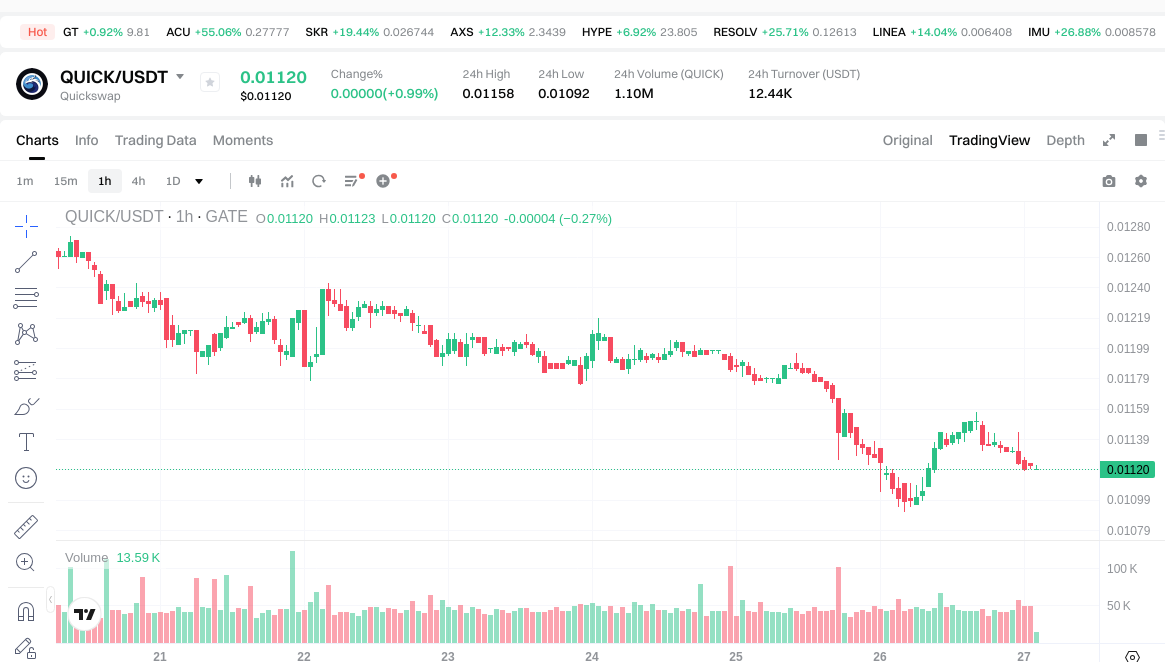
- Current QUICK Price: $0.01123
- 24-hour Trading Volume: $12,438.15
- Market Capitalization: $8,847,310.40
- Circulating Supply: 787,828,174 QUICK (78.78% of total supply)
- Total Supply: 940,852,901 QUICK
- Maximum Supply: 1,000,000,000 QUICK
- Market Cap Ranking: #1262
- Number of Holders: 644
- Available on 13 exchanges
View real-time QUICK market price
Recent Price Movements
- 1-Hour Change: +0.09%
- 24-Hour Change: +0.8%
- 7-Day Change: -11.08%
- 30-Day Change: +8.82%
- 1-Year Change: -65.25%
- 24-Hour Price Range: $0.01092 - $0.01158
II. Core Factors Affecting Whether QUICK is a Good Investment
Supply Mechanism and Scarcity (QUICK Investment Scarcity)
- Maximum supply capped at 1,000,000,000 QUICK tokens, with current circulating supply at 787,828,174 tokens (78.78% of maximum supply)
- Total supply stands at 940,852,900 tokens, indicating controlled token release mechanism
- The defined maximum supply creates a degree of scarcity, with approximately 21.22% of tokens yet to enter circulation
- Investment significance: The fixed supply cap may provide fundamental support for long-term value preservation, though market dynamics remain influenced by multiple factors
Technical and Ecosystem Development (Technology & Ecosystem for QUICK Investment)
- QuickSwap operates as a fork of Uniswap, deployed on Polygon Network (formerly Matic Network), leveraging low transaction costs for near-zero gas fees when trading ERC-20 assets
- Dual-chain deployment strategy: Primary contract on Polygon (0xB5C064F955D8e7F38fE0460C556a72987494eE17) with additional presence on Ethereum mainnet (0xd2ba23de8a19316a638dc1e7a9adda1d74233368)
- Token staking mechanism enables holders to earn rewards while participating in DAO governance through voting rights
- The protocol's integration within the Polygon ecosystem provides access to decentralized finance applications, though specific DeFi adoption metrics were not detailed in available materials
- Community engagement channels established through Twitter, Reddit, GitHub, and Medium platforms, with 644 recorded holders as of current data
- Current trading price at $0.01123 represents substantial distance from historical price levels recorded in May 2022
- Market capitalization stands at $8,847,310, ranking #1262 among tracked digital assets
- Market cap to fully diluted valuation ratio of 78.78% reflects current circulating supply percentage
- 24-hour trading volume of $12,438.15 indicates modest liquidity conditions
- Token listed on 13 exchanges, providing multiple access points for potential investors
- Price volatility observed across different timeframes: +0.09% (1H), +0.8% (24H), -11.08% (7D), +8.82% (30D), with notable annual decline of -65.25%
III. QUICK Future Investment Forecast and Price Outlook (Is Quickswap(QUICK) worth investing in 2026-2031)
Short-term Investment Forecast (2026, short-term QUICK investment outlook)
- Conservative forecast: $0.0066 - $0.0090
- Neutral forecast: $0.0095 - $0.0112
- Optimistic forecast: $0.0115 - $0.0133
Mid-term Investment Outlook (2027-2028, mid-term Quickswap(QUICK) investment forecast)
- Market stage expectation: gradual recovery phase with moderate volatility
- Investment return forecast:
- 2027: $0.0087 - $0.0126
- 2028: $0.0093 - $0.0176
- Key catalysts: potential ecosystem expansion and market sentiment shifts
Long-term Investment Outlook (Is QUICK a good long-term investment?)
- Base scenario: $0.0101 - $0.0182 (assuming steady development and moderate adoption)
- Optimistic scenario: $0.0141 - $0.0237 (assuming enhanced adoption and favorable market conditions)
- Risk scenario: below $0.0066 (under extreme market downturn or reduced ecosystem activity)
Click to view QUICK long-term investment and price forecast: Price Prediction
2026-01-27 - 2031 Long-term Outlook
- Base scenario: $0.0102 - $0.0182 (corresponding to steady progress and gradual mainstream application)
- Optimistic scenario: $0.0141 - $0.0237 (corresponding to large-scale adoption and favorable market environment)
- Transformative scenario: above $0.0237 (in case of breakthrough ecosystem developments and mainstream adoption)
- 2031-12-31 predicted high: $0.0237 (based on optimistic development assumptions)
Disclaimer: Price forecasts are based on historical data and market analysis, and actual results may vary significantly due to market volatility and unpredictable factors.
| Year |
Predicted High Price |
Predicted Average Price |
Predicted Low Price |
Price Change |
| 2026 |
0.013328 |
0.0112 |
0.006608 |
0 |
| 2027 |
0.01263192 |
0.012264 |
0.00870744 |
9 |
| 2028 |
0.0175516236 |
0.01244796 |
0.00933597 |
10 |
| 2029 |
0.01949972934 |
0.0149997918 |
0.013349814702 |
33 |
| 2030 |
0.0191472342327 |
0.01724976057 |
0.0141448036674 |
53 |
| 2031 |
0.023658046621755 |
0.01819849740135 |
0.010191158544756 |
62 |
IV. QUICK Investment Strategy and Risk Management (How to invest in DeFi tokens)
Investment Strategy (QUICK investment strategy)
-
Long-term holding (HODL QUICK): Suitable for conservative investors
Long-term holding strategies focus on capturing potential value appreciation over extended periods. Investors who believe in the fundamental utility of QuickSwap's decentralized exchange platform on Polygon may choose to accumulate and hold QUICK tokens, particularly during market downturns when prices may offer attractive entry points.
-
Active trading: Based on technical analysis and swing trading
Active traders may leverage QUICK's price volatility to generate returns through short to medium-term positions. This approach requires careful monitoring of technical indicators, trading volumes, and market sentiment. Given QUICK's 24-hour trading volume and price fluctuations, swing trading opportunities may emerge during periods of increased market activity.
Risk Management (Risk management for QUICK investment)
-
Asset allocation ratios: Conservative / Aggressive / Professional investors
- Conservative investors: May allocate 1-3% of their crypto portfolio to QUICK, treating it as a speculative position within a diversified digital asset strategy
- Aggressive investors: Could consider 5-10% allocation, accepting higher volatility in exchange for potential upside
- Professional investors: May implement dynamic allocation strategies based on market conditions, protocol developments, and ecosystem growth metrics
-
Risk hedging strategies: Multi-asset portfolio + risk mitigation tools
Investors can mitigate QUICK-specific risks through diversification across multiple DeFi protocols and blockchain ecosystems. Position sizing, stop-loss orders, and periodic rebalancing help manage downside exposure. Additionally, maintaining positions in stablecoins or more established cryptocurrencies can provide portfolio stability.
-
Secure storage: Hot and cold wallets + hardware wallet recommendations
Given QUICK's deployment on both Polygon and Ethereum networks, investors should utilize secure storage solutions appropriate for ERC-20 tokens. Hardware wallets such as Ledger or Trezor offer enhanced security for long-term holdings. For active traders, reputable exchange wallets with strong security protocols may be suitable, though self-custody remains the preferred option for larger holdings.
V. QUICK Investment Risks and Challenges (Risks of investing in DeFi tokens)
-
Market risk: High volatility and price manipulation concerns
QUICK has demonstrated considerable price volatility, with 7-day changes showing an 11.08% decline and 1-year performance indicating a 65.25% decrease. The token's market capitalization of approximately $8.85 million and relatively limited exchange listings (13 exchanges) may contribute to lower liquidity and increased susceptibility to price swings. Investors should be prepared for significant short-term fluctuations.
-
Regulatory risk: Policy uncertainty across different jurisdictions
As a DeFi protocol token, QUICK operates in an evolving regulatory landscape. Different countries maintain varying approaches to decentralized finance platforms and governance tokens. Regulatory developments affecting DEXs, token classifications, or cross-border crypto transactions could impact QUICK's utility and market value.
-
Technical risk: Network security vulnerabilities and upgrade failures
QuickSwap's dependence on the Polygon network means that technical issues, security vulnerabilities, or network congestion on Polygon could affect platform performance and user experience. Additionally, protocol upgrades or changes to the underlying smart contracts carry implementation risks. The platform's fork relationship with Uniswap provides some technical foundation, but ongoing development and security audits remain essential considerations.
VI. Conclusion: Is DeFi tokens a Good Investment?
-
Investment value summary: QUICK presents potential long-term opportunities within the DeFi sector, particularly for investors seeking exposure to Polygon-based protocols, though short-term price movements remain highly volatile.
-
Investor recommendations:
✅ Beginners: Consider dollar-cost averaging strategies combined with secure wallet storage. Start with small allocations to understand the platform's functionality and token dynamics before increasing exposure.
✅ Experienced investors: Implement swing trading approaches combined with portfolio diversification. Monitor QuickSwap's protocol metrics, including trading volumes, liquidity provision, and governance developments.
✅ Institutional investors: Evaluate strategic long-term allocation as part of a broader DeFi portfolio strategy, considering QUICK's role in the Polygon ecosystem and potential for protocol growth.
⚠️ Disclaimer: Cryptocurrency investments carry substantial risks. This content is provided for informational purposes only and does not constitute investment advice. Investors should conduct thorough research and consider their financial circumstances before making investment decisions.
VII. FAQ
Q1: What is the current price of Quickswap (QUICK) and its market position?
As of January 2026, QUICK trades at approximately $0.01123 with a market capitalization of $8.85 million, ranking #1262 among tracked digital assets. The token has a circulating supply of 787.83 million QUICK (78.78% of the 1 billion maximum supply), with 644 current holders and availability on 13 exchanges. Recent performance shows a 0.8% gain over 24 hours and an 8.82% increase over 30 days, though the token experienced an 11.08% decline over the past week and a 65.25% annual decrease.
Q2: How does Quickswap's technology differentiate it from other DEX platforms?
Quickswap operates as a Uniswap fork deployed on the Polygon network, enabling near-zero gas fees for ERC-20 token trading. The protocol maintains dual-chain deployment with contracts on both Polygon (0xB5C064F955D8e7F38fE0460C556a72987494eE17) and Ethereum mainnet (0xd2ba23de8a19316a638dc1e7a9adda1d74233368). Token holders can stake QUICK to earn rewards and participate in DAO governance through voting rights, providing both utility and governance functions within the ecosystem.
Q3: What are the projected price ranges for QUICK through 2031?
Short-term forecasts for 2026 range from $0.0066 to $0.0133 depending on market conditions. Mid-term projections suggest 2027 prices between $0.0087 and $0.0126, with 2028 estimates ranging from $0.0093 to $0.0176. Long-term optimistic scenarios for 2031 project a high of $0.0237, though actual performance will depend on ecosystem adoption, market sentiment, and broader DeFi sector developments. Conservative long-term estimates range from $0.0101 to $0.0182 under steady development assumptions.
Q4: What are the primary risks associated with investing in QUICK?
QUICK faces three major risk categories: market risk (high volatility with a 65.25% annual decline and relatively low liquidity with $12,438 in 24-hour trading volume), regulatory risk (uncertain policy frameworks for DeFi governance tokens across jurisdictions), and technical risk (dependency on Polygon network security and potential smart contract vulnerabilities). The token's limited exchange listings and small holder base of 644 addresses may contribute to increased price manipulation susceptibility.
Q5: What investment allocation strategies are recommended for different investor types?
Conservative investors should consider allocating 1-3% of their crypto portfolio to QUICK, treating it as a speculative position within a diversified strategy. Aggressive investors might allocate 5-10%, accepting higher volatility for potential upside. Professional investors can implement dynamic allocation based on protocol metrics and ecosystem growth. All investors should utilize secure storage solutions such as hardware wallets (Ledger or Trezor) for long-term holdings and maintain positions in stablecoins or established cryptocurrencies for portfolio stability.
Q6: How does QUICK's tokenomics structure affect its investment potential?
QUICK has a maximum supply cap of 1 billion tokens, with 78.78% currently in circulation (787.83 million tokens). The remaining 21.22% of tokens yet to enter circulation provides controlled release potential. The defined maximum supply creates inherent scarcity, which may provide fundamental value support. However, the market cap to fully diluted valuation ratio of 78.78% indicates that most tokens are already circulating, limiting potential supply-side pressure but also reducing future distribution-based growth catalysts.
Q7: What are the key factors that could drive QUICK's price performance in the coming years?
Several factors may influence QUICK's trajectory: Polygon network adoption and transaction volume growth, QuickSwap protocol development and feature enhancements, broader DeFi sector sentiment and total value locked (TVL) trends, competitive positioning against other Polygon-based DEXs, successful governance implementations through DAO voting, and overall cryptocurrency market conditions. Additionally, institutional adoption of Polygon-based protocols and regulatory clarity for DeFi platforms could serve as significant catalysts for price movement.
Q8: Is QUICK suitable for beginners in cryptocurrency investing?
QUICK may present challenges for beginners due to its high volatility, lower liquidity compared to major cryptocurrencies, and requirement to understand DeFi protocols and layer-2 scaling solutions. Beginners interested in QUICK should start with small allocations, implement dollar-cost averaging strategies, and thoroughly research the QuickSwap platform's functionality before increasing exposure. Priority should be given to understanding secure wallet storage for ERC-20 tokens and the risks associated with decentralized finance investments. Starting with more established cryptocurrencies to build foundational knowledge is advisable before venturing into specialized DeFi tokens like QUICK.
* The information is not intended to be and does not constitute financial advice or any other recommendation of any sort offered or endorsed by Gate.









