This comprehensive guide evaluates whether Radiant (RDNT) represents a sound investment opportunity within the cross-chain DeFi sector. Trading at $0.008371 with a market cap of $10.8 million, RDNT functions as a utility token powering a LayerZero-based cross-chain money market protocol. The analysis examines critical investment factors including RDNT's significant 82.45% annual decline, supply mechanics of 1.29 billion circulating tokens, and technical ecosystem capabilities enabling multi-chain lending and borrowing. Investment forecasts project RDNT price ranges from $0.009829 to $0.015185 by 2031 across multiple scenarios, contingent upon adoption expansion and market conditions. The article addresses investment strategies for different risk profiles, emphasizes substantial risks including volatility and regulatory uncertainties, and provides actionable guidance for portfolio positioning. Suited for investors seeking detailed DeFi token analysis on Gate exchange.
Introduction: Radiant (RDNT) Investment Position and Market Outlook
RDNT is a utility token within the cryptocurrency sector that has been developing since its launch. As of January 26, 2026, Radiant holds a market capitalization of approximately $10.82 million, with a circulating supply of around 1.29 billion tokens, and a current trading price near $0.008371. With its positioning as a cross-chain liquidity protocol, RDNT has become a subject of discussion among investors examining "Is Radiant (RDNT) a good investment?" This article provides a comprehensive analysis of RDNT's investment characteristics, historical price movements, future price considerations, and associated risks to serve as a reference for investors.
Radiant aims to establish a comprehensive money market built on LayerZero infrastructure, where users can deposit major assets on various chains and borrow supported assets across multiple networks. The RDNT token serves as the native utility token, with emissions distributed to users who contribute to the platform as lenders, borrowers, and RDNT/WETH liquidity providers. The token is available on multiple blockchain networks including Arbitrum, BSC, and Ethereum, and is listed on 23 exchanges. Recent price performance shows a decline of 3.9% over 24 hours, 17.16% over 7 days, and 82.45% over the past year, reflecting significant volatility in the current market environment.
I. Price History Review and Current Investment Value of RDNT
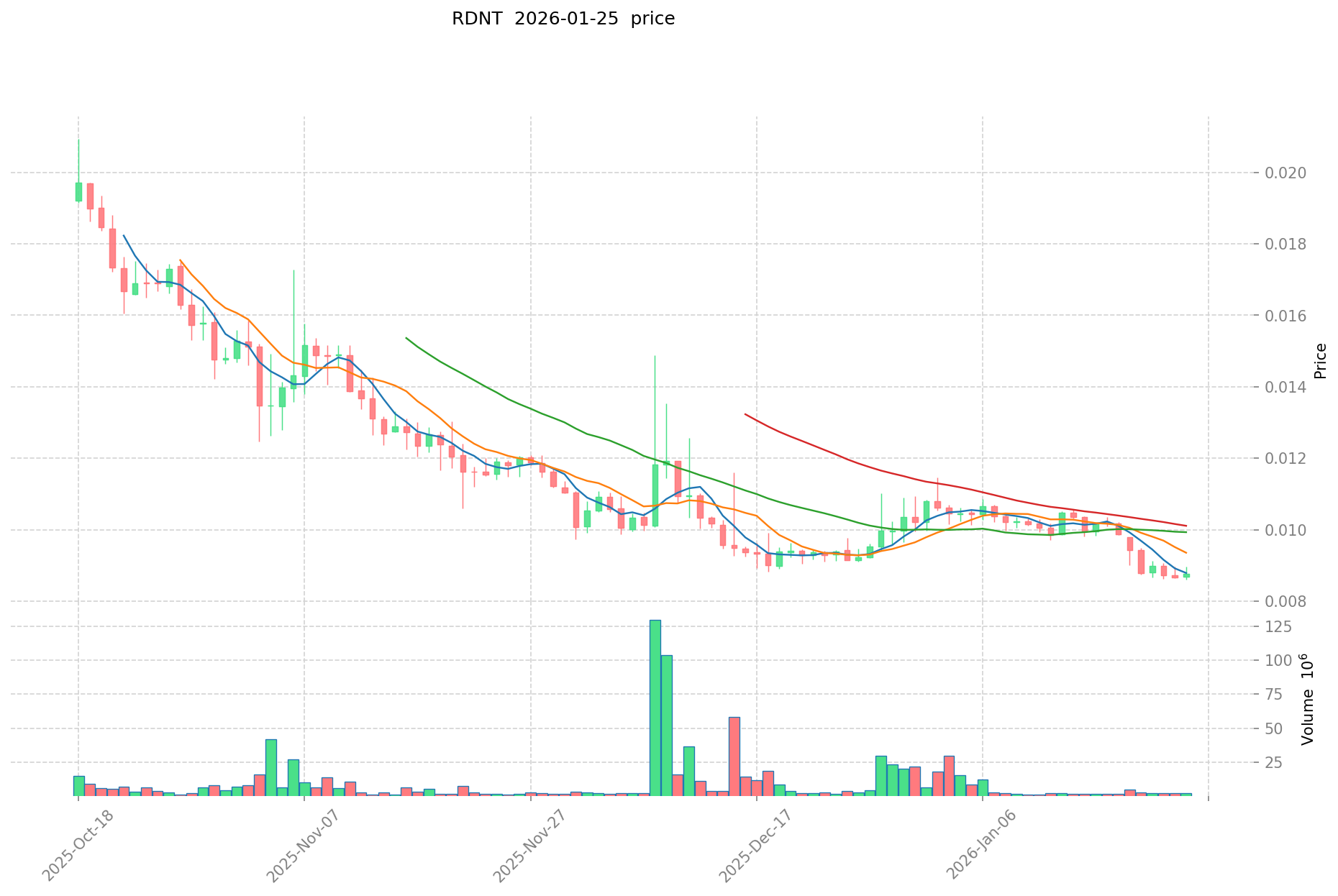
As of January 26, 2026, RDNT has experienced significant price fluctuations since its launch. The token reached a notable price level of $0.585268 on September 16, 2022, representing an earlier phase of market activity. Subsequently, the asset underwent substantial price adjustments, with recent trading around $0.00829965 on January 26, 2026, reflecting broader market dynamics and sector-specific developments.
Over the past year, RDNT has declined approximately 82.45%, indicating challenging market conditions for the asset. The 30-day period showed an 8.67% decrease, while the 7-day performance reflected a 17.16% decline, suggesting continued downward pressure in recent trading sessions.
Current RDNT Investment Market Status (January 2026)
- RDNT current price: $0.008371
- 24-hour trading volume: $21,038.56
- 24-hour price range: $0.008282 - $0.008854
- 1-hour price change: +0.26%
- Market capitalization: $10,815,951.18
- Fully diluted market cap: $12,556,500.00
- Circulating supply: 1,292,073,967 RDNT (86.14% of max supply)
- Total supply: 1,500,000,000 RDNT
- Number of exchanges listing RDNT: 23
- Token holder count: 1,921
Click to view real-time RDNT market price
II. Core Factors Affecting Whether RDNT is a Good Investment (Is Radiant(RDNT) a Good Investment)
Supply Mechanism and Scarcity (RDNT investment scarcity)
- Supply mechanism → affects price and investment value
- RDNT has a maximum supply of 1.5 billion tokens, with approximately 1.29 billion tokens currently in circulation, representing a circulating ratio of about 86.14%
- Investment significance: scarcity is key to supporting long-term investment
Institutional Investment and Mainstream Adoption (Institutional investment in RDNT)
- Radiant Capital operates as a cross-chain money market built on LayerZero infrastructure
- The platform allows users to deposit major assets on any major chain and borrow various supported assets across multiple chains
- RDNT serves as the native utility token, with emissions allocated to users who provide utility to the platform as lenders, borrowers, and RDNT/WETH liquidity providers
Macroeconomic Environment's Impact on RDNT Investment
- Monetary policy and interest rate changes → alter investment attractiveness
- The broader cryptocurrency market environment influences RDNT's investment appeal
- Market uncertainty → may affect demand for DeFi protocol tokens like RDNT
Technology and Ecosystem Development (Technology & Ecosystem for RDNT investment)
- LayerZero integration: enables cross-chain functionality → enhances platform utility and investment attractiveness
- Cross-chain money market protocol: expands ecosystem applications → provides long-term value support
- DeFi applications drive investment value through lending, borrowing, and liquidity provision mechanisms
III. RDNT Future Investment Forecast and Price Outlook (Is Radiant(RDNT) worth investing in 2026-2031)
Short-term Investment Forecast (2026, short-term RDNT investment outlook)
- Conservative Forecast: $0.00745108 - $0.008372
- Neutral Forecast: $0.008372
- Optimistic Forecast: $0.008372 - $0.00946036
Mid-term Investment Outlook (2027-2029, mid-term Radiant(RDNT) investment forecast)
-
Market Stage Expectation: Based on the provided data, RDNT may experience gradual price adjustments during the mid-term period, with potential fluctuations driven by market dynamics and broader crypto sector trends.
-
Investment Return Forecast:
- 2027: $0.0065979732 - $0.0121260048
- 2028: $0.009363772236 - $0.012204467184
- 2029: $0.0107946408024 - $0.01352170795248
-
Key Catalysts: Platform utility expansion, cross-chain lending adoption, RDNT token emission adjustments, and liquidity provider incentives.
Long-term Investment Outlook (Is Radiant a good long-term investment?)
- Base Scenario: $0.009829372659069 - $0.014433002891798 (assuming steady development and moderate market conditions)
- Optimistic Scenario: $0.013437623382019 - $0.015184514421681 (assuming enhanced cross-chain adoption and favorable DeFi market growth)
- Risk Scenario: $0.00739069286011 - $0.009829372659069 (under adverse market conditions or competitive pressures)
For detailed RDNT long-term investment and price forecasts: Price Prediction
2026-01-26 to 2031 Long-term Outlook
- Base Scenario: $0.009829372659069 - $0.014433002891798 (corresponding to steady progress and gradual mainstream application growth)
- Optimistic Scenario: $0.013437623382019 - $0.015184514421681 (corresponding to large-scale adoption and favorable market environment)
- Transformative Scenario: Above $0.015184514421681 (if the ecosystem achieves breakthrough developments and mainstream adoption)
- December 31, 2031 Projected High: $0.015184514421681 (based on optimistic development assumptions)
Disclaimer
| Year |
Predicted High Price |
Predicted Average Price |
Predicted Low Price |
Price Change |
| 2026 |
0.00946036 |
0.008372 |
0.00745108 |
0 |
| 2027 |
0.0121260048 |
0.00891618 |
0.0065979732 |
6 |
| 2028 |
0.012204467184 |
0.0105210924 |
0.009363772236 |
25 |
| 2029 |
0.01352170795248 |
0.011362779792 |
0.0107946408024 |
35 |
| 2030 |
0.014433002891798 |
0.01244224387224 |
0.009829372659069 |
48 |
| 2031 |
0.015184514421681 |
0.013437623382019 |
0.00739069286011 |
60 |
IV. Radiant Investment Strategy and Risk Management (How to invest in Radiant)
Investment Methodology (Radiant investment strategy)
Long-term Holding (HODL Radiant)
This approach may suit investors with a longer time horizon who believe in the potential development of cross-chain lending protocols. Given Radiant's position as a cross-chain money market built on LayerZero technology, holders would be betting on increased adoption of multi-chain DeFi infrastructure. However, investors should note that RDNT has experienced significant price fluctuations, with the token currently trading at $0.008371, representing an 82.45% decline over the past year.
Active Trading
Traders utilizing technical analysis and swing trading strategies should consider Radiant's volatility profile. Recent data shows:
- 24-hour price range: $0.008282 - $0.008854
- 7-day decline: -17.16%
- 30-day decline: -8.67%
The token's 24-hour trading volume of approximately $21,038 suggests moderate liquidity for active trading, though traders should be prepared for significant price swings.
Risk Management (Risk management for Radiant investment)
Asset Allocation Ratios
- Conservative investors: Consider limiting RDNT exposure to less than 1-2% of total crypto portfolio, given the high-risk nature of smaller-cap DeFi tokens
- Aggressive investors: May allocate 3-5% to RDNT as part of a diversified DeFi holdings strategy
- Professional investors: Could consider up to 5-10% allocation within a specialized DeFi portfolio, with active monitoring
Risk Hedging Solutions
Investors can consider:
- Diversifying across multiple DeFi protocols and cross-chain platforms
- Maintaining exposure to established cryptocurrencies alongside smaller positions in tokens like RDNT
- Setting predetermined exit points and stop-loss levels given the token's volatility
Secure Storage
Cold and Hot Wallet Solutions:
- For long-term holdings, hardware wallets such as Ledger or Trezor are recommended
- RDNT is deployed on multiple chains (Arbitrum, BSC, Ethereum), so investors should ensure wallet compatibility
- Contract addresses:
- Arbitrum: 0x3082cc23568ea640225c2467653db90e9250aaa0
- BSC: 0xf7DE7E8A6bd59ED41a4b5fe50278b3B7f31384dF
- Ethereum: 0x137dDB47Ee24EaA998a535Ab00378d6BFa84F893
- For active trading, reputable exchanges with strong security measures may be appropriate, though keeping large amounts on exchanges carries custodial risk
V. Radiant Investment Risks and Challenges (Risks of investing in Radiant)
Market Risk
High Volatility: RDNT has demonstrated substantial price fluctuations, with a historical high of $0.585268 (September 2022) and a historical low of $0.00829965 (January 2026). The current price of $0.008371 sits near these lows, indicating heightened volatility. The token has declined 82.45% over the past year, reflecting significant market risk.
Limited Market Depth: With a market capitalization of approximately $10.8 million and a ranking of #1156, RDNT represents a smaller market cap token, which can be subject to increased price manipulation risk and lower liquidity during market stress.
Regulatory Risk
Cross-chain DeFi protocols operate in an evolving regulatory landscape:
- Different jurisdictions have varying approaches to DeFi regulation
- Cross-chain protocols may face additional scrutiny due to their multi-network operations
- Changes in regulatory frameworks could impact the protocol's operations or token utility
- The lack of centralized control in DeFi presents both advantages and regulatory uncertainties
Technical Risk
Network Security Vulnerabilities: As a cross-chain protocol built on LayerZero, Radiant faces technical risks including:
- Smart contract vulnerabilities across multiple blockchain networks
- Bridge security risks inherent in cross-chain operations
- Potential exploits in lending/borrowing mechanisms
Protocol Development Risk: The success of Radiant depends on continued development and adoption. With approximately 1,921 token holders and listing on 23 exchanges, the project has limited scale compared to established DeFi protocols.
Tokenomics: With 1.29 billion tokens in circulation (86.14% of max supply) out of a maximum of 1.5 billion, the circulating supply is relatively high, which may limit potential supply-side price appreciation.
VI. Conclusion: Is Radiant a Good Investment?
Investment Value Summary
Radiant (RDNT) presents as a high-risk, speculative investment in the cross-chain DeFi sector. While the protocol aims to provide cross-chain lending and borrowing functionality—an innovative use case in DeFi—the token has experienced severe price depreciation, declining 82.45% over the past year. The project's relatively small market capitalization of $10.8 million and limited holder base of approximately 1,921 participants suggest early-stage adoption.
The token's price volatility remains substantial, with recent declines of 17.16% over 7 days and 8.67% over 30 days. These characteristics indicate that RDNT may be suitable only for investors with high risk tolerance and sufficient understanding of DeFi protocols and cross-chain technology.
Investor Recommendations
✅ Beginners: If considering RDNT, implement dollar-cost averaging with very small amounts (less than 1% of crypto portfolio) and store tokens in secure hardware wallets. Beginners should thoroughly research cross-chain DeFi mechanics before investing.
✅ Experienced Investors: May consider swing trading strategies based on technical analysis, given the token's volatility. Maintain strict position sizing (2-5% of DeFi allocation) and implement stop-loss mechanisms.
✅ Institutional Investors: Could evaluate RDNT as part of a diversified DeFi venture allocation, with appropriate due diligence on protocol security, team background, and competitive positioning in the cross-chain lending space.
⚠️ Disclaimer: Cryptocurrency investments carry substantial risk and may not be suitable for all investors. The high volatility and speculative nature of tokens like RDNT mean that investors could lose their entire investment. This content is for informational purposes only and does not constitute financial advice. Investors should conduct their own research and consult with qualified financial advisors before making investment decisions.
VII. FAQ
Q1: Is Radiant (RDNT) a good investment for beginners in 2026?
RDNT carries extremely high risk and is generally not recommended for beginners. The token has declined 82.45% over the past year and currently trades at $0.008371 with a small market cap of $10.8 million. Beginners considering RDNT should only allocate less than 1% of their crypto portfolio, implement dollar-cost averaging strategies, and use secure hardware wallets for storage. Understanding cross-chain DeFi mechanics and LayerZero technology is essential before investing.
Q2: What are the main risks of investing in Radiant (RDNT)?
The primary risks include extreme price volatility (82.45% annual decline), limited market depth with only $21,038 daily trading volume, smart contract vulnerabilities across multiple chains (Arbitrum, BSC, Ethereum), cross-chain bridge security risks, and evolving regulatory uncertainties for DeFi protocols. The project's limited adoption with only 1,921 token holders and ranking at #1156 also indicates substantial risk compared to established cryptocurrencies.
Q3: How does Radiant's cross-chain functionality affect its investment potential?
Radiant's LayerZero-based cross-chain money market allows users to deposit assets on one chain and borrow on another, which represents an innovative use case in DeFi. This functionality could drive long-term value if cross-chain lending gains mainstream adoption. However, the technology also introduces additional technical risks through bridge operations and multi-network smart contract complexity. The investment potential depends heavily on broader DeFi adoption and successful execution of the cross-chain vision.
Q4: What is the realistic price prediction for RDNT by 2031?
Based on current analysis, RDNT's 2031 price projections vary significantly by scenario. The base scenario estimates $0.009829 - $0.014433, assuming steady development. The optimistic scenario projects $0.013438 - $0.015185, contingent on enhanced cross-chain adoption and favorable DeFi market growth. The risk scenario suggests $0.007391 - $0.009829 under adverse conditions. These predictions assume continued protocol development, but investors should note that the token's recent performance has been substantially negative.
Q5: How should investors manage their RDNT position for optimal risk-reward?
Conservative investors should limit RDNT exposure to 1-2% of their total crypto portfolio and use hardware wallets for storage. Aggressive investors may allocate 3-5% within a diversified DeFi strategy with active monitoring and strict stop-loss levels. Professional investors could consider 5-10% allocation in specialized DeFi portfolios. All investors should diversify across multiple DeFi protocols, maintain exposure to established cryptocurrencies, and set predetermined exit points given RDNT's high volatility and 24-hour price range of $0.008282 - $0.008854.
Q6: Where can I securely buy and store Radiant (RDNT)?
RDNT is available on 23 exchanges and deployed across three blockchain networks: Arbitrum (0x3082cc23568ea640225c2467653db90e9250aaa0), BSC (0xf7DE7E8A6bd59ED41a4b5fe50278b3B7f31384dF), and Ethereum (0x137dDB47Ee24EaA998a535Ab00378d6BFa84F893). For long-term holdings, hardware wallets like Ledger or Trezor are recommended, ensuring wallet compatibility with your chosen blockchain network. For active trading, use reputable exchanges with strong security measures, though keeping large amounts on exchanges carries custodial risk.
Q7: What factors could drive RDNT's price recovery in the future?
Potential catalysts include: expanded platform utility through increased cross-chain lending adoption, adjustments to RDNT token emission schedules, enhanced liquidity provider incentives, broader DeFi market growth, successful LayerZero ecosystem development, and increased institutional interest in cross-chain protocols. However, recovery depends on overcoming current challenges including limited holder base (1,921 holders), low market cap ($10.8 million), and competitive pressure from established DeFi protocols.
Q8: How does RDNT's tokenomics affect its long-term investment value?
RDNT has a maximum supply of 1.5 billion tokens with approximately 1.29 billion (86.14%) already in circulation. This high circulating supply ratio limits potential supply-side price appreciation compared to tokens with lower circulation percentages. Token emissions are distributed to lenders, borrowers, and RDNT/WETH liquidity providers, creating utility-based demand. However, with the majority of supply already circulating and current weak demand (evidenced by low trading volume), tokenomics alone may not support significant price appreciation without substantial protocol adoption growth.
* The information is not intended to be and does not constitute financial advice or any other recommendation of any sort offered or endorsed by Gate.