This comprehensive analysis examines whether Radicle (RAD), a governance token for Web3-native decentralized code collaboration infrastructure, represents a viable investment opportunity. Currently priced at $0.2915 with a market cap of $14.53 million, RAD serves as an alternative to centralized platforms like GitHub, enabling developers to fund and manage projects through smart contracts and NFTs. The article evaluates RAD's historical performance, token economics with a 100 million maximum supply, and price forecasts ranging from $0.30-$0.56 by 2031 across various scenarios. Key investment considerations include significant volatility, regulatory uncertainty, and adoption risk balanced against long-term potential in decentralized development tools. Strategic recommendations encompass dollar-cost averaging for beginners, technical analysis for experienced traders, and portfolio allocation ranging from 1-15% based on risk tolerance. Investors can access RAD through Gate exchange and other platforms, with emph
Introduction: Radicle (RAD) Investment Position and Market Outlook
RAD is a governance token in the cryptocurrency space that has emerged as a significant asset since its launch in February 2021. Positioned as a Web3-native network for software collaboration, Radicle provides decentralized infrastructure comparable to GitHub, enabling developers to fund, monetize, and manage software projects using NFT, multi-signature wallets, and smart contracts. As of January 24, 2026, RAD has a market capitalization of approximately $14.53 million, with a circulating supply of around 49.83 million tokens, and a current price near $0.29. The token holds a market ranking of 1023 and maintains a market share of 0.00092%. With its governance-focused positioning in the decentralized software collaboration sector, RAD has become a point of discussion among investors considering "Is Radicle (RAD) a good investment?" This article provides a comprehensive analysis of RAD's investment value, historical price movements, future price predictions, and associated investment risks to serve as a reference for investors.
I. RAD Price History Review and Current Investment Value Status
- 2021: RAD reached a significant price level of $27.61 in April → Early investors experienced substantial returns during the initial market enthusiasm period
- 2025: RAD experienced notable market volatility → Price declined from higher levels to $0.247899 in December
- Recent Period: Market consolidation phase → Price stabilized around the $0.29 range with moderate volatility
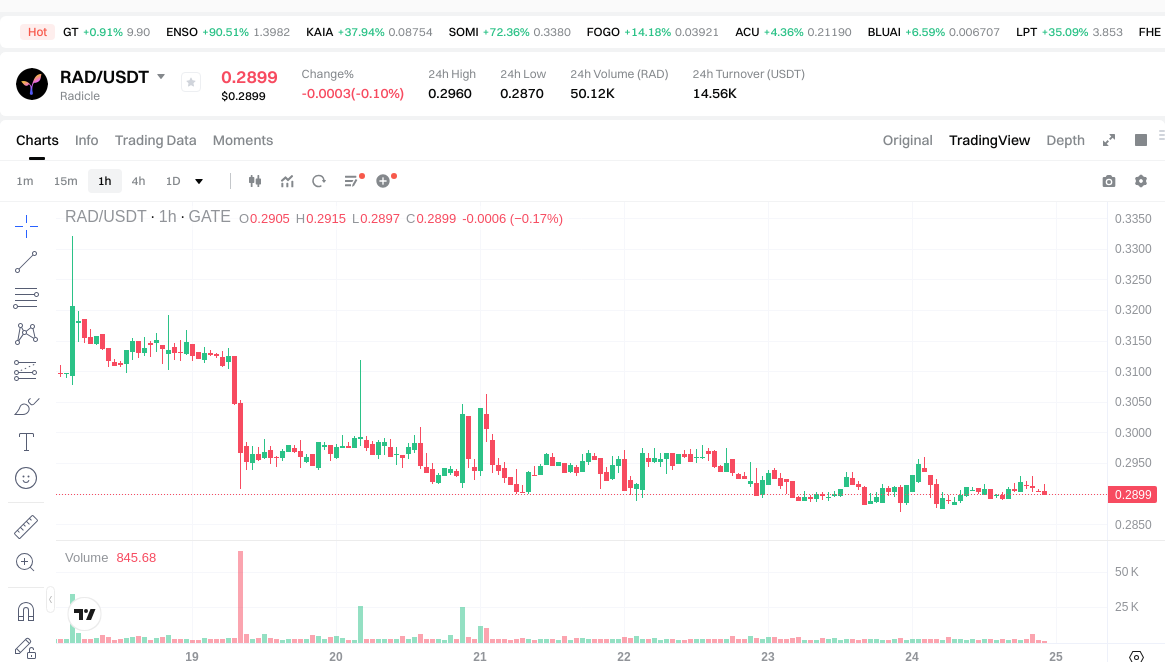
Current RAD Investment Market Status (January 2026)
- RAD current price: $0.2915
- Market sentiment (Fear & Greed Index): Data not available in provided materials
- 24-hour trading volume: $14,486.57
- Institutional investor holdings: Data not available in provided materials
Click to view real-time RAD market price
II. Core Factors Influencing Whether RAD is a Good Investment (Is Radicle(RAD) a Good Investment)
Supply Mechanism and Scarcity (RAD investment scarcity)
- Maximum supply cap of 100,000,000 RAD tokens → influences price and investment value through controlled scarcity
- Current circulating supply of 49,829,110.57 tokens represents approximately 49.83% of total supply → potential for future supply expansion
- Historical context: RAD price reached $27.61 in April 2021, while experiencing a low of $0.247899 in December 2025, demonstrating significant price volatility
- Investment significance: the fixed maximum supply mechanism provides a foundation for long-term scarcity considerations
Institutional Investment and Mainstream Adoption (Institutional investment in RAD)
- Token holder distribution: currently 7,775 token holders across the network
- RAD serves as a governance token for the Radicle protocol, enabling participation in smart contract system governance through voting and proposals
- Market positioning: Radicle provides Web3-native infrastructure for software collaboration, offering decentralized alternatives to centralized platforms
Macroeconomic Environment's Impact on RAD Investment
- Market capitalization of $14,525,185.73 represents 0.00092% of the broader cryptocurrency market
- Trading volume of $14,486.57 over 24 hours indicates relatively modest liquidity levels
- Price performance shows varied trends: +0.03% (1H), -0.27% (24H), -6.09% (7D), +9.46% (30D), -73.38% (1Y)
- Macroeconomic uncertainty and risk appetite changes may influence investment flows into mid-to-lower market cap digital assets
Technology and Ecosystem Development (Technology & Ecosystem for RAD investment)
- Core functionality: Radicle operates as a decentralized network for software collaboration, providing GitHub-like features on decentralized infrastructure
- Ethereum-based protocol integration: RAD token holders receive benefits when interacting with Radicle's Ethereum-based protocols, including potential discounts or fee reductions
- Developer tools: the platform enables developers to fund, monetize, and manage software projects using NFTs, multi-signature wallets, and smart contracts
- Ecosystem applications: governance participation rights provide token utility beyond speculative trading
- Available on 23 exchanges with trading pairs, providing accessibility for potential investors
III. RAD Future Investment Forecast and Price Outlook (Is Radicle(RAD) worth investing in 2026-2031)
Short-term Investment Forecast (2026, short-term RAD investment outlook)
- Conservative forecast: $0.272788 - $0.2902
- Neutral forecast: $0.2902 - $0.310514
- Optimistic forecast: $0.310514 with potential upside considering current market positioning
Mid-term Investment Outlook (2027-2029, mid-term Radicle(RAD) investment forecast)
- Market stage expectation: Gradual recovery phase with moderate growth trajectory, supported by Web3 infrastructure development and decentralized collaboration tools adoption
- Investment return forecast:
- 2027: $0.29134629 - $0.31837842
- 2028: $0.2567751993 - $0.340304481
- 2029: $0.217640183985 - $0.40279675842
- Key catalysts: Expansion of developer community adoption, integration with existing Web3 ecosystems, governance participation growth, and potential partnerships within decentralized software development space
Long-term Investment Outlook (Is Radicle a good long-term investment?)
- Base scenario: $0.36 - $0.44 (assuming steady ecosystem development and maintained governance token utility)
- Optimistic scenario: $0.52 - $0.56 (assuming accelerated Web3 adoption and expanded platform functionality)
- Risk scenario: $0.19 - $0.25 (under challenging market conditions or decreased developer ecosystem engagement)
View RAD long-term investment and price forecast: Price Prediction
2026-2031 Long-term Outlook
- Base scenario: $0.30 - $0.44 USD (corresponding to steady progress and gradual mainstream application growth)
- Optimistic scenario: $0.44 - $0.56 USD (corresponding to large-scale adoption and favorable market environment)
- Transformative scenario: Above $0.56 USD (in case of breakthrough ecosystem developments and mainstream adoption)
- 2031-12-31 predicted high: $0.559258611522912 USD (based on optimistic development assumptions)
Disclaimer: This forecast is based on historical data and current market trends. Cryptocurrency investments carry significant risks, and actual prices may vary substantially from predictions. This analysis does not constitute investment advice.
| Year |
Predicted High Price |
Predicted Average Price |
Predicted Low Price |
Price Change |
| 2026 |
0.310514 |
0.2902 |
0.272788 |
0 |
| 2027 |
0.31837842 |
0.300357 |
0.29134629 |
3 |
| 2028 |
0.340304481 |
0.30936771 |
0.2567751993 |
6 |
| 2029 |
0.40279675842 |
0.3248360955 |
0.217640183985 |
11 |
| 2030 |
0.5238956548224 |
0.36381642696 |
0.1964608705584 |
25 |
| 2031 |
0.559258611522912 |
0.4438560408912 |
0.248559382899072 |
52 |
IV. Radicle (RAD) Investment Strategy and Risk Management (How to invest in decentralized software collaboration tokens)
Investment Methodology (Radicle investment strategy)
Long-term Holding (HODL RAD): Suitable for Conservative Investors
Long-term holding of RAD may appeal to investors who believe in the future of decentralized software development infrastructure. This strategy involves purchasing RAD tokens and retaining them through market cycles, potentially benefiting from the growth of the Radicle network over time. Conservative investors typically allocate a smaller portion of their portfolio to such assets, recognizing the volatility inherent in the cryptocurrency market while positioning for potential long-term appreciation as Web3 development tools gain adoption.
Active Trading: Relying on Technical Analysis and Swing Trading
Active traders may approach RAD through technical analysis, utilizing price patterns, volume indicators, and market sentiment to identify entry and exit points. Given RAD's historical price movements, swing trading strategies could focus on capturing short-to-medium term price fluctuations. Traders should monitor the token's 24-hour trading volume and price ranges to identify potential opportunities, while remaining aware of the token's volatility characteristics.
Risk Management (Risk management for RAD investment)
Asset Allocation Ratios: Conservative / Aggressive / Professional Investors
Conservative Investors: May allocate 1-3% of their cryptocurrency portfolio to RAD, prioritizing established assets while maintaining limited exposure to governance tokens with specific use cases.
Aggressive Investors: Could allocate 5-10% of their portfolio to RAD, accepting higher volatility in exchange for potential growth opportunities within the decentralized development tools sector.
Professional Investors: May employ dynamic allocation strategies ranging from 3-15%, adjusting positions based on network adoption metrics, governance activity, and broader market conditions.
Investors can manage RAD exposure through diversification across different cryptocurrency categories, including established assets, stablecoins, and other governance tokens. Portfolio construction should consider correlation patterns with major cryptocurrencies and broader market movements. Some investors may use stablecoin positions or options strategies to hedge against downside risk during periods of heightened volatility.
Secure Storage: Hot and Cold Wallets + Hardware Wallet Recommendations
Given that RAD operates on the Ethereum network, investors should prioritize secure storage solutions. Hardware wallets compatible with ERC-20 tokens, such as Ledger and Trezor devices, provide robust security for long-term holdings. For active traders requiring frequent access, reputable software wallets with strong security features may be appropriate, though users should maintain only trading amounts in hot wallets while securing the majority of holdings in cold storage. Multi-signature wallet solutions offer additional security layers for larger holdings.
V. Radicle (RAD) Investment Risks and Challenges (Risks of investing in decentralized software collaboration tokens)
Market Risk: High Volatility and Price Manipulation
RAD exhibits significant price volatility, with recent data showing a 24-hour range between $0.287 and $0.296, and a 7-day decline of approximately 6%. The token's relatively modest trading volume may contribute to price volatility and potential susceptibility to large order impacts. Investors should be prepared for substantial price swings that characterize lower market capitalization tokens.
Regulatory Risk: Policy Uncertainty Across Different Countries
As a governance token for a decentralized software collaboration platform, RAD faces evolving regulatory frameworks across jurisdictions. Different countries maintain varying approaches to cryptocurrency regulation, particularly regarding tokens that facilitate governance functions. Changes in regulatory stances toward decentralized autonomous organizations (DAOs) and governance tokens could impact RAD's utility and market value. Investors should monitor regulatory developments in their jurisdictions and major cryptocurrency markets.
Technical Risk: Network Security Vulnerabilities and Upgrade Failures
As an Ethereum-based token, RAD's functionality depends on the underlying Ethereum network's security and performance. Smart contract vulnerabilities, though the Radicle protocol undergoes security audits, represent potential technical risks. Network upgrades or protocol changes could introduce unforeseen issues that temporarily affect token functionality or user access. Additionally, the success of the Radicle platform depends on continued technical development and adoption within the developer community.
VI. Conclusion: Is Decentralized Software Collaboration Token a Good Investment?
Investment Value Summary
Radicle (RAD) presents an investment opportunity in the emerging sector of decentralized development infrastructure, with potential long-term value tied to the adoption of Web3-native software collaboration tools. However, the token exhibits significant short-term price volatility, as evidenced by recent price movements. The project's positioning as an alternative to centralized platforms like GitHub offers differentiation, though market adoption remains a key factor in long-term value realization.
Investor Recommendations
✅ Beginners: Consider dollar-cost averaging (DCA) strategies to mitigate timing risk, paired with secure hardware wallet storage. Start with minimal allocation to understand the token's behavior before increasing exposure.
✅ Experienced Investors: May employ swing trading strategies based on technical analysis while maintaining a core position for potential long-term appreciation. Portfolio allocation should reflect risk tolerance and conviction in the decentralized development tools thesis.
✅ Institutional Investors: Could evaluate RAD as part of strategic thematic exposure to Web3 infrastructure, with position sizing appropriate to the token's market capitalization and liquidity characteristics.
⚠️ Disclaimer: Cryptocurrency investments carry substantial risk, including the potential for complete loss of capital. This content is provided for informational purposes only and does not constitute investment advice. Investors should conduct independent research and consult with financial professionals before making investment decisions.
VII. FAQ
Q1: What is the current price of Radicle (RAD) and where can I purchase it?
As of January 24, 2026, RAD is trading at approximately $0.2915. You can purchase RAD on 23 different cryptocurrency exchanges, with the token available in multiple trading pairs. For real-time pricing information and to begin purchasing RAD, visit reputable exchanges that list the token. It's recommended to use established platforms with strong security measures and adequate liquidity to ensure favorable execution of your trades.
Q2: How does RAD's governance function work and what utility does the token provide?
RAD serves as a governance token for the Radicle protocol, enabling holders to participate in the platform's decision-making process through voting and proposal submission. Beyond governance rights, RAD token holders receive benefits when interacting with Radicle's Ethereum-based protocols, including potential discounts or fee reductions on platform services. The token grants access to influence the development direction of this Web3-native software collaboration network, making it valuable for stakeholders invested in decentralized development infrastructure.
Q3: What is the maximum supply of RAD tokens and how does this affect investment value?
RAD has a fixed maximum supply cap of 100,000,000 tokens, with approximately 49,829,110 tokens (49.83%) currently in circulation. This controlled supply mechanism creates potential scarcity dynamics that may influence long-term value appreciation. The remaining ~50% of tokens yet to enter circulation represents potential future supply expansion that investors should consider when evaluating price projections and dilution risks.
Q4: How volatile is RAD compared to other cryptocurrencies?
RAD exhibits significant price volatility characteristic of lower market capitalization tokens. Recent performance shows varied timeframe movements: +0.03% (1H), -0.27% (24H), -6.09% (7D), +9.46% (30D), and -73.38% (1Y). Historically, the token reached $27.61 in April 2021 before declining to $0.247899 in December 2025. This substantial price range demonstrates high volatility levels that require careful risk management and appropriate position sizing based on individual risk tolerance.
Q5: What are the main risks associated with investing in RAD?
The primary investment risks for RAD include: (1) Market risk from high volatility and relatively low trading volume ($14,486.57 in 24-hour volume), which may lead to price manipulation susceptibility; (2) Regulatory risk stemming from evolving global policies regarding governance tokens and decentralized autonomous organizations; (3) Technical risk related to smart contract vulnerabilities and dependency on Ethereum network security; and (4) Adoption risk, as the token's long-term value depends on increased usage of the Radicle platform within the developer community.
Q6: What investment strategy is most suitable for RAD?
The appropriate strategy depends on investor profile and risk tolerance. Conservative investors may consider allocating 1-3% of their cryptocurrency portfolio to RAD with long-term holding (HODL) strategies, recognizing the platform's position in Web3 infrastructure development. Aggressive investors might allocate 5-10% with active trading approaches based on technical analysis to capture price fluctuations. All investors should implement proper risk management through portfolio diversification, secure storage using hardware wallets for ERC-20 tokens, and position sizing aligned with their overall investment objectives.
Q7: What is the long-term price forecast for RAD through 2031?
Price predictions suggest varied scenarios: Base scenario estimates RAD could reach $0.30-$0.44 by 2031 under steady ecosystem development; optimistic scenario projects $0.44-$0.56 assuming accelerated Web3 adoption; while risk scenario indicates potential decline to $0.19-$0.25 under challenging market conditions. The 2031-12-31 predicted high stands at approximately $0.56 based on optimistic development assumptions. However, these forecasts carry substantial uncertainty, and actual prices may differ significantly from projections due to market dynamics, adoption rates, and macroeconomic factors.
Q8: How does Radicle compare to centralized platforms like GitHub?
Radicle provides Web3-native infrastructure for software collaboration, offering decentralized alternatives to centralized platforms like GitHub. The platform enables developers to fund, monetize, and manage software projects using NFTs, multi-signature wallets, and smart contracts. Unlike centralized platforms, Radicle operates on decentralized infrastructure, providing censorship resistance and user sovereignty. However, adoption remains lower than established centralized alternatives, and the platform's success depends on attracting developers who value decentralization benefits despite potential trade-offs in user experience or feature completeness compared to mature centralized solutions.
* The information is not intended to be and does not constitute financial advice or any other recommendation of any sort offered or endorsed by Gate.