This comprehensive analysis examines whether Rarible (RARI) represents a viable investment opportunity within the NFT marketplace ecosystem. RARI, trading at $0.1878 with a market capitalization of $3.40 million as of January 2026, functions as the native governance token enabling staking rewards and voting participation on the Rarible platform. The article evaluates RARI's investment characteristics across multiple dimensions: historical performance showing significant decline from the $46.7 all-time high in March 2021, current market conditions reflecting the 67% year-over-year NFT market contraction, and long-term price forecasts spanning conservative to optimistic scenarios through 2031. Key investment considerations include the token's fixed 25 million supply (72.49% circulating), cross-chain rewards mechanisms distributing marketplace fees, and substantial risks encompassing market volatility, regulatory uncertainty, and technical vulnerabilities. The analysis provides tailored investment strategies for
Introduction: Rarible (RARI) Investment Position and Market Outlook
RARI is a significant asset in the cryptocurrency space, serving as the native governance token of the Rarible ecosystem since its launch in July 2020. As of January 30, 2026, RARI holds a market capitalization of approximately $3.40 million, with a circulating supply of around 18.12 million tokens and a current price of $0.1878. Positioned as infrastructure powering onchain commerce, RARI has established its role within the NFT marketplace sector. The token enables holders to participate in governance through staking while earning yields, and facilitates a cross-chain rewards program that distributes trading fees to users. With 24,446 holders and trading activity across 9 exchanges, RARI represents a case study for investors evaluating "Is Rarible (RARI) a good investment?" This article comprehensively examines RARI's investment characteristics, historical price movements, future price considerations, and associated risks to provide reference information for market participants.
I. RARI Price History Review and Investment Value Status
-
2020: RARI token launched in July 2020 with initial pricing around $0.515. Early adopters experienced initial price discovery phase as the NFT marketplace gained traction.
-
2021: March 2021 marked a notable period when RARI reached elevated price levels during the broader NFT market expansion. The token saw price appreciation alongside increased platform activity on Rarible.com.
-
2022-2024: The token entered a prolonged adjustment phase, with prices declining from previous levels as the NFT market experienced reduced trading volumes and broader crypto market corrections.
-
2025-2026: By January 2026, RARI continued to face downward pressure, with the token trading near lower price ranges as the project focused on cross-chain rewards programs and governance enhancements.
Current RARI Investment Market Status (January 2026)
- Current RARI price: $0.1878
- 24-hour trading volume: $19,734.73
- Market capitalization: $3,403,289.49
- Circulating supply: 18,121,882 RARI (72.49% of total supply)
- Price changes: -7.57% (24h), -14.43% (7d), -22.79% (30d), -89.77% (1y)
- Total supply: 25,000,000 RARI
- Number of holders: 24,446 addresses
- Trading pairs available: Listed on 9 exchanges
Click to view real-time RARI market price
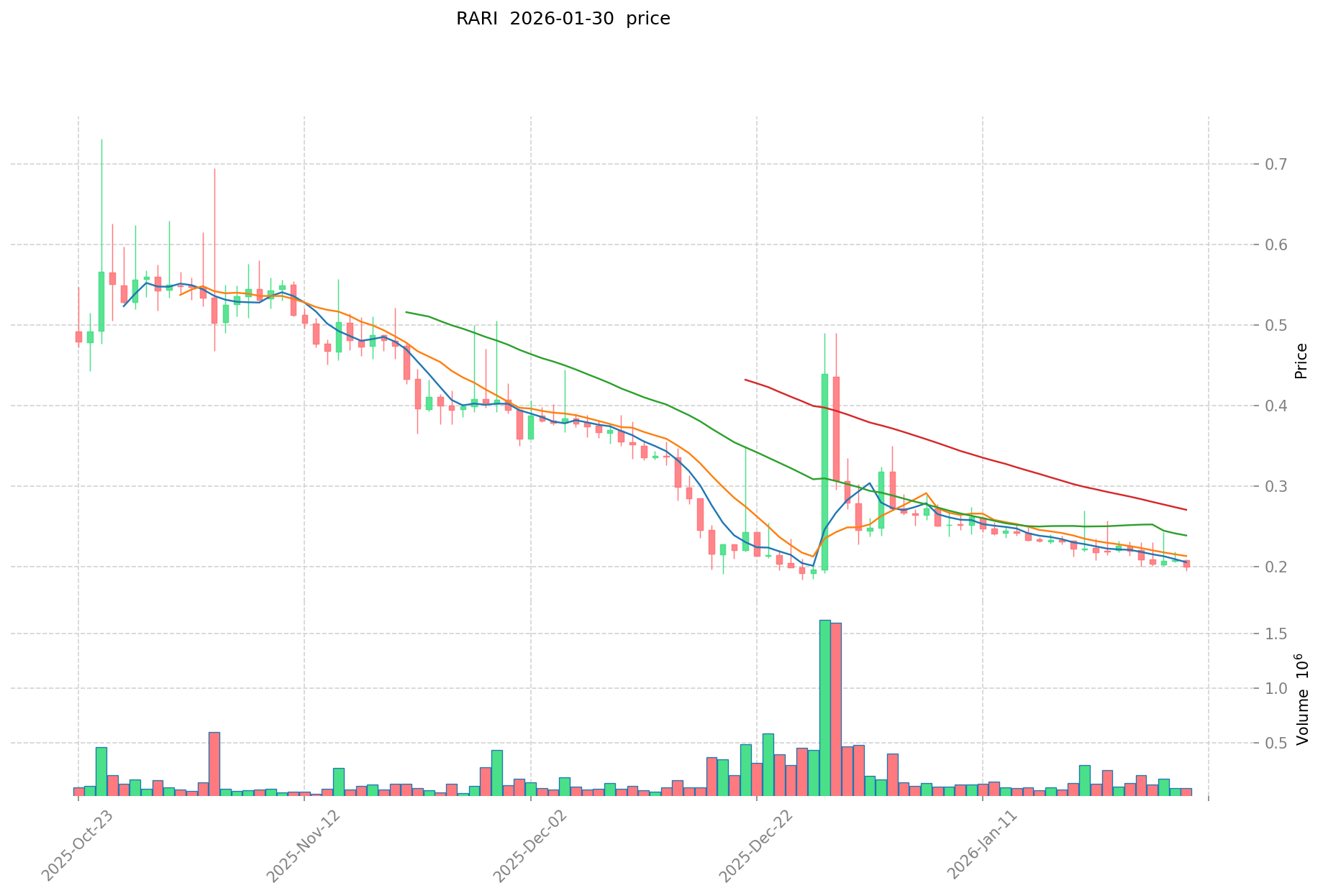
II. Core Factors Affecting Whether RARI is a Good Investment (Is Rarible(RARI) a Good Investment)
Supply Mechanism and Scarcity (RARI investment scarcity)
- Fixed supply mechanism influences price and investment value
- Historical pattern: RARI reached $46.7 in March 2021, while the current circulating supply stands at 18,121,882 tokens out of a maximum supply of 25,000,000, representing 72.49% circulation
- Investment significance: With 72.49% of tokens already in circulation, the remaining supply release schedule may impact long-term scarcity dynamics
Institutional Investment and Mainstream Adoption (Institutional investment in RARI)
- Current holder distribution: 24,446 addresses hold RARI tokens as of January 30, 2026
- Ecosystem integration: RARI functions as the governance token within the Rarible NFT marketplace infrastructure, with transaction fees collected and distributed to users in $RARI
- Market context: The NFT market cap declined 67% year-over-year to $2.7 billion as of January 2026, with monthly sales volume approximately $320 million, which may influence institutional adoption trends
Macroeconomic Environment's Impact on RARI Investment
- Market volatility: RARI experienced -89.77% change over one year and -22.79% over 30 days as of January 30, 2026, reflecting sensitivity to broader market conditions
- Price range: 24-hour trading range between $0.1828 and $0.2072, with current price at $0.1878
- Risk assessment: Technical indicators show 0 buy signals and 12 sell signals across moving averages from MA5 to MA200, suggesting caution in current market environment
Technology and Ecosystem Development (Technology & Ecosystem for RARI investment)
- Cross-chain rewards program: RARI Foundation facilitates cross-chain incentives on Rarible.com designed to fuel long-term growth and deepen liquidity
- Staking mechanism: Holders can stake $RARI to delegate voting power and earn annual percentage yield while participating in governance
- Ecosystem value capture: Every trade on the NFT marketplace generates fees that are collected by the Foundation and distributed to users in $RARI, creating a feedback loop between platform activity and token utility
III. RARI Future Investment Forecast and Price Outlook (Is Rarible(RARI) worth investing in 2026-2031)
Short-term Investment Outlook (2026, short-term RARI investment outlook)
- Conservative Forecast: $0.126 - $0.189
- Neutral Forecast: $0.189 - $0.220
- Optimistic Forecast: $0.220 - $0.240
Mid-term Investment Outlook (2027-2029, mid-term Rarible(RARI) investment forecast)
- Market Stage Expectation: The token may experience gradual growth supported by ecosystem development and cross-chain reward mechanisms facilitated by the RARI Foundation
- Investment Return Forecast:
- 2027: $0.109 - $0.319
- 2028: $0.216 - $0.312
- 2029: $0.223 - $0.420
- Key Catalysts: Expansion of NFT marketplace adoption, enhancement of staking rewards program, and increasing user participation in governance mechanisms
Long-term Investment Outlook (Is RARI a good long-term investment?)
- Base Scenario: $0.188 - $0.432 (assuming steady ecosystem growth and maintained liquidity incentives)
- Optimistic Scenario: $0.350 - $0.527 (assuming expanded NFT market share and enhanced cross-chain infrastructure)
- Risk Scenario: Below $0.126 (under conditions of declining NFT market activity or reduced ecosystem engagement)
View RARI long-term investment and price forecast: Price Prediction
2026-2031 Long-term Outlook
- Base Scenario: $0.188 - $0.432 (corresponding to steady progress and gradual mainstream application growth)
- Optimistic Scenario: $0.350 - $0.527 (corresponding to large-scale adoption and favorable market conditions)
- Transformative Scenario: Above $0.527 (if ecosystem achieves breakthrough developments and mainstream penetration)
- 2031-12-31 Forecast High: $0.527 (based on optimistic development assumptions)
Disclaimer: Price forecasts are based on historical data analysis and market trend projections. Actual performance may vary significantly due to market volatility, regulatory changes, technological developments, and other unpredictable factors. This information does not constitute investment advice.
| Year |
Predicted High Price |
Predicted Average Price |
Predicted Low Price |
Price Change |
| 2026 |
0.239649 |
0.1887 |
0.126429 |
0 |
| 2027 |
0.319120005 |
0.2141745 |
0.109228995 |
14 |
| 2028 |
0.311977285425 |
0.2666472525 |
0.215984274525 |
41 |
| 2029 |
0.419502789995625 |
0.2893122689625 |
0.222770447101125 |
54 |
| 2030 |
0.432377185964456 |
0.354407529479062 |
0.187835990623903 |
88 |
| 2031 |
0.527145759347157 |
0.393392357721759 |
0.350119198372365 |
109 |
IV. RARI Investment Strategy and Risk Management (How to invest in RARI)
Investment Methodology (RARI investment strategy)
Long-term Holding (HODL RARI): Suitable for conservative investors
Long-term holding represents a passive investment approach where investors acquire RARI tokens and maintain their positions over extended periods, typically years. This strategy aligns with the broader vision of the Rarible ecosystem's development and governance participation. Investors employing this method focus on the fundamental value proposition of RARI as a governance token within the NFT marketplace infrastructure, rather than short-term price movements. The staking mechanism available for RARI holders supports this strategy by providing Annual Percentage Yield (APY) rewards while enabling participation in ecosystem governance. This approach requires patience and conviction in the long-term viability of the Rarible platform and its role in onchain commerce.
Active Trading: Relies on technical analysis and swing trading
Active trading involves frequent buying and selling of RARI tokens based on technical analysis, market trends, and short-term price movements. Traders utilizing this approach monitor key technical indicators, support and resistance levels, and trading volume patterns to identify entry and exit points. Given RARI's price volatility, with recent data showing fluctuations between $0.1828 and $0.2072 within 24 hours, active traders may find opportunities in these price swings. This strategy demands continuous market monitoring, understanding of chart patterns, and risk management discipline. Traders should be aware of the token's historical performance, including significant drawdowns from all-time highs, when making short-term trading decisions.
Risk Management (Risk management for RARI investment)
Asset Allocation Ratio: Conservative / Aggressive / Professional investors
Asset allocation strategies vary based on investor risk tolerance and experience level. Conservative investors might limit RARI exposure to a small percentage of their overall portfolio, potentially allocating less than 5% to this single token position, given its volatility and relatively low market capitalization of approximately $3.4 million. Aggressive investors with higher risk tolerance may allocate a larger portion, up to 10-15% of their crypto holdings, seeking potentially higher returns while accepting greater downside risk. Professional investors and institutions typically implement more sophisticated allocation frameworks, potentially using RARI as part of a broader NFT ecosystem exposure strategy, with allocations determined by quantitative risk models and correlation analysis with other digital assets.
Risk Hedging Solutions: Multi-asset portfolio + risk mitigation tools
Effective risk management for RARI investment involves diversification across multiple asset classes and implementation of hedging strategies. Investors can construct portfolios combining RARI with other cryptocurrencies that have lower correlation, such as established assets with different use cases. Position sizing should account for RARI's historical volatility, which has demonstrated significant price movements including a one-year decline of approximately 89.77%. Risk mitigation tools may include setting predetermined stop-loss levels, using dollar-cost averaging to reduce timing risk, and maintaining sufficient liquidity reserves. Given RARI's relatively limited trading volume of approximately $19,735 in 24 hours, investors should be mindful of liquidity constraints when planning entry and exit strategies.
Secure Storage: Hot and cold wallets + hardware wallet recommendations
Secure storage of RARI tokens is fundamental to protecting investment capital. RARI is deployed on the Ethereum blockchain as an ERC-20 token, enabling storage across various wallet solutions. Cold storage solutions, such as hardware wallets from reputable manufacturers, provide the highest security level by keeping private keys offline and protected from internet-based threats. These devices are particularly recommended for long-term holders and larger positions. Hot wallets, including software wallets and mobile applications, offer greater convenience for active traders who require frequent access to their tokens. However, these connected wallets carry higher security risks. For investors participating in RARI staking to earn APY and delegate voting power, it is important to understand the security implications of interacting with staking smart contracts and to verify contract addresses through official Rarible channels before connecting wallets.
V. RARI Investment Risks and Challenges (Risks of investing in RARI)
Market Risk: High volatility and price manipulation concerns
RARI exhibits substantial price volatility characteristic of smaller market capitalization tokens. Recent data shows 24-hour price fluctuations of approximately 7.57%, seven-day declines of 14.43%, and thirty-day losses of 22.79%. The token's market capitalization of approximately $3.4 million and relatively low 24-hour trading volume create conditions where large individual transactions can significantly impact price. The current price of $0.1878 represents a considerable decline from the all-time high of $46.7 recorded in March 2021, illustrating the potential for extreme price movements. Investors should recognize that concentrated token holdings among approximately 24,446 addresses could lead to price pressure if major holders decide to liquidate positions. The limited exchange availability, with the token listed on only 9 exchanges, may further contribute to price volatility and potential liquidity challenges during periods of market stress.
Regulatory Risk: Policy uncertainty across different jurisdictions
The regulatory environment for NFT marketplace tokens and governance tokens remains uncertain and varies significantly across jurisdictions. RARI's function as a governance token for an NFT marketplace platform places it at the intersection of multiple regulatory considerations, including securities laws, digital asset regulations, and emerging NFT-specific frameworks. Different countries maintain varying stances on token classification, taxation, and permissible uses. Changes in regulatory policies could affect RARI's utility, trading availability, or legal status in certain jurisdictions. The RARI Foundation's role in collecting marketplace fees and distributing rewards to users may face scrutiny under evolving regulatory frameworks. Investors should monitor regulatory developments in their respective jurisdictions and understand that compliance requirements may change, potentially impacting token accessibility or functionality.
Technical Risk: Network security vulnerabilities and upgrade failures
As an Ethereum-based ERC-20 token, RARI inherits both the security properties and potential vulnerabilities of the Ethereum network. Smart contract risks associated with the staking mechanism and governance protocols represent potential technical vulnerabilities. While established blockchain networks like Ethereum generally maintain robust security, vulnerabilities in specific implementation details of RARI's smart contracts could potentially be exploited. The token's integration with the Rarible marketplace platform means that technical issues affecting the NFT marketplace operations could indirectly impact RARI's utility and value. The cross-chain rewards program mentioned in the project description introduces additional technical complexity and potential points of failure. Network congestion on Ethereum during periods of high activity can result in elevated transaction fees, potentially affecting the economics of claiming rewards or participating in governance activities. Investors should remain aware that protocol upgrades or migrations, while intended to improve functionality, carry inherent risks of unexpected issues or incompatibilities.
VI. Conclusion: Is RARI a Good Investment?
Investment Value Summary: RARI demonstrates potential through its role in NFT marketplace infrastructure and governance participation, yet faces considerable price volatility and market challenges.
RARI serves as the governance token for the Rarible ecosystem, providing holders with voting rights, staking opportunities, and participation in marketplace fee distributions. The token's utility is tied to the growth and adoption of the Rarible NFT marketplace and broader onchain commerce infrastructure. However, the investment proposition must be evaluated against significant price depreciation from historical peaks, with the current price representing a substantial decline from the all-time high. The relatively modest market capitalization and limited trading volume indicate that RARI remains a smaller-scale project within the cryptocurrency market. The circulating supply of approximately 18.1 million tokens represents about 72.49% of the maximum supply of 25 million tokens, suggesting limited additional supply pressure from token unlocks. The staking mechanism offers potential yield generation, though specific APY rates were not provided in the available materials.
Investor Recommendations:
✅ Beginners: Dollar-cost averaging + secure wallet storage
New investors approaching RARI should implement systematic investment plans through dollar-cost averaging to mitigate timing risk associated with the token's price volatility. This approach involves making regular, fixed-amount purchases regardless of current price, potentially reducing the impact of short-term fluctuations. Beginners should prioritize security by storing RARI tokens in reputable wallet solutions with proper backup procedures. Understanding the fundamental purpose of RARI within the Rarible ecosystem and the mechanics of governance participation is essential before committing capital. New investors should limit position sizes to amounts they can afford to lose entirely, given the token's historical price behavior and market risks.
✅ Experienced Investors: Swing trading + portfolio configuration
Investors with experience in cryptocurrency markets may consider incorporating RARI into diversified portfolio strategies, potentially utilizing the token's volatility for swing trading opportunities. This approach requires active monitoring of technical indicators, marketplace developments affecting the Rarible platform, and broader NFT market trends. Experienced investors can evaluate RARI's correlation with other NFT-related tokens and position sizing within a broader crypto asset allocation framework. Participation in governance and staking mechanisms may provide additional value for those committed to long-term engagement with the Rarible ecosystem. Risk management through stop-loss orders and position sizing discipline remains critical given the token's price behavior.
✅ Institutional Investors: Strategic long-term allocation
Institutional participants may consider RARI as a component of exposure to NFT marketplace infrastructure, subject to thorough due diligence regarding governance rights, token economics, and regulatory considerations. Strategic allocation would typically involve evaluation of the Rarible platform's competitive position, user adoption metrics, and marketplace volume trends. Institutions should assess the liquidity profile carefully, as the relatively low trading volume may present challenges for large position management. Participation in governance mechanisms could align with institutional strategies for active involvement in protocol development. Custody solutions meeting institutional security standards are essential for any significant allocation.
⚠️ Disclaimer: Cryptocurrency investment carries substantial risk. The information provided in this analysis is for informational purposes only and does not constitute financial, investment, or legal advice. RARI has demonstrated significant price volatility and substantial declines from historical price levels. Past performance does not indicate future results. Investors should conduct independent research, consider their financial situation and risk tolerance, and consult qualified professionals before making investment decisions. The regulatory environment for digital assets continues to evolve, and changes may affect token accessibility or functionality. Never invest more than you can afford to lose completely.
VII. FAQ
Q1: What is the current market position of RARI and how has its price performed historically?
As of January 30, 2026, RARI trades at $0.1878 with a market capitalization of approximately $3.40 million and 18.12 million tokens in circulation (72.49% of total supply). The token launched in July 2020 at around $0.515 and reached its all-time high of $46.7 in March 2021 during the NFT market expansion. Since then, RARI has experienced significant price depreciation, declining approximately 89.77% over the past year and 22.79% over the past 30 days. The current 24-hour trading volume stands at $19,734.73 across 9 exchanges, with 24,446 addresses holding the token. This price trajectory reflects both the broader NFT market contraction and specific challenges facing the Rarible ecosystem.
Q2: How does RARI's utility within the Rarible ecosystem contribute to its investment value?
RARI serves as the native governance token of the Rarible NFT marketplace, enabling holders to participate in protocol decisions through voting mechanisms. Token holders can stake RARI to delegate voting power while earning annual percentage yields, creating a dual utility model combining governance participation and yield generation. The RARI Foundation operates a cross-chain rewards program that collects transaction fees from marketplace activities and distributes them to users in RARI tokens, establishing a feedback loop between platform activity and token utility. This mechanism theoretically aligns the token's value with marketplace growth and trading volume. However, investors should note that the NFT market capitalization declined 67% year-over-year to $2.7 billion as of January 2026, which directly impacts the value capture potential of RARI through its fee distribution mechanism.
Q3: What are the primary risks associated with investing in RARI?
RARI presents several significant risk categories that investors must consider. Market risk is substantial, evidenced by extreme price volatility including 24-hour fluctuations of approximately 7.57% and a decline of nearly 90% from all-time highs. The relatively low market capitalization of $3.4 million and limited daily trading volume of under $20,000 create conditions where large transactions can significantly impact price, and liquidity constraints may challenge position entry or exit during market stress. Regulatory risk stems from uncertain classification and treatment of NFT marketplace governance tokens across different jurisdictions, with potential changes affecting token functionality or accessibility. Technical risks include smart contract vulnerabilities in the staking and governance mechanisms, cross-chain program complexities, and dependency on Ethereum network performance. The concentration of holdings among approximately 24,446 addresses could lead to price pressure from major holder liquidations.
Q4: What investment strategies are most suitable for different types of RARI investors?
Investment approaches should align with investor experience and risk tolerance. Beginners should implement dollar-cost averaging strategies, making regular fixed-amount purchases to mitigate timing risk associated with RARI's significant volatility, while prioritizing secure storage through reputable wallet solutions and limiting positions to capital they can afford to lose entirely. Experienced investors may leverage RARI's volatility for swing trading opportunities based on technical analysis while incorporating the token into diversified portfolios with appropriate position sizing (potentially 10-15% of crypto holdings for aggressive allocators, under 5% for conservative approaches). Institutional investors considering strategic allocation should conduct thorough due diligence on governance rights, competitive positioning, and liquidity profiles, with participation in governance mechanisms potentially aligning with active protocol involvement strategies. All investor categories should implement robust risk management including stop-loss disciplines, multi-asset diversification, and secure custody solutions appropriate to their position sizes.
Q5: What are the realistic price forecasts for RARI from 2026 to 2031?
Price projections for RARI across different timeframes reflect varying market scenarios and ecosystem development assumptions. For 2026, conservative forecasts range from $0.126 to $0.189, neutral forecasts from $0.189 to $0.220, and optimistic scenarios from $0.220 to $0.240. Mid-term projections through 2029 anticipate gradual growth supported by ecosystem development, with 2027 estimates ranging from $0.109 to $0.319, 2028 from $0.216 to $0.312, and 2029 from $0.223 to $0.420. Long-term outlooks through 2031 present base scenarios of $0.188 to $0.432 assuming steady ecosystem growth, optimistic scenarios of $0.350 to $0.527 contingent upon expanded NFT market share, and risk scenarios below $0.126 under declining market conditions. The 2031 predicted high of approximately $0.527 represents optimistic development assumptions. These forecasts carry significant uncertainty as actual performance depends on unpredictable factors including regulatory changes, technological developments, NFT market recovery, and competitive dynamics.
Q6: How does RARI's tokenomics and supply mechanism affect its investment potential?
RARI operates with a fixed maximum supply of 25,000,000 tokens, with approximately 18,121,882 tokens currently in circulation representing 72.49% of total supply. This relatively high circulation percentage suggests limited future supply pressure from token unlocks, which could theoretically support price stability compared to projects with significant locked allocations awaiting release. The token's distribution across 24,446 holder addresses indicates a degree of decentralization, though concentration metrics among major holders were not specified in available materials. The staking mechanism enables holders to lock tokens while earning yields and participating in governance, potentially reducing circulating supply available for trading. The cross-chain rewards program distributes marketplace transaction fees to users in RARI, creating ongoing buying pressure from fee collection and redistribution. However, these positive tokenomic features must be evaluated against the broader context of declining NFT market activity, with monthly sales volume of approximately $320 million representing significant contraction from previous peak periods.
Q7: What security considerations should RARI investors prioritize?
Security represents a critical dimension of RARI investment requiring multi-layered protection strategies. As an Ethereum-based ERC-20 token, RARI can be stored across various wallet solutions with differing security profiles. Cold storage through hardware wallets from reputable manufacturers provides the highest security level by maintaining private keys offline, particularly recommended for long-term holders and larger positions. Hot wallet solutions including software and mobile applications offer greater convenience for active traders requiring frequent access but carry elevated risks from internet-based threats. Investors participating in RARI staking must understand the security implications of interacting with smart contracts, verifying contract addresses through official Rarible channels before connecting wallets to avoid phishing attacks or fraudulent contracts. Given the token's presence on only 9 exchanges, investors should utilize platforms with established security track records, two-factor authentication, and appropriate insurance coverage where available. Regular security audits of wallet backups, seed phrase storage in secure physical locations, and maintaining operational security hygiene through updated software and awareness of common attack vectors constitute essential practices.
Q8: How does the current NFT market environment impact RARI's investment outlook?
The broader NFT market context significantly influences RARI's investment proposition as the token's utility directly correlates with Rarible marketplace activity and NFT trading volumes. As of January 2026, the NFT market capitalization stands at approximately $2.7 billion, representing a 67% year-over-year decline, with monthly sales volume around $320 million indicating substantially reduced activity from previous peak periods. This market contraction directly affects the volume of transaction fees collected by the RARI Foundation for distribution to token holders, potentially reducing the economic value capture of holding RARI. The declining NFT market may also impact new user acquisition and retention on the Rarible platform, affecting governance participation and staking activity. However, investors should consider that market cycles in crypto assets historically demonstrate periods of contraction followed by expansion, and RARI's position as infrastructure for onchain commerce could benefit from future NFT market recovery. The cross-chain rewards program and governance enhancements represent efforts to maintain engagement during market downturns and position the ecosystem for potential future growth phases.
* The information is not intended to be and does not constitute financial advice or any other recommendation of any sort offered or endorsed by Gate.