This comprehensive analysis examines whether Ravencoin (RVN) represents a viable investment opportunity within the cryptocurrency market. The article evaluates RVN's current market position—trading at $0.007493 with a $120 million market cap—alongside its historical performance and technological foundation as an open-source peer-to-peer asset transfer network. Key investment considerations include supply mechanics with 16.03 billion tokens circulating against a 21 billion maximum, modest trading volumes of $86,166 daily across 31 exchanges, and significant one-year volatility declining 64.05%. The analysis provides differentiated forecasts through 2031, ranging from conservative to optimistic scenarios, while detailing risk management strategies, allocation guidelines for varied investor profiles, and secure storage solutions. Readers will discover actionable investment methodologies, regulatory considerations, technical infrastructure insights, and practical guidance for navigating Ravencoin's specialized us
Introduction: Ravencoin (RVN) Investment Position and Market Prospects
RVN is a notable asset in the cryptocurrency space, launched in 2018 as an open-source project focused on digital asset transfer. As of January 2026, Ravencoin holds a market capitalization of approximately $120.10 million, with a circulating supply of around 16.03 billion tokens and a current price near $0.007493. Built on a fork of Bitcoin's code, Ravencoin positions itself as a peer-to-peer network designed to efficiently handle asset transfers from one party to another. With its ranking at #331 in the cryptocurrency market and a market dominance of 0.0035%, RVN has become a subject of interest among investors exploring "Is Ravencoin (RVN) a good investment?" This article provides a comprehensive analysis of Ravencoin's investment value, historical performance, future price projections, and associated risks to serve as a reference for investors.
I. Ravencoin (RVN) Historical Price Review and Current Investment Value
- 2018: Ravencoin launched on January 3 as an open-source project without ICO or masternodes → Early adopters witnessed initial community-building phase with modest price establishment
- 2021: Network experienced significant market attention during broader crypto rally → RVN price reached elevated levels in February before subsequent market correction
- 2025: Market experienced notable volatility throughout the year → Price fluctuated within a relatively narrow range during October-November period
Current RVN Investment Market Status (January 2026)
- RVN current price: $0.007493 USD
- Market sentiment (Fear & Greed Index): Market emotion indicator shows neutral sentiment level
- 24-hour trading volume: $86,166.26 USD
- Circulating supply: 16,028,665,807.35 RVN tokens
Click to view real-time RVN market price
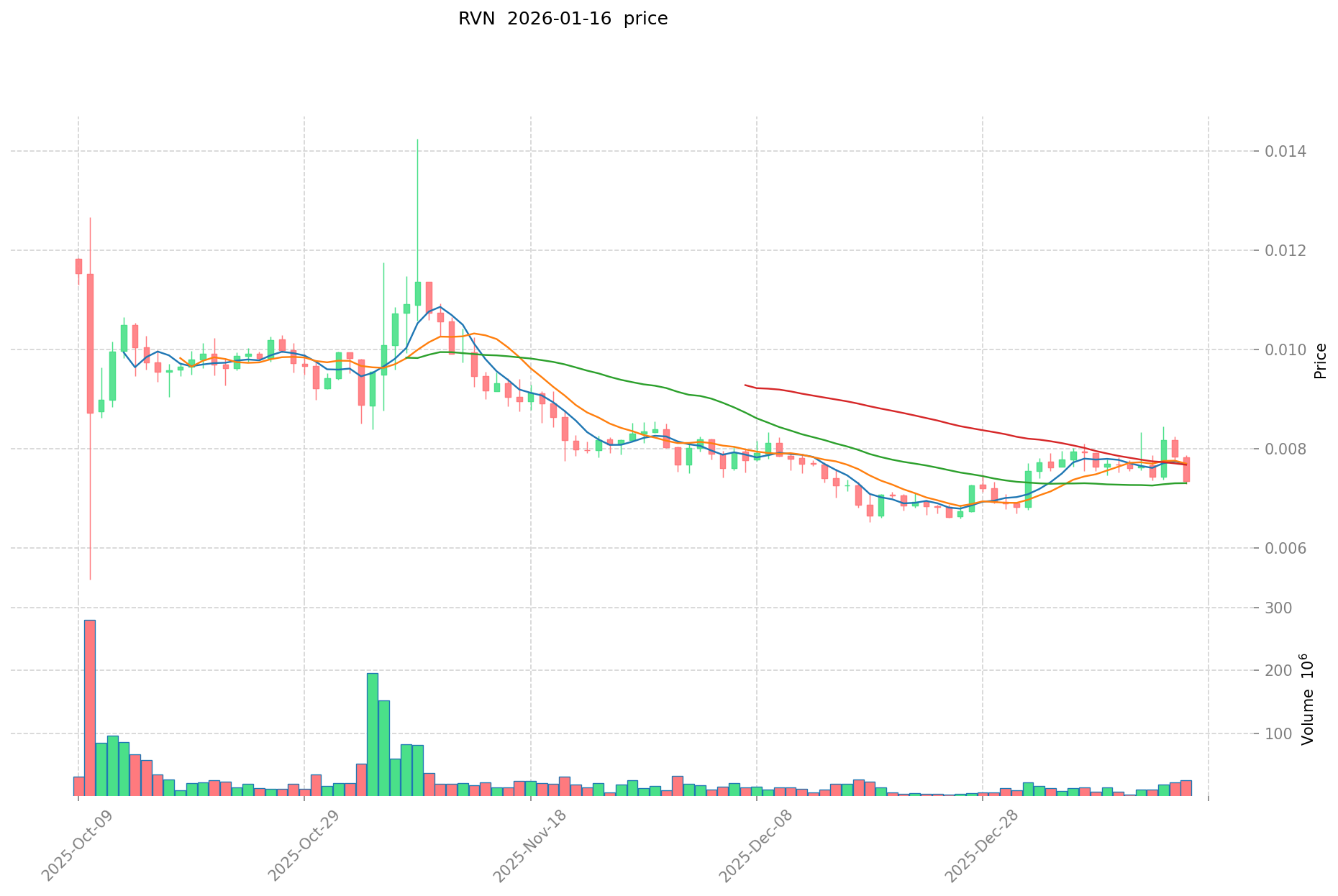
II. Core Factors Affecting Whether RVN is a Good Investment (Is Ravencoin(RVN) a Good Investment)
Supply Mechanism and Scarcity (RVN investment scarcity)
- Supply Structure → Influences price and investment value
- According to the reference materials, Ravencoin has a maximum supply of 21 billion tokens, with approximately 16.03 billion currently circulating, representing 76.33% of the total supply. This defined maximum supply creates a potential scarcity framework that may influence long-term valuation considerations.
- The circulating supply ratio indicates that the majority of tokens are already in circulation, which investors should consider when evaluating potential supply-side dynamics.
- Investment Consideration: Understanding the supply mechanics remains relevant for assessing long-term investment characteristics, though scarcity alone does not determine investment outcomes.
Institutional Investment and Mainstream Adoption (Institutional investment in RVN)
- The reference materials do not provide specific data regarding institutional holdings or significant enterprise adoption of Ravencoin.
- Mainstream adoption indicators such as exchange listings show RVN is available on 31 exchanges, suggesting some level of market accessibility.
- Policy and regulatory developments specific to Ravencoin's investment landscape are not detailed in the provided materials.
Macroeconomic Environment's Impact on RVN Investment
- Broader market conditions and monetary policy shifts can affect cryptocurrency investment sentiment generally, though specific impacts on Ravencoin are not detailed in the reference materials.
- The cryptocurrency market's relationship with traditional economic indicators such as inflation and interest rates may influence investor behavior across digital assets.
- Geopolitical factors and their specific influence on Ravencoin investment demand are not addressed in the available materials.
Technology and Ecosystem Development (Technology & Ecosystem for RVN investment)
- Core Functionality: Ravencoin is designed as a digital peer-to-peer network focused on asset transfer capabilities. The network operates as an open-source project without initial coin offerings or masternodes, as noted in the materials.
- Mining Infrastructure: Reference materials indicate that mining revenue has experienced changes, with hash rate variations noted over recent periods. These network participation metrics may influence perceptions of network security and sustainability.
- Ecosystem Applications: The materials mention that Ravencoin aims to build technology with community involvement, though specific details about DeFi integration, NFT applications, or payment system adoption are not provided in the reference documents.
- Technical Development: While Ravencoin is built on a fork of Bitcoin code and has been operational since January 2018, the materials do not detail recent technical upgrades or specific roadmap items that would directly impact investment considerations.
III. RVN Future Investment Forecast and Price Outlook (Is Ravencoin(RVN) worth investing in 2026-2031)
Short-term Investment Forecast (2026, short-term RVN investment outlook)
- Conservative Forecast: $0.00464 - $0.00748
- Neutral Forecast: $0.00748 - $0.00973
- Optimistic Forecast: $0.00973 - $0.01078
Mid-term Investment Outlook (2027-2029, mid-term Ravencoin(RVN) investment forecast)
- Market Stage Expectation: During this period, RVN may experience gradual growth with price fluctuations influenced by broader cryptocurrency market sentiment and technological developments within its ecosystem.
- Investment Return Forecast:
- 2027: $0.00714 - $0.01058
- 2028: $0.00806 - $0.01046
- 2029: $0.00792 - $0.01033
- Key Catalysts: Community development progress, adoption of asset transfer functionality, and overall cryptocurrency market conditions may serve as potential drivers.
Long-term Investment Outlook (Is RVN a good long-term investment?)
- Base Scenario: $0.00726 - $0.01345 (assuming steady ecosystem development and moderate market conditions)
- Optimistic Scenario: $0.01190 - $0.01364 (assuming increased adoption and favorable regulatory environment)
- Risk Scenario: Below $0.00726 (under adverse market conditions or technical challenges)
Click to view RVN long-term investment and price prediction: Price Prediction
2026-01-17 - 2031 Long-term Outlook
- Base Scenario: $0.00726 - $0.01019 USD (corresponding to steady progress and gradual mainstream application improvement)
- Optimistic Scenario: $0.01019 - $0.01364 USD (corresponding to large-scale adoption and favorable market environment)
- Transformative Scenario: Above $0.01364 USD (subject to breakthrough ecosystem progress and mainstream popularization)
- 2031-12-31 Predicted High: $0.01345 USD (based on optimistic development assumptions)
Disclaimer: The information provided represents forecasts based on available data and market analysis. Cryptocurrency investments carry inherent risks, including price volatility and potential loss of capital. Past performance does not guarantee future results. Investors should conduct their own research and consider their risk tolerance before making any investment decisions.
| Year |
Predicted High Price |
Predicted Average Price |
Predicted Low Price |
Price Change |
| 2026 |
0.0097266 |
0.007482 |
0.00463884 |
0 |
| 2027 |
0.010583289 |
0.0086043 |
0.007141569 |
14 |
| 2028 |
0.010457236005 |
0.0095937945 |
0.00805878738 |
28 |
| 2029 |
0.010326280710075 |
0.0100255152525 |
0.007920157049475 |
33 |
| 2030 |
0.013635703294925 |
0.010175897981287 |
0.009260067162971 |
35 |
| 2031 |
0.01345355472106 |
0.011905800638106 |
0.007262538389244 |
58 |
IV. Ravencoin Investment Strategy and Risk Management (How to invest in cryptocurrency)
Investment Methodology (Ravencoin investment strategy)
Long-term Holding (HODL Ravencoin)
For conservative investors seeking exposure to asset transfer blockchain technology, a long-term holding strategy may be considered. This approach involves acquiring RVN tokens and holding them through market cycles, potentially benefiting from the network's development and adoption over time. Given Ravencoin's focus on peer-to-peer asset transfers and its position as an open-source project, investors employing this strategy typically monitor:
- Network activity and asset creation metrics
- Community development initiatives
- Technical upgrades and protocol improvements
- Integration with exchanges and wallet providers
This strategy requires patience and tolerance for significant price fluctuations, as evidenced by RVN's historical price range from $0.00607508 to $0.285218.
Active Trading
Active traders may approach Ravencoin through technical analysis and swing trading strategies. With a 24-hour price change of 2.27% and trading volume of approximately $86,166, the token exhibits volatility that some traders seek to capitalize on. This approach typically involves:
- Analyzing short-term price movements and chart patterns
- Monitoring trading volumes across the 31 exchanges where RVN is listed
- Setting stop-loss orders to manage downside risk
- Identifying support and resistance levels based on recent price action
Active trading requires significant time commitment, technical expertise, and acceptance of higher transaction costs compared to long-term holding.
Risk Management (Risk management for Ravencoin investment)
Asset Allocation Ratios
Conservative Investors: May consider allocating 1-3% of their cryptocurrency portfolio to Ravencoin, given its market capitalization of approximately $120 million and ranking around position 331. This approach limits exposure while maintaining diversification.
Moderate Investors: Could allocate 3-7% of their digital asset holdings to RVN, balancing potential upside from the asset transfer use case against the inherent volatility of smaller-cap cryptocurrencies.
Aggressive/Professional Investors: May allocate 7-15% or more, particularly if they have conviction in the specific use case of decentralized asset transfers and are willing to accept higher volatility for potential returns.
Risk Hedging Solutions
Investors can implement several strategies to manage Ravencoin-specific risks:
- Multi-asset portfolio construction: Combining RVN with larger-cap cryptocurrencies, stablecoins, and potentially traditional assets to reduce concentration risk
- Position sizing: Limiting RVN exposure relative to total portfolio value, considering its 76.33% circulating supply ratio
- Rebalancing protocols: Establishing predetermined thresholds for taking profits or adding to positions based on price movements
- Correlation analysis: Understanding how RVN moves relative to Bitcoin and other major cryptocurrencies when constructing portfolio hedges
Secure Storage
Cold Wallet Storage: For long-term holdings, offline storage solutions significantly reduce exposure to online security threats. Hardware wallets that support Ravencoin provide physical security for private keys.
Hot Wallet Considerations: For active traders or those requiring frequent access, reputable software wallets with strong security features may be appropriate for smaller amounts. It is generally recommended to keep only trading amounts in hot wallets.
Hardware Wallet Recommendations: When selecting storage solutions, investors should verify compatibility with Ravencoin's blockchain and consider devices from established manufacturers with proven security track records.
Best Practices:
- Never store large amounts on exchanges
- Maintain secure backups of recovery phrases
- Use multi-signature options when available
- Regularly update wallet software
V. Ravencoin Investment Risks and Challenges (Risks of investing in cryptocurrency)
Market Risks
High Volatility: Ravencoin has demonstrated significant price volatility, with a one-year performance showing a decline of 64.05%. The token has traded between $0.007136 and $0.007503 in the past 24 hours alone, representing approximately 5% intraday range. This volatility can result in substantial losses over short periods.
Price Discovery Challenges: With a relatively modest 24-hour trading volume of approximately $86,166 across 31 exchanges, RVN may experience liquidity challenges during periods of market stress. Lower liquidity can lead to wider bid-ask spreads and potentially larger price impacts from individual trades.
Market Depth Concerns: The token's market capitalization of approximately $120 million places it outside the top 300 cryptocurrencies by market cap, potentially making it more susceptible to large holder movements and reduced institutional interest compared to higher-ranked assets.
Regulatory Risks
Jurisdictional Uncertainty: Cryptocurrency regulations vary significantly across jurisdictions and continue to evolve. Ravencoin's specific focus on asset transfer functionality may face different regulatory considerations in various countries:
- Some jurisdictions may classify asset-transfer tokens under securities regulations
- Cross-border asset transfers may face additional compliance requirements
- Regulatory changes could impact exchange listings and trading accessibility
Compliance Evolution: As global regulatory frameworks for digital assets develop, projects like Ravencoin may need to adapt their protocols or face potential restrictions in certain markets. The open-source nature of the project, while promoting decentralization, may present challenges in coordinated regulatory response.
Exchange Accessibility: Regulatory actions affecting exchanges where RVN is traded could impact liquidity and price discovery. Investors should monitor the regulatory status of exchanges in their jurisdiction.
Technical Risks
Network Security: While Ravencoin is built on a fork of Bitcoin's codebase, all blockchain networks face potential security vulnerabilities:
- 51% attack possibilities, particularly relevant for smaller proof-of-work networks
- Smart contract vulnerabilities in asset creation and transfer functions
- Node software bugs that could affect network stability
Upgrade and Fork Risks: Protocol upgrades, while necessary for network improvement, carry implementation risks:
- Potential for consensus splits if upgrades are contentious
- Temporary network disruptions during upgrade periods
- Compatibility issues with wallets and exchanges during transitions
Competition and Obsolescence: The asset transfer functionality that Ravencoin provides faces competition from:
- Larger blockchain platforms with asset tokenization capabilities
- Specialized asset transfer protocols
- Enterprise blockchain solutions
Technological advancement in competing platforms could impact Ravencoin's relative utility and adoption prospects.
VI. Conclusion: Is Cryptocurrency a Good Investment?
Investment Value Summary
Ravencoin represents a specialized approach to blockchain-based asset transfers, operating as an open-source project since its launch on January 3, 2018. The project's focus on peer-to-peer asset transfer functionality provides a specific use case within the broader cryptocurrency ecosystem. However, potential investors should consider several factors:
The token has experienced significant price fluctuations, with a one-year decline of 64.05% from previous levels, indicating substantial volatility. With a current price around $0.007493 and a market capitalization of approximately $120 million, RVN maintains a position outside the top 300 cryptocurrencies. The circulating supply of approximately 16.03 billion tokens represents 76.33% of the maximum supply of 21 billion, suggesting continued token distribution over time.
Trading across 31 exchanges provides multiple access points, though daily trading volume of approximately $86,166 indicates moderate liquidity levels. The project's position as an open-source initiative without an ICO structure reflects its community-driven development approach.
Investor Recommendations
✅ Beginner Investors:
- Consider dollar-cost averaging (DCA) strategies to manage entry point risk
- Prioritize secure storage using hardware wallets or reputable cold storage solutions
- Limit exposure to a small percentage of overall investment portfolio (1-3%)
- Focus on understanding the asset transfer use case before investing
- Avoid leveraged positions or margin trading
✅ Experienced Investors:
- May implement swing trading strategies based on technical analysis
- Consider position sizing relative to overall cryptocurrency portfolio allocation (3-7%)
- Monitor network metrics and development activity
- Employ stop-loss orders and risk management protocols
- Diversify across multiple asset classes and cryptocurrency categories
✅ Institutional Investors:
- Evaluate Ravencoin's specific use case within broader blockchain infrastructure strategies
- Consider long-term allocation as part of diversified digital asset portfolio
- Assess liquidity requirements against available trading volumes
- Implement comprehensive custody and security protocols
- Monitor regulatory developments affecting asset transfer tokens
⚠️ Important Notice: Cryptocurrency investment carries substantial risk, including potential loss of principal. Digital asset markets are highly volatile and prices can fluctuate significantly over short periods. Historical performance does not guarantee future results. This content is provided for informational purposes only and does not constitute financial advice, investment recommendation, or solicitation to buy or sell any security or digital asset. Investors should conduct their own research, consider their risk tolerance and financial situation, and consult with qualified financial advisors before making investment decisions. Regulatory treatment of cryptocurrencies varies by jurisdiction and continues to evolve, which may impact investment outcomes.
VII. FAQ
Q1: What makes Ravencoin different from other cryptocurrency investments?
Ravencoin specifically focuses on peer-to-peer asset transfer functionality, distinguishing it from general-purpose cryptocurrencies. Built on a fork of Bitcoin's codebase and launched in January 2018 without an ICO or masternodes, RVN operates as an open-source project designed to efficiently handle the transfer of digital assets from one party to another. Unlike many cryptocurrencies that aim for broad payment applications or smart contract platforms, Ravencoin's core value proposition centers on creating, issuing, and transferring assets on its blockchain. With a defined maximum supply of 21 billion tokens and approximately 76% already in circulation, the project maintains a community-driven development model that appeals to investors interested in specialized blockchain use cases rather than general cryptocurrency exposure.
Q2: Is Ravencoin suitable for beginners in cryptocurrency investment?
For beginners, Ravencoin presents both opportunities and challenges that require careful consideration. The token's relatively low price point of approximately $0.007493 allows for accessible entry, but its position outside the top 300 cryptocurrencies by market capitalization and significant one-year decline of 64.05% indicate substantial volatility and risk. Beginners considering RVN should limit exposure to 1-3% of their overall investment portfolio, prioritize secure storage solutions such as hardware wallets, and employ dollar-cost averaging strategies to manage entry point risk. The modest daily trading volume of approximately $86,166 means liquidity may be limited during market stress. New investors should thoroughly understand Ravencoin's specific asset transfer use case and avoid leveraged positions or margin trading, focusing instead on long-term holding strategies if they choose to invest.
Q3: What are the main risks associated with investing in Ravencoin?
Investing in Ravencoin carries several significant risks across market, regulatory, and technical dimensions. Market risks include high volatility, as evidenced by the 64.05% one-year decline, limited liquidity with daily trading volumes around $86,166, and susceptibility to large price movements due to its approximately $120 million market capitalization. Regulatory risks stem from evolving cryptocurrency regulations globally, with Ravencoin's asset transfer focus potentially facing varying treatment across jurisdictions and possible compliance requirements for cross-border transactions. Technical risks include potential network security vulnerabilities common to smaller proof-of-work blockchains, upgrade and fork implementation risks, and competitive pressure from larger blockchain platforms offering similar asset tokenization capabilities. Additionally, the 76.33% circulating supply ratio means continued token distribution may affect price dynamics, while the project's specialized focus and moderate market presence create concentration risk for investors.
Q4: What is the predicted long-term price outlook for Ravencoin through 2031?
According to analytical forecasts, Ravencoin's long-term price outlook presents multiple scenarios based on different development and adoption trajectories. The base scenario predicts a range of $0.00726 to $0.01345 USD by 2031, assuming steady ecosystem development and moderate market conditions. An optimistic scenario projects $0.01190 to $0.01364 USD, contingent upon increased adoption and favorable regulatory environments. Short-term forecasts for 2026 suggest a neutral range of $0.00748 to $0.00973, while mid-term projections for 2027-2029 anticipate gradual growth influenced by broader cryptocurrency market sentiment and technological developments. By 2031, the predicted high reaches $0.01345 USD under optimistic assumptions. However, investors should note that these projections carry substantial uncertainty, and a risk scenario exists where prices could fall below $0.00726 under adverse market conditions or technical challenges. Past performance, including the significant one-year decline of 64.05%, demonstrates that actual outcomes may differ materially from forecasts.
Q5: How should investors approach portfolio allocation for Ravencoin?
Portfolio allocation for Ravencoin should be calibrated according to individual risk tolerance and investment objectives. Conservative investors may consider allocating 1-3% of their cryptocurrency portfolio to RVN, given its approximately $120 million market capitalization and ranking around position 331, limiting exposure while maintaining diversification. Moderate investors could allocate 3-7% of digital asset holdings, balancing potential upside from the asset transfer use case against inherent volatility of smaller-cap cryptocurrencies. Aggressive or professional investors willing to accept higher volatility might allocate 7-15% or more, particularly if they have conviction in decentralized asset transfer functionality. Regardless of allocation level, investors should implement risk management strategies including multi-asset portfolio construction combining RVN with larger-cap cryptocurrencies and stablecoins, position sizing relative to total portfolio value, established rebalancing protocols based on predetermined thresholds, and correlation analysis to understand how RVN moves relative to Bitcoin and other major cryptocurrencies when constructing portfolio hedges.
Q6: What storage solutions are recommended for Ravencoin holdings?
Proper storage of Ravencoin requires different approaches depending on investment timeframe and trading frequency. For long-term holdings, cold wallet storage using hardware wallets significantly reduces exposure to online security threats by keeping private keys offline. Hardware wallets from established manufacturers with proven security track records that support Ravencoin's blockchain provide physical security for substantial holdings. For active traders requiring frequent access, reputable software wallets with strong security features may be appropriate for smaller amounts, though it is generally recommended to keep only trading amounts in hot wallets. Critical best practices include never storing large amounts on exchanges, maintaining secure backups of recovery phrases in multiple physical locations, using multi-signature options when available, and regularly updating wallet software to protect against emerging vulnerabilities. The open-source nature of Ravencoin means investors should verify wallet compatibility with the network and stay informed about any protocol updates that may affect storage requirements.
Q7: How does Ravencoin's mining infrastructure affect its investment potential?
Ravencoin's mining infrastructure represents a fundamental component of its network security and investment considerations. As a proof-of-work blockchain built on a fork of Bitcoin's code, RVN relies on miners to validate transactions and secure the network. Reference materials indicate that mining revenue has experienced changes, with hash rate variations noted over recent periods, which may influence perceptions of network security and sustainability. The mining ecosystem's health affects several investment factors including network security against potential 51% attacks (particularly relevant for smaller proof-of-work networks), the rate at which remaining tokens from the 21 billion maximum supply enter circulation, and the overall commitment of participants to maintaining network infrastructure. Investors should monitor hash rate trends, mining profitability metrics, and the distribution of mining power when assessing long-term investment viability. A declining or highly concentrated hash rate could signal potential security concerns, while a growing and distributed mining community generally indicates healthy network participation and sustained interest in the project's long-term success.
* The information is not intended to be and does not constitute financial advice or any other recommendation of any sort offered or endorsed by Gate.