This comprehensive guide analyzes whether Raydium (RAY), a leading automated market maker (AMM) on the Solana blockchain, represents a viable investment opportunity. As of January 2026, RAY trades at approximately $1.19 with a market cap of $320.82 million. The article examines RAY's historical price performance, ranging from $0.13 (December 2022) to $16.83 (September 2021), and evaluates core investment factors including tokenomics, ecosystem positioning, and macroeconomic influences. Price forecasts project 2026 range of $0.97-$2.24, with long-term 2031 estimates reaching $4.13 under optimistic scenarios. The analysis covers investment strategies for beginners through institutional investors, risk management approaches, and associated market, regulatory, and technical risks. Critical considerations include RAY's 77.42% annual decline, Solana dependency, and smart contract vulnerabilities. Investors can access real-time market data and price predictions through Gate exchange. The guide concludes that RAY ser
Introduction: Raydium (RAY)'s Investment Position and Market Outlook
Raydium (RAY) is a notable asset in the cryptocurrency space, serving as an automated market maker (AMM) and liquidity provider built on the Solana blockchain for decentralized exchanges (DEX). Since its launch in February 2021, Raydium has established itself within the decentralized finance (DeFi) ecosystem. As of January 15, 2026, RAY holds a market capitalization of approximately $320.82 million, with a circulating supply of around 268.60 million tokens, and is currently priced at approximately $1.19. With its positioning as an early-mover AMM within the Solana ecosystem, Raydium has gradually become a focal point for investors considering "Is Raydium (RAY) a good investment?" This article provides a comprehensive analysis of RAY's investment characteristics, historical price movements, future price projections, and associated investment risks to serve as a reference for investors.
I. Raydium (RAY) Price History Review and Current Investment Value
- 2021: Raydium experienced significant price appreciation during the DeFi boom period, reaching a notable peak of $16.83 in September 2021, reflecting strong investor interest in Solana-based decentralized exchange protocols.
- 2022: The token underwent substantial correction during the broader crypto market downturn, declining to $0.134391 by December 2022, representing a considerable value contraction from previous levels.
- 2024-2025: Following market stabilization, RAY demonstrated recovery momentum with price movements from lower ranges toward the $1.19 level, accompanied by increased platform activity and liquidity provision.
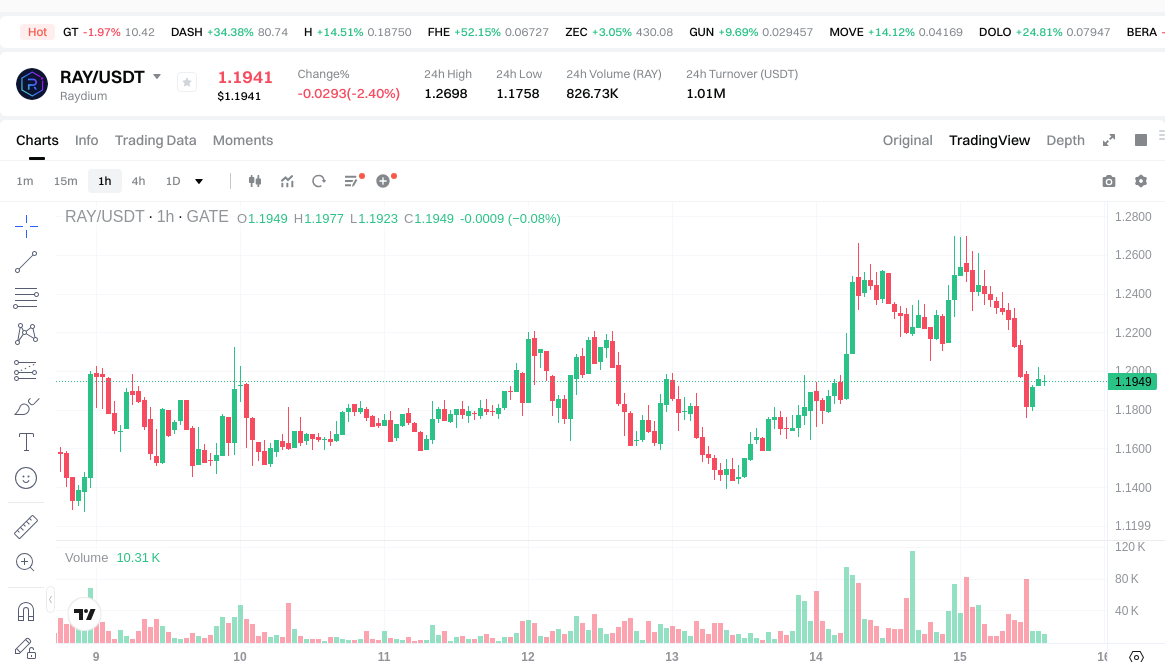
Current RAY Investment Market Status (January 2026)
- RAY current price: $1.1944
- Market sentiment (Fear & Greed Index): Data not provided in reference materials
- 24-hour trading volume: $1,018,621.55
- Institutional investor holdings: Specific institutional holdings data not available in provided materials
- Current market capitalization: $320,815,002.34
- Circulating supply: 268,599,298.68 RAY (approximately 48.40% of total supply)
- Recent price changes: -0.26% (1H), -2.38% (24H), +1.06% (7D), +27.63% (30D)
Click to view real-time RAY market price
II. Core Factors Influencing Whether RAY is a Good Investment
Supply Mechanism and Scarcity (RAY Investment Scarcity)
- Maximum supply cap of 555,000,000 RAY tokens establishes a fixed supply ceiling → influences long-term price dynamics and investment value
- Current circulating supply of 268,599,298 RAY (approximately 48.4% of maximum supply) → indicates controlled token release strategy
- Historical context: RAY traded at $0.134391 during market lows (December 30, 2022) and reached elevated levels of $16.83 (September 13, 2021), demonstrating price volatility influenced by supply-demand dynamics
- Investment significance: The defined maximum supply and gradual circulation expansion create a framework for evaluating scarcity-driven value appreciation potential
Institutional Investment and Mainstream Adoption (Institutional Investment in RAY)
- RAY is listed on 44 exchanges, indicating broad market accessibility and institutional integration
- Holder base of 249,645 addresses suggests distributed ownership and community adoption
- Market capitalization of approximately $320.8 million with fully diluted valuation of $662.9 million reflects current institutional and retail participation levels
- As a leading automated market maker (AMM) on Solana's DeFi ecosystem, Raydium's first-mover advantage positions it as an infrastructure component for protocol integration
Macroeconomic Environment's Impact on RAY Investment
- Broader cryptocurrency market cycles influence RAY performance: 1-year price change of -77.42% reflects market-wide corrections and volatility patterns
- 30-day price increase of 27.63% suggests responsiveness to shifting market sentiment and potential recovery phases
- DeFi sector growth trends and decentralized exchange adoption rates affect RAY's investment appeal as an AMM protocol token
- Solana blockchain ecosystem development and scalability narrative impact RAY's positioning within the broader infrastructure investment thesis
Technology and Ecosystem Development (Technology & Ecosystem for RAY Investment)
- Automated Market Maker (AMM) functionality on Solana blockchain: provides liquidity infrastructure for decentralized trading → supports fundamental utility value
- Integration with Serum decentralized exchange (DEX) ecosystem: establishes RAY as a component in Solana's DeFi architecture → creates network effects for long-term value
- Solana's high-performance blockchain characteristics (scalability and transaction speed): enable efficient AMM operations → enhance competitive positioning against other DEX protocols
- DeFi application expansion within Solana ecosystem: drives demand for liquidity provision and AMM services → supports RAY's functional adoption and investment case
III. RAY Future Investment Forecast and Price Outlook (Is Raydium(RAY) worth investing in 2026-2031)
Short-term Investment Forecast (2026, short-term RAY investment outlook)
Based on statistical models and historical patterns, RAY may experience varied performance in 2026:
- Conservative forecast: $0.97 - $1.20
- Neutral forecast: $1.20 - $1.54
- Optimistic forecast: $1.54 - $2.24
The trading range is expected to fluctuate between these levels, influenced by market dynamics and broader cryptocurrency trends. The current circulating supply of 268.60 million RAY represents approximately 48.40% of the maximum supply of 555 million tokens.
Mid-term Investment Outlook (2027-2029, mid-term Raydium(RAY) investment forecast)
- Market stage expectations: The mid-term period may reflect gradual ecosystem development and potential expansion of the Solana DeFi landscape, where Raydium functions as an automated market maker.
- Investment return forecast:
- 2027: $1.19 - $2.04 (representing potential growth of 14% based on average projections)
- 2028: $1.64 - $2.51 (representing potential growth of 42% based on average projections)
- 2029: $2.02 - $2.93 (representing potential growth of 76% based on average projections)
- Key catalysts: Factors such as Solana network adoption, DeFi sector growth, protocol upgrades, and trading volume trends may influence RAY's performance during this period.
Long-term Investment Outlook (Is Raydium a good long-term investment?)
- Base scenario: $1.46 - $3.47 (assuming steady ecosystem development and maintained market position)
- Optimistic scenario: $2.85 - $4.13 (assuming expanded adoption and favorable market conditions)
- Risk scenario: Below $1.46 (under conditions of significant market downturns or competitive pressures)
Click to view RAY long-term investment and price predictions: Price Prediction
2026-2031 Long-term Outlook
- Base scenario: $1.46 - $2.52 (corresponding to steady progress and gradual mainstream application growth)
- Optimistic scenario: $2.85 - $3.47 (corresponding to large-scale adoption and favorable market environment)
- Transformational scenario: Above $4.13 (if the ecosystem achieves breakthrough developments and mainstream popularization)
- 2031-12-31 forecast high: $4.13 (based on optimistic development assumptions)
Disclaimer: The forecasts presented are based on statistical models, historical data, and market analysis. Cryptocurrency investments carry substantial risks, including price volatility and potential loss of capital. These projections should not be construed as investment advice or guarantees of future performance. Market conditions, regulatory changes, technological developments, and other unforeseen factors may significantly impact actual outcomes. Investors should conduct their own research and consider their risk tolerance before making investment decisions.
| Year |
Predicted High Price |
Predicted Average Price |
Predicted Low Price |
Price Change |
| 2026 |
1.543485 |
1.1965 |
0.969165 |
0 |
| 2027 |
2.041288825 |
1.3699925 |
1.191893475 |
14 |
| 2028 |
2.507291773875 |
1.7056406625 |
1.637415036 |
42 |
| 2029 |
2.927988043280625 |
2.1064662181875 |
2.02220756946 |
76 |
| 2030 |
3.473773440413006 |
2.517227130734062 |
1.459991735825756 |
110 |
| 2031 |
4.133790394091477 |
2.995500285573534 |
2.845725271294857 |
150 |
IV. Raydium Investment Strategy and Risk Management (How to invest in Raydium)
Investment Strategy (Raydium investment strategy)
Long-term Holding (HODL Raydium)
Long-term holding represents a strategy suited for conservative investors who believe in Raydium's fundamental value proposition as an automated market maker (AMM) on the Solana blockchain. This approach involves purchasing RAY tokens and holding them through market cycles, rather than attempting to time short-term price movements.
Given Raydium's role as a liquidity provider within the Solana ecosystem and its first-mover advantage as an AMM on Serum, long-term holders typically focus on the protocol's adoption metrics, trading volume trends, and ecosystem development rather than daily price fluctuations.
Active Trading
Active trading strategies for Raydium rely on technical analysis and swing trading approaches. Traders may utilize various indicators and chart patterns to identify entry and exit points, capitalizing on RAY's price volatility.
With a 24-hour trading volume exceeding $1 million and availability across 44 exchanges, RAY provides sufficient liquidity for active trading strategies. However, traders should note the token's historical price volatility, with the asset having moved between $0.134391 and $16.83 since its launch in February 2021.
Risk Management (Risk management for Raydium investment)
Asset Allocation Ratios
Conservative Investors: May consider allocating 1-3% of their cryptocurrency portfolio to RAY, maintaining a diversified approach across multiple blockchain ecosystems.
Aggressive Investors: Could allocate 5-10% of their portfolio to RAY, reflecting higher risk tolerance and conviction in the Solana DeFi ecosystem.
Professional Investors: Might adopt more flexible allocation strategies ranging from 3-15%, adjusted based on technical indicators, market conditions, and portfolio rebalancing needs.
Risk Hedging Solutions
Implementing a multi-asset portfolio approach can help mitigate concentration risk. This may include:
- Diversifying across different blockchain protocols and DeFi platforms
- Maintaining positions in both layer-1 tokens and DeFi protocols
- Utilizing stablecoins as a hedge against volatility
- Considering derivatives or options strategies where available
Secure Storage
Hot Wallets: Suitable for tokens actively used in trading or liquidity provision, but should hold only amounts needed for immediate transactions.
Cold Wallets: Recommended for long-term holdings. As RAY is a Solana-based token, investors should use wallets that support SPL tokens.
Hardware Wallets: Devices such as Ledger or Trezor that support Solana tokens provide enhanced security for storing RAY holdings offline, protecting against online threats and exchange hacks.
V. Raydium Investment Risks and Challenges (Risks of investing in Raydium)
Market Risks
High Volatility: RAY has demonstrated significant price volatility, with its price ranging from a low of $0.134391 to a high of $16.83. Recent data shows 24-hour price fluctuations between $1.1758 and $1.2698, representing over 7% intraday movement. Over the past year, the token has experienced a decline of approximately 77.42%, highlighting the potential for substantial losses.
Price Manipulation: Lower market cap tokens like RAY, with a market capitalization of approximately $320.8 million, may be more susceptible to price manipulation compared to larger-cap assets. The relatively concentrated holder base of 249,645 addresses could potentially impact price discovery and market liquidity.
Regulatory Risks
Policy Uncertainty Across Jurisdictions: Different countries maintain varying regulatory stances toward decentralized exchanges and AMM protocols. Changes in regulatory frameworks could impact Raydium's operations, token utility, or accessibility in certain markets.
DeFi Regulatory Evolution: As regulators worldwide develop frameworks for decentralized finance protocols, new compliance requirements could emerge that affect how Raydium operates or how investors can interact with the platform.
Technical Risks
Network Security Vulnerabilities: As a protocol built on the Solana blockchain, Raydium's security is partially dependent on the underlying network's robustness. Any vulnerabilities in Solana's infrastructure could potentially affect Raydium's operations.
Smart Contract Risks: DeFi protocols face inherent risks related to smart contract bugs or exploits. While established protocols typically undergo security audits, vulnerabilities may still exist that could potentially be exploited.
Upgrade Failures: Protocol upgrades or network changes could potentially introduce unforeseen issues or compatibility problems that might temporarily or permanently affect functionality.
Solana Network Dependencies: Raydium's performance is closely tied to Solana's network health. Any network congestion, outages, or technical issues on Solana could impact Raydium's accessibility and functionality.
VI. Conclusion: Is Raydium a Good Investment?
Investment Value Summary
Raydium represents a significant player within the Solana DeFi ecosystem, holding a position as an early-mover AMM with established infrastructure and liquidity provision capabilities. The protocol's integration within the broader Solana ecosystem positions it as a potential gateway for new projects entering the network.
However, the token has experienced substantial price volatility, with a 77.42% decline over the past year and historical price movements spanning from $0.134391 to $16.83. The current circulating supply represents approximately 48.4% of the maximum supply of 555 million tokens, with a market cap to fully diluted valuation ratio of 48.4%.
While the protocol serves an important function within decentralized finance, potential investors should recognize that short-term price movements remain highly unpredictable and subject to broader cryptocurrency market dynamics, Solana ecosystem developments, and DeFi sector sentiment.
Investor Recommendations
✅ Beginners: Consider a dollar-cost averaging approach with small, regular purchases rather than lump-sum investments. Prioritize secure storage using hardware wallets or reputable software wallets that support Solana-based tokens. Focus on understanding the protocol's fundamentals before committing significant capital.
✅ Experienced Investors: May employ swing trading strategies while maintaining a core long-term position. Consider portfolio diversification across multiple DeFi protocols and blockchain ecosystems. Monitor on-chain metrics, trading volumes, and ecosystem developments to inform position sizing and timing decisions.
✅ Institutional Investors: Could evaluate RAY as part of a strategic long-term allocation to the Solana DeFi sector, with appropriate position sizing relative to overall portfolio risk parameters. Consider the token's role within broader DeFi exposure and its correlation with Solana's native token and other ecosystem assets.
⚠️ Disclaimer: Cryptocurrency investments carry substantial risk, including the potential for complete loss of capital. This analysis is provided for informational purposes only and does not constitute financial, investment, or trading advice. Prospective investors should conduct their own research and consult with qualified financial advisors before making investment decisions.
VII. FAQ
Q1: What is Raydium (RAY) and what makes it different from other DEX tokens?
Raydium is an automated market maker (AMM) and liquidity provider built on the Solana blockchain, serving as a decentralized exchange protocol. What distinguishes Raydium from other DEX tokens is its first-mover advantage within the Solana ecosystem and its strategic integration with the Serum decentralized exchange. Unlike traditional AMMs that operate in isolation, Raydium leverages Solana's high-performance blockchain architecture to provide faster transaction speeds and lower costs. The protocol benefits from Solana's scalability characteristics, enabling efficient trading operations and liquidity provision that can handle higher throughput compared to Ethereum-based AMMs. Additionally, RAY token holders can participate in governance and earn rewards through liquidity mining programs.
Q2: Is Raydium (RAY) a good short-term investment in 2026?
Short-term investment in RAY carries significant volatility and uncertainty. Based on statistical models, the 2026 price forecast ranges from a conservative $0.97-$1.20 to an optimistic $1.54-$2.24, with neutral expectations between $1.20-$1.54. Recent performance shows mixed signals: while the token gained 27.63% over 30 days, it declined 77.42% over the past year and experienced -2.38% movement in 24 hours. For short-term investors, RAY presents both opportunity and risk - the token's 24-hour trading volume of approximately $1 million and listing on 44 exchanges provide sufficient liquidity for active trading, but the substantial historical volatility (ranging from $0.134391 to $16.83) indicates potential for significant losses. Short-term trading strategies should incorporate strict risk management, technical analysis, and position sizing appropriate to individual risk tolerance.
Q3: What is the long-term investment potential of Raydium (RAY) from 2026 to 2031?
The long-term investment outlook for RAY presents a range of scenarios based on ecosystem development and market conditions. Under base-case assumptions of steady progress, forecasts suggest a price range of $1.46-$2.52 by 2031, representing potential growth of approximately 110-150% from current levels. The optimistic scenario projects prices reaching $2.85-$4.13, contingent upon expanded adoption and favorable market conditions. Key factors influencing long-term performance include: Solana's continued ecosystem growth, DeFi sector expansion, Raydium's ability to maintain its competitive position as new AMMs emerge, and broader cryptocurrency market cycles. However, investors should note that the token's circulating supply currently represents only 48.4% of the maximum 555 million token supply, meaning future token releases could impact price dynamics. The transformational scenario envisions prices above $4.13 if breakthrough developments occur, though this remains speculative.
Q4: What are the main risks associated with investing in Raydium (RAY)?
RAY investments face multiple risk categories that require careful consideration. Market risks include extreme volatility (historical range from $0.134391 to $16.83), with recent 24-hour fluctuations exceeding 7%, and potential price manipulation due to the relatively smaller market cap of $320.8 million compared to major cryptocurrencies. Regulatory risks encompass evolving DeFi frameworks across jurisdictions, which could impact protocol operations or token accessibility. Technical risks involve Solana network dependencies - any congestion, outages, or security vulnerabilities in the underlying blockchain could affect Raydium's functionality. Smart contract risks exist despite security audits, as vulnerabilities may be exploited. Additionally, competitive risks emerge as new AMM protocols launch on Solana, potentially fragmenting liquidity and market share. The concentrated holder base of 249,645 addresses may impact price discovery mechanisms compared to more widely distributed assets.
Q5: How should different types of investors approach Raydium (RAY) investment?
Investment strategies should align with investor experience levels and risk tolerance. Beginners are advised to implement dollar-cost averaging with small, regular purchases rather than lump-sum investments, allocating only 1-3% of their cryptocurrency portfolio to RAY while prioritizing secure storage through hardware wallets supporting SPL tokens. Experienced investors may adopt swing trading strategies while maintaining a core long-term position, potentially allocating 5-10% of their portfolio, utilizing technical analysis to identify entry and exit points across the token's typical volatility ranges. Professional investors might employ flexible allocation strategies from 3-15%, adjusting based on on-chain metrics, trading volumes, and broader market conditions, while implementing sophisticated risk hedging through multi-asset diversification across different blockchain protocols. All investor categories should recognize that RAY's performance correlates with both Solana ecosystem developments and broader DeFi sector sentiment, requiring continuous monitoring of these factors.
Q6: What factors could drive Raydium (RAY) price appreciation in the future?
Several catalysts could potentially drive RAY price appreciation. Protocol-specific factors include increased trading volumes on the Raydium platform, successful protocol upgrades enhancing functionality, and expansion of liquidity mining programs attracting more users. Ecosystem-level drivers involve Solana's continued adoption as a high-performance blockchain, migration of new DeFi projects to Solana that utilize Raydium's liquidity infrastructure, and overall growth in decentralized exchange trading volumes. Broader market factors encompass favorable cryptocurrency market cycles, increased institutional interest in DeFi protocols, and mainstream adoption of decentralized finance applications. The token's supply dynamics also play a role - with only 48.4% of maximum supply currently circulating, controlled token release schedules could support price stability. Additionally, strategic partnerships, integration with major wallets or platforms, and competitive advantages maintained against emerging AMM protocols could positively impact valuation. However, these factors represent potential catalysts rather than guaranteed outcomes.
Q7: How does Raydium compare to other Solana DeFi protocols as an investment?
Raydium holds a distinctive position within the Solana DeFi landscape as an early-mover AMM with established infrastructure and liquidity provision capabilities. Unlike newer protocols, Raydium benefits from its integration with the Serum ecosystem and first-mover advantages in market recognition. However, comparative investment merit depends on multiple factors: market capitalization ($320.8 million), trading volume metrics, token utility beyond speculation, and ecosystem positioning. While some Solana DeFi protocols may offer higher potential returns, they often carry correspondingly higher risks. Raydium's advantage lies in its established user base (249,645 holder addresses) and availability across 44 exchanges, providing better liquidity compared to emerging protocols. The token's fully diluted valuation of $662.9 million suggests a circulating supply ratio that impacts supply-demand dynamics differently than fully unlocked competitors. Investors should evaluate Raydium within a diversified DeFi portfolio context rather than as a standalone bet, considering correlation with Solana's native token and complementary exposure to other DeFi primitives.
Q8: What storage options are recommended for securing RAY tokens?
Secure RAY storage requires understanding the token's technical foundation as a Solana-based SPL token. For long-term holdings, hardware wallets such as Ledger or Trezor devices that support Solana tokens provide optimal security, protecting assets offline against online threats, exchange hacks, and phishing attacks. Software wallets supporting SPL tokens, including Phantom, Solflare, and Sollet, offer convenient access for active users but should implement strong security practices including multi-factor authentication and secure backup of recovery phrases. Hot wallets maintained on exchanges like Gate.com provide liquidity for active trading but should hold only amounts needed for immediate transactions due to counterparty risk. A tiered approach is recommended: hardware wallets for 70-90% of holdings intended for long-term investment, software wallets for 5-20% used in DeFi interactions or occasional trading, and exchange balances for 5-10% dedicated to active trading. Regardless of storage method, investors must securely backup recovery phrases, never share private keys, and verify wallet addresses through multiple sources before transactions.
* The information is not intended to be and does not constitute financial advice or any other recommendation of any sort offered or endorsed by Gate.