This comprehensive analysis evaluates whether RAYLS (RLS) represents a sound investment opportunity in 2024-2031. As an EVM-compatible Layer-1 blockchain designed to bridge traditional finance and DeFi through compliant, privacy-preserving infrastructure, RAYLS currently trades at $0.006929 with a market capitalization of $10.39 million. The article examines RLS price history, supply mechanics showing only 15% circulating supply, institutional adoption potential, and technical architecture combining public and private chains. Price forecasts range from conservative scenarios of $0.006555-$0.0069 through 2026 to optimistic long-term projections reaching $0.02045589945003 by 2031, contingent on institutional partnerships and regulatory clarity. Critical risk factors include substantial 47.34% monthly volatility, regulatory uncertainty, and technical execution challenges. Investment recommendations differentiate by investor profile, suggesting conservative allocations of 1-3% for beginners through strategic posi
Introduction: RAYLS (RLS) Investment Position and Market Outlook
RLS is a noteworthy asset in the cryptocurrency space. As of January 26, 2026, RAYLS holds a market capitalization of approximately $10.39 million, with a circulating supply of 1.5 billion tokens and a current price around $0.006929. The token ranks 1168 in the global cryptocurrency market and commands a market dominance of 0.0022%. With its positioning as a blockchain ecosystem connecting Traditional Finance and DeFi in a compliant and privacy-preserving manner, RAYLS has attracted attention from investors exploring "Is RAYLS (RLS) a good investment?" This article provides a comprehensive analysis of RLS investment value, historical price trends, future price forecasts, and associated investment risks to serve as a reference for market participants.
I. Token (RLS) Price History Review and Investment Value Status
- December 2025: Token deployment and initial market circulation → Price reached $0.0601 during early trading phase
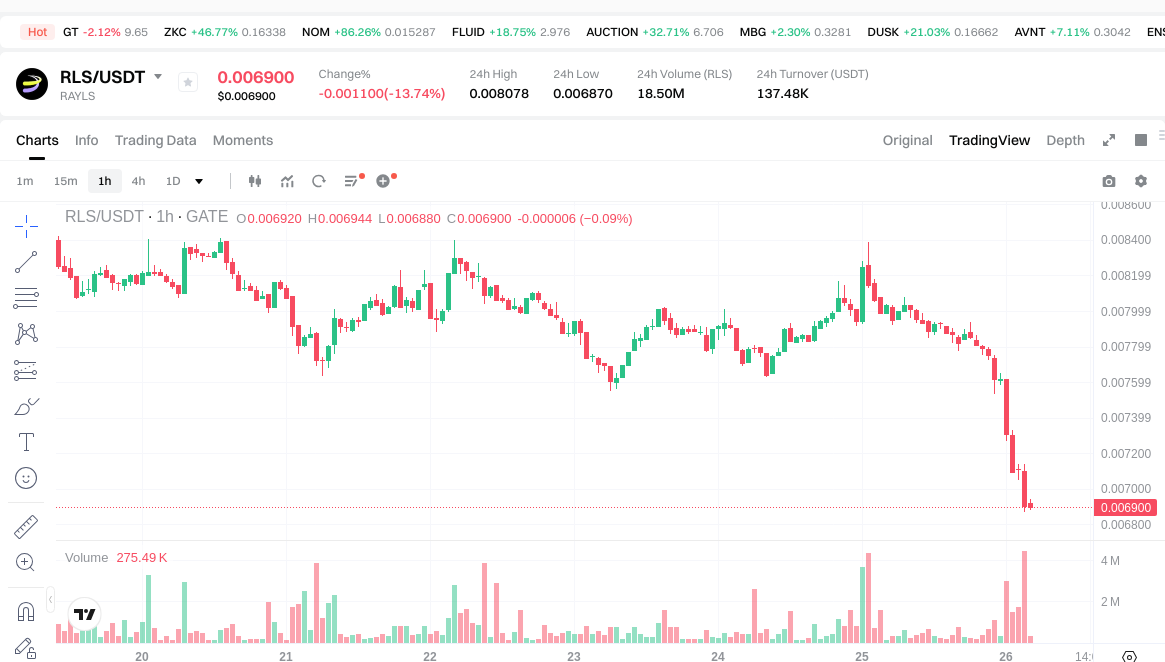
- January 2026: Market adjustment period → RLS experienced volatility from early trading levels to $0.00687
Current RLS Investment Market Status (January 2026)
- RLS current price: $0.006929
- 24-hour trading volume: $136,751.67
- Token holders: 46,502 addresses
- Circulating supply: 1,500,000,000 RLS (15% of total supply)
- Market capitalization: $10,393,500
- Fully diluted market cap: $69,290,000
Click to view real-time RLS market price
II. Core Factors Affecting Whether RLS is a Good Investment (Is RAYLS(RLS) a Good Investment)
Supply Mechanism and Scarcity (RLS investment scarcity)
- Total supply capped at 10,000,000,000 RLS with a current circulating supply of 1,500,000,000 RLS (15% of maximum supply) → influences price dynamics and investment considerations
- The controlled circulation rate may create supply-side dynamics that impact token valuation over time
- Investment perspective: The relatively low circulating supply ratio compared to maximum supply represents a factor investors may consider when evaluating long-term holding strategies
Institutional Investment and Mainstream Adoption (Institutional investment in RLS)
- Rayls positions itself to enable banks and regulated institutions to issue and settle digital assets securely, which may attract institutional participation
- The project combines a public EVM Layer-1 with private chains, designed to allow institutions to meet regulatory requirements while interacting with open markets
- The compliance-focused architecture and privacy-preserving design may appeal to institutions seeking regulated pathways into digital asset markets
Technology & Ecosystem Building (Technology & Ecosystem for RLS investment)
- EVM compatibility: Built as an EVM Layer-1, enabling developers to deploy applications using established Ethereum development tools and standards
- Dual-chain architecture: Combines public and private chain infrastructure to serve both DeFi users and regulated institutions
- Privacy features: Incorporates quantum-secure privacy protections designed to meet institutional security requirements
- Interoperability design: Structured to facilitate interaction between traditional finance infrastructure and DeFi protocols
- DeFi integration potential: The platform aims to provide DeFi builders access to institution-grade liquidity and trusted assets, which may expand ecosystem utility
- Asset tokenization focus: Positioned to support global asset tokenization initiatives, potentially broadening use cases beyond typical cryptocurrency applications
III. RLS Future Investment Forecast and Price Outlook (Is RAYLS(RLS) worth investing in 2026-2031)
Short-term RLS Investment Outlook (2026)
- Conservative forecast: $0.006555 - $0.0069
- Neutral forecast: $0.0069 - $0.00779
- Optimistic forecast: $0.00779 - $0.00897
Mid-term RAYLS(RLS) Investment Forecast (2027-2029)
- Market stage expectation: The project may experience gradual development as it works toward establishing connections between traditional finance and DeFi, with growth dependent on institutional adoption progress and ecosystem expansion.
- Investment return forecast:
- 2027: $0.00547515 - $0.009522
- 2028: $0.006371805 - $0.01274361
- 2029: $0.00955508895 - $0.0146010348
- Key catalysts: Institutional partnerships, regulatory clarity for asset tokenization, DeFi ecosystem growth, and adoption of the EVM Layer-1 infrastructure.
Long-term Investment Outlook (Is RLS a good long-term investment?)
- Base scenario: $0.011528375859 - $0.017862648309 (assuming steady institutional adoption and ecosystem development through 2030)
- Optimistic scenario: $0.0152655966045 - $0.02045589945003 (assuming accelerated institutional integration and favorable regulatory environment through 2031)
- Risk scenario: Below $0.006555 (under conditions of limited institutional adoption, regulatory challenges, or competitive pressure)
Check RLS long-term investment and price forecast: Price Prediction
2026-2031 Long-term Outlook
- Base scenario: $0.006555 - $0.017862648309 (corresponding to steady progress and gradual mainstream application growth)
- Optimistic scenario: $0.0087285 - $0.02045589945003 (corresponding to large-scale adoption and favorable market conditions)
- Transformative scenario: Above $0.02045589945003 (if ecosystem achieves breakthrough progress and mainstream penetration)
- 2031-12-31 predicted high: $0.02045589945003 (based on optimistic development assumptions)
Disclaimer: Price forecasts are based on historical data and market analysis models. Cryptocurrency investments carry significant risks. Past performance does not guarantee future results. Investors should conduct independent research and consider their risk tolerance before making investment decisions.
| Year |
Predicted High Price |
Predicted Average Price |
Predicted Low Price |
Price Change |
| 2026 |
0.00897 |
0.0069 |
0.006555 |
0 |
| 2027 |
0.009522 |
0.007935 |
0.00547515 |
14 |
| 2028 |
0.01274361 |
0.0087285 |
0.006371805 |
25 |
| 2029 |
0.0146010348 |
0.010736055 |
0.00955508895 |
54 |
| 2030 |
0.017862648309 |
0.0126685449 |
0.011528375859 |
82 |
| 2031 |
0.02045589945003 |
0.0152655966045 |
0.008701390064565 |
120 |
IV. RAYLS Investment Strategy and Risk Management (How to invest in cryptocurrency)
Investment Methodology (RAYLS investment strategy)
-
Long-term Holding (HODL RAYLS): Suitable for conservative investors seeking exposure to the institutional DeFi infrastructure space. Given RAYLS's focus on bridging traditional finance with decentralized finance through compliant, scalable solutions, long-term holders may benefit from potential adoption by regulated institutions and banks. The project's emphasis on quantum-secure privacy and interoperable design positions it as a foundational infrastructure play in the tokenization space.
-
Active Trading: Technical analysis reveals significant price volatility, with RAYLS experiencing a 24-hour decline of 13.76% and a 30-day decline of 47.34% as of January 26, 2026. Active traders may capitalize on price swings between support levels around $0.00687 (recent low on January 25, 2026) and resistance near $0.008078 (24-hour high). The token's circulating supply represents only 15% of the maximum supply (1.5 billion out of 10 billion tokens), suggesting potential dilution concerns that traders should monitor.
Risk Management (Risk management for RAYLS investment)
-
Asset Allocation Ratios:
- Conservative investors: Limit RAYLS exposure to 1-3% of crypto portfolio due to early-stage project risk and recent price declines
- Aggressive investors: May allocate 5-10% while maintaining diversification across multiple blockchain infrastructure projects
- Professional investors: Consider strategic allocation of 3-7% with active monitoring of institutional adoption milestones and regulatory developments
-
Risk Hedging Solutions: Diversify across multiple asset classes including established Layer-1 blockchains, stablecoins, and traditional financial instruments. Consider hedging strategies through correlated DeFi infrastructure tokens and maintaining sufficient stablecoin reserves for market downturns.
-
Secure Storage: RAYLS tokens are ERC-20 standard on Ethereum (contract address: 0xb5f7b021a78f470d31d762c1dda05ea549904fbd). Recommended storage solutions:
- Hardware wallets: Ledger or Trezor for long-term holdings
- Hot wallets: MetaMask or Trust Wallet for active trading, maintaining only necessary amounts
- Cold storage: Multi-signature wallets for institutional-grade security
V. RAYLS Investment Risks and Challenges (Risks of investing in cryptocurrency)
-
Market Risk: RAYLS demonstrates substantial volatility, with a 47.34% decline over 30 days and current trading at $0.006929, significantly below its historical peak of $0.0601 recorded on December 1, 2025. The token's relatively low market capitalization of approximately $10.39 million and limited exchange availability (16 exchanges) contribute to liquidity concerns and susceptibility to sharp price movements. The market cap to fully diluted valuation ratio of 15% indicates substantial future supply unlock risk.
-
Regulatory Risk: As a project explicitly designed to connect traditional finance with DeFi in a compliant manner, RAYLS faces heightened regulatory scrutiny. Different jurisdictions maintain varying stances on tokenized assets and institutional cryptocurrency participation. Changes in financial regulations, particularly regarding digital asset issuance by banks and regulated institutions, could significantly impact the project's adoption trajectory and token utility.
-
Technical Risk: The project's architecture combines a public EVM Layer-1 with private chains, introducing complexity in maintaining security across multiple network layers. Integration points between institutional private chains and public markets create potential attack vectors. The quantum-secure privacy claims require ongoing cryptographic research validation, and any security vulnerabilities in the cross-chain infrastructure or smart contracts could compromise user assets. Network upgrades and the coordination between public and private chain components present execution risks.
VI. Conclusion: Is cryptocurrency a Good Investment?
-
Investment Value Summary: RAYLS presents a specialized investment thesis centered on institutional adoption of blockchain infrastructure for asset tokenization. The project addresses a genuine market need for compliant, privacy-preserving bridges between traditional finance and DeFi. However, the token faces considerable challenges, including substantial recent price declines, low circulation ratio suggesting future dilution, and execution risks inherent in complex multi-chain architecture. The investment opportunity carries both significant upside potential from institutional adoption and considerable downside risk from market volatility and regulatory uncertainty.
-
Investor Recommendations:
✅ Beginners: Approach RAYLS with caution given its early-stage nature and recent volatility. If considering investment, employ dollar-cost averaging with small allocations (under 2% of crypto portfolio) and prioritize secure hardware wallet storage. Focus on understanding the project's institutional partnerships and adoption metrics before increasing exposure.
✅ Experienced Investors: Consider tactical allocation with active position management. Monitor key metrics including institutional adoption announcements, circulating supply changes, and technical developments. Employ stop-loss strategies given recent downtrend and maintain diversification across multiple blockchain infrastructure projects.
✅ Institutional Investors: Evaluate RAYLS within a strategic blockchain infrastructure portfolio allocation. Conduct thorough due diligence on the project's regulatory compliance framework, technical architecture security audits, and partnership development with traditional financial institutions. Consider staged investment approach aligned with project milestone achievement.
⚠️ Disclaimer: Cryptocurrency investments carry substantial risk due to market volatility, regulatory uncertainty, and technical challenges. This content is provided for informational purposes only and does not constitute investment advice. Investors should conduct independent research and consult with financial professionals before making investment decisions.
VII. FAQ
Q1: What is RAYLS (RLS) and what makes it different from other blockchain projects?
RAYLS is an EVM-compatible Layer-1 blockchain designed to bridge traditional finance and DeFi through compliant, privacy-preserving infrastructure. Unlike typical blockchain projects, RAYLS employs a dual-chain architecture combining a public EVM Layer-1 with private chains, specifically engineered to enable banks and regulated institutions to issue and settle digital assets while maintaining regulatory compliance. The platform incorporates quantum-secure privacy protections and positions itself as infrastructure for global asset tokenization, distinguishing it from general-purpose blockchains by focusing on institutional-grade security and regulatory alignment.
Q2: Is RAYLS (RLS) a good investment in 2026?
Investment suitability depends on individual risk tolerance and portfolio strategy. As of January 26, 2026, RLS trades at $0.006929 with a market capitalization of approximately $10.39 million, representing a significant decline from its December 2025 peak of $0.0601. Short-term forecasts suggest potential trading ranges between $0.006555 (conservative) and $0.00897 (optimistic) for 2026. The token presents a specialized thesis around institutional blockchain adoption but carries substantial risks including high volatility (47.34% decline over 30 days), low circulation ratio (15% of maximum supply), and early-stage project uncertainties. Conservative investors should limit exposure to 1-3% of crypto portfolios, while experienced traders may consider 5-10% allocations with active risk management strategies.
Q3: What are the major risks associated with investing in RAYLS?
RAYLS investments face three primary risk categories: Market Risk—demonstrated by 47.34% monthly decline, limited liquidity across 16 exchanges, and substantial future supply unlock potential (85% of maximum supply remains undistributed); Regulatory Risk—heightened scrutiny given the project's explicit focus on connecting traditional finance with DeFi, with varying jurisdictional stances on institutional cryptocurrency participation potentially impacting adoption; Technical Risk—complexity inherent in maintaining security across dual-chain architecture, unproven quantum-secure privacy claims, and potential vulnerabilities in cross-chain infrastructure that could compromise user assets. The combination of these factors requires investors to maintain rigorous risk management protocols.
Q4: What is the long-term price prediction for RAYLS (RLS) through 2031?
Long-term forecasts project potential price ranges based on adoption scenarios. The base scenario estimates $0.011528375859 to $0.017862648309 by 2030, assuming steady institutional adoption progress. The optimistic scenario projects $0.0152655966045 to $0.02045589945003 by 2031, contingent on accelerated institutional integration and favorable regulatory developments. Key catalysts include institutional partnership announcements, regulatory clarity for asset tokenization, DeFi ecosystem expansion, and adoption of the EVM Layer-1 infrastructure. However, a risk scenario exists where prices may fall below $0.006555 under conditions of limited institutional adoption, regulatory challenges, or competitive pressure. Investors should note that these projections are model-based estimates and actual performance may vary significantly.
Q5: How should I securely store my RAYLS tokens?
RAYLS tokens follow the ERC-20 standard on Ethereum (contract address: 0xb5f7b021a78f470d31d762c1dda05ea549904fbd), offering multiple secure storage options. For long-term holdings, hardware wallets such as Ledger or Trezor provide optimal security through offline private key storage. Active traders may utilize hot wallets like MetaMask or Trust Wallet, though only necessary trading amounts should be maintained in these environments to minimize exposure. Institutional investors or large holders should consider multi-signature wallet solutions for enhanced security. Regardless of storage method, investors must verify the correct contract address, enable two-factor authentication where available, and maintain secure backup procedures for recovery phrases.
Q6: What investment strategy is recommended for RAYLS (RLS)?
Investment strategy selection depends on investor profile and objectives. Long-term holding (HODL) suits conservative investors seeking exposure to institutional DeFi infrastructure, positioning for potential adoption by regulated entities over multi-year timeframes. Active trading strategies may capitalize on the token's significant volatility, with technical analysis suggesting support around $0.00687 and resistance near $0.008078 as of January 26, 2026. Recommended asset allocation varies by risk tolerance: conservative investors should limit RAYLS to 1-3% of crypto portfolios, aggressive investors may allocate 5-10% while maintaining diversification, and professional investors might consider 3-7% strategic allocation with active milestone monitoring. All strategies should incorporate risk hedging through diversification across multiple blockchain infrastructure projects and maintain sufficient stablecoin reserves.
Q7: What factors could drive RAYLS adoption and price appreciation?
Several factors may influence RAYLS valuation trajectory. Institutional partnerships represent the primary catalyst, as the platform specifically targets banks and regulated institutions seeking compliant pathways into digital asset markets. Regulatory clarity surrounding asset tokenization and institutional cryptocurrency participation could accelerate adoption. The project's EVM compatibility enables developers to deploy applications using established Ethereum tooling, potentially expanding ecosystem utility. DeFi integration providing institution-grade liquidity access may attract protocol builders. Technical milestones including successful implementation of quantum-secure privacy features and seamless interoperability between public and private chains could enhance market confidence. However, realization of these factors remains uncertain and dependent on execution capability and market conditions.
Q8: How does RAYLS's supply mechanism affect investment considerations?
RAYLS maintains a maximum supply cap of 10 billion tokens, with current circulation of 1.5 billion tokens (15% of maximum supply) as of January 26, 2026. This controlled circulation rate creates supply-side dynamics impacting token valuation. The relatively low circulating supply ratio compared to maximum supply presents both opportunities and risks: potential scarcity may support price appreciation if demand increases, but the substantial undistributed supply (85% or 8.5 billion tokens) represents significant future dilution risk. The fully diluted market capitalization of approximately $69.29 million versus current market cap of $10.39 million illustrates this valuation gap. Investors should monitor token unlock schedules, vesting periods for team and institutional allocations, and distribution mechanisms for the remaining supply when evaluating long-term holding strategies.
* The information is not intended to be and does not constitute financial advice or any other recommendation of any sort offered or endorsed by Gate.