RAYLS (RLS) is an emerging blockchain ecosystem launched in 2025 that bridges Traditional Finance and DeFi through compliant infrastructure, currently trading at 0.00754 USD with an 11.31 million USD market cap. This comprehensive analysis examines whether RLS represents a viable investment by evaluating its historical price performance, including a significant decline from December 2025's peak of 0.0601 USD, and assesses core investment factors such as token supply mechanics, institutional adoption potential, and technological capabilities. The article provides detailed price forecasts through 2031, ranging from conservative to optimistic scenarios, while outlining differentiated investment strategies for beginners, experienced traders, and institutional investors. Critical risk assessment covers market volatility, regulatory uncertainty, technical implementation challenges, and dilution risks from the 85% uncirculated supply. For investors evaluating RLS on Gate and other platforms, this analysis combines f
Introduction: RAYLS (RLS) Investment Position and Market Outlook
RLS is an emerging cryptocurrency asset in the digital asset space, launched in 2025, focusing on connecting Traditional Finance (TradFi) and Decentralized Finance (DeFi) through a compliant, scalable and privacy-preserving blockchain ecosystem. As of January 26, 2026, RLS has a market capitalization of approximately 11.31 million USD, with a circulating supply of around 1.5 billion tokens, and its current price is maintained at approximately 0.00754 USD. With its positioning as a bridge between institutional finance and DeFi, RLS has gradually become a focal point for investors discussing "Is RAYLS (RLS) a good investment?" The project combines a high-performance public EVM Layer-1 with independently operated private chains, enabling regulated institutions to interact with open markets while meeting compliance requirements. Through features such as predictable fees, quantum-secure privacy protection and interoperable design, the ecosystem aims to facilitate global asset tokenization. This article will comprehensively analyze the investment value, historical trends, future price predictions and investment risks of RLS, providing reference for investors in evaluating this asset.
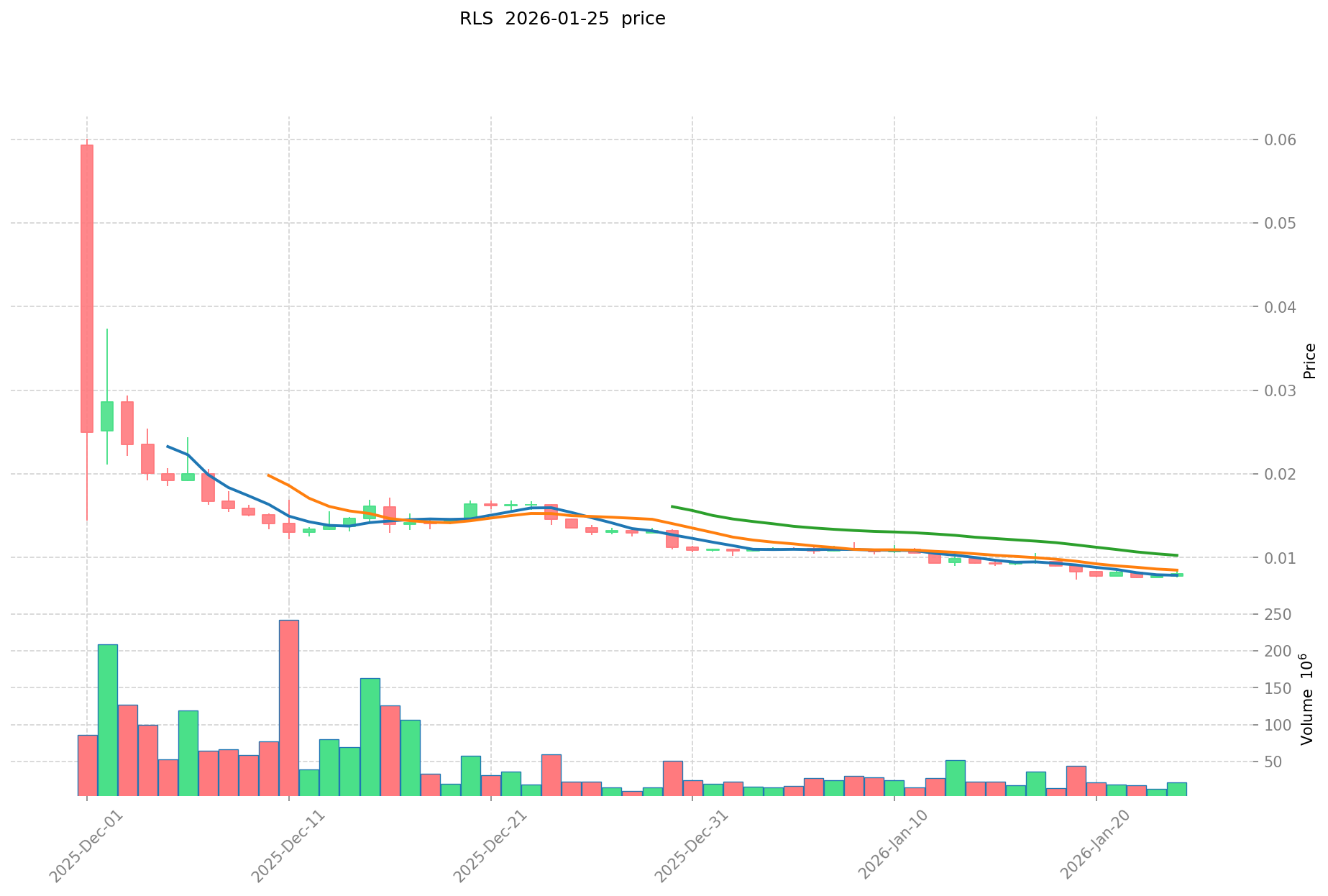
I. Token (RLS) Historical Price Review and Current Investment Value Status
- December 2025: RLS reached a peak price level of 0.0601 USD during its early market phase → Investors experienced significant returns during the initial listing period
- January 2026: Market correction led to substantial price adjustment → RLS price declined from earlier levels to approximately 0.007353 USD
- Current Market Cycle: Price fluctuated from 0.008389 USD to 0.007531 USD within 24 hours, reflecting ongoing volatility
Current RLS Investment Market Status (January 2026)
- RLS current price: 0.00754 USD
- 24-hour trading volume: 144,290.12 USD
- Market capitalization: 11,310,000 USD
- Circulating supply: 1,500,000,000 RLS (15% of total supply)
- Fully diluted market cap: 75,400,000 USD
- Token holders: 46,502 addresses
- Listed exchanges: 16 platforms
Click to view real-time RLS market price
II. Core Factors Affecting Whether RLS is a Good Investment (Is RAYLS(RLS) a Good Investment)
Supply Mechanism and Scarcity (RLS investment scarcity)
- Maximum supply capped at 10,000,000,000 RLS tokens → influences price dynamics and investment valuation
- Current circulating supply represents 15% of total supply (1,500,000,000 tokens) → staged release may affect scarcity perception
- Investment significance: Supply structure and gradual distribution represent foundational elements for evaluating long-term investment considerations
Institutional Investment and Mainstream Adoption (Institutional investment in RLS)
- Rayls ecosystem designed to connect Traditional Finance institutions with DeFi infrastructure → targets regulated institutional participation
- Compliance-focused architecture with private chain capabilities → addresses regulatory requirements for institutional involvement
- Current holder base of 46,502 addresses indicates early-stage distribution → institutional adoption patterns remain to be observed
Macroeconomic Environment Impact on RLS Investment
- Regulatory-compliant design positioning → may benefit from evolving financial regulations favoring compliant digital assets
- Asset tokenization focus → aligns with broader institutional trends toward digital asset infrastructure
- Market conditions and risk sentiment → affect appetite for blockchain infrastructure investments with institutional-grade ambitions
Technology and Ecosystem Development (Technology & Ecosystem for RLS investment)
- High-performance public EVM Layer-1 architecture → provides technical foundation for scalability and institutional integration
- Quantum-secure privacy features → addresses emerging security concerns relevant to institutional asset protection
- Interoperability design combining public and private chains → enables regulatory compliance while maintaining open market interaction
- Predictable fee structure → supports institutional operational requirements and cost management
- Early-stage ecosystem with focus on asset tokenization and DeFi-TradFi bridging → long-term value dependent on adoption and execution
III. RLS Future Investment Prediction and Price Outlook (Is RAYLS(RLS) worth investing in 2026-2031)
Short-term RLS Investment Outlook (2026, short-term RLS investment outlook)
- Conservative forecast: 0.0046 - 0.0062 USD
- Neutral forecast: 0.0062 - 0.0074 USD
- Optimistic forecast: 0.0074 - 0.0085 USD
Mid-term RAYLS(RLS) Investment Forecast (2027-2029, mid-term RAYLS(RLS) investment forecast)
-
Market stage expectation: The mid-term period may witness gradual ecosystem development as Rayls continues to bridge traditional finance and DeFi through its dual-chain architecture. Market performance could be influenced by adoption rates among institutions and regulatory clarity.
-
Investment return prediction:
- 2027: 0.0054 - 0.0090 USD
- 2028: 0.0077 - 0.0111 USD
- 2029: 0.0094 - 0.0130 USD
-
Key catalysts: Institutional partnerships, regulatory developments in tokenized assets, expansion of private chain implementations, and growth in DeFi integration with compliant infrastructure.
Long-term Investment Outlook (Is RLS a good long-term investment?)
- Base scenario: 0.0073 - 0.0101 USD (assuming steady ecosystem development and moderate institutional adoption)
- Optimistic scenario: 0.0114 - 0.0165 USD (assuming accelerated institutional integration and favorable regulatory framework)
- Risk scenario: 0.0046 - 0.0073 USD (under adverse market conditions or slower-than-expected adoption)
For detailed RLS long-term investment and price prediction: Price Prediction
2026-01-26 - 2031 Long-term Outlook
- Base scenario: 0.0073 - 0.0114 USD (corresponding to steady progress and gradual mainstream application adoption)
- Optimistic scenario: 0.0114 - 0.0193 USD (corresponding to large-scale adoption and favorable market environment)
- Transformative scenario: Above 0.0193 USD (if ecosystem achieves breakthrough progress and mainstream popularization)
- 2031-12-31 predicted high: 0.0193 USD (based on optimistic development assumptions)
Disclaimer: Price predictions are based on historical data analysis and market trends. Cryptocurrency markets are highly volatile and subject to various risks. This content does not constitute investment advice. Investors should conduct their own research and risk assessment before making any investment decisions.
| Year |
Predicted High Price |
Predicted Average Price |
Predicted Low Price |
Price Change |
| 2026 |
0.0085492 |
0.00737 |
0.0045694 |
-2 |
| 2027 |
0.008994348 |
0.0079596 |
0.005412528 |
5 |
| 2028 |
0.01110483594 |
0.008476974 |
0.00771404634 |
12 |
| 2029 |
0.0130219036101 |
0.00979090497 |
0.0093992687712 |
29 |
| 2030 |
0.016539286220572 |
0.01140640429005 |
0.010151699818144 |
51 |
| 2031 |
0.019282526452329 |
0.013972845255311 |
0.007265879532761 |
85 |
IV. RAYLS Investment Strategy and Risk Management (How to invest in RAYLS)
Investment Strategy (RAYLS investment strategy)
Long-term Holding (HODL RAYLS): This approach suits conservative investors who believe in the project's long-term vision of bridging Traditional Finance and DeFi. Given RAYLS's focus on compliance, institutional-grade infrastructure, and asset tokenisation, patient investors may consider accumulating during price corrections. The token's circulating supply represents 15% of the total supply, suggesting potential future unlock events that should be monitored.
Active Trading: Technical traders may capitalize on RAYLS's price volatility, which has demonstrated significant fluctuations since its listing. With recent 7-day and 30-day declines of 17.86% and 41.92% respectively, short-term traders can identify support and resistance levels. The 24-hour high of 0.008389 and low of 0.007531 indicate intraday trading opportunities, though traders should employ strict stop-loss mechanisms given the asset's volatility.
Risk Management (Risk management for RAYLS investment)
Asset Allocation Ratios:
- Conservative investors: Limit RAYLS exposure to 1-3% of crypto portfolio
- Aggressive investors: May allocate 5-10% depending on risk tolerance
- Professional investors: Consider strategic positions while maintaining diversification across multiple Layer-1 projects
Risk Hedging Strategies: Investors should consider multi-asset portfolios combining RAYLS with established cryptocurrencies and stablecoins. Position sizing should account for the token's relatively small market cap of approximately 11.31 million and its early-stage development. Correlation analysis with broader market movements can help optimize portfolio construction.
Secure Storage: Given that RAYLS is an ERC-20 token on Ethereum, investors should utilize:
- Cold wallets for long-term holdings (hardware wallets such as Ledger or Trezor)
- Hot wallets only for active trading amounts
- Multi-signature solutions for institutional holdings
- Regular security audits of storage methods
V. RAYLS Investment Risks and Challenges (Risks of investing in RAYLS)
Market Risks: RAYLS exhibits considerable price volatility, having experienced a decline from its peak of 0.0601 to current levels around 0.00754. The token's relatively low market capitalization and limited exchange listings (16 exchanges) may contribute to price susceptibility. The market cap to fully diluted valuation ratio of 15% indicates substantial token supply yet to enter circulation, potentially creating selling pressure.
Regulatory Risks: While RAYLS positions itself as a compliance-focused solution for institutional adoption, evolving regulatory frameworks across jurisdictions present uncertainty. The project's emphasis on connecting regulated institutions with DeFi markets means regulatory changes affecting either traditional finance or decentralized protocols could impact adoption trajectories. Different countries' approaches to asset tokenisation and institutional crypto participation remain fluid.
Technical Risks: As a blockchain ecosystem combining public EVM Layer-1 infrastructure with private chains, RAYLS faces implementation complexities. Network security vulnerabilities, smart contract risks, and potential challenges in achieving claimed quantum-secure privacy protections warrant careful monitoring. The project's success depends on seamless interoperability between institutional private chains and public markets, which introduces technical integration risks. Additionally, competition from established Layer-1 networks and other institutional-focused blockchain solutions may impact adoption.
VI. Conclusion: Is RAYLS a Good Investment?
Investment Value Summary: RAYLS presents an interesting proposition targeting the convergence of traditional finance and DeFi through compliant infrastructure and institutional-grade solutions. The project's focus on asset tokenisation, privacy preservation, and regulatory compliance addresses genuine market needs. However, investors should note the token's significant price volatility, with substantial declines over recent periods and a low circulating supply ratio indicating potential future dilution.
Investor Recommendations:
✅ Beginners: Consider dollar-cost averaging (DCA) approach to manage volatility risk, utilize secure hardware wallet storage, and allocate only risk capital that can withstand potential losses. Start with minimal exposure while learning about the project's development progress.
✅ Experienced Investors: May employ tactical trading strategies around technical levels, maintain diversified portfolio allocation with RAYLS as a speculative position, and actively monitor project milestones, partnership announcements, and institutional adoption indicators.
✅ Institutional Investors: Could evaluate strategic positioning based on thesis alignment regarding institutional blockchain adoption and asset tokenisation trends. Conduct thorough due diligence on technical architecture, team credentials, and competitive positioning before considering allocation.
⚠️ Disclaimer: Cryptocurrency investments carry substantial risk, including potential complete loss of capital. This content is provided for informational purposes only and does not constitute investment advice. Investors should conduct independent research and consult financial professionals before making investment decisions.
VII. FAQ
Q1: What is RAYLS (RLS) and what makes it different from other Layer-1 blockchains?
RAYLS is a blockchain ecosystem launched in 2025 that combines a public EVM Layer-1 with private chain capabilities, specifically designed to bridge Traditional Finance (TradFi) and Decentralized Finance (DeFi) through compliant infrastructure. What distinguishes RLS from other Layer-1 projects is its dual-chain architecture that enables regulated institutions to interact with open markets while maintaining compliance requirements, featuring quantum-secure privacy protection, predictable fee structures, and an explicit focus on asset tokenization for institutional adoption rather than general-purpose decentralized applications.
Q2: What are the current market fundamentals of RLS as of January 2026?
As of January 26, 2026, RLS has a market capitalization of approximately 11.31 million USD with a current price around 0.00754 USD. The token has a circulating supply of 1.5 billion RLS (15% of total supply), a fully diluted market cap of 75.4 million USD, and is held by 46,502 addresses across 16 exchanges. The 24-hour trading volume stands at approximately 144,290 USD, indicating relatively modest liquidity. The token has experienced significant volatility since its peak of 0.0601 USD in December 2025, with recent 7-day and 30-day declines of 17.86% and 41.92% respectively.
Q3: What are the key factors that could influence RLS investment value?
The primary factors affecting RLS investment value include: (1) Token supply structure with only 15% currently circulating, suggesting potential dilution from future unlocks; (2) Institutional adoption of its compliant blockchain infrastructure for asset tokenization; (3) Regulatory developments affecting both traditional finance institutions and DeFi protocols; (4) Technical execution of its quantum-secure privacy features and interoperability between public and private chains; (5) Competition from established Layer-1 networks and other institutional-focused blockchain solutions; and (6) Overall macroeconomic conditions and risk sentiment affecting institutional appetite for blockchain infrastructure investments.
Q4: What is the long-term price prediction for RLS through 2031?
Based on analytical models, RLS price forecasts suggest gradual appreciation contingent on ecosystem development. Short-term 2026 forecasts range from 0.0046-0.0085 USD depending on market conditions. Mid-term projections estimate 2027 at 0.0054-0.0090 USD, 2028 at 0.0077-0.0111 USD, and 2029 at 0.0094-0.0130 USD. Long-term outlook for 2031 projects a base scenario of 0.0073-0.0114 USD, an optimistic scenario of 0.0114-0.0193 USD, with a predicted high of 0.0193 USD under favorable conditions. These projections assume varying degrees of institutional adoption, regulatory clarity, and ecosystem maturation, though cryptocurrency markets remain highly volatile and unpredictable.
Q5: What investment strategy should different investor types adopt for RLS?
Conservative investors should limit RLS exposure to 1-3% of their crypto portfolio, employing dollar-cost averaging to manage volatility and focusing on long-term holding. Aggressive investors may allocate 5-10% while actively trading around technical levels, utilizing the token's volatility to capture short-term opportunities with strict stop-loss mechanisms. Institutional investors should conduct comprehensive due diligence on technical architecture, team credentials, and competitive positioning before considering strategic allocation. All investors should utilize hardware wallets for secure storage, maintain portfolio diversification, and monitor project milestones, partnership announcements, and institutional adoption indicators closely.
Q6: What are the primary risks associated with investing in RLS?
Major investment risks include: (1) Market risk from significant price volatility and recent substantial declines from peak levels; (2) Liquidity risk given relatively low market capitalization and limited exchange listings; (3) Dilution risk with only 15% of tokens currently circulating; (4) Regulatory uncertainty affecting both traditional finance institutions and DeFi protocols across jurisdictions; (5) Technical execution risks related to quantum-secure privacy implementation and interoperability between public and private chains; (6) Competition from established blockchain networks and institutional-focused solutions; and (7) Adoption risk if institutions do not embrace the platform as anticipated. Investors should only allocate capital they can afford to lose completely.
Q7: How does RLS compare to other institutional-focused blockchain projects?
RLS differentiates itself through its dual-chain architecture combining public EVM Layer-1 with private institutional chains, explicitly targeting regulatory compliance for traditional finance integration. Unlike general-purpose institutional blockchains, RLS focuses specifically on asset tokenization and bridging TradFi-DeFi markets. However, compared to established competitors, RLS remains in early stages with modest market capitalization (11.31 million USD), limited exchange presence (16 platforms), and unproven institutional adoption. The project's quantum-secure privacy features and predictable fee structures offer theoretical advantages, but practical implementation and competitive positioning against mature institutional blockchain solutions require ongoing evaluation.
Q8: Is RLS suitable for beginner cryptocurrency investors?
RLS presents significant challenges for beginner investors due to high volatility, early-stage development status, and complex technical architecture. The token's substantial price declines (41.92% over 30 days), low circulating supply ratio indicating future dilution potential, and relatively low liquidity create elevated risk profiles. Beginners interested in RLS should start with minimal exposure representing less than 3% of crypto portfolio, employ dollar-cost averaging to manage volatility, utilize secure hardware wallet storage, and thoroughly understand the project's institutional focus and tokenization objectives. However, beginners may find more established, liquid cryptocurrencies more appropriate for initial investment experience before exploring early-stage projects like RLS.
* The information is not intended to be and does not constitute financial advice or any other recommendation of any sort offered or endorsed by Gate.