This comprehensive analysis examines whether Redbelly (RBNT) represents a sound investment opportunity for cryptocurrency investors. The article evaluates Redbelly Network, the world's first formally verified blockchain developed by the University of Sydney and CSIRO, which enables asset issuers to establish digital registries for tokenized assets. Current market data shows RBNT trading at $0.005626 with a $13.51 million market cap, following a significant 94.34% decline from its December 2024 peak. The article analyzes core investment factors including token supply dynamics, institutional adoption potential, macroeconomic influences, and technical differentiation through formal verification. It provides price forecasts across conservative, neutral, and optimistic scenarios through 2031, alongside detailed investment strategies for different investor profiles. The analysis addresses substantial risks including market volatility, regulatory uncertainty, limited liquidity ($25,873 daily volume on 3 exchanges in
Introduction: Redbelly (RBNT)'s Investment Position and Market Outlook
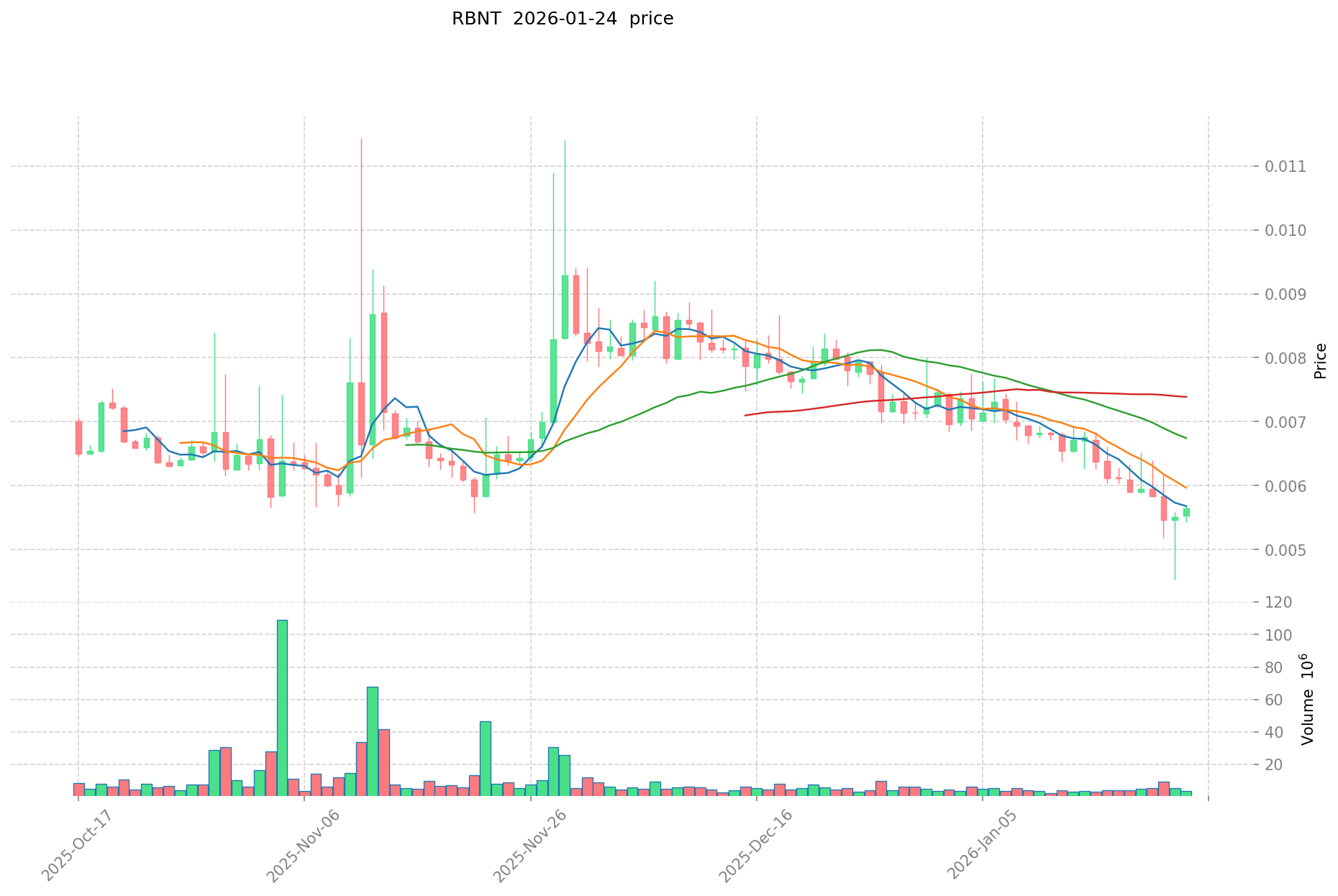
RBNT is a significant asset in the cryptocurrency field. Developed at the University of Sydney in collaboration with CSIRO and the Australian National Science Agency, Redbelly Network represents a formally verified blockchain platform. As of January 25, 2026, RBNT maintains a market capitalization of approximately $13.51 million, with a circulating supply of around 2.40 billion tokens, and a current price near $0.005626. The platform enables asset issuers to establish digital registries, creating unified sources of truth for entire asset classes on-chain and facilitating structured financial products from tokenized assets. With its unique positioning in the tokenized asset infrastructure space, RBNT has gradually become a subject of discussion among investors considering "Is Redbelly (RBNT) a good investment?" This article comprehensively analyzes RBNT's investment value, historical trends, future price outlook, and investment risks to provide reference for investors.
I. Token (RBNT) Price History Review and Current Investment Value Status
- December 2024: Token launch at $0.19 → Token experienced significant volatility in early trading period
- December 29, 2024: Price reached $0.449 → RBNT demonstrated notable price movement within weeks of launch
- January 2026: Market correction phase → Price adjusted from previous levels to approximately $0.00562
Current RBNT Investment Market Status (January 2026)
- RBNT current price: $0.005626
- 24-hour trading volume: $25,873.02
- Market capitalization: $13,514,269.23
- Circulating supply: 2,402,109,709.59 RBNT (24.02% of total supply)
- Fully diluted valuation: $56,260,000
- Market cap to FDV ratio: 24.02%
Click to view real-time RBNT market price
II. Core Factors Affecting Whether RBNT is a Good Investment
Supply Mechanism and Scarcity (RBNT Investment Scarcity)
- Maximum supply capped at 10 billion tokens with current circulation of approximately 2.4 billion RBNT (24.02% of total supply) → influences price dynamics and investment valuation framework
- The token experienced notable price volatility, with historical price ranges between $0.00453 and $0.449 since its December 2024 launch → demonstrates market discovery phase characteristics
- Investment significance: The controlled supply release mechanism and 76% of tokens remaining uncirculated may influence long-term scarcity dynamics for investment consideration
Institutional Investment and Mainstream Adoption (Institutional Investment in RBNT)
- Academic partnership foundation: Redbelly Network emerged from collaborative research between the University of Sydney and CSIRO (Australian National Science Agency) → provides institutional credibility framework
- Target market focus: The network positions itself toward asset issuers seeking digital registry solutions and tokenized asset infrastructure → indicates enterprise-oriented adoption strategy
- Collaboration approach: Works with challenger-brand asset issuers to create structured financial products from tokenized assets → suggests potential for institutional use cases in asset tokenization sector
Macroeconomic Environment's Impact on RBNT Investment
- Monetary policy considerations: Interest rate environments and liquidity conditions in global markets may influence risk appetite for blockchain infrastructure tokens
- Asset tokenization trends: Growing institutional interest in real-world asset (RWA) tokenization could create favorable conditions for platforms enabling digital registries and on-chain asset management
- Regulatory landscape: Evolving frameworks around tokenized assets and blockchain verification standards may affect adoption timelines and investment considerations for infrastructure projects
Technology and Ecosystem Development (Technology & Ecosystem for RBNT Investment)
- Formal verification distinction: Described as the world's first formally verified blockchain → technical differentiation in security and accountability features
- Digital registry infrastructure: Enables asset issuers to establish on-chain registries creating unified sources of truth for asset classes → addresses institutional requirements for transparency and accountability
- Ecosystem positioning: Facilitates creation of structured financial products from tokenized assets while promoting clean liquidity standards → targets growing demand for compliant tokenization infrastructure
III. RBNT Future Investment Forecast and Price Outlook (Is Redbelly(RBNT) worth investing in 2026-2031)
Short-term Investment Forecast (2026, short-term RBNT investment outlook)
- Conservative Forecast: $0.00414 - $0.00560
- Neutral Forecast: $0.00560 - $0.00767
- Optimistic Forecast: $0.00767 and above
Mid-term Investment Outlook (2027-2029, mid-term Redbelly(RBNT) investment forecast)
- Market Stage Expectation: Based on the projection data, RBNT may experience gradual growth during the mid-term period, with potential price fluctuations influenced by market dynamics and adoption trends.
- Investment Return Forecast:
- 2027: $0.00544 - $0.00955
- 2028: $0.00777 - $0.00931
- 2029: $0.00591 - $0.01096
- Key Catalysts: Factors such as platform development progress, adoption of tokenized asset solutions, partnerships with asset issuers, and broader blockchain ecosystem developments may influence price movements.
Long-term Investment Outlook (Is Redbelly a good long-term investment?)
- Base Scenario: $0.00541 - $0.01217 (assuming steady development and moderate market conditions through 2030-2031)
- Optimistic Scenario: $0.01217 - $0.01455 (assuming enhanced adoption of digital registry solutions and favorable regulatory environment)
- Risk Scenario: Below $0.00540 (under adverse market conditions or limited adoption progress)
View RBNT long-term investment and price predictions: Price Prediction
2026-01-25 to 2031 Long-term Outlook
- Base Scenario: $0.00541 - $0.01217 (corresponding to steady progress and gradual mainstream application growth)
- Optimistic Scenario: $0.01217 - $0.01455 (corresponding to large-scale adoption and favorable market environment)
- Transformative Scenario: Above $0.01455 (if ecosystem achieves breakthrough developments and mainstream adoption)
- 2031-12-31 Predicted High: $0.01455 (based on optimistic development assumptions)
Disclaimer: The forecasts provided are based on available data and market trends analysis. Cryptocurrency investments carry significant risks, and past performance does not guarantee future results. Investors should conduct their own research and consider their risk tolerance before making investment decisions.
| Year |
Predicted High Price |
Predicted Average Price |
Predicted Low Price |
Price Change |
| 2026 |
0.00766789 |
0.005597 |
0.00414178 |
0 |
| 2027 |
0.0095507208 |
0.006632445 |
0.0054386049 |
17 |
| 2028 |
0.009305320335 |
0.0080915829 |
0.007767919584 |
43 |
| 2029 |
0.01096004903805 |
0.0086984516175 |
0.0059149470999 |
54 |
| 2030 |
0.014547290485107 |
0.009829250327775 |
0.005406087680276 |
74 |
| 2031 |
0.012675801222698 |
0.012188270406441 |
0.006337900611349 |
116 |
IV. Redbelly Investment Strategy and Risk Management (How to invest in blockchain infrastructure tokens)
Investment Methodology (Redbelly investment strategy)
-
Long-term holding (HODL RBNT): Suitable for conservative investors who believe in the long-term development of formally verified blockchain infrastructure. Given that Redbelly Network represents the first formally verified blockchain developed through collaboration between the University of Sydney and CSIRO, investors with a multi-year horizon may consider accumulating positions during market downturns. This approach reduces the impact of short-term volatility and allows the project's technological advantages to materialize over time.
-
Active trading: Relies on technical analysis and swing trading strategies. Due to the token's significant price fluctuations (evidenced by a 7-day decline of 7.73% and a 30-day decline of 28.95% as of January 25, 2026), experienced traders may identify entry and exit points using chart patterns, volume analysis, and momentum indicators. The limited exchange availability (3 exchanges) may create liquidity constraints that active traders should consider when planning position sizes and exit strategies.
Risk Management (Risk management for RBNT investment)
-
Asset allocation ratios:
- Conservative investors: Allocate no more than 1-3% of total crypto portfolio to RBNT, given its mid-cap status (ranking #1061) and limited market presence.
- Aggressive investors: May allocate 5-10% of crypto portfolio, with awareness of heightened volatility risks.
- Professional investors: Can consider 10-15% allocation as part of a diversified blockchain infrastructure thesis, with active monitoring of development milestones and partnership announcements.
-
Risk hedging strategies: Implement multi-asset portfolio construction combining established cryptocurrencies with emerging infrastructure projects. Consider maintaining positions in more liquid assets to balance exposure to lower-liquidity tokens. Stablecoin reserves can provide flexibility to capitalize on price dislocations during volatile periods.
-
Secure storage: Cold wallet solutions for long-term holdings (hardware wallets such as Ledger or Trezor are recommended for amounts exceeding short-term trading needs). Hot wallets on reputable exchanges should only hold trading positions. Implement multi-signature arrangements for significant holdings and maintain backup recovery phrases in secure, geographically distributed locations.
V. Redbelly Investment Risks and Challenges (Risks of investing in blockchain infrastructure tokens)
-
Market risk: RBNT exhibits substantial volatility, with a 1-year decline of 94.34% from its price of $0.449 on December 29, 2024, to approximately $0.005626 as of January 25, 2026. The circulating supply represents only 24.02% of the maximum supply, indicating potential dilution pressure as additional tokens enter circulation. The relatively low 24-hour trading volume of $25,873 suggests limited liquidity, which may amplify price swings during periods of increased buying or selling pressure.
-
Regulatory risk: As a blockchain infrastructure project developed in collaboration with Australian research institutions, Redbelly Network may face evolving regulatory frameworks governing blockchain technology, tokenized assets, and digital registries across different jurisdictions. Changes in securities regulations, particularly regarding tokenized asset platforms, could impact the project's operational model and token utility. Investors should monitor regulatory developments in key markets where asset issuers may deploy the platform.
-
Technical risk: While formal verification provides mathematical assurance of certain protocol properties, blockchain networks face ongoing security challenges including potential consensus mechanism vulnerabilities, smart contract exploits, and network partition risks. The success of Redbelly's value proposition depends on adoption by asset issuers and the creation of digital registries, which remains in relatively early stages. Network upgrade coordination and maintaining validator participation are critical technical considerations that could impact network reliability and token value.
VI. Conclusion: Is Blockchain Infrastructure a Good Investment?
-
Investment value summary: Redbelly demonstrates long-term potential through its unique positioning as a formally verified blockchain developed through academic-industry collaboration. The project's focus on enabling asset issuers to build digital registries and create structured financial products from tokenized assets addresses specific institutional needs. However, the token has experienced significant price depreciation over the past year, and its limited exchange availability and low trading volume present liquidity challenges.
-
Investor recommendations:
✅ Beginners: Consider dollar-cost averaging (DCA) with small amounts to build exposure gradually, reducing timing risk. Prioritize secure wallet storage using hardware wallets or reputable non-custodial solutions. Allocate only capital that can withstand potential loss, given the token's volatility profile.
✅ Experienced investors: Evaluate swing trading opportunities based on technical analysis while maintaining core positions for potential long-term appreciation. Diversify across multiple blockchain infrastructure projects to reduce single-project risk. Monitor project development updates and partnership announcements that could catalyze price movements.
✅ Institutional investors: Assess strategic long-term allocation as part of a broader blockchain infrastructure thesis, with particular focus on formal verification advantages and potential adoption by regulated asset issuers. Conduct thorough due diligence on tokenomics, vesting schedules, and governance mechanisms before committing significant capital.
⚠️ Disclaimer: Cryptocurrency investments carry substantial risk due to price volatility, regulatory uncertainty, and technological challenges. This content is provided for informational purposes only and does not constitute investment advice. Investors should conduct independent research and consult with qualified financial advisors before making investment decisions.
VII. FAQ
Q1: What makes Redbelly Network different from other blockchain infrastructure projects?
Redbelly Network is the world's first formally verified blockchain, developed through collaboration between the University of Sydney and CSIRO (Australian National Science Agency). This formal verification provides mathematical assurance of protocol properties, distinguishing it from most blockchain platforms that rely on traditional security auditing methods. The platform specifically targets asset issuers seeking to establish digital registries and create structured financial products from tokenized assets, offering a unified source of truth for entire asset classes on-chain. This institutional-focused positioning, combined with its academic pedigree and emphasis on clean liquidity standards, differentiates Redbelly from general-purpose blockchain platforms.
Q2: Is RBNT suitable for long-term investment given its significant price decline?
RBNT has experienced a substantial 94.34% decline from its peak of $0.449 in December 2024 to approximately $0.005626 as of January 2026, indicating high volatility and significant downside risk. Long-term investment suitability depends on individual risk tolerance and belief in the project's technological advantages and adoption potential. Conservative investors should limit allocation to 1-3% of their crypto portfolio, while more aggressive investors accepting higher risk might allocate 5-10%. The project's formal verification credentials and institutional focus provide differentiation, but limited exchange availability (3 exchanges), low trading volume ($25,873 daily), and only 24.02% circulating supply present ongoing challenges that long-term holders must carefully consider.
Q3: What are the main risks associated with investing in RBNT?
The primary risks include: (1) Market risk – extremely high volatility with a 94.34% decline over one year and limited liquidity evidenced by low trading volume, which can amplify price swings; (2) Regulatory risk – evolving frameworks around tokenized assets and digital registries across jurisdictions may impact the platform's operational model; (3) Technical risk – while formally verified, the network still faces potential consensus vulnerabilities, smart contract exploits, and adoption challenges among target asset issuers; (4) Dilution risk – with only 24.02% of maximum supply in circulation, future token releases could create selling pressure. Investors should only commit capital they can afford to lose entirely given these substantial risk factors.
Q4: How should beginners approach investing in RBNT?
Beginners should adopt a cautious, measured approach: Start with dollar-cost averaging (DCA) using small amounts to gradually build exposure while reducing timing risk. Allocate only 1-3% of total cryptocurrency portfolio to RBNT, ensuring this represents money that can be lost without financial hardship. Prioritize secure storage using hardware wallets (Ledger, Trezor) rather than leaving tokens on exchanges. Conduct thorough independent research on the project's development progress, partnership announcements, and competitive positioning before committing funds. Avoid emotional decision-making during price volatility, and consider consulting qualified financial advisors who understand cryptocurrency markets before making investment decisions.
Q5: What factors could drive RBNT price appreciation in the future?
Several catalysts could potentially drive price growth: (1) Adoption by asset issuers – successful deployment of digital registries by institutional clients would validate the platform's value proposition; (2) Partnership announcements – collaborations with established financial institutions or asset managers could increase credibility; (3) Exchange listings – availability on additional major exchanges would improve liquidity and accessibility; (4) Regulatory clarity – favorable frameworks for tokenized assets could accelerate institutional adoption; (5) Technology milestones – successful network upgrades and expanded functionality demonstrating the advantages of formal verification; (6) Market sentiment – broader cryptocurrency market recovery and increased interest in real-world asset (RWA) tokenization infrastructure could create tailwinds for blockchain infrastructure projects like Redbelly.
Q6: What is the realistic price outlook for RBNT through 2031?
Based on available projection data, RBNT's price trajectory depends heavily on adoption progress and market conditions. Short-term (2026), conservative estimates range from $0.00414 to $0.00560, with optimistic scenarios reaching $0.00767. Mid-term (2027-2029), the token could trade between $0.00544 and $0.01096 under neutral conditions, assuming steady platform development. Long-term (2030-2031), base scenarios project $0.00541 to $0.01217, with optimistic scenarios reaching $0.01455 if the ecosystem achieves strong adoption among asset issuers. However, these projections carry significant uncertainty, and adverse scenarios could see prices remain below $0.00540. Investors should treat these forecasts as speculative scenarios rather than guaranteed outcomes, recognizing that actual performance may differ substantially based on execution, competition, and market dynamics.
Q7: How liquid is RBNT and what are the implications for investors?
RBNT currently exhibits limited liquidity with only $25,873 in 24-hour trading volume and availability on just 3 exchanges as of January 2026. This low liquidity has several important implications: (1) Price impact – larger buy or sell orders can significantly move the market price, making it difficult to execute substantial positions without slippage; (2) Exit challenges – investors may struggle to quickly liquidate positions during market stress without accepting unfavorable prices; (3) Volatility amplification – low liquidity can exacerbate price swings in both directions; (4) Spread costs – bid-ask spreads may be wider than more liquid tokens, increasing trading costs. Investors should size positions appropriately, avoid committing capital that may need to be accessed quickly, and consider the liquidity constraints when developing entry and exit strategies. Active traders should be particularly cautious about position sizing relative to average daily volume.
Q8: Should institutional investors consider RBNT as part of a blockchain infrastructure allocation?
Institutional investors evaluating blockchain infrastructure exposure may find RBNT's unique characteristics warrant consideration, but with significant caveats. The project's formal verification credentials and academic-industry collaboration provide technical credibility that differentiates it from many blockchain platforms. The focus on enabling digital registries for asset issuers aligns with institutional needs for transparency, accountability, and regulatory compliance in tokenized asset management. However, institutional investors must carefully assess: (1) Liquidity constraints that may make building or exiting positions challenging; (2) Token distribution and vesting schedules affecting potential dilution; (3) Governance mechanisms and decision-making processes; (4) Competitive landscape including other blockchain platforms targeting similar use cases; (5) Development roadmap and partnership pipeline with potential clients. Institutional allocations should be positioned as strategic, long-term holdings with 10-15% maximum allocation within a diversified blockchain infrastructure thesis, accompanied by active monitoring and regular reassessment based on adoption milestones.
* The information is not intended to be and does not constitute financial advice or any other recommendation of any sort offered or endorsed by Gate.