This comprehensive analysis evaluates whether Redbelly (RBNT) represents a viable investment opportunity in blockchain infrastructure. Developed by the University of Sydney and CSIRO, RBNT is a formally verified blockchain designed for asset tokenization and digital registries, currently trading at $0.005892 with a $14.15 million market cap. The article examines RBNT's price history showing a 94.05% decline from its $0.449 all-time high, analyzes core investment factors including tokenomics (24% circulating supply), institutional adoption potential, and macroeconomic influences. It provides multi-scenario price projections through 2031, ranging from conservative to optimistic forecasts, while detailing tailored investment strategies for beginners through institutional investors. The analysis emphasizes critical risks including market volatility, liquidity constraints across three Gate exchanges, regulatory uncertainty, and early-stage adoption challenges. Ultimately, RBNT suits risk-tolerant investors as a sp
Introduction: Redbelly (RBNT) Investment Position and Market Prospects
RBNT is a significant asset in the cryptocurrency field. Developed at the University of Sydney in collaboration with CSIRO, the Australian National Science Agency, Redbelly Network represents a formally verified blockchain designed for asset tokenization and digital registries. As of January 25, 2026, RBNT holds a market capitalization of approximately $14.15 million, with a circulating supply of around 2.40 billion tokens. The current price stands at approximately $0.005892, marking the token's position at rank 1035 in the broader cryptocurrency market. With a market dominance of 0.0018%, RBNT has established itself within the blockchain infrastructure sector focusing on creating single sources of truth for on-chain asset classes. The token launched in December 2024 at an initial price of $0.19 and is currently available on 3 exchanges. This article provides a comprehensive analysis of RBNT's investment characteristics, historical price movements, future price projections, and associated investment risks to serve as a reference for investors evaluating whether Redbelly (RBNT) aligns with their investment strategies.
I. RBNT Price History Review and Current Investment Value
- 2024: Token launch and listing → Initial trading price at $0.19, reflecting early market entry expectations
- December 2024: Post-launch price discovery phase → RBNT experienced significant volatility from $0.449 to subsequent levels
- 2025-2026: Market adjustment period → Price consolidated within a range, reflecting broader market conditions and project development progress
Current RBNT Investment Market Status (January 2026)
- RBNT current price: $0.005892
- Market sentiment (Fear & Greed Index): Data not available in provided materials
- 24-hour trading volume: $22,284.36
- Institutional investor holdings: Data not available in provided materials
Click to view real-time RBNT market price
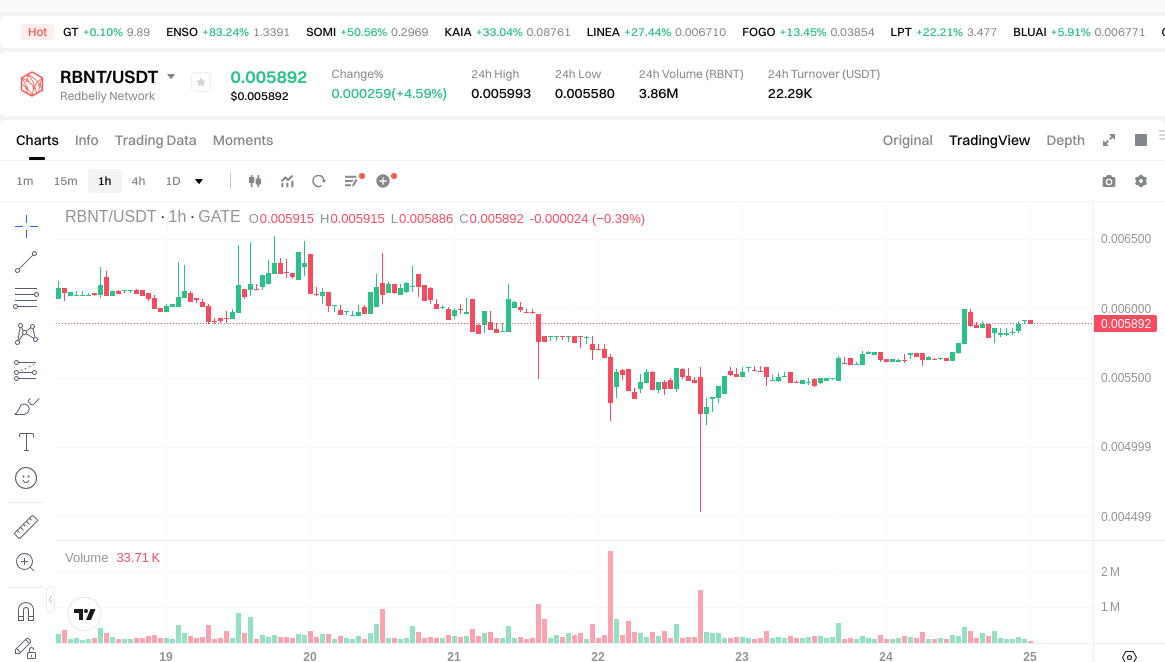
II. Core Factors Affecting Whether RBNT is a Good Investment (Is Redbelly(RBNT) a Good Investment)
Supply Mechanism and Scarcity (RBNT investment scarcity)
- Supply structure → Influences price and investment value: RBNT has a maximum supply of 10 billion tokens with approximately 2.4 billion tokens in circulation (24.02% of total supply)
- Circulating supply dynamics: The relatively low circulation ratio may create potential scarcity effects as more tokens enter the market over time
- Investment significance: The controlled token release mechanism could support long-term investment considerations by managing supply pressure
Institutional Investment and Mainstream Adoption (Institutional investment in RBNT)
- Academic and research foundation: Redbelly Network was developed at the University of Sydney in collaboration with CSIRO, the Australian National Science Agency, providing institutional research credibility
- Target market focus: The project works with asset issuers who have established network effects, positioning itself in the tokenized asset and structured financial products space
- Adoption strategy: RBNT enables asset issuers to build digital registries, creating applications for entire asset classes on-chain
Macroeconomic Environment's Impact on RBNT Investment
- Market positioning: As a blockchain infrastructure token focused on asset tokenization and financial products, RBNT's investment appeal may be influenced by broader trends in digital asset adoption
- Risk management approach: The project emphasizes promoting accountability and ensuring clean liquidity by default, which may appeal to risk-conscious institutional participants
- Economic uncertainty considerations: The focus on creating structured financial products from tokenized assets could align with evolving regulatory and economic frameworks
Technology and Ecosystem Development (Technology & Ecosystem for RBNT investment)
- Formal verification foundation: Redbelly Network is described as the world's first formally verified blockchain, potentially offering enhanced security and reliability for investment consideration
- Application focus: The platform enables the creation of digital registries and structured financial products from tokenized assets, providing specific use cases
- Ecosystem positioning: RBNT supports applications in asset tokenization, which intersects with DeFi and institutional finance sectors, potentially contributing to long-term value considerations
III. RBNT Future Investment Prediction and Price Outlook (Is Redbelly(RBNT) worth investing in 2026-2031)
Short-term Investment Prediction (2026, short-term RBNT investment outlook)
- Conservative Forecast: $0.0047136 - $0.005892
- Neutral Forecast: $0.005892
- Optimistic Forecast: $0.005892 - $0.00636336
Mid-term Investment Outlook (2027-2029, mid-term Redbelly(RBNT) investment forecast)
- Market Stage Expectation: The token may enter a gradual recovery phase following its significant decline from the all-time high, with potential for moderate growth as the ecosystem matures and adoption expands.
- Investment Return Prediction:
- 2027: $0.004289376 - $0.0089464128
- 2028: $0.005502043872 - $0.009722789856
- 2029: $0.0060409426896 - $0.01234078292304
- Key Catalysts: Expansion of digital registry partnerships with asset issuers, growth in tokenized asset applications, and broader adoption of formally verified blockchain technology in institutional settings.
Long-term Investment Outlook (Is Redbelly a good long-term investment?)
- Base Scenario: $0.007522190467008 - $0.011062044804423 (assuming steady ecosystem development and moderate market acceptance)
- Optimistic Scenario: $0.01048535052552 - $0.014270037797706 (assuming accelerated adoption of tokenized assets and favorable regulatory environment)
- Risk Scenario: Below $0.00453 (under conditions of prolonged market downturn or failure to achieve mainstream adoption)
Check RBNT long-term investment and price prediction: Price Prediction
2026-01-25 - 2031 Long-term Outlook
- Base Scenario: $0.009331961967712 - $0.011062044804423 (corresponding to steady progress and gradual mainstream application growth)
- Optimistic Scenario: $0.01048535052552 - $0.014270037797706 (corresponding to large-scale adoption and favorable market conditions)
- Transformative Scenario: Above $0.014270037797706 (if ecosystem achieves breakthrough progress and mainstream popularization)
- 2031-12-31 Predicted High: $0.014270037797706 (based on optimistic development assumptions)
Disclaimer: The above predictions are for informational purposes only and do not constitute investment advice. Cryptocurrency markets are highly volatile and unpredictable. Past performance does not guarantee future results. Investors should conduct their own research and consider their risk tolerance before making any investment decisions.
| Year |
Predicted High Price |
Predicted Average Price |
Predicted Low Price |
Price Change |
| 2026 |
0.00636336 |
0.005892 |
0.0047136 |
0 |
| 2027 |
0.0089464128 |
0.00612768 |
0.004289376 |
4 |
| 2028 |
0.009722789856 |
0.0075370464 |
0.005502043872 |
27 |
| 2029 |
0.01234078292304 |
0.008629918128 |
0.0060409426896 |
46 |
| 2030 |
0.011638739083327 |
0.01048535052552 |
0.009331961967712 |
77 |
| 2031 |
0.014270037797706 |
0.011062044804423 |
0.007522190467008 |
87 |
IV. Redbelly Investment Strategy and Risk Management (How to invest in blockchain infrastructure)
Investment Methodology (Redbelly investment strategy)
-
Long-term Holding (HODL Redbelly): Suitable for conservative investors who believe in the long-term potential of formally verified blockchain infrastructure. This approach focuses on accumulating RBNT tokens during market corrections and holding through volatility cycles, particularly given the project's academic foundation and institutional partnerships.
-
Active Trading: Relies on technical analysis and swing trading strategies. Given RBNT's 24-hour volatility of 5.32% and relatively low trading volume of $22,284, active traders should focus on identifying support levels (recent low at $0.00453) and resistance zones, while being mindful of liquidity constraints across the three exchanges where the token is currently listed.
Risk Management (Risk management for Redbelly investment)
-
Asset Allocation Ratios:
- Conservative investors: Allocate 1-3% of crypto portfolio to RBNT, focusing on established blockchain infrastructure plays
- Moderate investors: Consider 3-7% allocation as part of a diversified Layer-1 blockchain strategy
- Aggressive investors: May allocate up to 10-15%, accepting higher volatility for potential growth in the tokenized asset sector
-
Risk Hedging Solutions: Implement multi-asset portfolio strategies combining established cryptocurrencies with emerging infrastructure tokens. Consider maintaining stable positions in major assets to offset potential volatility in smaller-cap holdings like RBNT (current market cap: $14.15 million).
-
Secure Storage: Utilize cold wallet solutions for long-term holdings and hot wallets only for active trading portions. Hardware wallet options from reputable manufacturers are recommended for securing RBNT tokens, particularly given the project's focus on institutional-grade security and formal verification.
V. Redbelly Investment Risks and Challenges (Risks of investing in blockchain infrastructure)
-
Market Risks: RBNT demonstrates significant price volatility, with a 1-year decline of 94.05% from its all-time high of $0.449 (December 29, 2024) to current levels around $0.00589. The 24-hour price range ($0.00558 - $0.00599) indicates ongoing price fluctuations. The token's relatively small market capitalization of $14.15 million and limited exchange availability (3 exchanges) may expose investors to liquidity risks and potential price manipulation concerns.
-
Regulatory Risks: As a blockchain infrastructure project focused on tokenized assets and digital registries, Redbelly operates in a regulatory environment that varies significantly across jurisdictions. The project's collaboration with Australian institutions (University of Sydney, CSIRO) provides some credibility, but evolving regulations around tokenized financial products, particularly in different countries, create uncertainty for long-term adoption and token utility.
-
Technical Risks: While Redbelly Network is described as formally verified, any blockchain infrastructure faces potential technical challenges including network security vulnerabilities, scalability limitations, and implementation risks. With only 24.02% of total supply (2.40 billion of 10 billion tokens) currently in circulation, future token unlocks may create selling pressure. The project's focus on enabling structured financial products from tokenized assets requires successful technical execution and institutional adoption.
VI. Conclusion: Is blockchain infrastructure a Good Investment?
-
Investment Value Summary: Redbelly presents a unique value proposition as a formally verified blockchain developed through academic and institutional collaboration, targeting the tokenized asset and digital registry sectors. However, the token has experienced substantial price decline (94.05% from all-time high) and currently trades with limited liquidity across a small number of exchanges. The circulating supply represents only 24% of total supply, which may impact future price dynamics.
-
Investor Recommendations:
✅ Beginners: Consider dollar-cost averaging in small amounts while maintaining secure wallet storage. Start with minimal exposure (under 2% of portfolio) and prioritize understanding the project's technology and partnerships before increasing allocation.
✅ Experienced Investors: Implement swing trading strategies around support/resistance levels while maintaining core long-term position. Monitor trading volume trends and exchange listings for liquidity improvements. Consider allocation of 3-7% within a diversified blockchain infrastructure portfolio.
✅ Institutional Investors: Evaluate strategic long-term positioning based on the project's focus on tokenized assets and digital registries, particularly if aligned with institutional interest in blockchain-based financial infrastructure. Conduct thorough due diligence on technology verification, partnership developments, and token unlock schedules.
⚠️ Disclaimer: Cryptocurrency investments carry substantial risks including high volatility and potential loss of capital. This content is for informational purposes only and does not constitute investment advice. Conduct independent research and consult with financial professionals before making investment decisions.
VII. FAQ
Q1: What makes Redbelly (RBNT) different from other blockchain infrastructure projects?
Redbelly Network is the world's first formally verified blockchain, developed through collaboration between the University of Sydney and CSIRO (Australia's National Science Agency). This academic foundation provides enhanced security and reliability compared to many blockchain projects. The platform specifically focuses on creating digital registries and enabling structured financial products from tokenized assets, positioning it as infrastructure for institutional-grade asset tokenization rather than a general-purpose blockchain. The formal verification process mathematically proves the correctness of the blockchain's core protocols, potentially reducing technical risks compared to unverified systems.
Q2: Why has RBNT's price declined 94.05% from its all-time high?
The significant price decline from $0.449 (December 29, 2024) to current levels around $0.00589 reflects several factors. First, the token launched during a period requiring market price discovery, and early trading often experiences volatility as initial expectations adjust to market realities. Second, only 24.02% of the total 10 billion token supply is currently in circulation, suggesting that initial pricing may have been influenced by limited supply dynamics. Third, with availability on only 3 exchanges and relatively low trading volume ($22,284 in 24 hours), liquidity constraints may amplify price movements. Finally, as an infrastructure project focused on tokenized assets, adoption takes time to materialize, and the market may be adjusting expectations to align with the project's actual development timeline.
Q3: Is RBNT suitable for long-term investment?
RBNT may be suitable for long-term investment for specific investor profiles, but with important caveats. The project's strong academic foundation, focus on formally verified technology, and positioning in the growing tokenized asset sector provide fundamental support for long-term consideration. Conservative long-term investors should limit allocation to 1-3% of their crypto portfolio, while more aggressive investors comfortable with higher volatility might consider up to 10-15%. However, the token's current small market capitalization ($14.15 million), limited exchange availability, significant price decline from highs, and early-stage adoption status mean substantial risks exist. Long-term holders should be prepared for continued volatility and the possibility that mainstream adoption may take years to materialize, if it occurs at all.
Q4: What are the main risks of investing in RBNT?
Three primary risk categories affect RBNT investments: Market risks include significant price volatility (94% decline from all-time high), low liquidity with only $22,284 in 24-hour trading volume, limited exchange availability (3 exchanges), and a small market capitalization that may expose investors to manipulation risks. Regulatory risks stem from the project's focus on tokenized assets and structured financial products, which face evolving and uncertain regulatory frameworks across different jurisdictions, potentially impacting adoption and token utility. Technical risks involve the challenge of achieving mainstream adoption for formally verified blockchain infrastructure, the potential impact of future token unlocks (75.98% of supply not yet in circulation), and the execution risks associated with building institutional-grade digital registry solutions. Additionally, the project requires successful partnerships with asset issuers to achieve its vision, creating dependency risks.
Q5: How should investors approach position sizing for RBNT?
Position sizing for RBNT should align with individual risk tolerance and investment objectives. Conservative investors focused on capital preservation should limit RBNT to 1-3% of their total cryptocurrency portfolio, treating it as a speculative allocation within established blockchain infrastructure holdings. Moderate investors with balanced risk-return profiles might allocate 3-7% as part of a diversified Layer-1 and infrastructure blockchain strategy, complemented by larger positions in more established assets. Aggressive investors seeking higher growth potential and comfortable with substantial volatility may allocate up to 10-15%, though this should represent only a portion of overall crypto holdings. Regardless of profile, investors should implement dollar-cost averaging rather than lump-sum purchases to manage entry timing risks, maintain secure cold storage for long-term holdings, and establish clear exit strategies including both profit-taking levels and stop-loss thresholds based on individual risk parameters.
Q6: What catalysts could drive RBNT price appreciation in the coming years?
Several potential catalysts could positively impact RBNT's price trajectory through 2031. Primary drivers include successful partnerships with institutional asset issuers adopting Redbelly's digital registry infrastructure, which would demonstrate real-world utility and drive token demand. Increased exchange listings and liquidity improvements would reduce trading friction and potentially attract larger investors. Broader industry adoption of tokenized assets and structured financial products built on formally verified blockchain infrastructure could position RBNT as essential infrastructure. Regulatory clarity around digital asset tokenization, particularly in major jurisdictions, might reduce uncertainty and encourage institutional participation. Technical milestones such as network upgrades, enhanced security features, or ecosystem expansion could strengthen confidence in the platform's long-term viability. Finally, favorable macroeconomic conditions supporting risk assets and increased interest in blockchain infrastructure generally could create tailwinds for RBNT appreciation.
Q7: What investment strategy works best for RBNT given its current market conditions?
Given RBNT's current characteristics—small market cap, limited liquidity, significant price decline, and early-stage adoption—a hybrid investment strategy may be most appropriate. For the majority of an RBNT allocation (60-70%), implement a long-term holding (HODL) strategy with dollar-cost averaging, accumulating positions during market corrections while maintaining secure cold storage. This approach capitalizes on the project's fundamental infrastructure thesis without attempting to time short-term movements. For a smaller portion (30-40%), consider active trading strategies focused on technical analysis, particularly identifying support around recent lows ($0.00453) and resistance near recent highs ($0.00599). However, active trading should only be attempted by experienced investors given the liquidity constraints and volatility. Avoid over-leverage, maintain strict position sizing limits, set stop-loss orders to protect capital, and regularly rebalance the portfolio based on RBNT's development progress and changing market conditions. Most importantly, treat RBNT as a high-risk, speculative allocation rather than a core portfolio holding.
Q8: How does RBNT's tokenomics structure affect investment decisions?
RBNT's tokenomics significantly impact investment considerations. With a maximum supply of 10 billion tokens and only 2.40 billion (24.02%) currently in circulation, approximately 7.6 billion tokens remain to be released into the market. This creates potential supply overhang that could pressure prices as more tokens unlock, particularly if demand doesn't grow proportionally. The controlled release mechanism may support gradual price appreciation by managing supply, but investors must monitor unlock schedules and assess whether ecosystem adoption is expanding fast enough to absorb new supply. The relatively low current circulation could also mean early price action was influenced by scarcity effects that may diminish as circulation increases. For investment planning, this tokenomics structure suggests patience is essential—holding periods should extend across multiple years to allow time for both token distribution and ecosystem maturation. Investors should research the specific token unlock schedule, vesting periods for team and early investors, and any mechanisms that might affect circulating supply over time.
* The information is not intended to be and does not constitute financial advice or any other recommendation of any sort offered or endorsed by Gate.