This comprehensive analysis examines whether RedStone (RED) represents a viable investment opportunity in 2026-2031. The article evaluates RED's investment characteristics, having launched in January 2025 with current market cap of $75.55 million and price at $0.2487. It reviews historical price performance ranging from $0.1958 to $0.9771, explores core factors including supply mechanisms with only 30.38% circulating supply, institutional adoption across DeFi platforms, and oracle infrastructure technology. The analysis presents price forecasts from conservative ($0.129-$0.200 in 2026) to optimistic scenarios ($0.55-$0.64 by 2031). Risk management strategies address market volatility, regulatory uncertainty, technical vulnerabilities, and competition. Detailed investment recommendations cater to beginners using dollar-cost averaging, experienced traders employing swing strategies, and institutional investors through portfolio allocation guidelines. Essential for traders and investors evaluating oracle token o
Introduction: RedStone (RED)'s Investment Position and Market Outlook
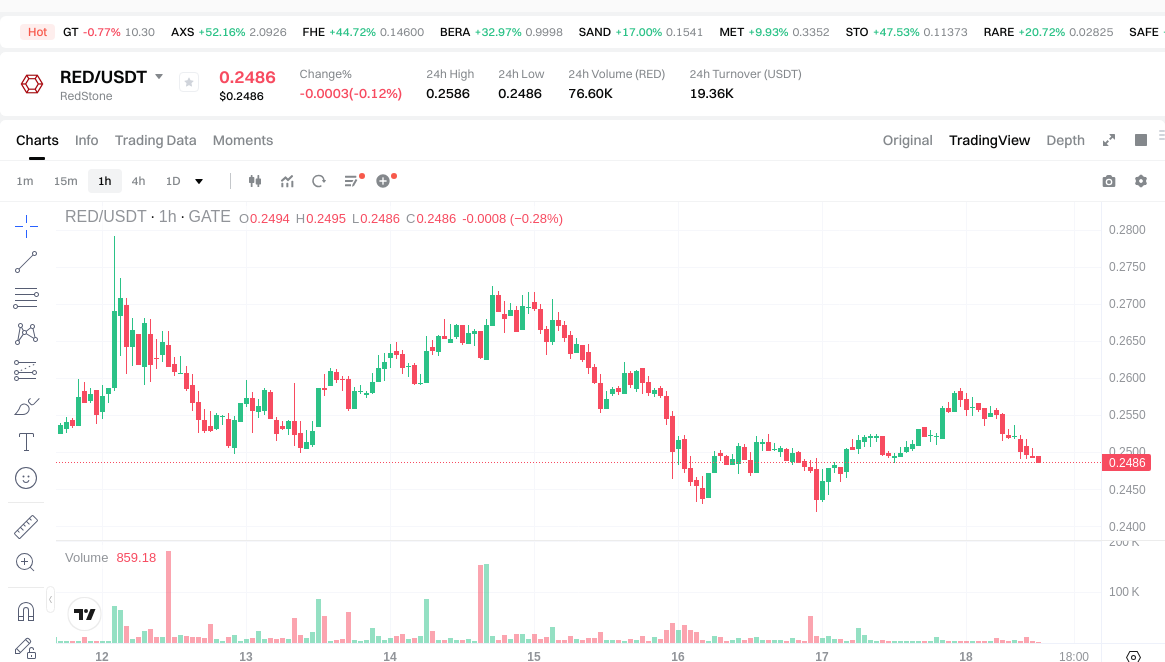
RedStone (RED) represents a notable asset in the cryptocurrency sector, having been launched in 2025 as an oracle solution with distinctive features in actively validated services and restaking mechanisms. As of January 18, 2026, RED holds a market capitalization of approximately $75.55 million with a circulating supply of 303.78 million tokens, currently trading at around $0.2487. Positioned as a rapidly expanding oracle provider serving the yield-bearing assets sector, including liquid restaking tokens, liquid staking tokens, and stablecoins such as Ethena and Elixir, RED has garnered attention among market participants exploring the question "Is RedStone (RED) a good investment?" This analysis examines RED's investment characteristics, historical price movements, future price projections, and associated risk factors to provide reference information for market observers.
I. RedStone (RED) Price History Review and Current Investment Value
- 2025: Launch and Initial Trading → RED token launched in January 2025 at $0.7525, providing early participants with initial market entry opportunities
- 2025: September Peak Period → Price reached approximately $0.9771 in early September, reflecting significant market interest in oracle services and restaking solutions
- 2025: December Market Adjustment → Price experienced correction to around $0.1958 in mid-December, representing a notable market cycle fluctuation
- 2026: Recovery Phase → As of January 18, 2026, RED trades at $0.2487, showing gradual stabilization after the December correction
Current RED Investment Market Status (January 2026)
- RED Current Price: $0.2487
- Market Capitalization: $75.55 million
- 24-Hour Trading Volume: $19,356.80
- Circulating Supply: 303.78 million RED (30.38% of total supply)
- Total Supply: 1 billion RED tokens
- Market Dominance: 0.0073%
- Listed on 26 exchanges, including Gate.com
Click to view real-time RED market price
II. Core Factors Influencing Whether RED is a Good Investment
Supply Mechanism and Scarcity (RED Investment Scarcity)
- Supply Structure: RedStone (RED) has a maximum supply of 1,000,000,000 tokens, with a current circulating supply of 303,783,257 tokens, representing approximately 30.38% of the total supply. This controlled release mechanism may influence price dynamics and investment characteristics over time.
- Historical Price Movement: RED has experienced notable price fluctuations since its launch in January 2025, with price variations ranging from $0.1958 to $0.9771. These movements reflect market response to supply dynamics and demand conditions.
- Investment Implications: The gradual token release schedule, with approximately 70% of tokens yet to enter circulation, represents a key consideration for evaluating long-term investment characteristics. The relationship between circulating supply expansion and market absorption capacity may influence future price development.
Institutional Investment and Mainstream Adoption (Institutional Investment in RED)
- Market Presence: As of January 2026, RED is listed on 26 exchanges and has approximately 10,573 token holders, indicating a developing user base in the oracle services sector.
- Ecosystem Integration: RedStone serves as an oracle provider for yield-bearing assets, including Liquid Restaking Tokens (LRTs), Liquid Staking Tokens (LSTs), and projects such as Ethena and Elixir. This integration within the DeFi ecosystem reflects growing utility in blockchain data services.
- Network Positioning: RedStone positions itself as a provider of Actively Validated Services with Restaking capabilities, differentiating its approach within the oracle infrastructure landscape.
Macroeconomic Environment's Impact on RED Investment
- Market Correlation: As a blockchain oracle token within the broader cryptocurrency market, RED's performance may be influenced by macroeconomic factors affecting digital asset markets, including monetary policy shifts and risk sentiment trends.
- Sector Dynamics: The oracle services sector plays a supporting role in blockchain infrastructure, with demand influenced by overall growth in decentralized applications and smart contract platforms.
- Market Conditions: The token's market capitalization of approximately $75.55 million and 24-hour trading volume of $19,356.80 as of January 18, 2026, reflect its current market liquidity and investor engagement levels.
Technology and Ecosystem Development (Technology & Ecosystem for RED Investment)
- Oracle Infrastructure: RedStone's modular architecture is designed to facilitate data transfer between off-chain sources and blockchain systems, serving developers building applications requiring external data feeds.
- Yield-Bearing Asset Focus: The protocol has established a presence in providing oracle services for yield-bearing assets, addressing data feed requirements for LRTs, LSTs, and related DeFi protocols.
- Staking Mechanism: RED incorporates a staking component that contributes to network security while providing potential rewards to participants, creating an economic model that may support token utility.
- DeFi Application: The protocol's integration within decentralized finance infrastructure, particularly in serving projects requiring reliable price feeds and data validation, represents a key aspect of its ecosystem positioning.
III. RED Future Investment Forecast and Price Outlook (Is RedStone(RED) worth investing in 2026-2031)
Short-term Investment Forecast (2026, short-term RED investment outlook)
- Conservative forecast: $0.129 - $0.200
- Neutral forecast: $0.200 - $0.249
- Optimistic forecast: $0.249 - $0.291
Mid-term Investment Outlook (2027-2028, mid-term RedStone(RED) investment forecast)
-
Market phase expectation: During the 2027-2028 period, RED may experience gradual growth as the oracle sector continues to evolve. The token's performance could be influenced by broader adoption of actively validated services and restaking mechanisms in the DeFi ecosystem.
-
Investment return forecast:
- 2027: $0.202 - $0.386
- 2028: $0.190 - $0.462
-
Key catalysts: Expansion of oracle services integration, growth in yield-bearing assets sector coverage including LRTs and LSTs, potential partnerships within DeFi protocols, and overall market conditions in the blockchain infrastructure space.
Long-term Investment Outlook (Is RED a good long-term investment?)
- Base scenario: $0.33 - $0.47 by 2030 (assuming steady development of oracle infrastructure and moderate market adoption)
- Optimistic scenario: $0.55 - $0.64 by 2031 (assuming accelerated adoption of restaking services and expanded integration with major DeFi protocols)
- Risk scenario: Below $0.20 (in cases of significant market downturns, competitive pressure from alternative oracle solutions, or technical setbacks)
View RED long-term investment and price prediction: Price Prediction
2026-01-18 - 2031 Long-term Outlook
- Base scenario: $0.33 - $0.47 (corresponding to steady progress and gradual mainstream application enhancement)
- Optimistic scenario: $0.55 - $0.64 (corresponding to large-scale adoption and favorable market environment)
- Transformative scenario: Above $0.68 (in case of breakthrough progress in ecosystem development and mainstream popularization)
- 2031-12-31 forecast high: $0.68 (based on optimistic development assumptions)
Disclaimer: These forecasts are based on historical data and technical analysis patterns. Cryptocurrency markets are highly volatile and subject to numerous external factors. Past performance does not guarantee future results. This analysis should not be considered as financial advice, and investors should conduct their own research and consider their risk tolerance before making investment decisions.
| Year |
Predicted High Price |
Predicted Average Price |
Predicted Low Price |
Price Change |
| 2026 |
0.290862 |
0.2486 |
0.129272 |
0 |
| 2027 |
0.38571533 |
0.269731 |
0.20229825 |
8 |
| 2028 |
0.46208966265 |
0.327723165 |
0.1900794357 |
31 |
| 2029 |
0.5449708510785 |
0.394906413825 |
0.2922307462305 |
58 |
| 2030 |
0.63911654013438 |
0.46993863245175 |
0.333656429040742 |
88 |
| 2031 |
0.682068931140469 |
0.554527586293065 |
0.360442931090492 |
122 |
IV. RedStone Investment Strategy and Risk Management (How to invest in Oracle Tokens)
Investment Methodology (RedStone investment strategy)
-
Long-term Holding (HODL RedStone): Suitable for conservative investors who believe in the long-term growth potential of oracle infrastructure and the expansion of yield-bearing asset markets. This approach focuses on accumulating RED tokens during market corrections and holding through volatility cycles.
-
Active Trading: Relies on technical analysis and swing trading strategies. Traders may capitalize on price movements by monitoring support levels around $0.20-$0.25 and resistance near previous highs, while incorporating on-chain metrics and oracle adoption data.
Risk Management (Risk management for RedStone investment)
-
Asset Allocation Ratios:
- Conservative investors: 1-3% of crypto portfolio in oracle tokens
- Moderate investors: 3-7% allocation with diversification across infrastructure projects
- Aggressive investors: 7-15% with active position management
-
Risk Hedging Solutions: Implement multi-asset portfolio strategies combining oracle tokens with established cryptocurrencies, stablecoins, and DeFi blue-chips. Consider using stop-loss orders and position sizing based on volatility metrics.
-
Secure Storage:
- Hot wallets: For active trading and smaller amounts
- Cold storage: Hardware wallets (Ledger, Trezor) recommended for long-term holdings
- Multi-signature wallets: For institutional-grade security
V. RedStone Investment Risks and Challenges (Risks of investing in Oracle Tokens)
-
Market Risks: Oracle tokens exhibit high volatility, with RED experiencing price fluctuations between $0.1958 and $0.9771. Market cap dominance of 0.0073% indicates limited liquidity compared to major cryptocurrencies, potentially leading to significant price swings during low-volume periods.
-
Regulatory Risks: Uncertainty across different jurisdictions regarding oracle services classification and DeFi regulation. Changes in securities laws or data provision regulations could impact oracle operations and token utility.
-
Technical Risks: Network security vulnerabilities in oracle infrastructure could compromise data feeds. Smart contract risks in restaking mechanisms and integration failures with supported protocols (LRTs, LSTs, stablecoins) may affect token value and ecosystem trust.
-
Competition Risk: The oracle sector includes established players, and maintaining competitive advantages in Actively Validated Services and restaking requires continuous innovation and ecosystem expansion.
VI. Conclusion: Is Oracle Token a Good Investment?
-
Investment Value Summary: RedStone demonstrates growth potential within the expanding oracle and yield-bearing asset sectors, particularly through its focus on restaking and Actively Validated Services. However, the token experiences substantial price volatility, with a circulating supply of only 30.38% of maximum supply, indicating potential dilution risks.
-
Investor Recommendations:
✅ Beginners: Dollar-cost averaging (DCA) strategy combined with secure wallet storage. Start with minimal allocation (1-2%) to understand oracle token dynamics before increasing exposure.
✅ Experienced Investors: Implement swing trading strategies around key support/resistance levels while maintaining a core long-term position. Diversify across multiple oracle and infrastructure projects to reduce single-protocol risk.
✅ Institutional Investors: Strategic long-term allocation as part of blockchain infrastructure portfolio. Consider hedging through derivatives and maintaining multiple custody solutions for risk management.
⚠️ Disclaimer: Cryptocurrency investments carry substantial risk due to high volatility and market uncertainty. This content is for informational purposes only and does not constitute investment advice. Conduct thorough research and consult financial professionals before making investment decisions.
VII. FAQ
Q1: Is RedStone (RED) a good investment for beginners in 2026?
RedStone may be suitable for beginners using a conservative approach with small allocations (1-2% of portfolio) and dollar-cost averaging (DCA) strategy. As an oracle token launched in January 2025, RED has demonstrated significant volatility, ranging from $0.1958 to $0.9771 in its first year. Beginners should note that only 30.38% of the total supply is currently circulating, which may lead to future dilution effects. The token's market capitalization of $75.55 million and daily trading volume of $19,356.80 indicate relatively limited liquidity compared to major cryptocurrencies. For those new to oracle tokens, starting with minimal exposure while learning about the sector's dynamics through secure wallet storage is recommended before considering increased investment.
Q2: What are the main risks associated with investing in RED tokens?
RED investment carries multiple risk categories requiring careful consideration. Market risks include high price volatility and limited liquidity with only 0.0073% market dominance, potentially causing significant price swings during low-volume periods. Technical risks involve potential network security vulnerabilities in oracle infrastructure, smart contract risks in restaking mechanisms, and possible integration failures with supported protocols (LRTs, LSTs, stablecoins). Regulatory uncertainty across jurisdictions regarding oracle services classification and DeFi regulations could impact operations. Additionally, competition from established oracle providers and the need for continuous innovation in Actively Validated Services present ongoing competitive challenges. The gradual release of approximately 70% of tokens yet to enter circulation also represents a supply-side consideration affecting long-term price dynamics.
Q3: How does RedStone's token supply mechanism affect its investment potential?
RedStone's supply structure features a maximum cap of 1 billion tokens with only 303.78 million (30.38%) currently in circulation as of January 2026. This controlled release mechanism creates a gradual unlock schedule where approximately 70% of tokens will enter the market over time. The limited circulating supply may initially support price stability during periods of strong demand, but future token releases could exert downward pressure if market absorption capacity doesn't keep pace with supply expansion. Investors should monitor the relationship between new token emissions and ecosystem growth, as the rate of circulation increase relative to adoption velocity will influence long-term price development. This supply dynamic distinguishes RED from fully-circulating tokens and requires consideration when evaluating multi-year investment horizons.
Q4: What price predictions exist for RedStone from 2026 to 2031?
Price forecasts for RED vary across different timeframes and scenarios. For 2026, conservative estimates range from $0.129-$0.200, neutral forecasts suggest $0.200-$0.249, while optimistic scenarios project $0.249-$0.291. Mid-term projections for 2027 range from $0.202-$0.386, expanding to $0.190-$0.462 by 2028 as the oracle sector evolves. Long-term outlooks present three scenarios: a base case projecting $0.33-$0.47 by 2030 assuming steady infrastructure development; an optimistic scenario of $0.55-$0.64 by 2031 with accelerated restaking adoption; and a risk scenario below $0.20 if significant market downturns or competitive pressures materialize. The 2031 optimistic high reaches $0.68 under breakthrough ecosystem development assumptions. However, these forecasts rely on historical patterns and technical analysis, and cryptocurrency markets remain highly volatile with numerous unpredictable external factors.
Q5: How should investors approach portfolio allocation for RED tokens?
Portfolio allocation strategies for RED vary based on investor risk profiles and experience levels. Conservative investors should limit oracle token exposure to 1-3% of their total cryptocurrency portfolio, emphasizing long-term holding through market cycles while accumulating during corrections. Moderate investors may allocate 3-7% with diversification across multiple infrastructure projects to reduce single-protocol concentration risk. Aggressive investors comfortable with higher volatility can consider 7-15% allocation combined with active position management and technical analysis. Recommended risk management includes implementing stop-loss orders, position sizing based on volatility metrics, and maintaining a diversified portfolio combining oracle tokens with established cryptocurrencies, stablecoins, and DeFi blue-chips. Secure storage practices should include hot wallets for active trading, cold storage hardware wallets (Ledger, Trezor) for long-term holdings, and multi-signature solutions for institutional-grade security.
Q6: What factors could drive RedStone's price growth in the coming years?
Several catalysts may influence RED's price trajectory through 2031. Ecosystem expansion within the oracle sector, particularly increased adoption of Actively Validated Services and restaking mechanisms, could drive demand. Growth in coverage of yield-bearing assets including Liquid Restaking Tokens (LRTs) and Liquid Staking Tokens (LSTs) may expand the protocol's addressable market. Integration partnerships with major DeFi protocols requiring reliable data feeds could enhance utility and token demand. Broader macroeconomic conditions affecting digital asset markets, including favorable monetary policy shifts and increased institutional participation in blockchain infrastructure, may provide tailwind support. Technical developments improving network security, data validation efficiency, and smart contract functionality could strengthen competitive positioning. However, these potential catalysts must be weighed against competitive pressures from established oracle providers and the regulatory landscape evolution affecting DeFi services.
Q7: Where can investors trade and securely store RED tokens?
RED tokens are available on 26 exchanges as of January 2026, with Gate.com among the listed platforms offering trading access. Investors should prioritize exchanges with adequate liquidity and security track records when selecting trading venues. For secure storage, multiple approaches serve different needs: hot wallets connected to the internet facilitate active trading and smaller holdings with convenient access; cold storage solutions including hardware wallets like Ledger and Trezor provide recommended security for long-term holdings by keeping private keys offline; multi-signature wallets offer institutional-grade protection requiring multiple authorization signatures for transactions. The choice between storage methods depends on trading frequency, holding period, and security preferences. Long-term investors should favor cold storage to minimize exposure to online threats, while active traders may balance convenience with security through a combination of hot and cold wallet solutions.
Q8: What role does RedStone play in the DeFi ecosystem?
RedStone functions as an oracle infrastructure provider specializing in yield-bearing assets within the decentralized finance landscape. The protocol delivers data feeds serving applications built around Liquid Restaking Tokens (LRTs), Liquid Staking Tokens (LSTs), and stablecoin projects including Ethena and Elixir. Its modular architecture facilitates data transfer between off-chain sources and blockchain systems, enabling developers to access reliable external information for smart contract applications. RedStone's positioning emphasizes Actively Validated Services combined with restaking capabilities, differentiating its approach within the oracle sector. The protocol's staking mechanism contributes to network security while potentially providing rewards to participants, creating an economic model supporting token utility. As DeFi continues evolving with increasing complexity in yield-bearing products, RedStone's specialized focus on these asset classes positions it to serve growing data validation requirements in this expanding market segment.
* The information is not intended to be and does not constitute financial advice or any other recommendation of any sort offered or endorsed by Gate.