This comprehensive analysis examines whether Reef (REEF) represents a viable investment opportunity in 2024-2025. REEF, a Layer 1 blockchain launched in December 2020, currently trades at $0.0001128 with a market cap of $2.57 million, emphasizing low transaction fees and Web3 accessibility. The article evaluates REEF's investment position through multiple lenses: historical price performance showing significant volatility and 76.94% annual decline, core investment factors including supply mechanisms and ecosystem development, and detailed price predictions ranging from conservative to optimistic scenarios through 2031. Key investment strategies including dollar-cost averaging and active trading are outlined with appropriate risk allocations for different investor profiles. Critical risks including market volatility, regulatory uncertainty, and technical challenges are thoroughly analyzed. The article concludes that while REEF's Layer 1 infrastructure offers cost-efficiency advantages, the token carries substa
Introduction: Reef (REEF)'s Investment Position and Market Prospects
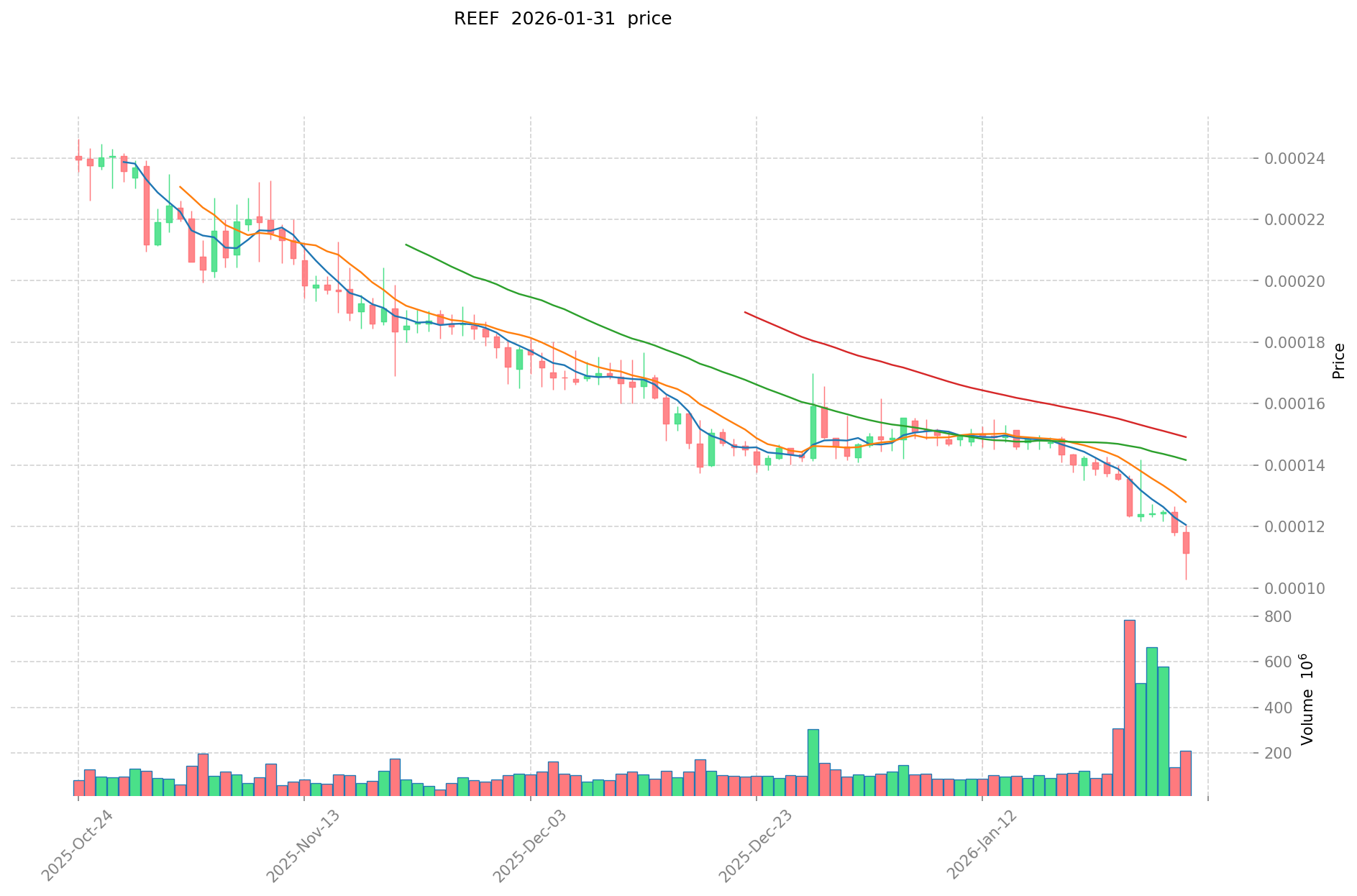
Reef (REEF) represents a notable asset in the cryptocurrency sector, having been launched in December 2020. As a Layer 1 blockchain focused on accessibility and affordability, Reef has positioned itself within the Web3 infrastructure space. As of January 31, 2026, REEF holds a market capitalization of approximately $2.57 million, with a circulating supply of around 22.82 billion tokens, and a current price hovering near $0.0001128. Ranking at position 1919 in the market with a dominance of 0.00017%, the project emphasizes low transaction fees and multi-exchange accessibility. Characterized by its mission to become the most user-friendly blockchain for Web3 participants, REEF has gradually become a subject of discussion when investors consider "Is Reef (REEF) a good investment?" This article provides a comprehensive analysis of REEF's investment characteristics, historical price movements, future price considerations, and associated risks to offer reference points for potential participants.
I. Reef (REEF) Price History Review and Investment Value Status
- 2020: REEF commenced trading on December 23, 2020 → Early adopters witnessed initial market formation
- 2021: Active trading period in Q1 2021 → REEF approached $0.05 on multiple occasions
- 2021-2026: Market cycle adjustment → Price declined from March 2021 levels to current trading range
Current REEF Investment Market Status (January 2026)
- REEF current price: $0.0001128
- Market sentiment (Fear & Greed Index): Data not available in provided materials
- 24-hour trading volume: $22,168.94
- Institutional investor holdings: Data not available in provided materials
Click to view real-time REEF market price
II. Core Factors Influencing Whether REEF is a Good Investment
Supply Mechanism and Scarcity (REEF Investment Scarcity)
- Total supply of 45,005,558,582.72 REEF with a circulating supply of 22,821,409,581 REEF (100% circulation ratio) → impacts price dynamics and investment value
- Historical pattern: REEF reached a notable price level of $0.05746 in March 2021, while recent price levels have been substantially lower at $0.0001128 as of January 31, 2026
- Investment significance: The fully circulating supply and token distribution across multiple exchanges may influence long-term investment considerations
Institutional Investment and Mainstream Adoption (Institutional Investment in REEF)
- Current holder base: 107,316 holders across the network
- Token accessibility: Available on 11 exchanges (both centralized and decentralized), facilitating widespread access
- Market position: Market capitalization of approximately $2.57 million with a market share of 0.00017%
Macroeconomic Environment's Impact on REEF Investment
- Transaction cost advantage: Network fees remain below $0.01, positioning REEF as a cost-effective blockchain option in varying economic conditions
- Market volatility considerations: REEF has experienced price fluctuations with a 1-year performance decline of 76.94% as of January 2026
- Accessibility factor: Low transaction costs and multi-platform availability may provide resilience across different economic cycles
Technology and Ecosystem Development (Technology & Ecosystem for REEF Investment)
- Layer 1 blockchain infrastructure: Designed as a fast, affordable, and efficient blockchain platform
- User accessibility focus: Mission-oriented toward becoming the most accessible blockchain for Web3 users
- Ecosystem presence: Active development community with GitHub repository and social media engagement across Twitter and Reddit platforms
- Price trends indicate recent market challenges: 7-day decline of 17.59%, 30-day decline of 19.90%, suggesting ecosystem development considerations for potential investors
III. REEF Future Investment Prediction and Price Outlook (Is Reef(REEF) worth investing in 2026-2031)
Short-term Investment Prediction (2026, short-term REEF investment outlook)
Based on technical analysis models, REEF may experience moderate volatility in 2026:
- Conservative scenario: $0.000097155 - $0.0001143
- Neutral scenario: $0.0001143 - $0.000126873
- Optimistic scenario: approaching $0.000126873
The predicted average price for 2026 stands at approximately $0.0001143, with potential fluctuations between the low of $0.000097155 and the high of $0.000126873. Market participants should note that REEF recently touched its all-time low of $0.00010998 on January 30, 2026, suggesting the asset may be in a consolidation phase.
Mid-term Investment Outlook (2027-2029, mid-term Reef(REEF) investment forecast)
-
Market stage expectation: The 2027-2029 period may witness gradual recovery and accumulation phases, with REEF potentially establishing a higher price floor compared to early 2026 levels.
-
Investment return prediction:
- 2027: $0.000104910255 - $0.000136262745, with an average of $0.0001205865
- 2028: $0.000088612989525 - $0.000181078717725, with an average of $0.0001284246225
- 2029: $0.000136181469699 - $0.000201177171146, with an average of $0.000154751670112
-
Key catalysts: The blockchain's positioning as a fast, affordable, and efficient Layer 1 solution with transaction fees below $0.01 may serve as a fundamental driver. Accessibility through multiple centralized and decentralized exchanges could support broader adoption. Technical development progress and ecosystem expansion within the Web3 space may also influence mid-term performance.
Long-term Investment Outlook (Is REEF a good long-term investment?)
- Base scenario: $0.000168176377494 - $0.000262275064902 by 2031 (assuming steady ecosystem development and maintained network efficiency)
- Optimistic scenario: $0.000200209973208 - $0.000262275064902 by 2031 (contingent on expanded use cases and favorable market conditions)
- Risk scenario: below $0.000168176377494 (under adverse market conditions or reduced adoption rates)
For detailed REEF long-term investment and price predictions, visit: Price Prediction
January 31, 2026 - 2031 Long-term Outlook
- Base scenario: $0.000168176377494 - $0.000222455525786 (corresponding to steady progress and gradual mainstream application enhancement)
- Optimistic scenario: $0.000200209973208 - $0.000262275064902 (corresponding to large-scale adoption and favorable market environment)
- Transformational scenario: above $0.000262275064902 (contingent on breakthrough ecosystem developments and mainstream penetration)
- December 31, 2031 predicted high: $0.000262275064902 (based on optimistic development assumptions)
Disclaimer: These predictions are based on technical analysis models and historical data patterns. Cryptocurrency markets involve substantial risks and volatility. Past performance does not guarantee future results. This content is for informational purposes only and should not be considered as financial advice. Investors should conduct independent research and consider their risk tolerance before making investment decisions.
| Year |
Predicted High Price |
Predicted Average Price |
Predicted Low Price |
Price Change |
| 2026 |
0.000126873 |
0.0001143 |
0.000097155 |
1 |
| 2027 |
0.000136262745 |
0.0001205865 |
0.000104910255 |
6 |
| 2028 |
0.000181078717725 |
0.0001284246225 |
0.000088612989525 |
13 |
| 2029 |
0.000201177171146 |
0.000154751670112 |
0.000136181469699 |
37 |
| 2030 |
0.000222455525786 |
0.000177964420629 |
0.000097880431346 |
57 |
| 2031 |
0.000262275064902 |
0.000200209973208 |
0.000168176377494 |
77 |
IV. Reef Investment Strategy and Risk Management (How to invest in Reef)
Investment Methodology (Reef investment strategy)
-
Long-term Holding (HODL Reef): Suitable for conservative investors who believe in the long-term potential of Reef's Layer 1 blockchain infrastructure. This approach focuses on accumulating REEF tokens during market downturns and holding through volatility cycles.
-
Active Trading: Relies on technical analysis and swing trading strategies. Given Reef's price volatility, traders may leverage support and resistance levels, trading volume patterns, and market sentiment indicators. REEF is available on 11 exchanges, providing adequate liquidity for active trading strategies.
Risk Management (Risk management for Reef investment)
-
Asset Allocation Ratios:
- Conservative investors: Allocate 1-3% of crypto portfolio to REEF
- Aggressive investors: Allocate 5-10% of crypto portfolio to REEF
- Professional investors: May allocate higher percentages based on comprehensive analysis and risk tolerance
-
Risk Hedging Solutions: Implement multi-asset portfolio strategies combining REEF with established cryptocurrencies and stablecoins. Consider utilizing stop-loss orders and portfolio rebalancing mechanisms to manage downside risks.
-
Secure Storage: Use cold wallets for long-term holdings and hot wallets for active trading. Hardware wallets are recommended for storing significant amounts of REEF tokens. Ensure proper backup procedures for wallet recovery phrases.
V. Reef Investment Risks and Challenges (Risks of investing in Reef)
-
Market Risks: REEF has demonstrated high price volatility. Historical data shows significant price fluctuations, with the token trading at $0.0001128 as of January 31, 2026. The 24-hour trading volume of approximately $22,168 indicates relatively modest liquidity compared to major cryptocurrencies, which may increase susceptibility to price manipulation.
-
Regulatory Risks: As with all cryptocurrencies, REEF faces uncertain regulatory landscapes across different jurisdictions. Changes in cryptocurrency regulations, particularly regarding Layer 1 blockchains and DeFi platforms, could impact REEF's accessibility, trading availability, and overall adoption.
-
Technical Risks: Blockchain infrastructure projects face inherent technical challenges including potential network security vulnerabilities, smart contract bugs, and risks associated with protocol upgrades. Any technical failures or security breaches could negatively impact REEF's reputation and token value.
VI. Conclusion: Is Reef a Good Investment?
-
Investment Value Summary: Reef presents itself as an accessible Layer 1 blockchain with low transaction fees (below $0.01), which may appeal to Web3 users seeking cost-effective blockchain solutions. However, the token has experienced substantial price decline, with a one-year change of -76.94%, indicating significant volatility and market challenges.
-
Investor Recommendations:
✅ Beginners: Consider dollar-cost averaging (DCA) strategy combined with secure wallet storage. Start with small allocations to understand market dynamics before increasing exposure.
✅ Experienced Investors: May explore swing trading opportunities while maintaining diversified portfolio allocation. Monitor technical indicators and market sentiment closely.
✅ Institutional Investors: Evaluate strategic long-term positioning based on comprehensive due diligence, considering Reef's technological roadmap and competitive positioning within the Layer 1 blockchain ecosystem.
⚠️ Disclaimer: Cryptocurrency investments carry high risks. This content is for informational purposes only and does not constitute investment advice. Investors should conduct thorough research and consider their risk tolerance before making any investment decisions.
VII. FAQ
Q1: Is Reef (REEF) a good investment for beginners in 2026?
For beginners, REEF presents both opportunities and significant challenges. The token currently trades at $0.0001128 with extremely low transaction fees (below $0.01), making it accessible from a cost perspective. However, REEF has experienced substantial volatility with a one-year decline of 76.94% and recently touched its all-time low on January 30, 2026. Beginners should consider starting with a dollar-cost averaging (DCA) strategy, allocating only 1-3% of their crypto portfolio to REEF, and using secure wallet storage. The token's accessibility across 11 exchanges and its Layer 1 blockchain positioning provide some fundamental support, but the high risk-to-reward ratio requires careful consideration and thorough research before investment.
Q2: What is the predicted price range for REEF in the next 3-5 years?
Based on technical analysis models, REEF's mid-term outlook shows potential for gradual recovery. For 2027, predictions suggest a range between $0.000104910255 and $0.000136262745 with an average of $0.0001205865. By 2028, the range expands to $0.000088612989525 - $0.000181078717725 (average: $0.0001284246225). Looking toward 2029, projections indicate $0.000136181469699 - $0.000201177171146 (average: $0.000154751670112). For 2030-2031, the optimistic scenario projects a high of $0.000262275064902 by December 2031. These predictions assume steady ecosystem development and favorable market conditions, though investors should note that cryptocurrency markets are highly volatile and past performance does not guarantee future results.
Q3: How does REEF's market position compare to other Layer 1 blockchains?
REEF occupies a unique but modest position in the Layer 1 blockchain space. With a market capitalization of approximately $2.57 million and ranking at position 1919 with a market dominance of 0.00017%, REEF is significantly smaller than major Layer 1 competitors. Its primary competitive advantage lies in extremely low transaction fees (below $0.01) and accessibility through 11 different exchanges. The project focuses on becoming the most user-friendly blockchain for Web3 participants, which differentiates it from technically complex alternatives. However, with a 24-hour trading volume of only $22,168.94 and 107,316 network holders, REEF faces substantial challenges in achieving mainstream adoption comparable to established Layer 1 blockchains. The token's fully circulating supply (100% circulation ratio) eliminates concerns about future token unlocks but also means limited scarcity mechanisms.
Q4: What are the main risks associated with investing in REEF?
REEF investment carries several critical risks. First, market risk is substantial—the token has experienced a 76.94% decline over one year, with short-term drops of 17.59% (7-day) and 19.90% (30-day), indicating high volatility. Second, liquidity risk exists due to relatively low trading volume ($22,168.94 daily), which could lead to significant price slippage during large transactions. Third, regulatory uncertainty affects all cryptocurrencies, and changes in crypto regulations could impact REEF's trading availability and adoption. Fourth, technical risks include potential smart contract vulnerabilities, network security threats, and challenges associated with blockchain protocol upgrades. Finally, competition risk is considerable—REEF faces intense competition from established Layer 1 blockchains with larger ecosystems and more robust developer communities. Investors should allocate only what they can afford to lose and maintain diversified portfolios.
Q5: What investment strategies work best for REEF?
Two primary strategies suit different investor profiles. For long-term holders (HODL strategy), conservative investors should allocate 1-3% of their crypto portfolio to REEF, focusing on accumulation during market downturns and holding through volatility cycles. This approach is suitable for those believing in Reef's Layer 1 infrastructure potential and Web3 accessibility mission. For active traders, technical analysis-based swing trading may capitalize on REEF's price volatility. Traders should monitor support and resistance levels, utilize the token's availability across 11 exchanges for optimal entry and exit points, and implement strict stop-loss orders due to high volatility. Regardless of strategy, investors should employ proper risk management: use cold wallets for long-term storage, hot wallets for active trading, maintain diversified portfolios combining REEF with established cryptocurrencies and stablecoins, and regularly rebalance portfolios to manage downside risks. Professional investors may increase allocations based on comprehensive due diligence, but should still maintain prudent position sizing.
Q6: How significant is REEF's low transaction fee advantage in the current market?
REEF's transaction fees below $0.01 represent a meaningful technical advantage in the blockchain ecosystem, particularly for users conducting frequent small-value transactions or interacting with decentralized applications. This cost efficiency positions REEF favorably against networks with higher gas fees, potentially attracting Web3 users prioritizing accessibility and affordability. However, while low fees provide competitive differentiation, they have not yet translated into substantial market adoption or price appreciation—as evidenced by REEF's modest market cap of $2.57 million and declining price trends. The advantage becomes most relevant during periods of network congestion on competing blockchains when users seek alternative platforms. For investors, the low-fee infrastructure suggests fundamental utility value, but ecosystem development, user adoption rates, and overall market conditions remain more decisive factors for investment returns than transaction cost advantages alone.
Q7: What factors could drive REEF's price recovery in 2026-2027?
Several potential catalysts could influence REEF's price trajectory in the near term. First, increased adoption of REEF's Layer 1 infrastructure for Web3 applications could drive organic demand, particularly if the platform successfully attracts developers building decentralized applications. Second, expansion of the token's presence on additional exchanges or integration with major DeFi protocols could improve liquidity and accessibility. Third, favorable broader cryptocurrency market conditions—such as a bull market cycle or increased institutional investment in altcoins—could create positive momentum for smaller-cap assets like REEF. Fourth, significant technical upgrades or partnership announcements could renew investor interest. However, given REEF's recent all-time low price on January 30, 2026, and substantial year-over-year decline, recovery would likely require multiple favorable factors converging simultaneously. Investors should monitor network activity metrics (transaction volume, active users, developer engagement) alongside traditional price indicators when assessing recovery potential.
Q8: Should institutional investors consider adding REEF to their portfolios?
Institutional investors should approach REEF with considerable caution and conduct comprehensive due diligence. The token's extremely small market capitalization ($2.57 million), low trading volume ($22,168.94 daily), and recent price performance (down 76.94% annually) present significant challenges for institutions requiring adequate liquidity and risk-adjusted returns. However, institutions with high-risk venture capital allocations focused on emerging blockchain infrastructure might consider strategic positioning in REEF as part of a diversified Layer 1 blockchain portfolio. Key evaluation criteria should include: assessment of Reef's technological roadmap and competitive positioning, analysis of the development team's execution capabilities and track record, evaluation of the token's role within the broader Web3 ecosystem, and consideration of regulatory compliance across relevant jurisdictions. Institutional investors should implement rigorous risk management frameworks, maintain position sizes commensurate with the asset's volatility profile, and establish clear exit strategies. Given REEF's current market dynamics, this investment would be speculative and suitable only for institutions with explicit mandates for high-risk, high-potential blockchain infrastructure plays.
* The information is not intended to be and does not constitute financial advice or any other recommendation of any sort offered or endorsed by Gate.