This comprehensive guide evaluates REI Network (REI) as an investment opportunity, analyzing its market position as an EVM-compatible Layer 1 blockchain. The article examines REI's price trajectory from $0.1506 (May 2022) to $0.003187 (January 2026), highlighting the 93.19% annual decline despite features like gas-free transactions and developer-friendly architecture. It explores core investment factors including token supply mechanisms, institutional adoption across 7 exchanges, ecosystem development with AI integration, and technological innovations. The guide provides detailed price forecasts from 2026-2031 across conservative, neutral, and optimistic scenarios, alongside practical investment strategies for different investor profiles. Critical risk analysis addresses market volatility, regulatory uncertainty, and technical vulnerabilities inherent to Layer 1 projects. Ultimately, REI represents a speculative high-risk asset suitable only for experienced traders with limited portfolio allocation, requiring
Introduction: REI Network (REI) Investment Position and Market Outlook
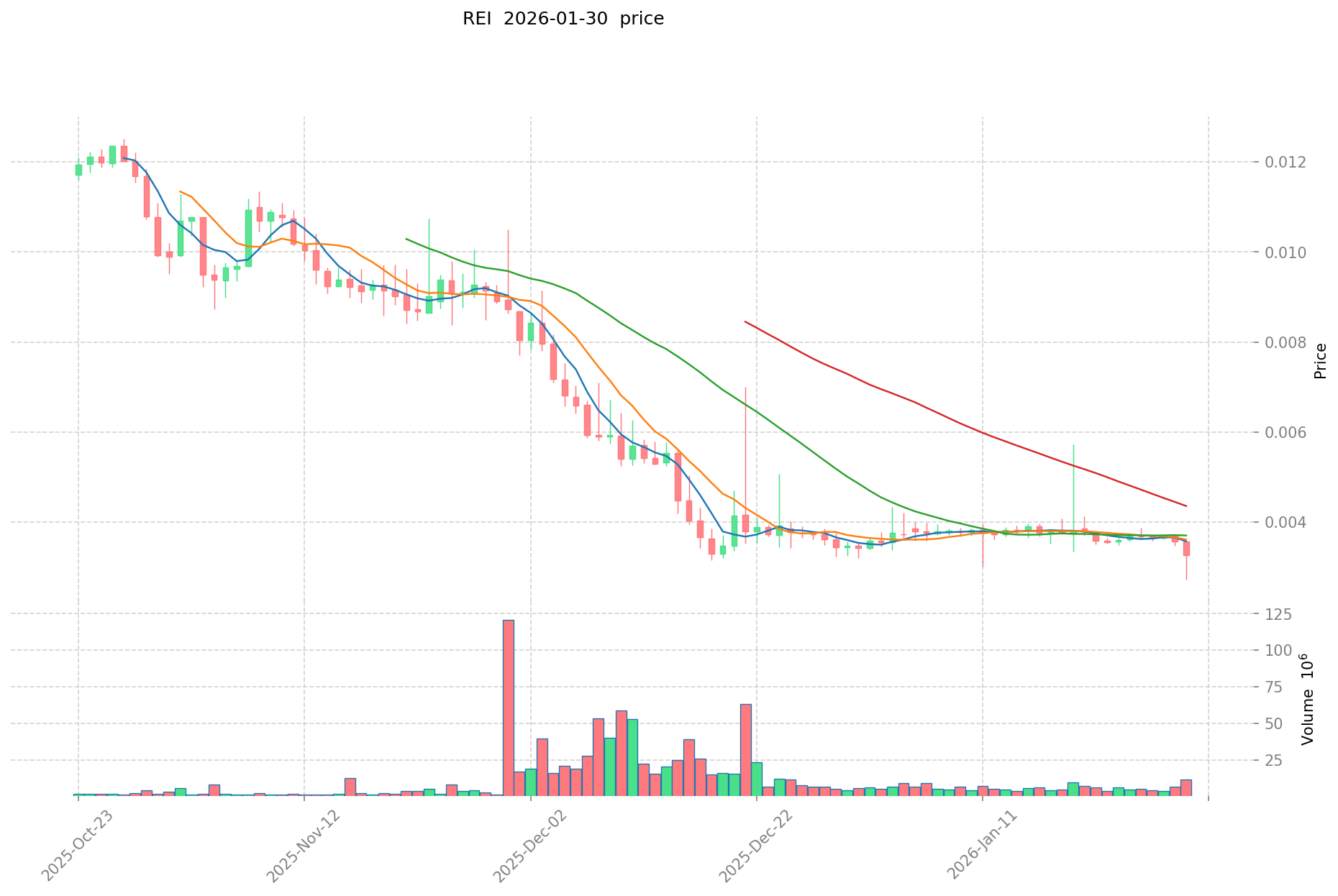
REI is a significant asset in the cryptocurrency field. As of January 2026, REI Network maintains a market capitalization of approximately $3.13 million, with a circulating supply of around 981.91 million tokens, and a current price hovering around $0.003187. Positioned as an Ethereum EVM-compatible, lightweight, and developer-friendly application-level public chain, REI has gradually become a focal point for investors exploring the question "Is REI Network (REI) a good investment?" The token originated from the replacement and increment of GXChain (GXC) mainnet tokens, following a 1:10 conversion ratio, with a maximum supply of 1 billion tokens. This article will comprehensively analyze REI's investment value, historical trends, future price predictions, and investment risks to provide reference for investors.
I. REI Token Price History Review and Current Investment Value
- 2022: Token launched at $0.1506 in May → Early investors experienced initial market entry
- 2024: REI reached a notable price level of $0.354607 in March → Price demonstrated significant volatility during this period
- 2025-2026: Market experienced downward pressure → Price declined from higher levels to $0.003187
Current REI Investment Market Status (January 2026)
- REI current price: $0.003187
- Market sentiment (Fear & Greed Index): Data indicates cautious market positioning
- 24-hour trading volume: $71,421.11
- Circulating supply: 981,908,426 REI tokens
- Market capitalization: $3,129,342.15
- Total supply: 1,000,000,000 REI
- Price change (24H): -5.48%
- Price change (7D): -10.63%
- Price change (1Y): -93.19%
- Circulating ratio: 98.19%
Click to view real-time REI market price
II. Core Factors Affecting Whether REI is a Good Investment (Is REI Network(REI) a Good Investment)
Supply Mechanism and Scarcity (REI investment scarcity)
- Maximum supply capped at 1 billion REI tokens → influences price dynamics and investment considerations
- Token conversion mechanism: REI originated from GXChain (GXC) mainnet token replacement following a 1:10 splitting rule
- Current circulation: approximately 981.9 million REI (98.19% of maximum supply) → limited room for additional supply expansion
- Investment consideration: With near-complete circulation and fixed maximum supply, scarcity factors may provide structural support for potential value appreciation
Institutional Investment and Mainstream Adoption (Institutional investment in REI)
- Exchange presence: Listed on 7 exchanges as of January 31, 2026
- Network activity: Recent on-chain staking event introduced with a reward pool of 1 million REI tokens, aimed at enhancing user engagement and network liquidity
- Ecosystem development: Integration efforts include AI modules, decentralized applications (dApps), gas-free transactions, and cross-chain operations
- Developer and enterprise positioning: Designed as an Ethereum Virtual Machine (EVM)-compatible public blockchain with lightweight and cost-free characteristics for developers and enterprises
Macroeconomic Environment's Impact on REI Investment
- Broader cryptocurrency market conditions: REI's market share stands at approximately 0.00010%, indicating exposure to overall digital asset market sentiment and macroeconomic factors
- Market capitalization positioning: Ranked around 1800 with a market capitalization of approximately $3.13 million and fully diluted valuation of approximately $3.19 million
- Performance context: 1-year price movement shows substantial decline (-93.19%), reflecting sensitivity to market cycles and external economic conditions
- Investment environment: Cryptocurrency investments remain subject to monetary policy shifts, inflation dynamics, and regulatory developments that may affect risk appetite
Technology and Ecosystem Development (Technology & Ecosystem for REI investment)
- EVM compatibility: Full compatibility with Ethereum Virtual Machine enables seamless migration of existing Ethereum-based applications
- Gas-free transaction model: Zero-fee structure designed to lower barriers for developers and users
- Cross-chain infrastructure: Development roadmap includes multi-chain liquidity bridges and cross-chain operational capabilities
- AI integration: Incorporation of AI modules into the ecosystem framework, with REI tokens utilized for AI module calls and related operations
- Governance mechanism: Plans for incentivized participation including voting, proposals, and community coordination linked to token rewards
- DeFi ecosystem: Recent launch of on-chain staking mechanisms designed to secure network liquidity (Total Value Locked) and reward long-term participants
- Scalability features: Architecture designed for infinite extensibility while maintaining lightweight operational characteristics
III. REI Future Investment Forecast and Price Outlook (Is REI Network(REI) worth investing in 2026-2031)
Short-term Investment Forecast (2026, short-term REI investment outlook)
- Conservative forecast: $0.00268464 - $0.003196
- Neutral forecast: $0.003196 - $0.00428264
- Optimistic forecast: $0.00428264 or above
Mid-term Investment Outlook (2027-2029, mid-term REI Network(REI) investment forecast)
- Market stage expectation: REI Network may experience gradual development during this period, with price movements potentially influenced by adoption trends and broader market conditions.
- Investment return forecast:
- 2027: $0.0034027812 - $0.0054594072
- 2028: $0.004461382692 - $0.00482933178
- 2029: $0.0035357607675 - $0.0069300911043
- Key catalysts: Factors may include ecosystem expansion, developer adoption, and overall market sentiment toward EVM-compatible blockchain solutions.
Long-term Investment Outlook (Is REI a good long-term investment?)
- Base scenario: $0.005758174983781 - $0.007632929629663 (assuming steady development and moderate market conditions)
- Optimistic scenario: $0.007568885216295 - $0.007632929629663 or higher (assuming favorable market environment and increased adoption)
- Risk scenario: Below $0.00349333163829 (under adverse market conditions or limited ecosystem growth)
Click to view REI long-term investment and price forecast: Price Prediction
2026-01-31 - 2031 Long-term Outlook
- Base scenario: $0.00349333163829 - $0.006695552306722 (corresponding to stable progress and steady mainstream application growth)
- Optimistic scenario: $0.00582221939715 - $0.007632929629663 (corresponding to large-scale adoption and favorable market environment)
- Transformational scenario: Above $0.007632929629663 (if ecosystem achieves breakthrough progress and mainstream popularization)
- 2031-12-31 forecast high: $0.007632929629663 (based on optimistic development assumptions)
Disclaimer: Price forecasts are based on historical data analysis and market modeling. Cryptocurrency markets are highly volatile, and actual prices may differ significantly from predictions. This information does not constitute investment advice, and investors should conduct their own research and consider their risk tolerance before making investment decisions.
| Year |
Predicted High Price |
Predicted Average Price |
Predicted Low Price |
Price Change |
| 2026 |
0.00428264 |
0.003196 |
0.00268464 |
0 |
| 2027 |
0.0054594072 |
0.00373932 |
0.0034027812 |
17 |
| 2028 |
0.00482933178 |
0.0045993636 |
0.004461382692 |
44 |
| 2029 |
0.0069300911043 |
0.00471434769 |
0.0035357607675 |
47 |
| 2030 |
0.007568885216295 |
0.00582221939715 |
0.00349333163829 |
82 |
| 2031 |
0.007632929629663 |
0.006695552306722 |
0.005758174983781 |
110 |
IV. REI Investment Strategy and Risk Management (How to invest in Layer 1 Blockchain)
Investment Methodology (REI investment strategy)
Long-term Holding (HODL REI): Suitable for Conservative Investors
Long-term holding involves acquiring REI tokens and maintaining positions over extended periods, typically measured in years rather than months. This approach may suit investors who believe in the fundamental development trajectory of the REI Network ecosystem and its EVM-compatible infrastructure. Conservative investors utilizing this strategy should consider dollar-cost averaging to mitigate the impact of price volatility, given REI's historical price fluctuation from an all-time high of $0.354607 (March 29, 2024) to an all-time low of $0.00315219 (January 30, 2026). The current circulating supply of 981,908,426 REI tokens (98.19% of maximum supply) suggests limited future dilution risk from token unlocks.
Active Trading: Relying on Technical Analysis and Swing Trading
Active trading strategies focus on capitalizing on REI's price movements through technical analysis and swing trading techniques. With 24-hour trading volume of $71,421.11 and a 24-hour price range between $0.002721 and $0.003405, REI exhibits volatility characteristics that may present opportunities for experienced traders. Technical traders should monitor key support and resistance levels, volume patterns, and correlation with broader cryptocurrency market movements. The token's availability on 7 exchanges provides liquidity options, though traders should be aware of potential slippage and exchange-specific risks.
Risk Management (Risk management for REI investment)
Asset Allocation Ratios: Conservative / Aggressive / Professional Investors
-
Conservative Investors: Consider allocating no more than 1-3% of total cryptocurrency portfolio to REI, given its relatively lower market capitalization of approximately $3.13 million and ranking around position 1800. This allocation should be part of a diversified basket of established and emerging blockchain projects.
-
Aggressive Investors: May allocate 5-10% of cryptocurrency holdings to REI, accepting higher volatility in exchange for potential upside from ecosystem development and adoption of the EVM-compatible, lightweight public chain infrastructure.
-
Professional Investors: Institutional or sophisticated investors might employ dynamic allocation strategies ranging from 2-8%, adjusting positions based on technical indicators, fundamental developments, and macro cryptocurrency market conditions.
Risk Hedging Solutions: Multi-asset Portfolio + Hedging Instruments
Investors should implement risk mitigation strategies through portfolio diversification across multiple blockchain ecosystems rather than concentrated exposure to REI. Hedging approaches may include maintaining positions in stablecoins for liquidity management, holding established Layer 1 tokens as portfolio ballast, and utilizing stop-loss orders to limit downside exposure. Given REI's 93.19% decline over the past year, position sizing and risk controls become particularly important considerations.
Secure Storage: Hot/Cold Wallets + Hardware Wallet Recommendations
REI token security should follow industry best practices for digital asset custody:
-
Hot Wallets: Suitable for active trading amounts only, with recommended allocation of less than 10% of total REI holdings. EVM-compatible wallets that support custom token additions can be used for REI storage.
-
Cold Wallets: Majority of REI holdings should be transferred to cold storage solutions for long-term security. Hardware wallets that support EVM-compatible tokens provide enhanced security against online threats.
-
Multi-signature Solutions: Larger holders should consider multi-signature wallet arrangements for additional security layers, particularly given the irreversible nature of blockchain transactions.
V. REI Investment Risks and Challenges (Risks of investing in Layer 1 Blockchain)
Market Risks: High Volatility and Price Manipulation
REI demonstrates significant price volatility, with recent fluctuations including a 5.48% decline over 24 hours and a 10.63% decrease over 7 days. The relatively modest 24-hour trading volume of $71,421.11 combined with a market capitalization of approximately $3.13 million creates conditions where market depth may be limited. This liquidity profile potentially exposes investors to higher price slippage during entry or exit transactions, particularly for larger position sizes. The substantial 93.19% decline over the past year from higher price levels indicates exposure to broader cryptocurrency market downturns and project-specific factors.
Regulatory Risks: Policy Uncertainty Across Different Jurisdictions
As an EVM-compatible Layer 1 blockchain, REI Network operates within the evolving global regulatory landscape for cryptocurrencies and blockchain technology. Different jurisdictions maintain varying approaches to cryptocurrency regulation, ranging from supportive frameworks to restrictive policies. Changes in regulatory stances, particularly regarding blockchain infrastructure projects, token classifications, or cross-border transactions, could impact REI's operational environment and token utility. Investors should monitor regulatory developments in key markets and assess how compliance requirements might affect the project's development trajectory or token accessibility.
Technical Risks: Network Security Vulnerabilities and Upgrade Failures
REI Network's technical architecture as an EVM-compatible, lightweight public chain introduces specific risk considerations. Blockchain networks face ongoing challenges related to consensus mechanism security, smart contract vulnerabilities, and network upgrade implementations. Any technical issues, security breaches, or failed protocol upgrades could impact network functionality and token value. The project's approach to addressing scalability, maintaining network security, and implementing technical improvements represents ongoing risk factors that investors should evaluate. Additionally, competition from other EVM-compatible chains and evolving blockchain technology standards may affect REI Network's competitive positioning.
VI. Conclusion: Is Layer 1 Blockchain a Good Investment?
Investment Value Summary
REI Network presents a mixed investment profile characterized by significant near-term challenges alongside its positioning as an EVM-compatible, lightweight blockchain infrastructure. The project's approach to providing developer-friendly, low-cost blockchain solutions addresses recognized needs in the blockchain ecosystem. However, the substantial price decline of 93.19% over the past year, combined with modest trading volumes and market capitalization, reflects considerable market uncertainty regarding the project's adoption trajectory and competitive positioning among Layer 1 alternatives.
Investor Recommendations
✅ Beginners: Consider REI only as a small experimental allocation within a diversified cryptocurrency portfolio. Utilize dollar-cost averaging if investing, and prioritize secure storage through hardware wallet solutions that support EVM-compatible tokens. Limit exposure to amounts you can afford to lose entirely, given the high volatility and speculative nature of lower-capitalization cryptocurrency projects.
✅ Experienced Investors: May explore swing trading opportunities based on technical analysis, while maintaining strict position sizing limits (1-3% of cryptocurrency portfolio). Experienced traders should monitor trading volume patterns, key technical levels, and broader market correlations. Consider REI within a basket approach to emerging Layer 1 projects rather than concentrated exposure.
✅ Institutional Investors: Approach REI Network as a speculative allocation within broader blockchain infrastructure exposure strategies. Conduct thorough due diligence on project development progress, ecosystem adoption metrics, and competitive positioning. Institutional allocations should be limited and accompanied by comprehensive risk assessment frameworks.
⚠️ Disclaimer: Cryptocurrency investment carries substantial risk, including potential total loss of capital. This analysis is provided for informational purposes only and does not constitute investment advice. Market conditions, project developments, and regulatory environments can change rapidly. Investors should conduct independent research, assess personal risk tolerance, and consider consulting qualified financial advisors before making investment decisions. Past performance does not guarantee future results, and cryptocurrency markets remain highly speculative.
VII. FAQ
Q1: What is REI Network and what makes it different from other blockchain platforms?
REI Network is an Ethereum Virtual Machine (EVM)-compatible, lightweight, and developer-friendly Layer 1 blockchain designed for application development. What distinguishes REI from other blockchain platforms is its zero-fee transaction model, which eliminates gas costs for developers and users, creating a more accessible environment for decentralized application (dApp) deployment. The network originated from GXChain (GXC) through a 1:10 token conversion mechanism, with a maximum supply capped at 1 billion REI tokens. As of January 2026, REI maintains a market capitalization of approximately $3.13 million with 981.9 million tokens in circulation (98.19% of maximum supply). The platform emphasizes infinite scalability while maintaining lightweight operational characteristics, and incorporates AI modules, cross-chain infrastructure, and a governance mechanism designed to incentivize community participation through voting and proposal rewards.
Q2: Has REI Network been a profitable investment historically?
REI Network has experienced substantial price volatility with significant downward pressure over recent periods. The token launched at $0.1506 in May 2022 and reached a notable high of $0.354607 in March 2024. However, by January 2026, the price declined to approximately $0.003187, representing a 93.19% decrease over the past year. Recent short-term performance shows continued decline with -5.48% over 24 hours and -10.63% over 7 days. This historical trajectory indicates that early investors who acquired REI at higher price levels have experienced substantial losses. The current trading volume of $71,421.11 and modest market capitalization suggest limited liquidity conditions. Investors should recognize that REI's historical performance reflects considerable market uncertainty and competitive challenges within the Layer 1 blockchain space, making it a high-risk speculative asset rather than a consistently profitable investment vehicle.
Q3: What factors could influence REI's future price performance?
Several key factors may influence REI Network's future price trajectory. First, ecosystem development and adoption rates will be critical—successful integration of AI modules, expansion of decentralized applications, implementation of cross-chain operations, and growth in developer activity could positively impact token value. Second, broader cryptocurrency market conditions significantly affect REI given its 0.00010% market share, making it highly sensitive to overall digital asset sentiment, regulatory developments, and macroeconomic factors including monetary policy and inflation dynamics. Third, competitive positioning among EVM-compatible blockchains will influence adoption—REI's gas-free transaction model and lightweight architecture must differentiate effectively against established Layer 1 alternatives. Fourth, network activity metrics such as Total Value Locked (TVL) in the recently launched staking mechanism, transaction volumes, and active wallet growth provide indicators of organic adoption. Finally, liquidity improvements through exchange listings and institutional interest could reduce volatility and support price stability, though current market depth remains limited.
Q4: What investment strategy is most appropriate for REI Network tokens?
The appropriate investment strategy for REI depends on investor profile and risk tolerance. Conservative investors should consider REI only as a minimal allocation (1-3% of cryptocurrency portfolio) within a diversified basket of blockchain projects, utilizing dollar-cost averaging to mitigate volatility impact. This approach suits those who believe in the long-term potential of EVM-compatible infrastructure but recognize the substantial risks associated with lower-capitalization projects. Aggressive investors might allocate 5-10% while accepting higher volatility for potential upside from ecosystem development, though this requires careful position sizing given the 93.19% annual decline. Active traders may explore swing trading opportunities based on technical analysis, monitoring the 24-hour price range and volume patterns, though they should be aware of liquidity constraints and potential slippage. All investors should implement strict risk management including secure storage through hardware wallets, position limits aligned with risk tolerance, and diversification across multiple blockchain ecosystems. Beginners should approach REI as an experimental allocation only, limiting exposure to amounts they can afford to lose entirely.
Q5: What are the primary risks of investing in REI Network?
REI Network investment carries several significant risks that investors must carefully evaluate. Market risk is substantial—the token demonstrates high volatility with a 93.19% decline over the past year, limited trading volume of $71,421.11, and modest market capitalization of approximately $3.13 million, creating conditions for potential price manipulation and liquidity challenges during position entry or exit. Regulatory risk stems from evolving cryptocurrency policies across different jurisdictions, which could impact REI's operational environment, token classification, or cross-border transaction capabilities. Technical risk includes potential network security vulnerabilities, smart contract exploits, protocol upgrade failures, and competition from other EVM-compatible chains that may affect REI's competitive positioning. Project-specific risks relate to ecosystem adoption uncertainty, developer engagement levels, and the ability to achieve sustainable network growth in a competitive Layer 1 landscape. Additionally, the near-complete circulation (98.19% of maximum supply) limits future dilution concerns but also indicates minimal room for supply-driven scarcity effects. Investors should recognize that REI represents a speculative, high-risk asset with potential for total capital loss.
Q6: How does REI Network's technology compare to established blockchain platforms?
REI Network positions itself as an EVM-compatible, lightweight alternative to established blockchain platforms, offering several distinct technical features. The full Ethereum Virtual Machine compatibility enables seamless migration of existing Ethereum-based applications, providing developers with familiar tooling and frameworks. REI's gas-free transaction model represents a significant departure from traditional blockchain fee structures, potentially lowering barriers for developers and users compared to Ethereum's variable gas costs or other Layer 1 platforms' transaction fees. The architecture emphasizes infinite scalability while maintaining lightweight operational characteristics, though actual performance metrics compared to established platforms require ongoing evaluation. Plans for cross-chain infrastructure and AI module integration demonstrate forward-looking technical ambitions, though implementation maturity and real-world adoption remain in developmental stages. However, REI faces significant competition from established Layer 1 platforms with larger ecosystems, more substantial developer communities, and proven track records. The modest market capitalization and limited trading activity suggest that REI's technical features have not yet translated into widespread adoption or competitive differentiation sufficient to challenge more established alternatives.
Q7: What is the outlook for REI Network's price from 2026 to 2031?
Price forecasts for REI Network from 2026 to 2031 present a range of scenarios based on different adoption and market condition assumptions. Short-term projections for 2026 range from a conservative $0.00268464-$0.003196 to an optimistic $0.00428264 or above. Mid-term forecasts for 2027-2029 show potential gradual development with 2027 estimates of $0.0034027812-$0.0054594072, 2028 projections of $0.004461382692-$0.00482933178, and 2029 expectations of $0.0035357607675-$0.0069300911043. Long-term outlook through 2031 presents a base scenario of $0.005758174983781-$0.007632929629663 assuming steady development and moderate market conditions, with an optimistic scenario reaching $0.007632929629663 or higher under favorable adoption and market environments. However, a risk scenario projects prices below $0.00349333163829 under adverse conditions. These forecasts depend heavily on ecosystem expansion, developer adoption, broader cryptocurrency market sentiment, and REI's ability to differentiate within the competitive EVM-compatible blockchain landscape. Investors should recognize that cryptocurrency price predictions carry substantial uncertainty, and actual prices may differ significantly from projections due to market volatility and unforeseen developments.
Q8: Where can I buy REI tokens and how should I store them securely?
REI tokens are available for purchase on 7 cryptocurrency exchanges as of January 31, 2026, providing multiple access points for investors. When selecting an exchange, consider factors including trading volume, liquidity depth, security track record, and regulatory compliance in your jurisdiction. After purchasing REI tokens, implementing proper security measures is essential for protecting your investment. For active trading amounts, EVM-compatible hot wallets that support custom token additions can be used, but allocate no more than 10% of total REI holdings to hot wallet storage due to online security risks. The majority of REI holdings should be transferred to cold storage solutions, with hardware wallets that support EVM-compatible tokens providing enhanced security against online threats. Hardware wallet brands that support Ethereum-based tokens can typically accommodate REI through custom token addition features. For larger holdings, consider implementing multi-signature wallet arrangements for additional security layers, particularly given the irreversible nature of blockchain transactions. Always verify wallet addresses carefully before transactions, enable all available security features, maintain secure backups of recovery phrases in offline locations, and never share private keys or seed phrases with anyone.
* The information is not intended to be and does not constitute financial advice or any other recommendation of any sort offered or endorsed by Gate.