Renzo (REZ) is a Liquid Restaking Token and Strategy Manager for EigenLayer that launched in April 2024, enabling users to participate in Ethereum's restaking ecosystem while maintaining liquidity. Currently trading at $0.004578 with a market cap of $20.59 million, REZ has experienced significant volatility, declining 84% from its all-time high of $0.265. This comprehensive analysis examines REZ's investment potential through multiple lenses: historical price performance, supply mechanics affecting scarcity, ecosystem integration within EigenLayer, and macroeconomic influences. Price projections suggest a range from $0.0025 to $0.0076 through 2031, depending on ecosystem adoption rates. The investment thesis balances opportunities in the emerging liquid restaking sector against substantial risks including market volatility, regulatory uncertainty, and technical dependencies. Suitable allocation ranges from 1-10% based on investor risk profiles, with emphasis on secure storage and diversified portfolio strateg
Introduction: Renzo (REZ) Investment Position and Market Outlook
REZ is a digital asset within the cryptocurrency sector, having launched in April 2024 as a Liquid Restaking Token (LRT) and Strategy Manager for EigenLayer. As of January 23, 2026, REZ holds a market capitalization of approximately $20.59 million with a circulating supply of around 4.50 billion tokens, and its current price stands at approximately $0.004578. With its positioning as an interface to the EigenLayer ecosystem that facilitates Actively Validated Services (AVSs) and aims to provide yields beyond traditional ETH staking, REZ has become a subject of discussion among investors evaluating "Is Renzo (REZ) a good investment?" This article will comprehensively analyze REZ's investment characteristics, historical price movements, future price projections, and associated investment risks to provide reference for investors.
I. REZ Price History Review and Investment Value Status
- 2024: Initial token launch in April → REZ opened at $0.05 with significant price volatility in early trading period
- 2024: Peak valuation reached in April 2024 → Price climbed to $0.265 following launch momentum
- 2024-2025: Market adjustment cycle → Price declined from April 2024 levels to December 2025 range
Current REZ Investment Market Status (January 2026)
- REZ current price: $0.004578
- 24-hour trading volume: $68,655.45
- Circulating supply: 4,497,083,777.41 REZ
- Market capitalization: $20,587,649.53
- Total supply: 9,821,668,820.83 REZ
- Maximum supply: 10,000,000,000 REZ
- Circulating supply ratio: 44.97%
Click to view real-time REZ market price
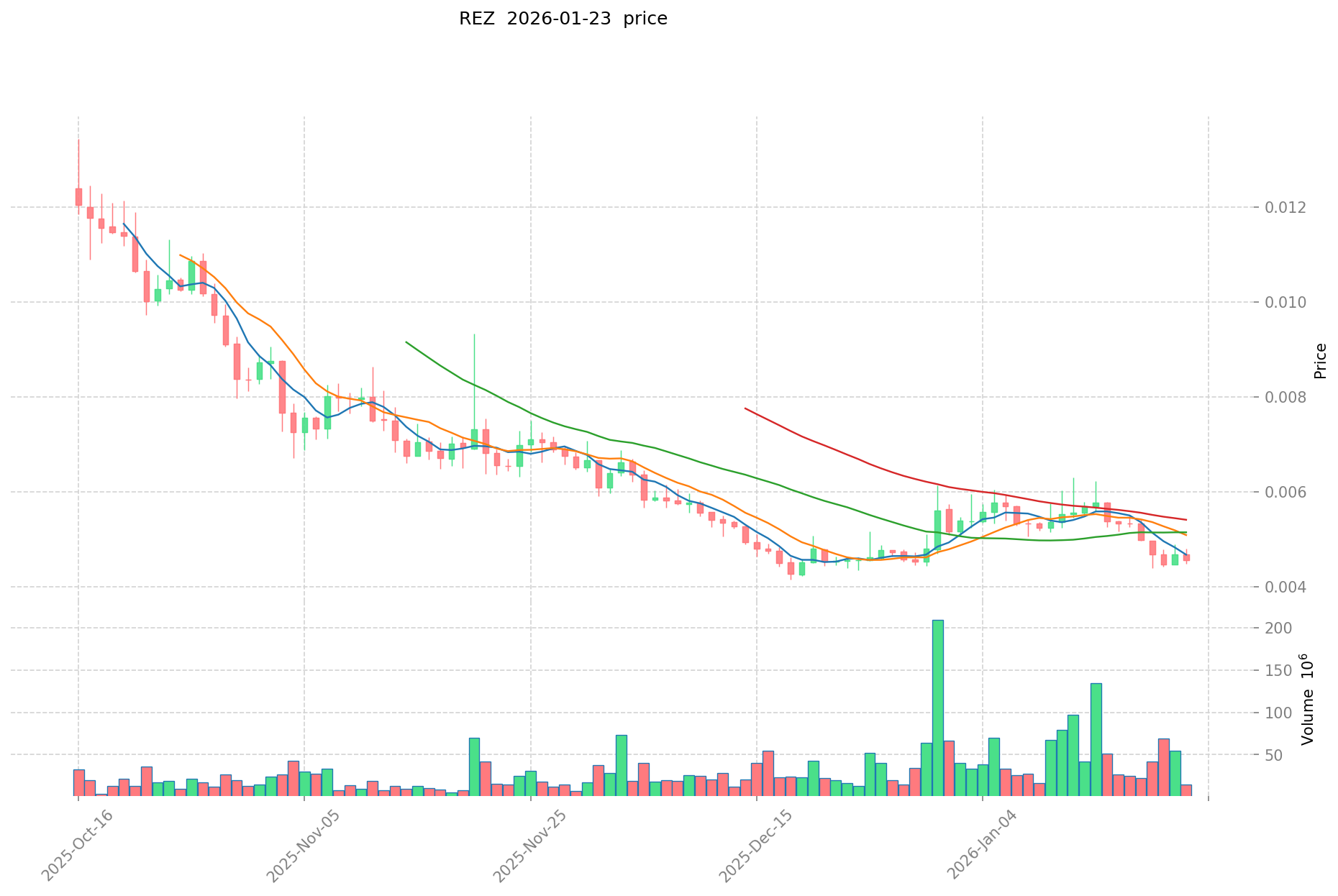
II. Core Factors Affecting Whether REZ is a Good Investment (Is Renzo(REZ) a Good Investment)
Supply Mechanism and Scarcity (REZ investment scarcity)
- Supply mechanism → affects price and investment value
- Historical patterns: supply changes have influenced REZ price movements
- Investment significance: scarcity is a key factor supporting long-term investment
Renzo (REZ) operates with a defined token supply structure. The current circulating supply stands at approximately 4.50 billion tokens, representing about 45% of the total supply of 9.82 billion tokens. The maximum supply is capped at 10 billion tokens. This supply distribution creates a partial scarcity dynamic, with more than half of the total supply yet to enter circulation. The circulating supply ratio and controlled token release may influence price dynamics over time. The token has experienced price fluctuations since its launch, with historical data showing various price levels throughout its trading history. Understanding the supply schedule and unlock mechanisms remains important for assessing potential dilution effects on investment value.
Institutional Investment and Mainstream Adoption (Institutional investment in REZ)
- Institutional holding trends
- Enterprise adoption of REZ → enhances investment value
- Policy impact on REZ investment outlook
Renzo functions as a Liquid Restaking Token (LRT) and Strategy Manager for EigenLayer, serving as an interface to the EigenLayer ecosystem. The protocol is designed to simplify complexity for end-users and facilitate collaboration with EigenLayer node operators. The holder count stands at approximately 54,118 addresses. The project advocates for EigenLayer's goal of facilitating permissionless innovation on Ethereum and programmatically acquiring trust for the ecosystem. REZ is listed on 31 exchanges, indicating a certain level of market accessibility. The protocol's positioning within the EigenLayer ecosystem represents its connection to institutional-grade infrastructure development in the Ethereum staking landscape.
Macroeconomic Environment's Impact on REZ Investment
- Monetary policy and interest rate changes → alter investment attractiveness
- Hedging role in inflationary environments → "digital gold" positioning
- Geopolitical uncertainty → strengthens REZ investment demand
As a token within the broader cryptocurrency ecosystem, REZ may be influenced by macroeconomic factors affecting digital assets generally. Monetary policy shifts, interest rate adjustments, and changes in liquidity conditions can impact investor risk appetite for cryptocurrency investments. During periods of heightened inflation concerns, some investors may seek alternative assets, though REZ's specific correlation with macroeconomic variables would require individual assessment. Geopolitical developments and regulatory changes in major markets can affect sentiment toward cryptocurrency investments. The token's performance may also be influenced by broader trends in the Ethereum ecosystem and the DeFi sector, which can be affected by macroeconomic conditions.
Technology and Ecosystem Development (Technology & Ecosystem for REZ investment)
- Technical upgrades: enhance network performance → strengthen investment appeal
- Ecosystem expansion: expand application scope → support long-term value
- DeFi, NFT, and payment applications driving investment value
Renzo is built on the ERC-20 standard and operates within the Ethereum ecosystem. The protocol focuses on liquid restaking functionality, offering users the ability to participate in EigenLayer's restaking mechanism while maintaining liquidity. The technical architecture is designed to provide higher yields compared to standard ETH staking by securing Actively Validated Services (AVSs). The protocol abstracts complexity from end-users, which may contribute to broader accessibility. Development activity and ecosystem integration within the EigenLayer framework represent ongoing technical factors. The protocol's documentation and technical resources are available for review. As the EigenLayer ecosystem evolves, Renzo's integration and utility within this infrastructure may influence its long-term investment characteristics.
III. REZ Future Investment Prediction and Price Outlook (Is Renzo(REZ) worth investing in 2026-2031)
Short-term Investment Prediction (2026, short-term REZ investment outlook)
- Conservative Forecast: $0.0025 - $0.0046
- Neutral Forecast: $0.0046 - $0.0048
- Optimistic Forecast: $0.0048 and above
Based on the current market data, REZ is trading at $0.004578 as of January 23, 2026. The token has experienced notable volatility, with a 7-day decline of 14.78% and a 1-year decline of 84% from its historical high of $0.265. Short-term projections suggest the price may range between $0.0025 and $0.0048 throughout 2026, with the predicted average price around $0.004576.
Mid-term Investment Outlook (2027-2029, mid-term Renzo(REZ) investment forecast)
- Market Stage Expectation: Recovery and stabilization phase with gradual price appreciation
- Investment Return Prediction:
- 2027: $0.0045 - $0.0057 (2% estimated increase)
- 2028: $0.0034 - $0.0066 (13% estimated increase)
- 2029: $0.0045 - $0.0061 (29% estimated increase from base year)
- Key Catalysts: Integration with EigenLayer ecosystem expansion, increased adoption of liquid restaking services, and broader participation in Actively Validated Services (AVS)
The mid-term outlook indicates a recovery trajectory following the significant decline observed in 2024-2025. The protocol's role as a Liquid Restaking Token (LRT) for EigenLayer positions it to benefit from growing interest in restaking mechanisms and higher yield opportunities compared to traditional ETH staking.
Long-term Investment Outlook (Is Renzo a good long-term investment?)
- Base Scenario: $0.0041 - $0.0065 (assuming steady ecosystem development and moderate market conditions)
- Optimistic Scenario: $0.0059 - $0.0076 (assuming strong EigenLayer ecosystem growth and increased AVS participation)
- Risk Scenario: $0.0025 - $0.0042 (under challenging market conditions or reduced restaking demand)
For more details on REZ long-term investment and price prediction: Price Prediction
2026-01-23 - 2031 Long-term Outlook
- Base Scenario: $0.0041 - $0.0062 USD (corresponding to steady progress and mainstream application growth)
- Optimistic Scenario: $0.0060 - $0.0076 USD (corresponding to large-scale adoption and favorable market environment)
- Transformative Scenario: Above $0.0076 USD (if ecosystem achieves breakthrough developments and mainstream adoption)
- 2031-12-31 Predicted High: $0.0076 USD (based on optimistic development assumptions)
The long-term investment case for REZ depends significantly on the success of the EigenLayer ecosystem and the broader adoption of liquid restaking solutions. With a current market cap of approximately $20.59 million and a circulating supply representing 44.97% of the maximum supply, the token has substantial room for growth. However, investors should note the token's historical volatility and the 84% decline from its all-time high. The protocol's focus on simplifying user interaction with EigenLayer and facilitating permissionless innovation on Ethereum provides fundamental support, though market conditions and competitive dynamics will remain important factors.
Disclaimer: The above predictions are based on historical data, market trends, and technical analysis. Cryptocurrency investments carry significant risks, and past performance does not guarantee future results. Investors should conduct their own research and consider their risk tolerance before making investment decisions.
| Year |
Predicted High Price |
Predicted Average Price |
Predicted Low Price |
Price Change |
| 2026 |
0.0048048 |
0.004576 |
0.0025168 |
0 |
| 2027 |
0.005722288 |
0.0046904 |
0.004502784 |
2 |
| 2028 |
0.00661205688 |
0.005206344 |
0.0033841236 |
13 |
| 2029 |
0.0060864764532 |
0.00590920044 |
0.0044909923344 |
29 |
| 2030 |
0.006477665522328 |
0.0059978384466 |
0.004138508528154 |
31 |
| 2031 |
0.007610057421046 |
0.006237751984464 |
0.00417929382959 |
36 |
IV. REZ Investment Strategy and Risk Management (How to invest in Liquid Restaking Tokens)
Investment Methodology (REZ investment strategy)
Long-term Holding (HODL REZ): Suitable for Conservative Investors
For investors seeking stable exposure to the Ethereum restaking ecosystem, a long-term holding strategy may be appropriate. This approach involves acquiring REZ tokens and maintaining positions through market cycles, potentially benefiting from the growth of EigenLayer's actively validated services (AVS) network. Conservative investors typically allocate a smaller percentage of their portfolio to such assets, focusing on the protocol's fundamental role as a liquid restaking token within the EigenLayer ecosystem.
Active Trading: Technical Analysis and Swing Operations
Active traders may approach REZ through technical analysis and swing trading strategies. With 24-hour trading volume reaching $68,655.45 and price fluctuations between $0.004481 and $0.004803, the token exhibits intraday volatility that experienced traders might utilize. This strategy requires continuous market monitoring, understanding of support and resistance levels, and disciplined risk management protocols.
Risk Management (Risk management for REZ investment)
Asset Allocation Ratios: Conservative / Aggressive / Professional Investors
- Conservative Investors: May consider allocating 1-3% of their crypto portfolio to REZ, given its position within the emerging liquid restaking sector
- Aggressive Investors: Could allocate 5-10% to REZ while maintaining diversification across other DeFi protocols
- Professional Investors: May implement dynamic allocation strategies based on protocol metrics, EigenLayer adoption rates, and broader market conditions
Risk Hedging Solutions: Multi-asset Portfolio + Hedging Tools
Investors should consider diversification across different crypto categories to mitigate concentration risk. Potential hedging approaches include maintaining core positions in established assets, utilizing stablecoins for liquidity management, and considering correlation factors with Ethereum's performance given REZ's ecosystem dependency.
Secure Storage: Hot and Cold Wallets + Hardware Wallet Recommendations
Given REZ's ERC-20 standard deployment on Ethereum mainnet (contract address: 0x3B50805453023a91a8bf641e279401a0b23FA6F9), investors should implement appropriate storage solutions:
- Cold Storage: Hardware wallets supporting ERC-20 tokens provide enhanced security for long-term holdings
- Hot Wallets: For active traders, reputable software wallets with multi-signature capabilities offer convenience with reasonable security
- Exchange Storage: Limited amounts for trading purposes only, with majority holdings moved to self-custody solutions
V. REZ Investment Risks and Challenges (Risks of investing in Liquid Restaking Tokens)
Market Risk: High Volatility and Price Fluctuations
REZ demonstrates substantial price volatility, with weekly performance showing -14.78% fluctuation. The token's price range from an all-time low of $0.004148 (December 18, 2025) to current levels of $0.004578 illustrates significant short-term price movements. Investors should be prepared for continued volatility as the liquid restaking sector matures and market participants adjust their positions based on EigenLayer ecosystem developments.
Regulatory Risk: Policy Uncertainty Across Jurisdictions
As a liquid restaking token within the DeFi ecosystem, REZ faces regulatory uncertainties across different jurisdictions. The evolving nature of restaking protocols and their classification under existing securities regulations presents ongoing compliance considerations. Changes in regulatory frameworks regarding staking derivatives, token classifications, or DeFi protocols could impact REZ's operational environment and market accessibility.
Technical Risk: Network Security and Protocol Vulnerabilities
Technical considerations include smart contract risks associated with the EigenLayer integration, potential vulnerabilities in the restaking mechanism, and dependencies on Ethereum network stability. As REZ serves as an interface to the EigenLayer ecosystem and manages strategies for actively validated services, any technical issues affecting these underlying protocols could impact REZ token holders. Additionally, protocol upgrades or modifications to the restaking framework require careful assessment of implementation risks.
VI. Conclusion: Is Liquid Restaking Token a Good Investment?
Investment Value Summary
REZ represents participation in the emerging liquid restaking sector within the Ethereum ecosystem, offering exposure to EigenLayer's actively validated services network. The protocol's role in simplifying restaking complexity and enabling collaboration between users and node operators positions it within a developing infrastructure layer. However, the token has experienced substantial price fluctuations, with year-to-date performance showing significant volatility.
Investor Recommendations:
✅ Beginners: Consider dollar-cost averaging strategies combined with secure self-custody wallet storage. Focus on understanding the underlying restaking mechanism and EigenLayer ecosystem before committing significant capital.
✅ Experienced Investors: May implement swing trading strategies while maintaining core positions. Portfolio allocation should reflect risk tolerance and understanding of liquid restaking token dynamics within broader DeFi trends.
✅ Institutional Investors: Strategic allocation decisions should incorporate thorough due diligence on protocol mechanics, team execution capability, and competitive positioning within the restaking landscape.
⚠️ Important Notice: Cryptocurrency investments carry substantial risk and high volatility. This content is provided for informational purposes only and does not constitute investment advice. Investors should conduct independent research and consider their financial situation before making investment decisions.
VII. FAQ
Q1: What is Renzo (REZ) and how does it function within the EigenLayer ecosystem?
Renzo (REZ) is a Liquid Restaking Token (LRT) and Strategy Manager for EigenLayer that launched in April 2024. It serves as an interface to the EigenLayer ecosystem, simplifying the restaking process for end-users while facilitating collaboration with EigenLayer node operators. The protocol enables users to participate in EigenLayer's restaking mechanism while maintaining liquidity, offering potential yields beyond traditional ETH staking through securing Actively Validated Services (AVSs). REZ operates on the ERC-20 standard within the Ethereum mainnet ecosystem.
Q2: What are the key supply metrics and market capitalization of REZ?
As of January 23, 2026, REZ has a circulating supply of approximately 4.50 billion tokens, representing 44.97% of its maximum supply of 10 billion tokens. The current market capitalization stands at approximately $20.59 million, with the token price at $0.004578. The total supply is 9.82 billion tokens, indicating that more than half of the total supply has yet to enter circulation. This supply distribution creates a partial scarcity dynamic that may influence future price movements.
Q3: How has REZ performed since its launch and what is its price history?
REZ opened at $0.05 following its April 2024 launch and quickly reached a peak of $0.265. However, the token has experienced significant volatility, declining 84% from its all-time high to current levels. Recent performance shows a 14.78% decline over seven days and an all-time low of $0.004148 recorded on December 18, 2025. The 24-hour trading volume stands at $68,655.45, reflecting relatively modest trading activity compared to its market capitalization.
Q4: What investment strategies are suitable for different types of REZ investors?
Conservative investors may consider allocating 1-3% of their cryptocurrency portfolio to REZ through a long-term holding (HODL) strategy, focusing on the protocol's fundamental role in the EigenLayer ecosystem. Aggressive investors could allocate 5-10% while maintaining diversification across other DeFi protocols. Active traders may implement swing trading strategies utilizing technical analysis, given the token's intraday volatility between support and resistance levels. All investors should prioritize secure storage solutions, with cold storage recommended for long-term holdings and hot wallets for active trading purposes only.
Q5: What are the projected price ranges for REZ from 2026 to 2031?
Short-term predictions for 2026 suggest a price range of $0.0025 to $0.0048, with an average around $0.004576. Mid-term forecasts indicate gradual recovery: 2027 ($0.0045-$0.0057), 2028 ($0.0034-$0.0066), and 2029 ($0.0045-$0.0061). Long-term projections for 2031 suggest a predicted high of $0.0076 under optimistic scenarios, with base case scenarios ranging from $0.0041 to $0.0065. These predictions assume steady ecosystem development and increased adoption of liquid restaking services, though actual performance may vary significantly based on market conditions.
Q6: What are the primary risks associated with investing in REZ?
REZ faces substantial market risk with high volatility, as evidenced by its 84% decline from all-time highs and weekly fluctuations of -14.78%. Regulatory uncertainty presents ongoing challenges, as the classification of restaking protocols under existing securities frameworks remains unclear across different jurisdictions. Technical risks include smart contract vulnerabilities, dependencies on EigenLayer protocol stability, and potential issues with the Ethereum network. Additionally, the token's relatively modest trading volume and early-stage ecosystem development pose liquidity and adoption risks for investors.
Q7: How does REZ's role in the liquid restaking sector contribute to its investment value?
REZ's positioning as a Liquid Restaking Token within the EigenLayer ecosystem provides exposure to the emerging restaking infrastructure on Ethereum. The protocol simplifies complexity for end-users while enabling participation in Actively Validated Services (AVSs), potentially offering higher yields than traditional ETH staking. With approximately 54,118 holder addresses and listings on 31 exchanges, REZ demonstrates a certain level of market accessibility. The protocol's success depends significantly on EigenLayer ecosystem growth, broader adoption of liquid restaking solutions, and the expansion of AVS participation across the Ethereum network.
Q8: What factors should investors consider before deciding whether REZ is a suitable investment?
Investors should evaluate their risk tolerance given REZ's substantial price volatility and 84% decline from peak levels. Understanding the technical mechanics of liquid restaking and EigenLayer's ecosystem is essential before committing capital. Portfolio allocation should reflect individual financial situations, with conservative investors limiting exposure to 1-3% of cryptocurrency holdings. The token's relatively low market capitalization ($20.59 million) and modest trading volume suggest limited liquidity, which may impact entry and exit opportunities. Additionally, the circulating supply ratio of 44.97% indicates potential dilution effects as additional tokens enter circulation over time.
* The information is not intended to be and does not constitute financial advice or any other recommendation of any sort offered or endorsed by Gate.