This comprehensive analysis examines Request (REQ) as an investment opportunity, a decentralized payment network built on Ethereum targeting enterprise-level financial operations. Currently trading at $0.1076 with a market cap of $80.09 million (rank 417), REQ demonstrates moderate price momentum with 5.65% 30-day gains but -14.23% annual decline. The article evaluates core investment factors including supply mechanics, institutional adoption on 15 exchanges, macroeconomic influences, and blockchain technology positioning. Price projections span conservative to optimistic scenarios through 2031, ranging from $0.10-$0.24 depending on enterprise adoption levels. Investment strategies address long-term holding and active trading approaches, with risk management emphasizing portfolio allocation of 1-5% based on investor profile. Key risks include high volatility, limited liquidity, regulatory uncertainties, and technical dependencies on Ethereum infrastructure, requiring thorough due diligence before investment d
Introduction: Request (REQ) Investment Position and Market Outlook
Request (REQ) represents a notable asset in the cryptocurrency space, launched in October 2017 as a decentralized network built on the Ethereum infrastructure. The project focuses on payment requests and financial operations, including invoicing, accounting, and auditing functionalities. As of January 18, 2026, REQ holds a market capitalization of approximately $80.09 million, with a circulating supply of around 744.29 million tokens, and trades at approximately $0.1076. Ranked 417th in the crypto market with a 0.0031% market share, REQ has demonstrated moderate price movements, showing a 1.25% increase over 24 hours, 2.39% over 7 days, and 5.65% over 30 days, while experiencing a -14.23% change over the past year. The token contract address is deployed on the Ethereum network (0x8f8221aFbB33998d8584A2B05749bA73c37a938a), with approximately 41,317 holders and availability on 15 exchanges. This article examines Request's investment characteristics, historical price patterns, future projections, and associated risks to provide analytical reference for potential investors.
I. Request (REQ) Price History Review and Investment Value Status
- 2018: Request reached a notable price level of $1.059 in early January → Subsequently experienced substantial volatility as broader crypto markets entered a correction phase
- 2020: Market conditions drove prices to lower levels around $0.00454707 in March → REQ trading patterns reflected wider industry consolidation trends
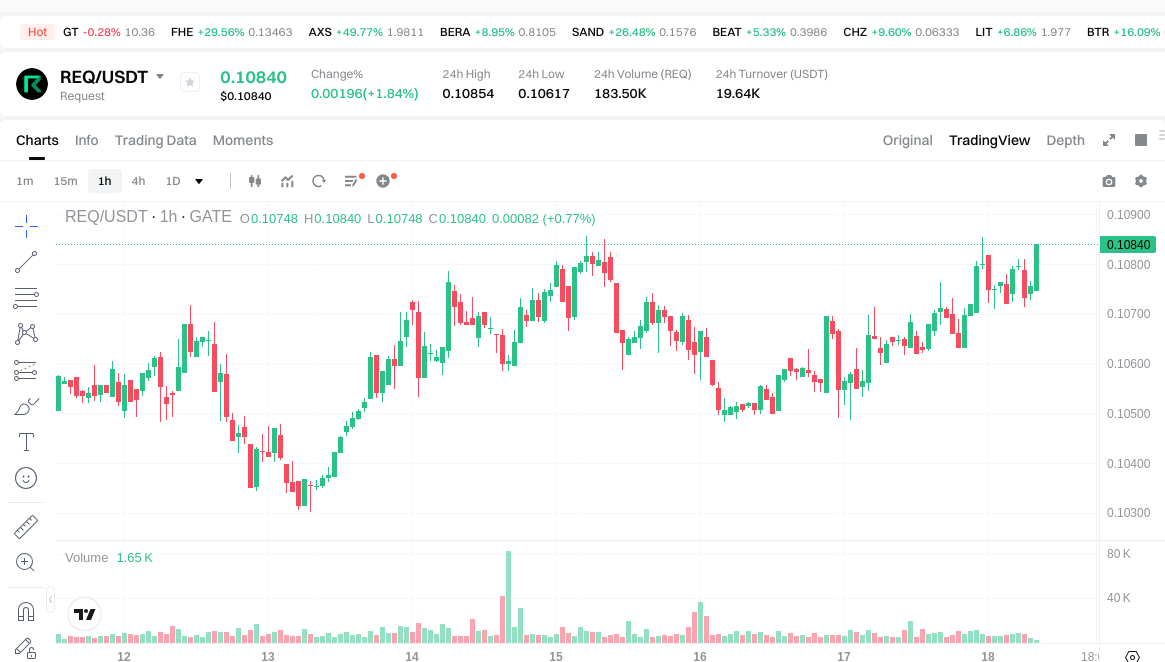
- 2024-2026: Token demonstrated gradual recovery from previous lows → Price movements ranged from approximately $0.10617 to $0.10854 in recent trading sessions
Current REQ Investment Market Status (January 2026)
- REQ current price: $0.10761
- Market sentiment (Fear & Greed Index): Data indicates neutral positioning with measured investor activity
- 24-hour trading volume: $19,633.68
- Circulating supply stands at 744.29 million tokens, representing approximately 74.43% of maximum supply
Click to view real-time REQ market price
II. Core Factors Influencing Whether REQ is a Good Investment (Is Request(REQ) a Good Investment)
Supply Mechanism and Scarcity (REQ investment scarcity)
- Maximum supply capped at 1,000,000,000 REQ tokens → influences price dynamics and investment value
- Circulating supply of approximately 744,291,192 tokens represents about 74.43% of total supply → moderate scarcity profile
- Historical context: REQ has experienced significant price fluctuations, with price levels ranging from $0.00454707 to $1.059 over its trading history
- Investment significance: The defined maximum supply provides a scarcity framework that may support long-term investment considerations
Institutional Investment and Mainstream Adoption (Institutional investment in REQ)
- Holder base: approximately 41,317 token holders as of current data → indicates community distribution
- Trading availability: REQ is listed on 15 exchanges, including major platforms → facilitates accessibility for institutional and retail participants
- Payment infrastructure focus: Request Network's positioning as a decentralized payment and invoicing platform may attract enterprise-level adoption interest
- Market capitalization standing: REQ maintains a market cap of approximately $80.09 million with a fully diluted valuation of $107.55 million → represents mid-to-lower tier market positioning
Macroeconomic Environment Impact on REQ Investment
- Cryptocurrency market correlation: REQ's performance may be influenced by broader crypto market sentiment and Bitcoin dominance trends
- Volatility considerations: 24-hour trading volume of approximately $19.63 million suggests moderate liquidity conditions that may be affected by macroeconomic shifts
- Risk factors: Like other digital assets, REQ investment attractiveness may vary with changes in monetary policy, interest rate environments, and regulatory developments
- Market cycle sensitivity: The token's annual performance showing a -14.23% change indicates susceptibility to broader market conditions and economic uncertainties
Technology and Ecosystem Development (Technology & Ecosystem for REQ investment)
- Ethereum network foundation: Request operates as a decentralized network built on Ethereum, leveraging established blockchain infrastructure
- Payment and invoicing functionality: The platform enables secure payment requests and provides tools for asset invoices, accounting, auditing, and payment standards → targets enterprise financial operations
- Decentralized ledger system: All transaction data is stored on a decentralized ledger, supporting transparency and audit capabilities
- Financial platform positioning: Request aims to serve as an enterprise-grade payment and financial audit platform utilizing cryptocurrency and blockchain technology → potential for integration into business financial workflows
III. REQ Future Investment Predictions and Price Outlook (Is Request(REQ) worth investing in 2026-2031)
Short-term Investment Prediction (2026, short-term REQ investment outlook)
Based on current market analysis, Request (REQ) shows varied price trajectories across different scenarios in 2026:
- Conservative prediction: $0.0627 - $0.0800
- Neutral prediction: $0.0900 - $0.1082
- Optimistic prediction: $0.1082 - $0.1158
The short-term outlook reflects a period of potential consolidation following recent price movements, with the 24-hour change at 1.25% and 7-day performance at 2.39%, indicating modest positive momentum. Current trading volume stands at approximately $19,633.68 within 24 hours, suggesting moderate market activity.
Mid-term Investment Outlook (2027-2029, mid-term Request(REQ) investment forecast)
- Market stage expectation: Gradual growth phase with potential accumulation patterns, supported by the project's focus on enterprise-level payment and financial audit solutions
- Investment return predictions:
- 2027: $0.0773 - $0.1366
- 2028: $0.0721 - $0.1404
- 2029: $0.0821 - $0.1932
- Key catalysts: Market expansion efforts, enterprise adoption progress, integration developments within the Ethereum-based decentralized payment network ecosystem
Long-term Investment Outlook (Is REQ a good long-term investment?)
- Base scenario: $0.1416 - $0.2117 (based on steady development and gradual market acceptance)
- Optimistic scenario: $0.1759 - $0.2359 (assuming enhanced enterprise adoption and favorable market conditions)
- Risk scenario: Below $0.0721 (under scenarios of reduced adoption, competitive pressure, or adverse market conditions)
For detailed REQ long-term investment and price predictions: Price Prediction
2026-01-18 - 2031 Long-term Outlook
- Base scenario: $0.10 - $0.19 USD (corresponding to steady progress and gradual mainstream application advancement)
- Optimistic scenario: $0.18 - $0.24 USD (corresponding to large-scale adoption and favorable market environment)
- Transformative scenario: Above $0.24 USD (such as breakthrough ecosystem developments and mainstream popularization)
- 2031-12-31 predicted high: $0.2359 USD (based on optimistic development assumptions)
Disclaimer: Price predictions are based on historical data analysis and market projections. Actual results may vary significantly due to market volatility, regulatory changes, technological developments, and other unforeseen factors. This analysis does not constitute investment advice, and investors should conduct their own research and consider their risk tolerance before making investment decisions.
| Year |
Predicted High Price |
Predicted Average Price |
Predicted Low Price |
Price Change |
| 2026 |
0.1157526 |
0.10818 |
0.0627444 |
0 |
| 2027 |
0.136598886 |
0.1119663 |
0.077256747 |
4 |
| 2028 |
0.14043933009 |
0.124282593 |
0.07208390394 |
15 |
| 2029 |
0.1932470038557 |
0.132360961545 |
0.0820637961579 |
23 |
| 2030 |
0.211645177510455 |
0.16280398270035 |
0.141639464949304 |
51 |
| 2031 |
0.235902970932807 |
0.187224580105402 |
0.175991105299078 |
73 |
IV. Request (REQ) Investment Strategy and Risk Management (How to invest in REQ)
Investment Methodology (Request investment strategy)
Long-term Holding (HODL Request)
For conservative investors seeking exposure to the decentralized payment infrastructure sector, a long-term holding strategy may be considered. Request's positioning as a financial platform for enterprise-level payment and audit solutions built on Ethereum presents potential utility value. Historical data shows the token launched at $0.066 in October 2017, with current pricing around $0.10761 as of January 18, 2026. The circulating supply represents approximately 74.43% of the maximum supply of 1 billion tokens, indicating a relatively mature distribution phase.
Active Trading
Traders employing technical analysis may observe Request's price movements across different timeframes. Recent data indicates:
- 1-hour change: +0.54%
- 24-hour change: +1.25%
- 7-day change: +2.39%
- 30-day change: +5.65%
- 1-year change: -14.23%
The 24-hour trading range between $0.10617 and $0.10854 suggests moderate intraday volatility. Active traders should note the 24-hour trading volume of approximately $19,633.68.
Risk Management (Risk management for Request investment)
Asset Allocation Ratios
- Conservative investors: May consider allocating no more than 1-2% of crypto portfolio to REQ, given its mid-cap positioning (market cap rank: 417)
- Aggressive investors: Could allocate 3-5% while maintaining diversification across multiple blockchain payment solutions
- Professional investors: May employ dynamic allocation strategies based on fundamental developments in the payment infrastructure sector
Risk Hedging Approaches
- Multi-asset portfolio construction combining established cryptocurrencies with sector-specific tokens
- Position sizing based on market capitalization and liquidity metrics (current market cap: approximately $80.09 million)
- Consideration of correlation factors with Ethereum, given Request's deployment on the Ethereum network
Secure Storage
- Cold storage: For long-term holdings, hardware wallets supporting ERC-20 tokens are recommended
- Hot wallets: Only for active trading amounts, using reputable wallet providers with multi-signature capabilities
- Contract verification: Token contract address on Ethereum: 0x8f8221aFbB33998d8584A2B05749bA73c37a938a (verify through Etherscan before any transactions)
V. Request (REQ) Investment Risks and Challenges (Risks of investing in Request)
Market Risk
- High volatility: Historical price range from an all-time low of $0.00454707 (March 13, 2020) to an all-time high of $1.059 (January 6, 2018) demonstrates substantial price fluctuations
- Limited liquidity: With listing on approximately 15 exchanges and 24-hour volume around $19,633.68, liquidity may be constrained during periods of market stress
- Market dominance: Request represents only 0.0031% of total crypto market capitalization, indicating sensitivity to broader market movements
Regulatory Risk
- Payment infrastructure projects face evolving regulatory frameworks across jurisdictions regarding financial services and cryptocurrency payments
- Compliance requirements for enterprise-level financial platforms may vary significantly between regions
- Potential classification uncertainties regarding tokens providing payment and audit functionalities
Technical Risk
- Smart contract vulnerabilities: As an ERC-20 token on Ethereum, exposure to both Request protocol-specific and Ethereum network risks
- Network dependency: Performance and security tied to Ethereum's infrastructure and upgrade cycles
- Development progress: Project advancement and adoption rates for enterprise payment solutions remain subject to execution risk
- Competition: Presence of alternative blockchain payment solutions and traditional fintech competitors
VI. Conclusion: Is Request (REQ) a Good Investment?
Investment Value Summary
Request presents a positioning within the decentralized payment and financial infrastructure sector, with functionality focused on invoicing, accounting, and audit solutions. The token shows moderate short-term price momentum with a 30-day gain of 5.65%, though the 1-year performance indicates a decline of 14.23%. The circulating supply of approximately 744 million tokens (74.43% of maximum supply) suggests a relatively established distribution phase.
Investor Recommendations
✅ Beginner investors: Consider dollar-cost averaging (DCA) strategies with small allocations, combined with secure ERC-20 compatible hardware wallet storage. Limit exposure to 1-2% of overall crypto portfolio.
✅ Experienced investors: May employ technical analysis for swing trading opportunities while maintaining core positions. Portfolio allocation of 2-4% within payment infrastructure sector basket could provide sector exposure with diversification.
✅ Institutional investors: Strategic allocation decisions should evaluate Request's adoption metrics within enterprise payment workflows, competitive positioning, and regulatory environment developments. Position sizing based on comprehensive risk-return analysis.
⚠️ Disclaimer: Cryptocurrency investments carry substantial risk, including potential total loss of capital. Price volatility in crypto assets can be extreme. This content is for informational purposes only and does not constitute investment advice, financial advice, trading advice, or recommendation to buy, sell, or hold any cryptocurrency. Conduct thorough independent research and consult with qualified financial advisors before making investment decisions.
VII. FAQ
Q1: What is Request (REQ) and what makes it different from other payment cryptocurrencies?
Request (REQ) is a decentralized payment network built on Ethereum that provides comprehensive financial infrastructure including invoicing, accounting, and auditing functionalities. Unlike simple payment tokens, Request focuses on enterprise-level financial operations, offering secure payment requests, asset invoice management, and audit trail capabilities through its decentralized ledger system. The platform aims to serve businesses requiring professional-grade financial tools rather than just peer-to-peer transactions.
Q2: Is Request (REQ) suitable for beginner investors in 2026?
REQ can be considered by beginners using conservative strategies, but with strict limitations. Given its mid-tier market positioning (rank 417, market cap ~$80.09 million) and moderate liquidity ($19,633.68 24-hour volume), beginners should limit allocation to 1-2% of their crypto portfolio and employ dollar-cost averaging (DCA) strategies. The token's volatility—ranging from $0.00454707 to $1.059 historically—requires careful risk management and secure storage using ERC-20 compatible hardware wallets.
Q3: What is the predicted price range for REQ in 2026-2031?
Based on current market analysis, REQ price projections vary across different scenarios:
- 2026: Conservative ($0.0627-$0.0800), Neutral ($0.0900-$0.1082), Optimistic ($0.1082-$0.1158)
- 2027-2029: Mid-term range from $0.0721 to $0.1932 depending on enterprise adoption progress
- 2030-2031: Long-term base scenario ($0.10-$0.19), optimistic scenario ($0.18-$0.24), with 2031 predicted high at $0.2359
These predictions assume steady development and gradual enterprise adoption but remain subject to significant market volatility and unforeseen factors.
Q4: What are the main risks associated with investing in Request?
REQ investment carries multiple risk categories: Market risks include high volatility (historical range $0.00454707-$1.059), limited liquidity on 15 exchanges, and sensitivity to broader crypto movements given its 0.0031% market dominance. Technical risks involve smart contract vulnerabilities as an ERC-20 token, dependency on Ethereum network performance, and execution risks in development progress. Regulatory risks stem from evolving frameworks for payment infrastructure projects and potential compliance requirements across jurisdictions. The -14.23% annual decline demonstrates susceptibility to adverse market conditions.
Q5: How can investors securely store and manage REQ tokens?
REQ security practices should align with holding amounts and timeframes:
- Long-term holdings: Use hardware wallets supporting ERC-20 tokens (cold storage) for maximum security
- Active trading amounts: Employ reputable hot wallets with multi-signature capabilities, keeping only necessary trading amounts
- Contract verification: Always verify the official token contract address on Ethereum (0x8f8221aFbB33998d8584A2B05749bA73c37a938a) through Etherscan before transactions
- Portfolio allocation: Conservative investors should maintain 1-2% allocation, aggressive investors 3-5%, with diversification across multiple blockchain payment solutions
Q6: What factors could drive REQ price appreciation in the future?
Several catalysts may influence REQ's investment outlook: Enterprise adoption of Request's payment and audit solutions by businesses seeking blockchain-based financial infrastructure represents a primary growth driver. Ethereum network upgrades may enhance scalability and reduce transaction costs for Request operations. Payment infrastructure expansion through integration developments and partnership announcements could broaden utility. Market cycle conditions during favorable crypto environments may support price appreciation. However, actual outcomes depend heavily on execution of development roadmap and competitive positioning against traditional fintech and alternative blockchain solutions.
Q7: Should investors choose Request over established cryptocurrencies like Bitcoin or Ethereum?
Request serves a different investment purpose compared to Bitcoin or Ethereum. While BTC functions as digital gold and ETH as a smart contract platform, REQ targets specific enterprise payment infrastructure use cases. For diversification purposes, REQ could complement holdings in major cryptocurrencies within a 1-5% allocation depending on risk tolerance. However, REQ's lower liquidity ($19,633.68 24-hour volume) and mid-cap status (rank 417) present higher risk compared to established assets. Investors should prioritize core positions in major cryptocurrencies before considering specialized tokens like REQ for sector-specific exposure.
Q8: What trading strategies work best for Request (REQ)?
Long-term holding (HODL) suits conservative investors seeking exposure to decentralized payment infrastructure, given REQ's enterprise-focused positioning and 74.43% circulating supply maturity. Active trading approaches may capitalize on moderate volatility, with recent data showing +5.65% (30-day) and +2.39% (7-day) momentum, though intraday range remains narrow ($0.10617-$0.10854). Dollar-cost averaging (DCA) helps mitigate volatility risk for gradual position building. Technical analysis can identify entry/exit points within observed trading ranges. Regardless of strategy, maintain strict risk management with position sizing based on portfolio allocation ratios and liquidity considerations given the moderate 24-hour trading volume.
* The information is not intended to be and does not constitute financial advice or any other recommendation of any sort offered or endorsed by Gate.