ResearchCoin (RSC) is a blockchain-based cryptocurrency launched in November 2022 to incentivize scientific collaboration on the ResearchHub platform. Currently trading at $0.1235 with a $16.57 million market capitalization, RSC has experienced significant volatility, declining 85.7% over the past year despite reaching $1.6 in January 2025. This comprehensive analysis examines whether RSC represents a viable investment opportunity by evaluating its tokenomics, price trends, and market position across multiple timeframes. The article covers historical performance, current market status with 75,259 token holders and availability on 11 exchanges including Gate, mid-term and long-term price predictions through 2031, and risk management strategies tailored to different investor profiles. Key considerations include market volatility, regulatory uncertainty, and adoption-dependent growth within the decentralized science ecosystem, alongside practical investment methodologies and security recommendations for cryptocu
Introduction: ResearchCoin (RSC) Investment Position and Market Prospects
ResearchCoin (RSC) is a digital asset in the cryptocurrency space that has been designed to support the ResearchHub platform since its launch in November 2022. As of January 24, 2026, RSC maintains a market capitalization of approximately $16.57 million with a circulating supply of about 134.16 million tokens, trading at around $0.1235. With its positioning as an incentive mechanism for scientific collaboration and open research, RSC has attracted attention from investors exploring the question "Is ResearchCoin (RSC) a good investment?" This article provides a comprehensive analysis of RSC's investment characteristics, historical performance, future price considerations, and associated risks to serve as a reference for investors.
The ResearchHub platform aims to accelerate scientific discovery by enabling researchers, academics, and enthusiasts to share and evaluate scientific content across disciplines in a decentralized community. RSC serves as the native token that rewards contributions such as sharing preprints, reviewing papers, and engaging in scholarly discussions. Currently ranked #954 by market capitalization with a market dominance of 0.0039%, RSC represents approximately 13.42% of its fully diluted valuation of $123.5 million, with a maximum supply capped at 1 billion tokens.
Recent price trends indicate that RSC has experienced volatility across different timeframes. The token has declined by 1.43% over the past 24 hours, 12.049% over the past 7 days, and 12.73% over the past 30 days. The one-year performance shows a decline of 85.7% from previous levels. The token's price has fluctuated between a recorded low of $0.112 and a previous level of $1.6, demonstrating the volatility characteristic of emerging digital assets in the research and academic incentive sector.
With a holder base of approximately 75,259 addresses and availability across 11 exchanges, RSC maintains a presence in the cryptocurrency market. The token operates with a contract address on the Base blockchain ecosystem. As the intersection of blockchain technology and scientific research continues to develop, understanding RSC's market position, tokenomics, and the factors influencing its valuation becomes relevant for those considering exposure to this niche segment of the digital asset market.
I. Price History Review and Current Investment Value of RSC
Based on available data, ResearchCoin (RSC) was published on November 7, 2022. The token experienced notable price volatility during its operational period. On January 3, 2025, RSC reached a price level of $1.6, representing a significant milestone in its trading history. Subsequently, the token underwent considerable price adjustments, with the price declining to $0.112 by December 31, 2025. Over the past year, RSC has experienced a substantial price decline of approximately 85.7%, reflecting challenging market conditions and investor sentiment shifts.
Current RSC Investment Market Status (January 2026)
- RSC Current Price: $0.1235
- 24-hour Trading Volume: $21,611.04
- Market Capitalization: $16,568,431.93
- Circulating Supply: 134,157,343.60 RSC (13.42% of total supply)
- Fully Diluted Valuation: $123,500,000.00
- Total Token Holders: 75,259
- Listed Exchanges: 11 platforms
- Recent Price Performance:
- 1-hour change: -0.48%
- 24-hour change: -1.43%
- 7-day change: -12.05%
- 30-day change: -12.73%
Click to view real-time RSC market price
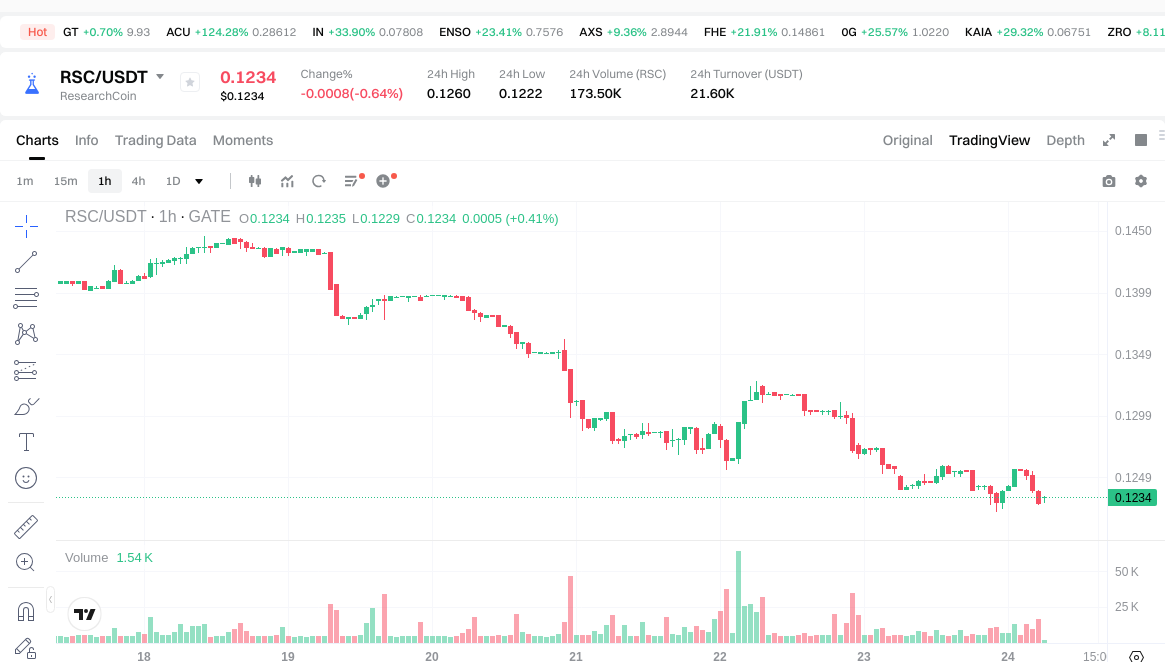
II. Core Factors Influencing Whether RSC is a Good Investment (Is ResearchCoin(RSC) a Good Investment)
Supply Mechanism and Scarcity (RSC investment scarcity)
- Maximum supply capped at 1,000,000,000 RSC tokens → influences price dynamics and investment value
- Current circulating supply of approximately 134.16 million RSC represents 13.42% of total supply → demonstrates controlled token distribution
- Historical price volatility observed, with RSC trading at $0.1235 as of January 24, 2026, showing notable fluctuations from previous price levels
- Investment significance: The controlled supply mechanism and gradual token release schedule serve as fundamental factors supporting long-term investment considerations
Institutional Investment and Mainstream Adoption (Institutional investment in RSC)
- ResearchCoin maintains a holder base of 75,259 addresses, indicating distributed ownership across the research community
- The platform incentivizes academic participation through RSC rewards for contributions such as sharing preprints, reviewing papers, and engaging in scholarly discussions
- ResearchHub's mission to break down traditional barriers in academia positions RSC as a utility token within the scientific research ecosystem
Technology & Ecosystem Development (Technology & Ecosystem for RSC investment)
- Built on BASE blockchain infrastructure → provides technical foundation for platform operations
- Trading availability across 11 exchanges → enhances liquidity and accessibility for investors
- Platform ecosystem centered on accelerating scientific discovery through decentralized collaboration → creates utility-driven demand for RSC tokens
- ResearchHub facilitates cross-disciplinary sharing, discussion, and evaluation of scientific content → expands use cases for token utilization within academic communities
III. RSC Future Investment Predictions and Price Outlook (Is ResearchCoin(RSC) worth investing in 2026-2031)
Short-term Investment Prediction (2026, short-term RSC investment outlook)
- Conservative Prediction: $0.062934 - $0.1234
- Neutral Prediction: $0.1234
- Optimistic Prediction: $0.1234 - $0.173994
Mid-term Investment Outlook (2027-2029, mid-term ResearchCoin(RSC) investment forecast)
- Market Stage Expectation: The mid-term outlook suggests potential growth as the platform continues to foster academic collaboration and incentivize research contributions. Price movements may reflect broader adoption within the scientific community and developments in the decentralized research ecosystem.
- Investment Return Prediction:
- 2027: $0.11747063 - $0.18289731
- 2028: $0.1061101792 - $0.1724290412
- 2029: $0.11837916867 - $0.209700241644
- Key Catalysts: Platform user growth, expansion of academic partnerships, integration with additional research institutions, developments in the decentralized science sector, and broader cryptocurrency market conditions.
Long-term Investment Outlook (Is RSC a good long-term investment?)
- Baseline Scenario: $0.128758654178985 - $0.189406669872 (assuming steady platform development and moderate user adoption)
- Optimistic Scenario: $0.19508886996816 - $0.284829750153513 (assuming significant growth in the decentralized science ecosystem and increased institutional adoption)
- Risk Scenario: Below $0.11837916867 (under adverse market conditions or limited platform adoption)
Click to view RSC long-term investment and price prediction: Price Prediction
2026-01-24 - 2031 Long-term Outlook
- Baseline Scenario: $0.128758654178985 - $0.189406669872 (corresponding to steady progress and gradual mainstream application enhancement)
- Optimistic Scenario: $0.19508886996816 - $0.284829750153513 (corresponding to large-scale adoption and favorable market environment)
- Transformative Scenario: Above $0.284829750153513 (such as breakthrough progress in the ecosystem and mainstream popularization)
- 2031-12-31 Predicted High: $0.284829750153513 (based on optimistic development assumptions)
Disclaimer: The above predictions are based on historical data and market analysis models and do not constitute investment advice. Cryptocurrency markets are highly volatile, and actual prices may differ significantly from predictions. Investors should conduct thorough research and consider their risk tolerance before making investment decisions.
| Year |
Predicted High Price |
Predicted Average Price |
Predicted Low Price |
Price Change |
| 2026 |
0.173994 |
0.1234 |
0.062934 |
0 |
| 2027 |
0.18289731 |
0.148697 |
0.11747063 |
20 |
| 2028 |
0.1724290412 |
0.165797155 |
0.1061101792 |
34 |
| 2029 |
0.209700241644 |
0.1691130981 |
0.11837916867 |
36 |
| 2030 |
0.20077107006432 |
0.189406669872 |
0.17425413628224 |
53 |
| 2031 |
0.284829750153513 |
0.19508886996816 |
0.128758654178985 |
57 |
IV. RSC Investment Strategy and Risk Management (How to invest in ResearchCoin)
Investment Methodology (RSC investment strategy)
Long-term Holding (HODL RSC): Suitable for conservative investors
Long-term holding strategies may be appropriate for investors who believe in ResearchHub's mission to accelerate scientific discovery through decentralized collaboration. This approach typically involves:
- Accumulating RSC tokens during market corrections
- Holding through short-term price fluctuations
- Focusing on the platform's adoption growth and ecosystem development
- Monitoring the expansion of ResearchHub's user base and research community engagement
Active Trading: Relying on technical analysis and swing trading
Active traders may consider:
- Technical analysis using price action patterns observed in RSC's trading history
- Monitoring 24-hour trading volume patterns (current volume: approximately 21,611 USD)
- Setting stop-loss orders to manage downside risk given the token's volatility
- Tracking correlation with broader crypto market movements and sentiment
Risk Management (Risk management for RSC investment)
Asset Allocation Ratios: Conservative / Aggressive / Professional investors
- Conservative investors: Limiting RSC exposure to 1-3% of total crypto portfolio
- Aggressive investors: Allocating 5-10% while maintaining diversification
- Professional investors: Strategic positions based on comprehensive due diligence and risk tolerance
Risk Hedging Strategies: Multi-asset portfolio + hedging tools
- Diversifying across multiple cryptocurrencies and asset classes
- Maintaining stablecoin reserves for strategic rebalancing
- Utilizing dollar-cost averaging to mitigate timing risk
- Monitoring correlation with major cryptocurrencies to assess portfolio exposure
Secure Storage: Hot and cold wallets + hardware wallet recommendations
- Cold storage solutions for long-term holdings (hardware wallets)
- Hot wallets for active trading with limited amounts
- Ensuring proper backup of recovery phrases and private keys
- Verifying contract address (0xfbb75a59193a3525a8825bebe7d4b56899e2f7e1 on Base network) before transactions
V. RSC Investment Risks and Challenges (Risks of investing in ResearchCoin)
Market Risk: High volatility and price manipulation concerns
- RSC has experienced substantial price fluctuations, with performance showing -85.7% over the past year
- Recent price movements include -12.049% over 7 days and -12.73% over 30 days
- Current price of 0.1235 USD reflects significant decline from the price level of 1.6 USD recorded on January 3, 2025
- Limited liquidity with 24-hour trading volume of approximately 21,611 USD may amplify price volatility
- Market capitalization of approximately 16.57 million USD represents relatively small market presence
Regulatory Risk: Policy uncertainty across different jurisdictions
- Evolving regulatory frameworks for cryptocurrencies may impact RSC's accessibility and trading
- Potential classification changes affecting token utility and platform operations
- Compliance requirements may vary significantly across different countries and regions
- Academic and research sector regulations may intersect with crypto policy development
Technical Risk: Network security vulnerabilities and upgrade failures
- Smart contract risks associated with the Base network deployment
- Platform dependency on ResearchHub's continued development and maintenance
- Potential technical challenges in scaling the platform while maintaining decentralization
- Integration risks between the cryptocurrency incentive layer and research platform functionality
Additional Considerations:
- Low circulating supply ratio (13.42% of total supply) may create future supply pressure
- Project's success depends heavily on adoption within academic and research communities
- Competition from traditional academic publishing platforms and other decentralized science initiatives
- Token holder concentration risk with 75,259 holders recorded
VI. Conclusion: Is ResearchCoin a Good Investment?
Investment Value Summary: RSC presents a unique value proposition within the decentralized science sector, but faces significant price volatility and market challenges.
ResearchCoin operates within a specialized niche focused on accelerating scientific discovery through blockchain-based incentives. The platform's mission to democratize research access and reward academic contributions represents an innovative approach to addressing traditional barriers in scholarly publishing. However, recent price performance has been challenging, with substantial declines across multiple timeframes.
The token's relatively small market capitalization and limited trading volume suggest early-stage market development, which carries both opportunities and risks. The low circulating supply ratio indicates potential for future token releases that may impact price dynamics.
Investor Recommendations:
✅ Beginners: Dollar-cost averaging + secure wallet storage
- Start with small allocations to understand market dynamics
- Use hardware wallets or reputable software wallets for secure storage
- Verify contract addresses before transactions
- Focus on learning about the ResearchHub platform and its ecosystem
✅ Experienced Investors: Swing trading + portfolio configuration
- Implement technical analysis strategies appropriate for low-liquidity assets
- Monitor platform adoption metrics and community engagement
- Maintain strict position sizing relative to overall portfolio
- Consider correlation with broader crypto market trends
✅ Institutional Investors: Strategic long-term allocation
- Conduct comprehensive due diligence on platform fundamentals
- Assess alignment with decentralized science investment thesis
- Evaluate token economics and future supply distribution plans
- Monitor regulatory developments affecting both crypto and academic sectors
⚠️ Disclaimer: Cryptocurrency investment carries substantial risk. This content is for informational purposes only and does not constitute investment advice. Investors should conduct independent research and consider their risk tolerance before making investment decisions.
VII. FAQ
Q1: What is ResearchCoin (RSC) and how does it work?
ResearchCoin (RSC) is a cryptocurrency token that powers the ResearchHub platform, serving as an incentive mechanism for scientific collaboration and open research. Launched in November 2022, RSC operates on the Base blockchain with a maximum supply capped at 1 billion tokens. The token rewards researchers, academics, and enthusiasts for contributing to the platform through activities such as sharing preprints, reviewing papers, and engaging in scholarly discussions. Currently trading at approximately $0.1235 with a market capitalization of $16.57 million, RSC aims to democratize academic research by breaking down traditional barriers in scholarly publishing. The platform facilitates cross-disciplinary collaboration and enables decentralized evaluation of scientific content, positioning RSC as a utility token within the emerging decentralized science ecosystem.
Q2: Has ResearchCoin (RSC) experienced significant price volatility?
Yes, RSC has demonstrated substantial price volatility throughout its trading history. The token reached a price level of $1.6 on January 3, 2025, but subsequently declined to $0.112 by December 31, 2025, representing an approximate 85.7% decrease over the past year. Recent performance shows continued downward pressure with declines of 1.43% over 24 hours, 12.05% over 7 days, and 12.73% over 30 days as of January 24, 2026. This volatility is characteristic of emerging digital assets in niche sectors and reflects both market sentiment shifts and the early-stage development of the platform. The limited liquidity, with 24-hour trading volume of approximately $21,611, may amplify price fluctuations. Investors should recognize that such volatility patterns are common in smaller-cap cryptocurrencies and require careful risk management strategies.
Q3: What are the primary risk factors associated with investing in RSC?
Investing in RSC carries several significant risk factors that potential investors should carefully consider. Market risk is substantial, as evidenced by the token's 85.7% decline over the past year and relatively low trading volume of approximately $21,611 daily, which may amplify price volatility. The limited circulating supply (13.42% of total supply) creates potential future supply pressure as additional tokens enter circulation. Regulatory uncertainty poses challenges, as evolving cryptocurrency frameworks and potential classification changes could impact RSC's accessibility and platform operations. Technical risks include smart contract vulnerabilities on the Base network, platform dependency on ResearchHub's continued development, and integration challenges between the cryptocurrency layer and research functionality. Additionally, the project's success depends heavily on adoption within academic communities, faces competition from traditional publishing platforms and other decentralized science initiatives, and operates with a relatively small market capitalization of $16.57 million, indicating limited market presence.
Q4: What investment strategies are recommended for RSC holders?
Investment strategies for RSC should align with individual risk tolerance and experience levels. For beginners, a dollar-cost averaging approach is recommended, involving small periodic purchases to mitigate timing risk, combined with secure storage in hardware wallets or reputable software wallets. Beginners should start with minimal allocations (1-3% of crypto portfolio) to understand market dynamics and verify contract addresses before transactions. Experienced investors may implement swing trading strategies using technical analysis appropriate for low-liquidity assets, maintaining strict position sizing (5-10% allocation) while monitoring platform adoption metrics and community engagement. Institutional investors should conduct comprehensive due diligence on platform fundamentals, assess alignment with the decentralized science investment thesis, and evaluate token economics including future supply distribution plans. All investor categories should implement robust risk management, including portfolio diversification, maintaining stablecoin reserves for rebalancing, and monitoring correlation with broader crypto market trends. Given RSC's volatility and early-stage market development, conservative position sizing relative to overall portfolio remains essential.
Q5: What factors could influence RSC's price performance in the coming years?
Several key factors are likely to influence RSC's price trajectory through 2031. Platform adoption within academic and research communities represents the most fundamental driver, as increased user engagement and contribution activity would strengthen token utility and demand. Expansion of academic partnerships and integration with additional research institutions could broaden the platform's reach and credibility. Developments in the broader decentralized science (DeSci) sector may create favorable market conditions and increased investor interest in research-focused cryptocurrencies. The token's controlled supply mechanism, with 86.58% of tokens yet to enter circulation, will impact price dynamics depending on the distribution schedule and vesting arrangements. Technical developments on the Base blockchain, including scalability improvements and network security enhancements, could affect platform performance and user experience. Regulatory clarity regarding cryptocurrency classification and academic sector applications will influence accessibility and institutional adoption potential. Additionally, broader cryptocurrency market conditions, including Bitcoin and Ethereum price movements, typically correlate with altcoin performance and investor sentiment toward smaller-cap projects. Price predictions estimate potential ranges from $0.062934 to $0.284829750153513 by 2031, though actual outcomes will depend on these interconnected factors and market developments.
Q6: How does ResearchCoin compare to traditional academic publishing models?
ResearchCoin represents a paradigm shift from traditional academic publishing by introducing blockchain-based incentives and decentralized collaboration mechanisms. Unlike conventional publishing platforms controlled by centralized entities with subscription paywalls and lengthy peer-review processes, ResearchHub enables open access to research content while directly rewarding contributors through RSC tokens. Traditional academic systems often lack immediate compensation for peer reviewers and community participants, whereas RSC provides tangible incentives for sharing preprints, reviewing papers, and engaging in scholarly discussions. The platform facilitates cross-disciplinary collaboration without institutional barriers, contrasting with traditional silos in academic publishing. However, RSC faces challenges in establishing credibility and recognition compared to established journals with decades of reputation. The decentralized model offers transparency in contributions and evaluations, but the platform's relatively small user base of 75,259 token holders indicates early-stage adoption compared to millions of researchers using traditional systems. Success will depend on whether the cryptocurrency incentive model can overcome institutional inertia and gain acceptance within academic communities while maintaining scientific rigor and quality standards.
Q7: What are the long-term prospects for RSC investment through 2031?
Long-term prospects for RSC investment through 2031 present both opportunities and challenges based on current market positioning and ecosystem development. Price predictions suggest potential ranges from a baseline scenario of $0.128758654178985 to $0.189406669872, an optimistic scenario of $0.19508886996816 to $0.284829750153513, and a risk scenario below $0.11837916867. These projections assume varying degrees of platform adoption, ecosystem expansion, and favorable market conditions. The transformative potential exists if ResearchHub achieves breakthrough progress in mainstream academic adoption and the decentralized science sector gains significant traction. Key success factors include expanding the platform's user base beyond current 75,259 holders, securing partnerships with major research institutions, demonstrating measurable impact on scientific discovery acceleration, and maintaining technical innovation on the Base blockchain infrastructure. However, substantial risks remain, including competition from established academic platforms and emerging DeSci projects, potential regulatory constraints, and dependence on broader cryptocurrency market conditions. The token's relatively small market capitalization of $16.57 million and limited liquidity suggest significant price volatility may continue. Investors considering long-term positions should recognize that actual outcomes may differ substantially from predictions and should only allocate capital they can afford to lose while maintaining diversified portfolios.
Q8: What security measures should RSC investors implement?
RSC investors should implement comprehensive security measures to protect their digital assets from theft, loss, and unauthorized access. For long-term holdings, cold storage solutions using hardware wallets (such as Ledger or Trezor) provide the highest security level by keeping private keys offline and away from internet-connected devices. Investors should verify the official RSC contract address (0xfbb75a59193a3525a8825bebe7d4b56899e2f7e1 on the Base network) before any transactions to avoid interacting with fraudulent tokens. Proper backup procedures are critical, including securely storing recovery phrases in multiple physical locations, never sharing private keys or seed phrases digitally, and using metal backup solutions to protect against physical damage. For active trading, hot wallets should contain only limited amounts necessary for immediate transactions, with the majority of holdings secured in cold storage. Investors should enable two-factor authentication on exchange accounts, use unique strong passwords for each platform, and remain vigilant against phishing attempts targeting cryptocurrency holders. Regular security audits of wallet software and firmware updates for hardware devices help maintain protection against emerging threats. Given RSC's operation on the Base blockchain, investors should also understand network-specific security considerations and monitor official ResearchHub communications for any security advisories or protocol updates.
* The information is not intended to be and does not constitute financial advice or any other recommendation of any sort offered or endorsed by Gate.