This comprehensive analysis examines whether ResearchCoin (RSC) represents a viable investment opportunity within the decentralized science sector. The article evaluates RSC's market position, including its $0.1222 current price, $16.39 million market cap, and 83.24% one-year decline. It provides detailed price forecasts through 2031, ranging from conservative to optimistic scenarios, while analyzing core factors affecting investment value such as tokenomics, institutional adoption, and BASE blockchain integration. The guide presents tailored investment strategies for different investor profiles, risk management approaches, and security recommendations for Gate exchange and wallet storage. Critical examination of market, regulatory, and technical risks alongside future growth catalysts enables investors to make informed decisions about RSC allocation.
Introduction: ResearchCoin (RSC) Investment Position and Market Outlook
ResearchCoin (RSC) represents a notable asset in the cryptocurrency sector, having been launched in November 2022 as the native token of the ResearchHub platform. As of January 24, 2026, RSC maintains a market capitalization of approximately $16.39 million, with a circulating supply of around 134.16 million tokens out of a maximum supply of 1 billion tokens. The current trading price stands at $0.1222, reflecting recent market dynamics. With its positioning as an incentive mechanism for academic collaboration and open science, RSC has garnered attention among investors exploring "Is ResearchCoin (RSC) a good investment?" The platform facilitates cross-disciplinary knowledge sharing by rewarding researchers, academics, and enthusiasts for contributions such as sharing preprints, reviewing papers, and engaging in scholarly discussions. This article provides a comprehensive analysis of RSC's investment characteristics, historical price movements, future price projections, and associated risks to assist investors in their evaluation process.
I. ResearchCoin (RSC) Price History Review and Current Investment Value Status
- 2024: RSC token launched on ResearchHub platform → Initial price discovery phase with volatile trading patterns
- 2025 January: Price reached $1.6 in early January → Subsequently experienced significant correction amid broader market dynamics
- 2025 December: Market adjustment period → Price declined to $0.112 during year-end trading
Current RSC Investment Market Status (January 2026)
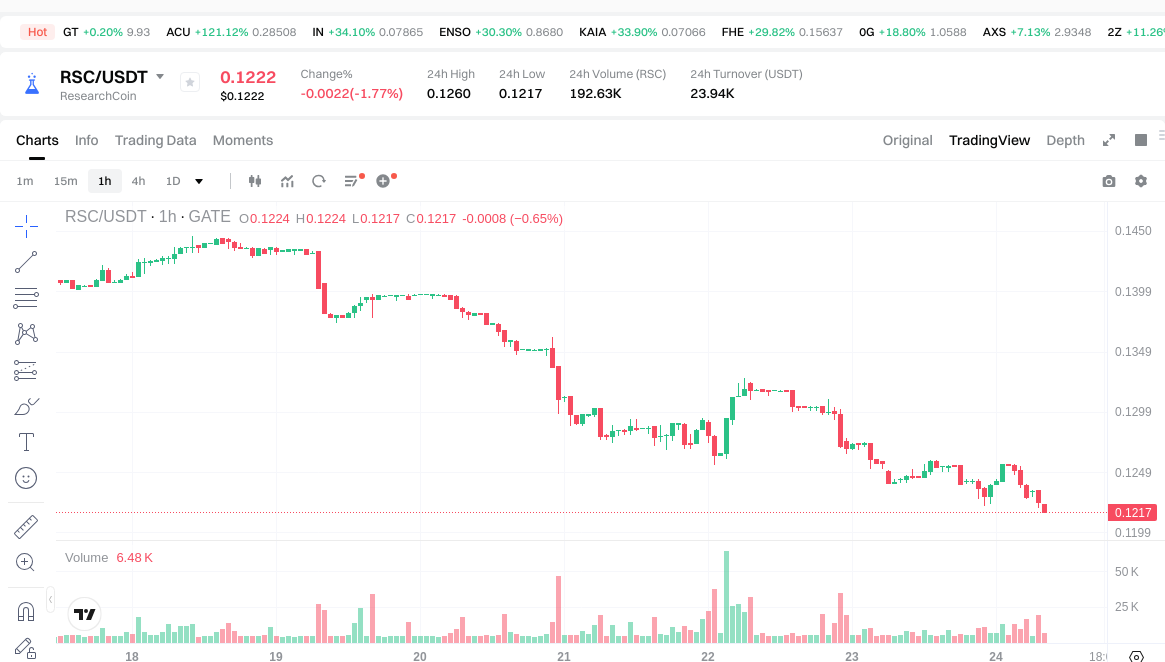
- RSC current price: $0.1222
- Market sentiment (Fear & Greed Index): Data not available in provided materials
- 24-hour trading volume: $23,425.05
- Institutional investor holdings: 75,259 holders recorded
- Market capitalization: $16.39 million with 13.42% of fully diluted valuation
- Circulating supply: 134.16 million RSC (13.42% of total supply)
- Recent price movements: -1.46% (1H), -2.17% (24H), -13.5% (7D), -14.36% (30D)
Click to view real-time RSC market price
II. Core Factors Affecting Whether RSC is a Good Investment (Is ResearchCoin(RSC) a Good Investment)
Supply Mechanism and Scarcity (RSC investment scarcity)
- Maximum supply of 1,000,000,000 RSC tokens with current circulation of approximately 134,157,343.60 tokens (13.42% of total supply) → influences price dynamics and investment considerations
- Historical patterns: RSC experienced price movements from $0.112 to $1.6 within documented periods, demonstrating supply-demand interactions
- Investment consideration: The relatively low circulating supply ratio may contribute to scarcity characteristics as adoption expands
Institutional Investment and Mainstream Adoption (Institutional investment in RSC)
- Current holder base: Approximately 75,259 holders actively participate in the RSC ecosystem
- ResearchHub platform utilizes RSC to incentivize academic contributions including preprint sharing, paper reviews, and scholarly discussions → establishes utility-driven demand
- Trading availability: RSC is accessible across 11 exchanges, facilitating broader market participation
Macroeconomic Environment's Impact on RSC Investment
- ResearchCoin operates within the BASE blockchain ecosystem, positioning it within the broader digital asset sector influenced by macroeconomic conditions
- Market capitalization of approximately $16.39 million with 0.0038% market dominance reflects its current positioning within the cryptocurrency landscape
- Academic and research sector adoption patterns may demonstrate different correlations to traditional macroeconomic factors compared to conventional cryptocurrencies
Technology and Ecosystem Development (Technology & Ecosystem for RSC investment)
- BASE blockchain integration: RSC operates as a token on the BASE network (contract address: 0xfbb75a59193a3525a8825bebe7d4b56899e2f7e1), leveraging its infrastructure capabilities
- Platform utility: ResearchHub enables decentralized academic collaboration across disciplines, rewarding contributions through RSC incentives → establishes foundational use case
- Ecosystem applications: The platform focuses on scientific content sharing, peer review processes, and knowledge dissemination, targeting the academic research community for sustained engagement
III. RSC Future Investment Forecast and Price Outlook (Is ResearchCoin(RSC) worth investing in 2026-2031)
Short-term Investment Forecast (2026, short-term RSC investment outlook)
- Conservative forecast: $0.0767 - $0.1217
- Neutral forecast: $0.1217
- Optimistic forecast: $0.1217 - $0.1412
Mid-term Investment Outlook (2027-2029, mid-term ResearchCoin(RSC) investment forecast)
-
Market stage expectation: The RSC token may experience gradual price appreciation as the ResearchHub platform continues to develop its decentralized scientific collaboration ecosystem. The period could see increased adoption among researchers and academic communities seeking alternative platforms for knowledge sharing.
-
Investment return forecast:
- 2027: $0.0710 - $0.1406
- 2028: $0.0748 - $0.1864
- 2029: $0.1451 - $0.1757
-
Key catalysts: Platform user growth, expansion of academic partnerships, token utility enhancement within the ResearchHub ecosystem, and broader adoption of decentralized research platforms.
Long-term Investment Outlook (Is ResearchCoin a good long-term investment?)
- Base scenario: $0.0859 - $0.1921 (assuming steady platform development and moderate user adoption)
- Optimistic scenario: $0.1568 - $0.2361 (assuming significant ecosystem expansion and increased academic community engagement)
- Risk scenario: Below $0.0767 (in case of limited platform adoption or adverse market conditions)
Click to view RSC long-term investment and price forecast: Price Prediction
2026-2031 Long-term Outlook
- Base scenario: $0.0859 - $0.1921 (corresponding to steady progress and gradual mainstream application growth)
- Optimistic scenario: $0.1568 - $0.2361 (corresponding to large-scale adoption and favorable market environment)
- Transformative scenario: Above $0.2361 (in case of breakthrough ecosystem developments and mainstream popularization)
- 2031-12-31 predicted high: $0.2361 (based on optimistic development assumptions)
Disclaimer: Price predictions are subject to market volatility and various factors. This analysis does not constitute investment advice.
| Year |
Predicted High Price |
Predicted Average Price |
Predicted Low Price |
Price Change |
| 2026 |
0.141172 |
0.1217 |
0.076671 |
0 |
| 2027 |
0.14063652 |
0.131436 |
0.07097544 |
7 |
| 2028 |
0.1863696762 |
0.13603626 |
0.074819943 |
11 |
| 2029 |
0.175711235229 |
0.1612029681 |
0.14508267129 |
31 |
| 2030 |
0.19204109589753 |
0.1684571016645 |
0.085913121848895 |
37 |
| 2031 |
0.236126319403129 |
0.180249098781015 |
0.156816715939483 |
47 |
IV. ResearchCoin Investment Strategy and Risk Management (How to invest in ResearchCoin)
Investment Methodology (ResearchCoin investment strategy)
Long-term Holding (HODL ResearchCoin)
For conservative investors, a long-term holding strategy may involve accumulating RSC during price corrections and maintaining positions through market cycles. This approach focuses on the fundamental development of the ResearchHub platform and its adoption within the academic community, rather than short-term price movements. Investors following this strategy typically evaluate the platform's user growth, scientific content quality, and ecosystem expansion as key indicators.
Active Trading
Active trading strategies rely on technical analysis and swing trading opportunities. Given RSC's 24-hour volatility of -2.17% and weekly movement of -13.5%, traders may identify entry and exit points based on support and resistance levels. The current price of $0.1222, positioned between the all-time low of $0.112 (December 31, 2025) and recent 24-hour high of $0.126, presents various technical trading opportunities. Volume analysis shows daily trading of approximately $23,425, which traders should consider when assessing liquidity for position sizing.
Risk Management (Risk management for ResearchCoin investment)
Asset Allocation Ratios
- Conservative Investors: May allocate 1-3% of their cryptocurrency portfolio to RSC, given its market cap rank of 962 and relatively smaller market dominance of 0.0038%.
- Aggressive Investors: Could consider 5-10% allocation, accepting higher volatility in exchange for potential upside from platform growth.
- Professional Investors: Might implement dynamic allocation strategies based on technical indicators, platform metrics, and broader DeSci (Decentralized Science) sector trends.
Risk Hedging Solutions
A diversified portfolio approach may include combining RSC with established cryptocurrencies, stablecoins, and other DeSci tokens to reduce concentration risk. The circulating supply represents only 13.42% of total supply (134,157,344 out of 1,000,000,000 tokens), which investors should monitor for potential dilution effects from future token unlocks.
Secure Storage
RSC is deployed on the Base blockchain (contract address: 0xfbb75a59193a3525a8825bebe7d4b56899e2f7e1). Investors should consider:
- Hot Wallets: For active trading and platform participation, using Base-compatible wallets with regular security audits.
- Cold Storage: For long-term holdings, hardware wallets supporting Base network provide enhanced security against online threats.
- Hardware Wallet Recommendations: Leading hardware wallet providers offering Base support can provide offline storage solutions, reducing exposure to exchange-related risks.
V. ResearchCoin Investment Risks and Challenges (Risks of investing in ResearchCoin)
Market Risks
RSC exhibits significant price volatility, with a one-year decline of -83.24% and 30-day decrease of -14.36%. The price has fluctuated between $0.112 and $1.6 since its listing in November 2022. The relatively low daily trading volume of approximately $23,425 and market cap of around $16.39 million may contribute to increased price sensitivity to large orders. The market cap to fully diluted valuation ratio of 13.42% indicates substantial token supply yet to enter circulation, which could create downward pressure if released without corresponding demand growth.
Regulatory Risks
As a platform focused on scientific research and academic collaboration, ResearchHub operates in an evolving regulatory landscape. Different jurisdictions maintain varying approaches to cryptocurrency regulation and decentralized platforms. The token's utility within an academic ecosystem may face scrutiny regarding securities classification, particularly concerning how RSC incentivizes platform participation. Investors should monitor regulatory developments in their respective jurisdictions and major markets where the platform operates.
Technical Risks
Being deployed on the Base blockchain, RSC inherits both the benefits and risks of this Layer 2 infrastructure. Potential technical challenges include:
- Network Security: Smart contract vulnerabilities or Base network issues could affect token accessibility and security.
- Platform Development: The ResearchHub platform's technical roadmap execution and potential technical failures could impact token utility and value.
- Integration Risks: Dependencies on Base network stability and Ethereum mainnet security for the underlying infrastructure.
- Adoption Barriers: Technical complexity in onboarding traditional academic users to blockchain-based systems may slow platform growth.
With 11 exchanges currently listing RSC and 75,259 holders, the token maintains moderate but not extensive market infrastructure, which could pose liquidity challenges during market stress periods.
VI. Conclusion: Is ResearchCoin a Good Investment?
Investment Value Summary
ResearchCoin presents a specialized investment opportunity within the DeSci sector, targeting the academic and scientific research community. The platform's mission to democratize scientific knowledge and incentivize research collaboration addresses real-world challenges in traditional academic publishing. However, the token has experienced substantial price decline over the past year, with an -83.24% decrease, and maintains a relatively small market position ranked at 962 by market capitalization.
The low circulating supply ratio (13.42% of total supply) presents both opportunity and risk: future token distribution could support ecosystem growth but may also create selling pressure. The platform's success depends on sustained adoption within the academic community and effective execution of its decentralized research vision.
Investor Recommendations
✅ Beginners: Consider dollar-cost averaging with small allocations (1-2% of crypto portfolio) to manage volatility. Prioritize secure wallet storage using Base-compatible solutions and invest time in understanding the ResearchHub platform's purpose and development progress.
✅ Experienced Investors: May explore swing trading opportunities based on technical analysis, given the token's volatility patterns. Combine fundamental analysis of platform metrics (user growth, content volume, engagement rates) with technical indicators. Consider position sizing that accounts for the low liquidity environment.
✅ Institutional Investors: Could evaluate strategic allocation within DeSci sector exposure as part of thematic portfolio construction. Conduct thorough due diligence on tokenomics, vesting schedules, and platform roadmap. Consider the long-term potential of blockchain-based academic infrastructure while accounting for execution risks.
⚠️ Disclaimer: Cryptocurrency investments carry significant risk, including potential complete loss of capital. This content is provided for informational purposes only and does not constitute investment, financial, or legal advice. Readers should conduct independent research and consult with qualified professionals before making investment decisions.
VII. FAQ
Q1: What is ResearchCoin (RSC) and how does it function?
ResearchCoin (RSC) is the native cryptocurrency token of the ResearchHub platform, launched in November 2022, designed to incentivize academic collaboration and open science. RSC operates on the Base blockchain with a maximum supply of 1 billion tokens, of which approximately 134.16 million are currently in circulation. The token rewards researchers, academics, and enthusiasts for contributions such as sharing preprints, reviewing papers, and engaging in scholarly discussions. Users earn RSC by participating in cross-disciplinary knowledge sharing, creating a decentralized ecosystem that aims to democratize scientific research and address challenges in traditional academic publishing.
Q2: What is RSC's current market position and trading performance?
As of January 24, 2026, RSC trades at $0.1222 with a market capitalization of approximately $16.39 million, ranking 962nd in the cryptocurrency market with 0.0038% market dominance. The token is available on 11 exchanges with a 24-hour trading volume of $23,425.05 and approximately 75,259 holders. Recent performance shows declines of -1.46% (1-hour), -2.17% (24-hour), -13.5% (7-day), and -14.36% (30-day), with a one-year decline of -83.24%. The circulating supply represents only 13.42% of the total token supply, indicating substantial tokens remain to be distributed.
Q3: What are the price forecasts for ResearchCoin through 2031?
Price predictions for RSC vary based on platform development and adoption scenarios. For 2026, conservative forecasts range from $0.0767 to $0.1412, with a neutral estimate around $0.1217. Mid-term projections suggest 2027 prices between $0.0710-$0.1406, 2028 ranging $0.0748-$0.1864, and 2029 spanning $0.1451-$0.1757. Long-term forecasts for 2030-2031 present a base scenario of $0.0859-$0.1921, an optimistic scenario of $0.1568-$0.2361, with the 2031 predicted high reaching $0.2361 under favorable conditions. These predictions depend on platform adoption, academic community engagement, and broader market conditions.
Q4: What investment strategies are suitable for RSC?
Conservative investors may adopt a long-term holding (HODL) strategy with 1-3% portfolio allocation, focusing on the ResearchHub platform's fundamental development and academic adoption rather than short-term price movements. Aggressive investors might consider 5-10% allocations with active trading strategies, leveraging technical analysis on the token's volatility patterns (-2.17% daily, -13.5% weekly). Professional investors could implement dynamic allocation strategies based on platform metrics such as user growth, content volume, and engagement rates. Secure storage is essential, with Base-compatible hot wallets for active trading and hardware cold storage for long-term holdings of the token (contract address: 0xfbb75a59193a3525a8825bebe7d4b56899e2f7e1).
Q5: What are the primary risks associated with investing in ResearchCoin?
RSC investment carries multiple risk categories. Market risks include significant volatility with an 83.24% one-year decline, relatively low trading volume ($23,425 daily), and potential dilution from the 86.58% of tokens not yet in circulation. Regulatory risks involve uncertain classification as the token incentivizes academic participation in an evolving regulatory landscape. Technical risks stem from Base blockchain dependencies, smart contract vulnerabilities, and potential platform development failures. The relatively small market cap ($16.39 million) and limited exchange availability (11 exchanges) may create liquidity challenges during market stress, making RSC unsuitable for risk-averse investors.
Q6: How does ResearchCoin's tokenomics affect its investment potential?
RSearchCoin's tokenomics structure significantly influences its investment characteristics. With only 134.16 million tokens circulating from a 1 billion maximum supply (13.42% circulating ratio), substantial token distribution remains ahead. This low circulation creates potential scarcity characteristics that may support price appreciation as adoption expands, but also presents dilution risk if tokens are released without corresponding demand growth. The market cap to fully diluted valuation ratio of 13.42% indicates significant room for market cap expansion if the platform achieves widespread adoption. The token's utility-driven demand model, based on actual platform usage for academic contributions, provides fundamental value anchoring beyond pure speculation.
Q7: Who should consider investing in ResearchCoin and at what allocation?
Beginners should approach RSC with caution, allocating only 1-2% of their cryptocurrency portfolio through dollar-cost averaging to manage volatility, while prioritizing secure Base-compatible wallet storage. Experienced investors familiar with DeSci sector dynamics may explore larger positions (3-5%) combined with swing trading opportunities based on technical analysis and platform metrics monitoring. Institutional investors might evaluate RSC as part of thematic DeSci portfolio construction, conducting thorough due diligence on tokenomics, vesting schedules, and platform roadmap execution. Risk-averse investors should avoid RSC due to its significant historical volatility, small market cap, and execution uncertainty. All investors must understand that cryptocurrency investments carry substantial risk, including potential complete capital loss.
Q8: What factors could drive ResearchCoin's future value appreciation?
Several catalysts could support RSC value growth. Platform development factors include user base expansion beyond the current 75,259 holders, increased academic community engagement, and enhanced token utility within the ResearchHub ecosystem. Technology developments such as successful Base blockchain integration improvements and new platform features could attract more researchers. Broader adoption triggers include academic partnerships, integration with traditional research institutions, and growing acceptance of decentralized science (DeSci) models. Market factors such as favorable cryptocurrency market conditions and increased investor interest in utility-focused tokens could provide additional support. However, actual value appreciation depends on execution of the platform's vision and sustained adoption within the target academic community.
* The information is not intended to be and does not constitute financial advice or any other recommendation of any sort offered or endorsed by Gate.