Reserve Rights (RSR) is the governance and collateral token of the Reserve Protocol ecosystem, designed to maintain stablecoin stability while serving regions with unreliable financial infrastructure. As of January 2026, RSR trades at $0.002689 with a $168.2 million market cap, backed by notable investors including PayPal co-founder Peter Thiel and Y Combinator President Sam Altman. This comprehensive analysis examines RSR's price history, current market position, and investment fundamentals across multiple timeframes. The article evaluates key factors including token supply mechanisms, institutional adoption, macroeconomic relevance, and technological architecture, while providing detailed price projections ranging from conservative to optimistic scenarios through 2031. Critical risk assessment covers market volatility, regulatory challenges, and technical complexities, alongside investment strategies for different investor profiles. Whether through long-term holding or active trading on Gate and other major
Introduction: Reserve Rights (RSR) Investment Position and Market Prospects
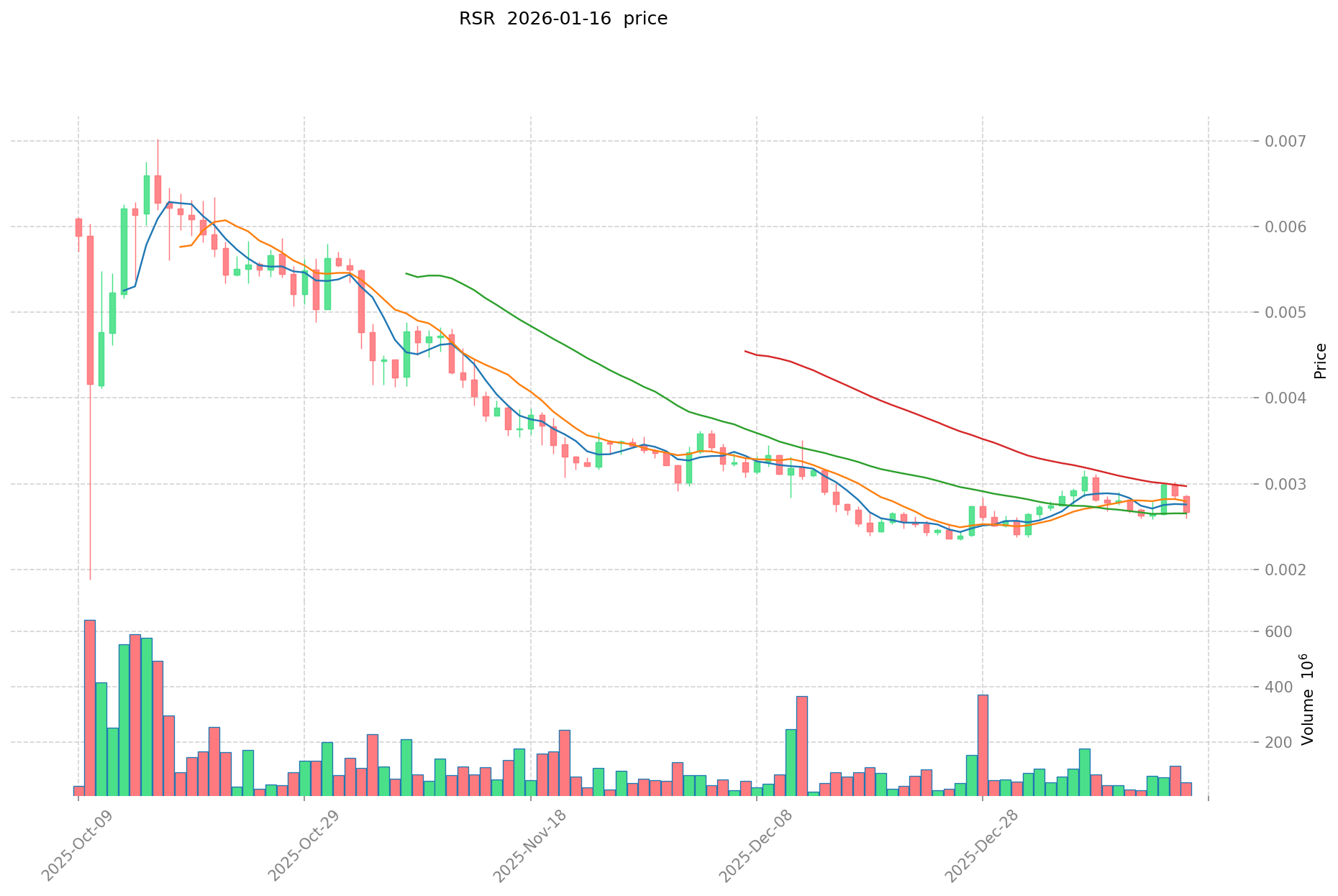
Reserve Rights (RSR) represents a noteworthy asset in the cryptocurrency space, having launched in May 2019 as part of the Reserve Protocol ecosystem. The project aims to establish a stable, distributed stablecoin and digital payment system, with particular focus on regions experiencing unreliable financial infrastructure or elevated inflation rates. As of January 16, 2026, RSR holds a market capitalization of approximately $168.21 million, with a circulating supply of around 62.55 billion tokens, and trades at approximately $0.002689. The token ranks #268 by market capitalization and maintains a market dominance of 0.0079%. RSR serves as the stabilization mechanism for the Reserve stablecoin system, backed by notable investors including PayPal co-founder Peter Thiel and Y Combinator President Sam Altman. Recent price movements show a decline of 3.55% over 24 hours and 4.27% over 7 days, while demonstrating a modest 0.49% gain over the past 30 days. The token's performance over the past year reflects an 81.31% decrease from previous levels. With 35,541 holders and availability on 41 exchanges, RSR has established presence in the digital asset market. This analysis examines RSR's investment characteristics, historical price trends, future price projections, and associated risk factors to provide reference information for market participants considering "Is Reserve Rights (RSR) a good investment?"
I. ReserveRights (RSR) Price History Review and Current Investment Value Status
- 2020: RSR reached its historical low point during market turbulence → Price dropped to $0.00121354 in March
- 2021: Token experienced significant upward momentum amid DeFi expansion → RSR climbed from lower levels to $0.117424 in April
- 2022-2025: Market correction phase → Price declined from previous elevated levels, experiencing volatility throughout the bear market cycle
- Recent period: Token demonstrated mixed performance → 1-year period showed -81.31% change, while 30-day performance indicated +0.49% movement
Current RSR Investment Market Status (January 2026)
- RSR current price: $0.002689
- 24-hour price change: -3.55%
- 24-hour trading volume: $136,107.15
- Market capitalization: $168,205,485
- Circulating supply: 62,553,174,091 RSR (62.55% of total supply)
- Market dominance: 0.0079%
- Token holders: 35,541 addresses
Click to view real-time RSR market price
II. Core Factors Influencing Whether RSR is a Good Investment
Supply Mechanism and Scarcity (RSR Investment Scarcity)
- Token Supply Dynamics → The total supply of RSR is capped at 100 billion tokens, with approximately 62.55 billion tokens currently in circulation. This limited supply structure incorporates an anti-inflation mechanism that may support long-term value appreciation.
- Token Burn Proposal → A significant token burn proposal targeting approximately 30 billion RSR tokens has been discussed within the ecosystem. If implemented, this reduction in circulating supply could enhance scarcity and potentially reduce selling pressure, thereby improving the remaining tokens' weighting in the protocol's future revenue distribution.
- Historical Context → RSR reached a notable price point of $0.117424 on April 17, 2021, demonstrating the token's capacity for significant price movements during periods of heightened market interest.
- Investment Implications → The combination of capped supply and potential supply reduction through token burns represents a fundamental factor that could support RSR's investment case over extended timeframes.
Institutional Investment and Mainstream Adoption
- Notable Backing → The Reserve Protocol has received support from prominent figures and entities including Peter Thiel (PayPal co-founder), Sam Altman (YCombinator President), and various influential investors from Silicon Valley and the digital assets sector.
- Exchange Presence → RSR is listed on 41 cryptocurrency exchanges, indicating a degree of mainstream recognition and accessibility for investors.
- Holder Base → The token maintains approximately 35,541 holders, suggesting a distributed ownership structure across the market.
Macroeconomic Environment Impact on RSR Investment
- Inflation Resistance Goal → The Reserve Protocol aims to create a universal currency resistant to inflation, particularly targeting regions with unreliable financial infrastructure or elevated inflation rates. This positioning could make RSR relevant in macroeconomic environments characterized by currency instability.
- Stablecoin Integration → RSR functions as the collateral and governance token within the Reserve Protocol, which has developed the Reserve stablecoin (RSV). The protocol's focus on creating a stablecoin independent of the U.S. dollar may attract attention during periods of fiat currency volatility.
- Market Sentiment Indicators → Current market data indicates mixed performance, with RSR experiencing a decline of 81.31% over the past year, suggesting the token has been sensitive to broader market conditions and risk appetite.
Technology and Ecosystem Development (Technology & Ecosystem for RSR Investment)
- Token Standard → RSR operates as an ERC-20 token on the Ethereum blockchain, leveraging established infrastructure and security standards.
- Dual-Token Model → The ecosystem employs a dual-token structure: RSR serves as the volatile governance and collateral token, while RSV functions as the stablecoin. This architecture allows RSR to maintain Reserve token price stability through supply adjustments.
- Governance Experimentation → The project team has indicated plans to increase decentralization, with users currently able to experiment with different governance solutions, potentially enhancing community participation in protocol development.
- Application Development → The Reserve ecosystem includes an application designed to facilitate easier access to digital currencies, supporting practical utility beyond speculative trading.
- Capital Efficiency → The protocol's design enables RSR to collateralize RToken value, with higher RSR prices theoretically allowing fewer tokens to support greater stablecoin issuance, potentially improving overall capital efficiency within the Reserve Protocol.
III. RSR Future Investment Prediction and Price Outlook (Is ReserveRights(RSR) worth investing in 2026-2030)
Short-term Investment Prediction (2026, short-term RSR investment outlook)
- Conservative prediction: $0.00229075 - $0.002695
- Neutral prediction: $0.002695 - $0.003
- Optimistic prediction: $0.003 - $0.0036113
Mid-term Investment Outlook (2027-2028, mid-term ReserveRights(RSR) investment forecast)
- Market stage expectation: Based on available forecasts, RSR may experience gradual growth during this period, with price movements influenced by broader market conditions and ecosystem development
- Investment return prediction:
- 2027: $0.002333331 - $0.004540536
- 2028: $0.00261585324 - $0.00496242747
- Key catalysts: Market adoption trends, stablecoin ecosystem expansion, and overall cryptocurrency market sentiment
Long-term Investment Outlook (Is RSR a good long-term investment?)
- Baseline scenario: $0.004299364452883 - $0.00744889887767 (assuming steady market conditions and moderate ecosystem growth through 2030)
- Optimistic scenario: $0.006224079934697 - $0.008278026313147 (assuming favorable market environment and increased adoption by 2031)
- Risk scenario: Below $0.00229075 (in case of adverse market conditions or significant regulatory challenges)
Click to view RSR long-term investment and price prediction: Price Prediction
2026-01-16 - 2031 Long-term Outlook
- Base scenario: $0.004299364452883 - $0.00744889887767 (corresponding to steady progress and gradual mainstream application improvement)
- Optimistic scenario: $0.006224079934697 - $0.008278026313147 (corresponding to large-scale adoption and favorable market environment)
- Transformative scenario: Above $0.008278026313147 (if ecosystem achieves breakthrough progress and mainstream popularization)
- 2031-12-31 predicted high: $0.008278026313147 (based on optimistic development assumptions)
Disclaimer: The predictions presented are based on statistical models and historical data analysis. Actual results may vary due to market volatility, regulatory changes, technological developments, and other unpredictable factors. These forecasts should not be considered as financial advice or guarantees of future performance. Investors should conduct their own research and consider their risk tolerance before making investment decisions.
| Year |
Predicted High Price |
Predicted Average Price |
Predicted Low Price |
Price Change |
| 2026 |
0.0036113 |
0.002695 |
0.00229075 |
0 |
| 2027 |
0.004540536 |
0.00315315 |
0.002333331 |
17 |
| 2028 |
0.00496242747 |
0.003846843 |
0.00261585324 |
43 |
| 2029 |
0.00559388674845 |
0.004404635235 |
0.0036118008927 |
63 |
| 2030 |
0.00744889887767 |
0.004999260991725 |
0.004299364452883 |
86 |
| 2031 |
0.008278026313147 |
0.006224079934697 |
0.004792541549717 |
131 |
IV. RSR Investment Strategy and Risk Management (How to invest in cryptocurrency)
Investment Strategy (RSR investment strategy)
-
Long-term Holding (HODL RSR): This approach may be suitable for conservative investors who believe in the long-term vision of Reserve Protocol. Given RSR's role in maintaining Reserve token stability and its backing from notable investors including PayPal co-founder Peter Thiel and YCombinator President Sam Altman, some investors may consider a multi-year holding strategy. However, investors should note the token's significant price decline of 81.31% over the past year and evaluate whether current market conditions align with their investment thesis.
-
Active Trading: For traders utilizing technical analysis and swing trading strategies, RSR's notable volatility presents both opportunities and risks. Recent data shows 24-hour price fluctuations between $0.002595 and $0.002833, with a 3.55% decline over 24 hours and 4.27% decline over 7 days. Traders should establish clear entry and exit points, utilize stop-loss mechanisms, and closely monitor short-term price movements.
Risk Management (Risk management for RSR investment)
-
Asset Allocation Ratio: Investment allocation should align with individual risk tolerance:
- Conservative investors: Consider limiting RSR exposure to 1-3% of total portfolio
- Moderate investors: May allocate 3-7% depending on overall cryptocurrency exposure
- Experienced investors: Could consider higher allocations but should maintain diversification across multiple assets
-
Risk Hedging Solutions: Implement portfolio diversification strategies including:
- Combining RSR with established cryptocurrencies and traditional assets
- Utilizing stablecoins for quick liquidity access
- Considering dollar-cost averaging to mitigate timing risk
- Monitoring correlation with broader cryptocurrency market trends
-
Secure Storage: Protect RSR holdings through appropriate wallet solutions:
- Cold Wallets: Hardware wallets (such as Ledger or Trezor) for long-term holdings
- Hot Wallets: Reputable software wallets for active trading amounts only
- Exchange Storage: Minimize holdings on exchanges; use only for immediate trading needs
- Security Practices: Enable two-factor authentication, maintain backup seed phrases in secure offline locations
V. RSR Investment Risks and Challenges (Risks of investing in cryptocurrency)
-
Market Risk: RSR demonstrates substantial price volatility, with historical price ranging from an all-time low of $0.00121354 (March 2020) to an all-time high of $0.117424 (April 2021). Current price levels represent approximately 97.7% below the all-time high. The token's market capitalization of approximately $168.2 million and trading volume of $136,107 indicate moderate liquidity, which may contribute to price swings during periods of heightened market activity.
-
Regulatory Risk: As a stablecoin-related project operating across multiple jurisdictions, Reserve Protocol faces evolving regulatory frameworks. Different countries maintain varying approaches to stablecoin regulation, with ongoing policy discussions that could impact the project's operational model. The Reserve system's goal of serving regions with unreliable financial infrastructure may encounter additional regulatory scrutiny in target markets. Investors should monitor regulatory developments that could affect stablecoin projects and digital payment systems.
-
Technical Risk: The Reserve Protocol's dual-token model and algorithmic stability mechanisms present technical complexities. Potential technical risks include:
- Smart contract vulnerabilities on the Ethereum network where RSR is deployed
- Challenges in maintaining Reserve token stability during extreme market conditions
- Protocol upgrade risks that could affect token economics or system functionality
- Network congestion or security issues on underlying blockchain infrastructure
- Integration risks with collateral assets backing the Reserve stablecoin
VI. Conclusion: Is Cryptocurrency a Good Investment?
-
Investment Value Summary: RSR presents a unique value proposition within the stablecoin ecosystem, focusing on creating a stable store of value particularly for regions with financial infrastructure challenges. The project has attracted notable backing from influential investors in both traditional finance and digital assets. However, the token has experienced significant price volatility, with an 81.31% decline over the past year. The current circulating supply of approximately 62.55 billion RSR (62.55% of maximum supply) suggests substantial token distribution. While the long-term vision of establishing a distributed stable payment system holds potential significance, short-term price movements reflect broader cryptocurrency market dynamics and project-specific developments.
-
Investor Recommendations:
✅ Beginners: Consider starting with small allocations through dollar-cost averaging strategy. Prioritize understanding the Reserve Protocol's dual-token mechanism before investing. Store RSR in secure hardware wallets and avoid keeping significant amounts on exchanges. Conduct thorough research on stablecoin projects and their regulatory environment.
✅ Experienced Investors: May employ swing trading strategies based on technical analysis, utilizing RSR's price volatility. Consider portfolio allocation that balances RSR exposure with other cryptocurrency and traditional assets. Monitor project developments, partnership announcements, and adoption metrics in target markets. Utilize risk management tools including stop-loss orders and position sizing strategies.
✅ Institutional Investors: Could evaluate RSR as part of strategic exposure to stablecoin infrastructure and emerging market payment solutions. Consider the project's technological approach to algorithmic stability and collateralization. Assess regulatory compliance frameworks and potential policy impacts across different jurisdictions. Implement comprehensive due diligence on the Reserve Protocol's governance, technical architecture, and market positioning.
⚠️ Disclaimer: Cryptocurrency investment carries substantial risk. Market conditions can change rapidly, and past performance does not indicate future results. This content is for informational purposes only and does not constitute investment advice. Investors should conduct independent research and consult with qualified financial advisors before making investment decisions.
VII. FAQ
Q1: What is Reserve Rights (RSR) and how does it function in the Reserve Protocol?
Reserve Rights (RSR) is the governance and collateral token of the Reserve Protocol, designed to maintain the stability of the Reserve stablecoin (RSV). RSR operates as an ERC-20 token on the Ethereum blockchain and serves multiple functions: it acts as collateral to back the Reserve stablecoin, provides governance rights for protocol decisions, and absorbs volatility through supply adjustments. When the Reserve stablecoin (RSV) trades below its target price, the protocol can mint and sell RSR to purchase RSV and restore stability. Conversely, when RSV trades above target, the protocol may buy back and burn RSR. This dual-token model allows RSR to serve as a buffer that protects the stablecoin's price stability while potentially creating value for RSR holders through protocol growth and revenue distribution.
Q2: Who are the notable investors backing Reserve Rights?
Reserve Rights has secured backing from prominent figures in technology and finance, including Peter Thiel (PayPal co-founder), Sam Altman (President of Y Combinator), and various influential investors from Silicon Valley and the digital assets sector. This institutional support provides the project with both financial resources and strategic guidance. The involvement of such high-profile investors has contributed to RSR's credibility within the cryptocurrency space and suggests confidence in the project's long-term vision. However, investors should note that prominent backing does not guarantee investment success, and RSR's price performance ultimately depends on market conditions, adoption rates, and execution of the project's roadmap.
Q3: What are the key risks associated with investing in RSR?
RSR carries several significant investment risks. Market risk is substantial, with the token demonstrating high volatility—currently trading approximately 97.7% below its all-time high of $0.117424 and showing an 81.31% decline over the past year. Regulatory risk exists as stablecoin projects face evolving frameworks across different jurisdictions, which could impact operational models and market access. Technical risks include smart contract vulnerabilities, challenges in maintaining stability during extreme market conditions, and potential protocol upgrade complications. The relatively modest trading volume of approximately $136,107 over 24 hours indicates moderate liquidity, which may contribute to price swings during periods of high market activity. Additionally, the project's focus on emerging markets with financial infrastructure challenges introduces geopolitical and adoption risks.
Q4: How does RSR's supply mechanism affect its investment potential?
RSR has a capped maximum supply of 100 billion tokens, with approximately 62.55 billion tokens currently in circulation (62.55% of total supply). This limited supply structure incorporates an anti-inflation mechanism that may support long-term value appreciation. Notably, a token burn proposal targeting approximately 30 billion RSR tokens has been discussed within the ecosystem. If implemented, this significant supply reduction could enhance scarcity, potentially reduce selling pressure, and improve the remaining tokens' weighting in future protocol revenue distribution. The supply mechanism creates a deflationary potential that contrasts with many traditional currencies experiencing inflation. However, investors should understand that token burns require governance approval and that supply dynamics alone do not determine price performance—market demand, adoption rates, and overall cryptocurrency market conditions remain critical factors.
Q5: What is the difference between RSR and RSV in the Reserve ecosystem?
The Reserve Protocol employs a dual-token architecture with distinct roles. RSR (Reserve Rights) serves as the volatile governance and collateral token, subject to market price fluctuations and used to stabilize the system. RSV (Reserve) functions as the stablecoin designed to maintain a stable value, intended as a medium of exchange and store of value, particularly in regions with unreliable financial infrastructure. RSR holders provide collateral backing for RSV and participate in governance decisions, potentially benefiting from protocol growth and revenue distribution. When RSV deviates from its target price, the protocol adjusts RSR supply through minting or burning to restore stability. This separation allows RSR to absorb volatility while enabling RSV to maintain price stability, creating a system where RSR represents the speculative investment opportunity while RSV serves as the stable payment instrument.
Q6: What factors could drive RSR price appreciation in the future?
Several factors could potentially support RSR price appreciation. Increased adoption of the Reserve stablecoin (RSV) in target markets with high inflation or unreliable financial systems would increase demand for RSR as collateral. Implementation of the proposed token burn reducing circulating supply by approximately 30 billion tokens could create scarcity and improve tokenomics. Growing decentralized finance (DeFi) ecosystem integration and partnerships could expand RSR utility. Favorable regulatory clarity for stablecoin projects might reduce uncertainty and attract institutional investment. Technical developments improving protocol efficiency and security could enhance confidence. General cryptocurrency market bull cycles typically correlate with increased interest in altcoins including RSR. However, investors should recognize that these potential catalysts face significant uncertainties, and price appreciation is not guaranteed given current market conditions showing an 81.31% decline over the past year.
Q7: How should investors approach portfolio allocation for RSR?
Portfolio allocation for RSR should align with individual risk tolerance and investment experience. Conservative investors might consider limiting RSR exposure to 1-3% of total portfolio value, treating it as a high-risk, speculative position within a diversified asset allocation. Moderate investors could allocate 3-7% depending on their overall cryptocurrency exposure and risk appetite, balancing RSR with more established digital assets and traditional holdings. Experienced investors familiar with cryptocurrency volatility and stablecoin mechanisms might consider higher allocations but should maintain diversification across multiple assets to mitigate concentration risk. Dollar-cost averaging represents a prudent approach for building positions gradually, reducing timing risk in volatile markets. Regardless of allocation level, investors should only commit capital they can afford to lose, implement appropriate risk management strategies including stop-loss orders, and regularly rebalance their portfolio based on changing market conditions and investment objectives.
Q8: Is RSR suitable for long-term holding or short-term trading?
RSR may suit different investment strategies depending on investor objectives and risk tolerance. For long-term holding (HODL strategy), investors would focus on the Reserve Protocol's vision of creating an inflation-resistant universal currency, the project's notable investor backing, and potential ecosystem growth over multi-year timeframes. However, the significant 81.31% price decline over the past year suggests substantial patience and conviction are required for this approach. For short-term trading, RSR's volatility presents opportunities for active traders employing technical analysis and swing trading strategies. Recent data shows 24-hour price fluctuations between $0.002595 and $0.002833, offering potential entry and exit points for experienced traders. Short-term traders should establish clear risk management protocols including stop-losses and profit-taking levels. The choice between strategies depends on individual circumstances—long-term holders must accept extended periods of potential unrealized losses, while short-term traders face transaction costs and require constant market monitoring.
* The information is not intended to be and does not constitute financial advice or any other recommendation of any sort offered or endorsed by Gate.