Resistance Dog (REDO) is a TON blockchain-based digital asset launched in January 2024, currently valued at approximately $3.61 million with a trading price of $0.03614 (January 2026). This comprehensive analysis evaluates REDO's investment potential through multiple dimensions: tokenomics featuring a fixed 100 million token supply with 100% circulation, price history showing volatility from $2.754 peak to current levels with -65.05% annual decline, and market positioning with 26,168 holders across 3 Gate and partner exchanges. The analysis projects price scenarios ranging from conservative ($0.02856-$0.0357 by 2026) to optimistic ($0.055500370108344 by 2031), while addressing market risks including high volatility, regulatory uncertainty, and technical dependencies. Investment recommendations span conservative dollar-cost averaging for beginners to active trading strategies for experienced investors, emphasizing portfolio allocation between 1-15% based on risk tolerance. The content provides informational co
Introduction: Resistance Dog (REDO) Investment Position and Market Outlook
Resistance Dog (REDO) is a digital asset in the cryptocurrency sector that launched in January 2024. As a symbolic representation of digital resistance against censorship, REDO has positioned itself within the TON ecosystem. As of January 30, 2026, REDO holds a market capitalization of approximately $3.61 million, with a circulating supply of 100 million tokens and a current trading price around $0.03614. The token has experienced notable price fluctuations since its inception, with a 30-day performance showing a variation of 30.42%. With approximately 26,168 holders and trading availability on multiple exchanges, REDO has attracted attention from investors examining digital assets with specific thematic positioning. This analysis explores REDO's investment characteristics, historical price movements, future price considerations, and associated investment risks to provide informational context for market participants.
I. Resistance Dog (REDO) Price History Review and Current Investment Value Status
- August 2024: Token reached a notable price level → REDO was trading at $2.754, representing a period of heightened market interest
- December 2024: Market correction phase → Price declined to $0.0183, reflecting broader market volatility
- November 2025: Stabilization period → Token price was approximately $0.03177 with a market capitalization of $3.177 million
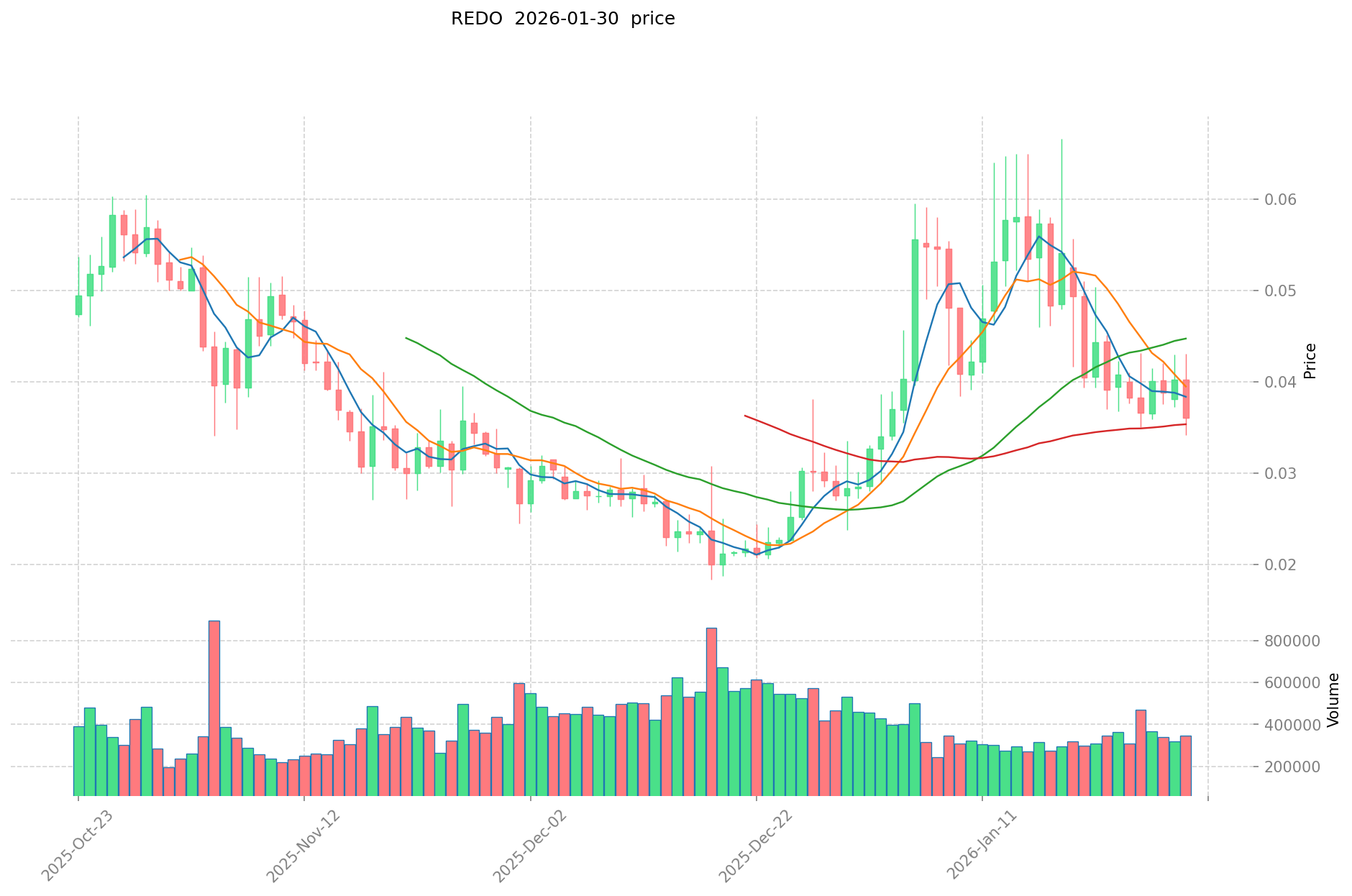
- January 2026: Recent fluctuations → From $0.04303 declined to $0.03416 within 24 hours, demonstrating ongoing price dynamics
Current REDO Investment Market Status (January 2026)
- REDO current price: $0.03614
- Market sentiment (Fear & Greed Index): Data not available in provided materials
- 24-hour trading volume: $13,194.03
- Institutional investor holdings: Approximately 26,168 holders recorded
Click to view real-time REDO market price
II. Core Factors Influencing Whether REDO is a Good Investment
Supply Mechanism and Scarcity (REDO Investment Scarcity)
- Fixed Maximum Supply of 100,000,000 Tokens → Influences Price and Investment Value
- The token maintains a 100% circulation ratio, with all tokens currently in circulation, establishing a clear supply ceiling that may impact long-term scarcity dynamics
- Investment Significance: Limited supply structure serves as one factor supporting long-term investment considerations
Institutional Investment and Mainstream Adoption (Institutional Investment in REDO)
- Holder Base: The token has attracted 26,168 holders as of the current date
- Market presence includes listing on 3 exchanges, providing accessibility for potential investors
- The relatively limited exchange coverage and holder base suggest the project remains in early stages of broader institutional and mainstream adoption
Macroeconomic Environment Impact on REDO Investment
- Market Performance Context: REDO has experienced significant volatility, with a 1-year price change of -65.05%, reflecting broader market conditions and investor sentiment shifts
- Short-term fluctuations show mixed signals: 30-day performance increased by 30.42%, while 7-day and 24-hour periods showed declines of -13.19% and -10.12% respectively
- Market capitalization of $3,614,000 and market share of 0.00012% indicate REDO operates as a smaller market cap asset, potentially subject to higher volatility during macroeconomic shifts
Technology and Ecosystem Development (Technology & Ecosystem for REDO Investment)
- Infrastructure: REDO operates on the TON (The Open Network) blockchain, leveraging its underlying technical architecture
- The project positions itself as "a symbolic representation of our fight against censorship and freedom through digital resistance", establishing a thematic foundation for community engagement
- Contract Address: EQBZ_cafPyDr5KUTs0aNxh0ZTDhkpEZONmLJA2SNGlLm4Cko on TON network, providing transparency for verification and interaction
III. REDO Future Investment Forecast and Price Outlook (Is Resistance Dog(REDO) worth investing in 2026-2031)
Short-term Investment Forecast (2026, short-term REDO investment outlook)
- Conservative forecast: $0.02856 - $0.0357
- Neutral forecast: $0.0357 - $0.044268
- Optimistic forecast: $0.044268 and above
Mid-term Investment Outlook (2027-2029, mid-term Resistance Dog(REDO) investment forecast)
-
Market stage expectation: The reference materials indicate a gradual upward trend with projected price movements showing incremental growth across multiple timeframes. The mid-term period may witness evolving market dynamics as the token establishes its position within the broader digital asset ecosystem.
-
Investment return forecast:
- 2027: $0.0219912 - $0.04678128
- 2028: $0.0394782024 - $0.047720904
- 2029: $0.03006416952 - $0.05284005552
-
Key catalysts: Market sentiment fluctuations, adoption patterns within the TON ecosystem, and broader cryptocurrency market conditions may influence price dynamics during this period.
Long-term Investment Outlook (Is REDO a good long-term investment?)
- Base scenario: $0.0260738342928 - $0.0509177707416 (assuming steady market conditions and moderate ecosystem development)
- Optimistic scenario: $0.0526396277232 - $0.055500370108344 (assuming favorable market environment and increased adoption)
- Risk scenario: Below $0.0260738342928 (under challenging market conditions)
View REDO long-term investment and price forecast: Price Prediction
2026-2031 Long-term Outlook
- Base scenario: $0.02856 - $0.0509177707416 (corresponding to steady progress and gradual mainstream application growth)
- Optimistic scenario: $0.044268 - $0.055500370108344 (corresponding to large-scale adoption and favorable market environment)
- Transformative scenario: Above $0.055500370108344 (subject to breakthrough developments in ecosystem and mainstream adoption)
- 2031-12-31 projected high: $0.055500370108344 (based on optimistic development assumptions)
Disclaimer: The above forecasts are based on historical data analysis and current market information, and do not constitute investment advice. Cryptocurrency markets are highly volatile, and actual prices may differ significantly from projections. Investors should conduct thorough research and consider their risk tolerance before making investment decisions.
| Year |
Predicted High Price |
Predicted Average Price |
Predicted Low Price |
Price Change |
| 2026 |
0.044268 |
0.0357 |
0.02856 |
-1 |
| 2027 |
0.04678128 |
0.039984 |
0.0219912 |
10 |
| 2028 |
0.047720904 |
0.04338264 |
0.0394782024 |
20 |
| 2029 |
0.05284005552 |
0.045551772 |
0.03006416952 |
26 |
| 2030 |
0.0526396277232 |
0.04919591376 |
0.0260738342928 |
36 |
| 2031 |
0.055500370108344 |
0.0509177707416 |
0.032587373274624 |
40 |
IV. Resistance Dog Investment Strategy and Risk Management (How to invest in Resistance Dog)
Investment Methodology (Resistance Dog investment strategy)
Long-term Holding (HODL Resistance Dog): Suitable for conservative investors
Long-term holding represents a fundamental approach for investors seeking to capture potential value appreciation of REDO over extended periods. This strategy involves acquiring tokens and maintaining positions through market cycles, potentially benefiting from the project's development trajectory while minimizing transaction costs associated with frequent trading.
Active Trading: Relying on technical analysis and swing trading
Active trading strategies for REDO involve leveraging technical analysis tools and market indicators to identify short to medium-term price movements. Given the token's 24-hour price fluctuation of -10.12% and demonstrated volatility range between $0.03416 and $0.04303, traders may identify opportunities through chart pattern recognition, momentum indicators, and volume analysis. The 30-day positive performance of 30.42% suggests periods of upward momentum that active traders might capitalize on.
Risk Management (Risk management for Resistance Dog investment)
Asset Allocation Ratio: Conservative / Aggressive / Professional investors
- Conservative allocation: 1-3% of crypto portfolio exposure to REDO
- Moderate allocation: 3-7% for investors comfortable with higher volatility
- Aggressive allocation: 7-15% for experienced traders with risk tolerance
Given REDO's market capitalization of approximately $3.61 million and ranking of 1,708, position sizing should reflect the asset's relative market scale and liquidity profile.
Risk Hedging Solutions: Multi-asset portfolio + hedging instruments
Investors can implement risk mitigation through portfolio diversification across multiple crypto assets with varying correlations. Consideration of stablecoin positions or established cryptocurrencies can provide balance against REDO's volatility characteristics. The token's year-to-date performance showing -65.05% decline emphasizes the importance of hedging strategies.
Secure Storage: Hot/cold wallets + hardware wallet recommendations
Secure storage practices are essential for REDO holdings. Cold storage solutions using hardware wallets provide enhanced security for long-term positions, while hot wallets may serve active trading needs. Given REDO operates on the TON blockchain (contract address: EQBZ_cafPyDr5KUTs0aNxh0ZTDhkpEZONmLJA2SNGlLm4Cko), investors should utilize TON-compatible wallet solutions that support secure key management.
V. Resistance Dog Investment Risks and Challenges (Risks of investing in Resistance Dog)
Market Risks: High volatility and price dynamics
REDO exhibits significant price volatility, with 24-hour movements of -10.12% and weekly fluctuations of -13.19%. The token reached a price level of $2.754 in August 2024, compared to the current price of approximately $0.03614, representing substantial value variation. Daily trading volume of approximately $13,194 indicates relatively modest liquidity, which may amplify price movements during periods of concentrated buying or selling activity.
Regulatory Risks: Policy uncertainty across jurisdictions
Cryptocurrency regulatory frameworks continue evolving across different jurisdictions, creating uncertainty for digital assets including REDO. Changes in regulatory approaches toward digital resistance-themed projects or TON-based tokens could impact accessibility, trading venues, and holder participation. Investors should monitor regulatory developments in their respective jurisdictions and compliance requirements for crypto asset holdings.
Technical Risks: Network security and operational considerations
As a token operating on the TON blockchain, REDO's functionality depends on the underlying network's security and operational stability. Technical vulnerabilities, network congestion, or smart contract issues could affect token transfers and holder experience. The project's digital resistance focus adds considerations regarding platform accessibility and censorship resistance capabilities. With approximately 26,168 holders, community engagement and technical maintenance represent ongoing operational factors.
VI. Conclusion: Is Resistance Dog a Good Investment?
Investment Value Summary: Resistance Dog presents characteristics of a smaller market capitalization digital asset with notable price volatility. The token's 30-day performance showing 30.42% growth contrasts with longer-term decline of 65.05% over one year, reflecting variable market conditions and investor sentiment cycles.
Investor Recommendations:
✅ Beginners: Consider dollar-cost averaging approach + secure wallet storage practices. Start with minimal allocation while developing understanding of TON ecosystem and REDO's positioning.
✅ Experienced Investors: Evaluate swing trading opportunities + portfolio diversification strategies. Monitor technical indicators and volume patterns for position management.
✅ Institutional Investors: Assess strategic allocation potential within broader digital asset frameworks, considering liquidity constraints and market depth.
⚠️ Notice: Cryptocurrency investment carries substantial risks. This content serves informational purposes and does not constitute investment advice. Conduct thorough research and consider consulting financial professionals before making investment decisions.
VII. FAQ
Q1: What is the current market position and trading volume of Resistance Dog (REDO)?
As of January 30, 2026, REDO holds a market capitalization of approximately $3.61 million with a current trading price around $0.03614. The token has a 24-hour trading volume of $13,194.03, with approximately 26,168 holders and availability on 3 exchanges. REDO ranks at position 1,708 in the overall cryptocurrency market with a market share of 0.00012%, indicating it operates as a smaller market cap asset within the digital asset ecosystem.
Q2: How volatile has REDO's price been since launch?
REDO has demonstrated significant price volatility since its January 2024 launch. The token reached $2.754 in August 2024 but declined to $0.0183 by December 2024. Recent performance shows mixed signals: while the 30-day period showed a positive movement of 30.42%, the 7-day and 24-hour periods recorded declines of -13.19% and -10.12% respectively. The 1-year performance indicates a -65.05% decline, reflecting substantial value fluctuation and market sensitivity.
Q3: What is REDO's supply structure and how does it impact investment value?
REDO maintains a fixed maximum supply of 100,000,000 tokens with 100% currently in circulation. This complete circulation ratio establishes a clear supply ceiling without additional token releases, creating a defined scarcity framework. The fixed supply mechanism serves as one factor supporting long-term investment considerations, as no inflationary pressure from new token generation exists within the current structure.
Q4: What are the projected price ranges for REDO through 2031?
Price projections vary significantly across different scenarios and timeframes. For 2026, forecasts range from a conservative $0.02856-$0.0357 to an optimistic scenario above $0.044268. Mid-term projections for 2027-2029 show ranges from $0.0219912 to $0.05284005552 depending on market conditions. The 2031 projected high reaches $0.055500370108344 under optimistic development assumptions. These forecasts are based on historical data analysis and do not guarantee future performance.
Q5: What blockchain network does REDO operate on and what are its technical characteristics?
REDO operates on the TON (The Open Network) blockchain with the contract address EQBZ_cafPyDr5KUTs0aNxh0ZTDhkpEZONmLJA2SNGlLm4Cko. The token leverages TON's underlying technical architecture and positions itself as "a symbolic representation of our fight against censorship and freedom through digital resistance." Technical functionality and security depend on the TON network's operational stability and infrastructure capabilities.
Q6: What are the primary risks associated with investing in REDO?
Three primary risk categories affect REDO investments: Market risks include high volatility with 24-hour movements reaching -10.12% and modest daily trading volume of approximately $13,194, which may amplify price swings. Regulatory risks stem from evolving cryptocurrency frameworks across jurisdictions that could impact accessibility and trading venues. Technical risks involve dependency on TON blockchain security, potential network congestion, and smart contract vulnerabilities that could affect token transfers and holder experience.
Q7: What investment strategies are suitable for different types of REDO investors?
Investment approaches vary by experience level and risk tolerance. Conservative investors may consider 1-3% portfolio allocation with dollar-cost averaging and secure cold storage practices. Experienced investors might pursue 3-7% allocation with active trading strategies leveraging technical analysis of the token's volatility patterns. Aggressive traders with 7-15% allocation can explore swing trading opportunities, though they must account for liquidity constraints given the token's market depth and trading volume characteristics.
Q8: How does REDO compare in terms of exchange availability and holder base?
REDO is currently listed on 3 exchanges with a holder base of approximately 26,168 participants. This relatively limited exchange coverage suggests the project remains in early stages of broader institutional and mainstream adoption compared to more established cryptocurrencies. The holder base indicates growing community interest, though the numbers remain modest relative to major digital assets. These factors contribute to considerations regarding liquidity depth and market accessibility for potential investors.
* The information is not intended to be and does not constitute financial advice or any other recommendation of any sort offered or endorsed by Gate.