This comprehensive analysis evaluates whether Rhea Finance (RHEA) merits investment consideration by examining its tokenomics, market performance, and ecosystem role. RHEA, launched January 2025 as a strategic merger of Ref Finance and Burrow Finance, functions as NEAR Protocol's unified liquidity hub with a current market cap of $2.84 million and trading price of $0.01419. The article assesses key investment factors including token supply dynamics (200M circulating of 1B total), institutional accessibility across 11 exchanges including Gate, and NEAR ecosystem development potential. Short-term RHEA price ranges project $0.0099-$0.0190, while mid-term forecasts through 2029 suggest potential 17-38% appreciation based on ecosystem adoption. The analysis provides tailored investment strategies for beginners, experienced traders, and institutional investors, alongside critical risk assessment covering market volatility, technical integration challenges, and regulatory uncertainties. Investors must conduct indepe
Introduction: Rhea Finance (RHEA) Investment Position and Market Prospects
RHEA is a notable asset in the cryptocurrency sector, having launched in 2025 as the strategic evolution of NEAR Protocol's DeFi infrastructure. As of January 31, 2026, RHEA maintains a market capitalization of approximately $2.84 million with a circulating supply of 200 million tokens, currently trading at around $0.01419. With a market dominance of 0.00047%, the token is available on 11 exchanges with a 24-hour trading volume of approximately $33,967. Positioned as a unified liquidity hub and chain-abstracted liquidity layer for NEAR ecosystem, RHEA has emerged from the merger of Ref Finance and Burrow Finance, two established protocols in decentralized exchange and lending services. The project serves as the primary infrastructure supporting DeFi projects on NEAR Protocol, incorporating protocol-level integrations and community incentive mechanisms built on NEAR's technology stack, including Chain Abstraction and AI-powered frameworks. This analysis examines RHEA's investment characteristics, historical performance, price dynamics, and associated risk factors to provide reference for market participants considering exposure to this asset.
I. RHEA Price History Review and Current Investment Value Status
- 2025: Token launch on January 29 → Initial market entry phase commenced
- 2025: Price peaked at $0.35778 in early August → RHEA experienced notable volatility in its first months of trading
- 2025: Market correction period → From August peak declined to $0.01311 by November
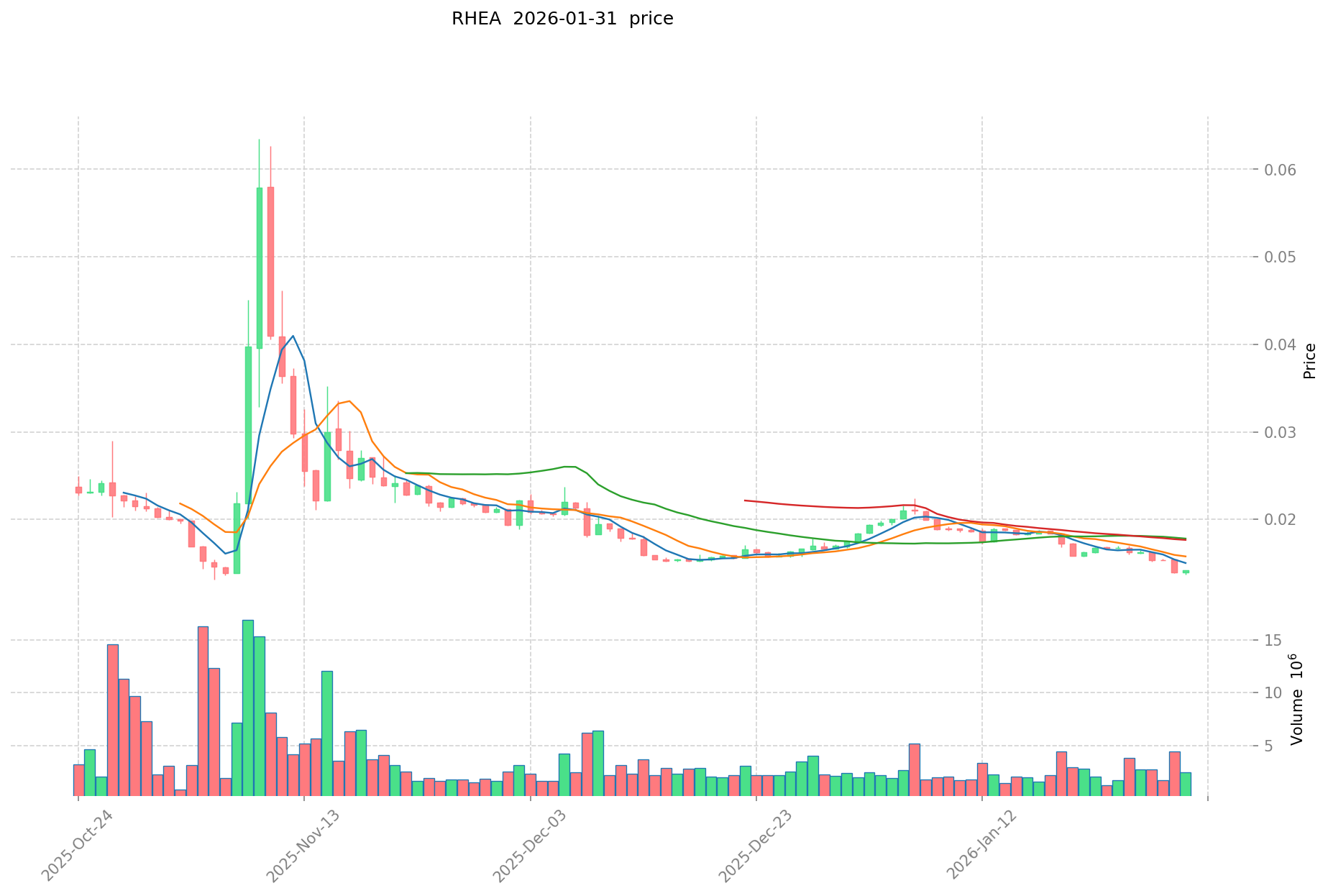
Current RHEA Investment Market Status (January 2026)
- RHEA current price: $0.01419
- Market sentiment (Fear & Greed Index): Data not available in provided materials
- 24-hour trading volume: $33,966.72
- Institutional investor holdings: Data not available in provided materials
Click to view real-time RHEA market price
II. Core Factors Influencing Whether RHEA is a Good Investment
Supply Mechanism and Scarcity (RHEA investment scarcity)
- RHEA has a maximum supply of 1,000,000,000 tokens, with 200,000,000 tokens currently in circulation (20% circulating ratio) → influences price dynamics and investment value
- The controlled token release schedule may create supply-side pressure as circulation ratio remains relatively low
- Investment significance: the gradual token unlock mechanism represents a key consideration for long-term investment evaluation, as increasing circulating supply could affect price stability
Institutional Investment and Mainstream Adoption (Institutional investment in RHEA)
- RHEA is listed on 11 exchanges, indicating a moderate level of market accessibility
- The project emerged from the strategic merger of Ref Finance and Burrow Finance, two established DeFi protocols on NEAR Protocol, suggesting institutional-level backing within the NEAR ecosystem
- As NEAR Protocol's primary liquidity hub and chain-abstracted liquidity layer, RHEA's adoption depends on the broader development of DeFi projects building on NEAR's technology stack
Macroeconomic Environment's Impact on RHEA Investment
- The current market capitalization of $2,838,000 and fully diluted valuation of $14,190,000 reflect relatively modest market positioning
- RHEA's 24-hour trading volume of $33,966.72 indicates limited liquidity, which may amplify price volatility during periods of macroeconomic uncertainty
- Market dominance of 0.00047% suggests that RHEA's investment performance may be more sensitive to sector-specific trends in DeFi rather than broader macroeconomic factors
Technology and Ecosystem Development (Technology & Ecosystem for RHEA investment)
- Built directly on NEAR's technology stack, including Chain Abstraction and AI-powered framework → enhances technical infrastructure for long-term value creation
- Protocol-level integrations and community incentive mechanisms → supports ecosystem expansion and user engagement
- Functions as the primary liquidity hub for NEAR's DeFi ecosystem → potential investment value correlates with the growth trajectory of NEAR-based DeFi projects
- DEX and lending protocol capabilities from legacy Ref Finance and Burrow Finance → provides foundational utility for ecosystem participants
III. RHEA Future Investment Forecast and Price Outlook (Is Rhea Finance (RHEA) worth investing in 2026-2031)
Short-term Investment Forecast (2026, short-term RHEA investment outlook)
- Conservative forecast: $0.0099 - $0.0142
- Neutral forecast: $0.0142 - $0.0166
- Optimistic forecast: $0.0166 - $0.0190
Mid-term Investment Outlook (2027-2029, mid-term Rhea Finance (RHEA) investment forecast)
-
Market phase expectation: According to available price prediction models, RHEA may experience moderate growth during this period. The token could benefit from its role as a liquidity hub within the NEAR ecosystem and potential developments in chain abstraction technology.
-
Investment return forecast:
- 2027: $0.0118 - $0.0194 (representing potential growth of approximately 17% from 2026 levels)
- 2028: $0.0142 - $0.0213 (representing potential growth of approximately 26% from 2026 levels)
- 2029: $0.0165 - $0.0255 (representing potential growth of approximately 38% from 2026 levels)
-
Key catalysts: Integration progress within the NEAR DeFi ecosystem, adoption of chain abstraction features, community incentive mechanisms, and overall DeFi market conditions.
Long-term Investment Outlook (Is RHEA a good long-term investment?)
- Baseline scenario: $0.0117 - $0.0275 (assuming steady ecosystem development and moderate market conditions through 2030-2031)
- Optimistic scenario: $0.0226 - $0.0276 (assuming successful protocol integrations and favorable DeFi sector growth)
- Risk scenario: Below $0.0117 (under challenging market conditions or reduced ecosystem activity)
Click to view RHEA long-term investment and price forecast: Price Prediction
2026-01-31 to 2031 Long-term Outlook
- Baseline scenario: $0.0142 - $0.0226 USD (corresponding to steady progress and gradual mainstream application improvement)
- Optimistic scenario: $0.0226 - $0.0276 USD (corresponding to large-scale adoption and favorable market environment)
- Transformative scenario: Above $0.0276 USD (in case of breakthrough ecosystem developments and mainstream adoption)
- 2031-12-31 forecast high: $0.0263 USD (based on optimistic development assumptions)
Disclaimer: Price predictions are inherently uncertain and should not be considered as investment advice. Cryptocurrency markets are highly volatile and subject to numerous unpredictable factors. Past performance does not guarantee future results. Investors should conduct their own research and consider their risk tolerance before making investment decisions.
| Year |
Predicted High Price |
Predicted Average Price |
Predicted Low Price |
Price Change |
| 2026 |
0.0190146 |
0.01419 |
0.009933 |
0 |
| 2027 |
0.019424691 |
0.0166023 |
0.011787633 |
17 |
| 2028 |
0.02125592469 |
0.0180134955 |
0.014230661445 |
26 |
| 2029 |
0.0255251231235 |
0.019634710095 |
0.0164931564798 |
38 |
| 2030 |
0.027547498263285 |
0.02257991660925 |
0.01174155663681 |
59 |
| 2031 |
0.02631689280808 |
0.025063707436267 |
0.019299054725925 |
76 |
IV. RHEA Investment Strategy and Risk Management (How to invest in Rhea Finance)
Investment Methodology (RHEA investment strategy)
Risk Management (Risk management for RHEA investment)
-
Asset Allocation Ratio: Conservative / Aggressive / Professional investors
- Conservative investors: Allocate a small percentage (1-3%) of crypto portfolio to RHEA
- Aggressive investors: May consider 5-10% allocation based on risk tolerance
- Professional investors: Conduct thorough due diligence on protocol integrations and ecosystem development
-
Risk Hedging Solutions: Multi-asset portfolio + hedging instruments
- Diversify across different DeFi protocols and blockchain ecosystems
- Consider correlation with NEAR Protocol and broader DeFi market trends
- Monitor liquidity conditions given the 24-hour trading volume of approximately $33,966
-
Secure Storage: Hot and cold wallets + hardware wallet recommendations
- Use hardware wallets for long-term storage of RHEA tokens
- For active traders, maintain only necessary amounts in exchange wallets
- Note that RHEA is deployed on NEAR Protocol (contract address: token.rhealab.near)
- Ensure wallet compatibility with NEAR-based tokens
V. RHEA Investment Risks and Challenges (Risks of investing in Rhea Finance)
-
Market Risks: High volatility, price manipulation potential
- RHEA has experienced significant price fluctuations, with a 1-year decline of -65.57%
- The token reached a peak of $0.35778 on August 1, 2025, and a low of $0.01311 on November 5, 2025
- Current market cap represents only 20% of fully diluted valuation ($14,190,000), indicating potential dilution risk
- Limited market dominance (0.00047%) and relatively low liquidity may increase vulnerability to price swings
-
Regulatory Risks: Policy uncertainty across different jurisdictions
- DeFi protocols face evolving regulatory frameworks globally
- Compliance requirements may impact protocol operations and token utility
- Investors should stay informed about regulatory developments affecting DeFi platforms
-
Technical Risks: Network security vulnerabilities, upgrade failures
- As a merged entity of Ref Finance and Burrow Finance, integration risks may exist during the transition period
- Dependency on NEAR Protocol's infrastructure and chain abstraction technology
- Smart contract vulnerabilities could affect the liquidity hub and lending protocol functions
- AI-powered framework integration introduces additional technical complexity
-
Project-Specific Risks:
- Execution risk related to the strategic merger and rebranding process
- Competition from other DeFi protocols within and outside the NEAR ecosystem
- Adoption rate of protocol-level integrations and community incentive mechanisms
- Limited exchange availability (11 exchanges) may affect liquidity and accessibility
VI. Conclusion: Is Rhea Finance a Good Investment?
-
Investment Value Summary: RHEA represents an innovative consolidation in the NEAR DeFi ecosystem, merging two established protocols to create a unified liquidity layer. While the long-term potential depends on successful execution of the merger and adoption of chain abstraction features, short-term price movements have shown considerable volatility.
-
Investor Recommendations:
✅ Beginners: Dollar-cost averaging (DCA) approach + secure wallet storage
- Start with small, regular investments to mitigate timing risk
- Use hardware wallets or reputable NEAR-compatible wallets for storage
- Focus on understanding the project fundamentals before increasing exposure
✅ Experienced Investors: Swing trading + portfolio diversification
- Monitor technical indicators and price levels for entry and exit points
- Maintain diversification across DeFi sectors and blockchain ecosystems
- Track developments in NEAR Protocol and ecosystem growth metrics
✅ Institutional Investors: Strategic long-term allocation
- Conduct comprehensive due diligence on protocol integrations and governance structure
- Assess the competitive positioning within the DeFi liquidity landscape
- Consider allocation as part of a broader blockchain infrastructure investment thesis
⚠️ Important Notice: Cryptocurrency investments carry significant risks. This content is for informational purposes only and does not constitute investment advice. Investors should conduct their own research and consult with financial professionals before making investment decisions.
VII. FAQ
Q1: What is Rhea Finance (RHEA) and what makes it unique in the DeFi landscape?
Rhea Finance is the strategic merger of two established NEAR Protocol DeFi platforms—Ref Finance and Burrow Finance—creating a unified liquidity hub and chain-abstracted liquidity layer. As NEAR's primary DeFi infrastructure, RHEA distinguishes itself by integrating both decentralized exchange (DEX) and lending protocol functionalities within a single ecosystem, while leveraging NEAR's advanced technology stack including Chain Abstraction and AI-powered frameworks. This consolidation positions RHEA as the central liquidity gateway for DeFi projects building on NEAR Protocol.
Q2: How has RHEA performed since its launch, and what is its current market position?
Since launching on January 29, 2025, RHEA experienced significant volatility, reaching a peak of $0.35778 in early August 2025 before declining -65.57% over the year to its current price around $0.01419 as of January 31, 2026. The token maintains a modest market capitalization of approximately $2.84 million with 200 million tokens in circulation (20% of total supply), trading on 11 exchanges with a 24-hour volume of roughly $33,967. Its market dominance stands at 0.00047%, indicating a relatively small but specialized positioning within the DeFi sector.
Q3: What are the key factors that could influence RHEA's investment value?
Several critical factors affect RHEA's investment potential: (1) Token supply dynamics—with only 20% of maximum supply currently circulating, future token unlocks may create supply pressure; (2) NEAR ecosystem development—RHEA's success directly correlates with the growth of DeFi projects on NEAR Protocol; (3) Protocol integration progress—successful implementation of chain abstraction features and community incentive mechanisms; (4) Market liquidity—relatively low trading volume may amplify price volatility during market fluctuations; (5) Technical execution—effective merger integration of Ref Finance and Burrow Finance functionalities.
Q4: What investment strategies are most suitable for different types of RHEA investors?
Investment approaches vary by experience level: Beginners should employ dollar-cost averaging (DCA) with 1-3% portfolio allocation, using secure NEAR-compatible wallets for storage while focusing on understanding project fundamentals. Experienced investors may consider swing trading strategies based on technical analysis, maintaining 5-10% allocation while monitoring price ranges between $0.01371-$0.01423 and tracking NEAR ecosystem developments. Institutional investors should conduct comprehensive due diligence on protocol integrations, competitive positioning, and consider RHEA as part of a broader blockchain infrastructure investment thesis with appropriate risk management frameworks.
Q5: What are the primary risks associated with investing in RHEA?
RHEA carries multiple risk categories: Market risks include high volatility (demonstrated by -65.57% annual decline), limited liquidity with $33,967 daily volume, and potential price manipulation due to small market cap. Technical risks involve smart contract vulnerabilities, merger integration challenges, dependency on NEAR Protocol infrastructure, and complexity of AI-powered framework integration. Project-specific risks encompass execution uncertainty around the strategic merger, competition from other DeFi protocols, adoption rate of protocol features, and limited exchange availability (11 exchanges). Additionally, regulatory uncertainty affecting DeFi platforms globally presents ongoing compliance challenges.
Q6: What are the realistic price predictions for RHEA through 2031?
Based on predictive models, RHEA's price trajectory suggests: 2026 (short-term): $0.0099-$0.0190 depending on market conditions; 2027-2029 (mid-term): gradual growth from $0.0118-$0.0194 (2027) to $0.0165-$0.0255 (2029), representing potential 17-38% appreciation contingent on ecosystem adoption; 2030-2031 (long-term): baseline scenario projects $0.0117-$0.0275, with optimistic scenarios reaching $0.0226-$0.0276 under favorable conditions. However, these predictions carry significant uncertainty due to market volatility, technological developments, and ecosystem growth variables.
Q7: How should investors securely store their RHEA tokens?
Proper RHEA storage requires NEAR Protocol-compatible solutions since the token is deployed on NEAR (contract address: token.rhealab.near). Long-term holders should utilize hardware wallets that support NEAR-based tokens for maximum security. Active traders should maintain only necessary trading amounts on exchange wallets while keeping the majority in cold storage. Ensure wallet compatibility verification before transferring RHEA tokens, and implement backup procedures for recovery phrases. Given the relatively limited exchange availability, selecting reputable platforms among the 11 available exchanges is essential for both trading and initial acquisition.
Q8: Is RHEA suitable as a long-term investment, and what should investors monitor?
RHEA's long-term investment suitability depends on belief in the NEAR ecosystem's growth trajectory and successful execution of the protocol merger. Conservative investors might consider 1-3% allocation as part of a diversified crypto portfolio, monitoring: (1) protocol-level integration progress and community incentive mechanism effectiveness; (2) adoption rates of chain abstraction features; (3) growth metrics of DeFi projects building on NEAR; (4) circulating supply increases as tokens unlock from the current 20%; (5) competitive positioning against other liquidity hubs. The token's strategic role as NEAR's primary DeFi infrastructure provides fundamental utility, but execution risk and market volatility require careful ongoing assessment.
⚠️ Disclaimer: This FAQ is for informational purposes only and does not constitute investment advice. Cryptocurrency investments carry substantial risks including potential loss of principal. Investors should conduct independent research, assess their risk tolerance, and consult with qualified financial professionals before making investment decisions.
* The information is not intended to be and does not constitute financial advice or any other recommendation of any sort offered or endorsed by Gate.