Rhea Finance (RHEA) represents a strategic merger of Ref Finance and Burrow Finance, functioning as NEAR Protocol's primary liquidity hub and chain-abstracted liquidity layer. This comprehensive analysis evaluates RHEA's investment viability through multiple dimensions: tokenomics reveal only 20% of total supply currently circulates (200 million of 1 billion tokens), indicating future dilution risks; market performance shows significant volatility with a one-year decline of -65.48% and current trading price of $0.01408 on Gate; core investment factors include institutional consolidation potential, NEAR's advanced chain abstraction technology, and DeFi ecosystem positioning. The article addresses critical concerns for potential investors by examining price history, conducting short-to-long-term price analysis, detailing risk management strategies, and clarifying technical and regulatory risks. Comprehensive investment recommendations differentiate approaches for beginners, experienced traders, and institutiona
Introduction: Rhea Finance (RHEA) Investment Position and Market Outlook
Rhea Finance (RHEA) represents a strategic evolution in the decentralized finance sector, emerging from the merger of two prominent protocols on the NEAR ecosystem. As of January 31, 2026, RHEA maintains a market capitalization of approximately $2.82 million, with a circulating supply of 200 million tokens and a current trading price around $0.01408. The asset holds a market share of 0.00047% and ranks at position 1866 among digital assets. Positioned as a unified liquidity hub and chain-abstracted liquidity layer for DeFi projects on NEAR Protocol, RHEA serves both protocol-level integrations and community incentive mechanisms. This analysis examines RHEA's investment characteristics, historical price movements, future outlook considerations, and associated risk factors to provide reference information for market participants evaluating "Is Rhea Finance (RHEA) a good investment?" within their research framework.
I. Price History Review and Current Investment Value of RHEA
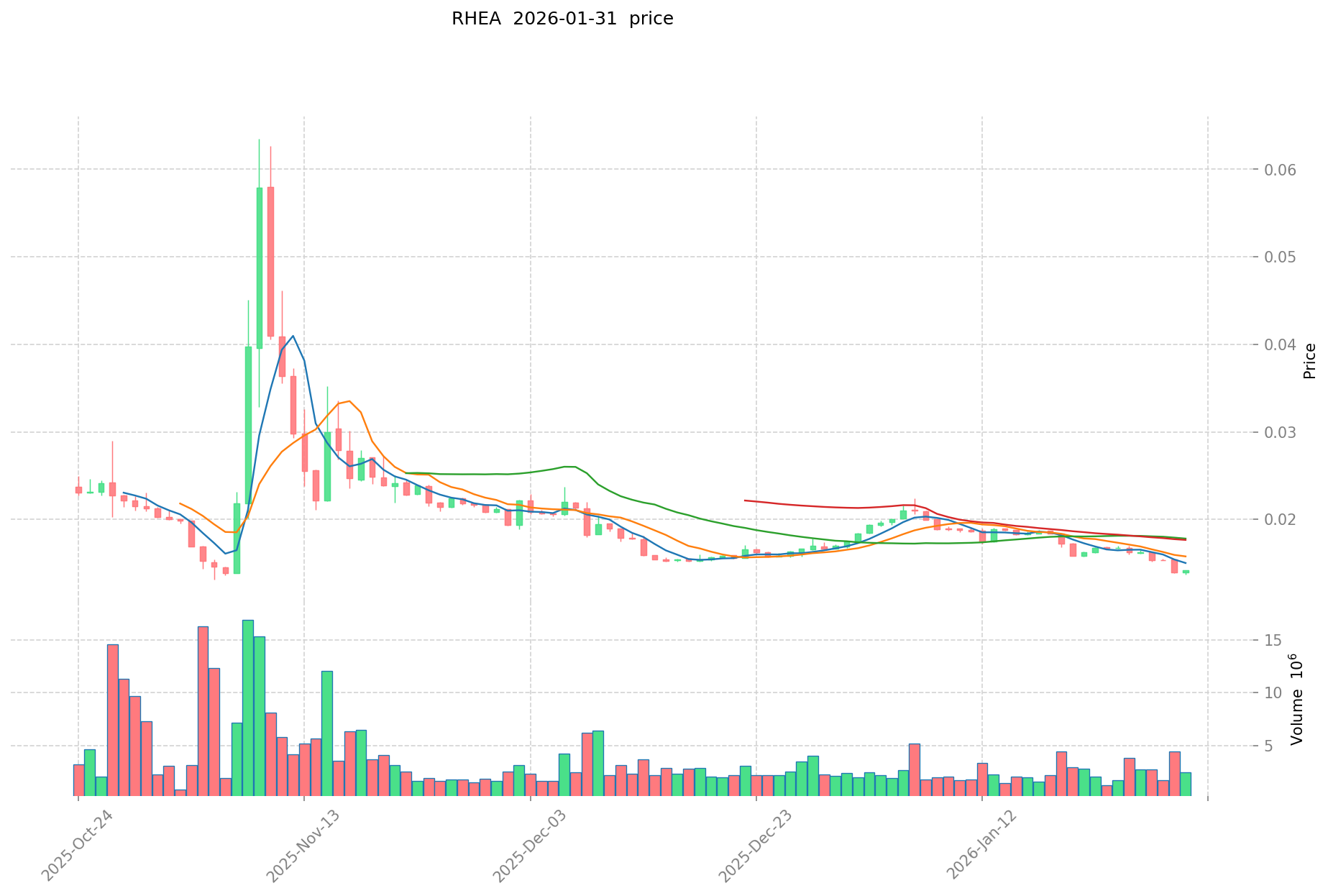
Based on the available data, RHEA has experienced notable price movements since its market introduction:
- 2025: Token launch period → RHEA began trading on January 29, 2025, establishing its initial market presence as the evolved form of NEAR Protocol's DeFi infrastructure
- 2025 (August 1): Peak pricing period → RHEA reached a significant valuation of $0.35778, reflecting strong initial market interest in the merged DeFi ecosystem
- 2025 (November 5 - Present): Market correction phase → Price declined from earlier highs to $0.01311, representing substantial volatility typical of emerging DeFi tokens
Current Investment Market Status (January 2026)
- Current RHEA Price: $0.01408 (as of January 31, 2026)
- 24-Hour Trading Volume: $33,798.65
- Market Capitalization: $2,816,000 with 200 million tokens in circulation (20% of total supply)
- Recent Price Performance:
- 1-Hour Change: +0.27%
- 24-Hour Change: +2.76%
- 7-Day Change: -15.89%
- 30-Day Change: -21.34%
- 1-Year Change: -65.48%
Click to view real-time RHEA market price
The token currently represents the strategic merger of Ref Finance and Burrow Finance, serving as the primary liquidity hub for NEAR Protocol's DeFi ecosystem with protocol-level integrations built on NEAR's Chain Abstraction and AI-powered framework technology.
II. Core Factors Influencing Whether RHEA is a Good Investment
Supply Mechanism and Scarcity (RHEA investment scarcity)
- Total Supply: 1,000,000,000 RHEA tokens with a maximum supply cap of 1,000,000,000 tokens
- Current Circulating Supply: 200,000,000 tokens (20% of total supply)
- Market Cap to FDV Ratio: 20%, indicating significant token unlock potential ahead
- Investment Implication: The current circulating supply represents only one-fifth of the total supply, suggesting that future token releases may impact price dynamics and scarcity perception over time
Institutional Investment and Mainstream Adoption (Institutional investment in RHEA)
- RHEA Finance represents a strategic merger of Ref Finance and Burrow Finance, two established DeFi protocols on the NEAR Protocol
- Protocol Positioning: Serves as the primary liquidity hub and chain-abstracted liquidity layer for DeFi projects on NEAR
- Integration Capabilities: Enables protocol-level integrations and community incentive mechanisms built on NEAR's technology stack, including Chain Abstraction and AI-powered frameworks
- Investment Consideration: The consolidation of two established NEAR ecosystem projects may influence institutional perception and adoption potential
Macroeconomic Environment Impact on RHEA Investment
- DeFi Sector Dynamics: As a liquidity hub within the NEAR ecosystem, RHEA's investment appeal may correlate with broader DeFi market conditions
- Market Position: Trading volume of $33,798.65 with a market capitalization of $2,816,000 as of January 31, 2026
- Price Performance Context: 24-hour change of +2.76%, contrasted with 7-day decline of -15.89% and 30-day decline of -21.34%
- Investment Consideration: Short-term volatility and medium-term downward trends may reflect broader market uncertainty affecting investor sentiment
Technology and Ecosystem Development (Technology & Ecosystem for RHEA investment)
- Chain Abstraction Technology: Built on NEAR's chain abstraction capabilities, potentially enabling cross-chain liquidity flows
- AI-Powered Framework: Integration of AI-driven mechanisms into the protocol infrastructure
- Unified DeFi Foundation: Merger aims to create a consolidated platform supporting the next wave of DeFi projects on NEAR
- Liquidity Infrastructure: Functions as both a DEX and lending protocol successor, maintaining established DeFi functionalities
- Investment Implication: Technical integration of legacy protocols and adoption of NEAR's advanced features may influence long-term utility and ecosystem positioning
III. RHEA Future Investment Prediction and Price Outlook (Is Rhea Finance (RHEA) worth investing in 2026-2031)
Short-term Investment Prediction (2026, short-term RHEA investment outlook)
- Conservative forecast: $0.0089 - $0.0141
- Neutral forecast: $0.0141 - $0.0177
- Optimistic forecast: $0.0177 - $0.0227
Mid-term Investment Outlook (2027-2029, mid-term Rhea Finance (RHEA) investment forecast)
-
Market phase expectations: The token may experience gradual development as the merged protocol from Ref Finance and Burrow Finance continues to establish its position as a liquidity hub within the NEAR ecosystem. The chain abstraction features and protocol-level integrations could support organic growth.
-
Investment return prediction:
- 2027: $0.0146 - $0.0169
- 2028: $0.0141 - $0.0184
- 2029: $0.0137 - $0.0191
-
Key catalysts: Protocol adoption within NEAR DeFi ecosystem, successful implementation of chain abstraction technology, community incentive mechanisms effectiveness, and broader DeFi market conditions.
Long-term Investment Outlook (Is RHEA a good long-term investment?)
- Base scenario: $0.0140 - $0.0195 (assuming steady development of NEAR DeFi ecosystem and sustained protocol usage)
- Optimistic scenario: $0.0195 - $0.0260 (assuming increased adoption of chain abstraction features and expansion of liquidity provision services)
- Risk scenario: Below $0.0132 (in case of severe market downturns or reduced protocol engagement)
View RHEA long-term investment and price prediction: Price Prediction
2026-2031 Long-term Outlook
- Base scenario: $0.0141 - $0.0182 USD (corresponding to steady progress and incremental mainstream application growth)
- Optimistic scenario: $0.0182 - $0.0260 USD (corresponding to large-scale adoption and favorable market conditions)
- Transformative scenario: Above $0.0260 USD (in case of breakthrough ecosystem developments and mainstream adoption)
- 2031-12-31 predicted high: $0.0260 USD (based on optimistic development assumptions)
Disclaimer: Price predictions are based on historical data analysis and market modeling. Cryptocurrency markets are highly volatile and subject to numerous external factors. These predictions should not be considered as investment advice, and actual prices may differ materially from forecasts.
| Year |
Predicted High Price |
Predicted Average Price |
Predicted Low Price |
Price Change |
| 2026 |
0.0177408 |
0.01408 |
0.0088704 |
0 |
| 2027 |
0.016865024 |
0.0159104 |
0.014637568 |
13 |
| 2028 |
0.01835423744 |
0.016387712 |
0.01409343232 |
16 |
| 2029 |
0.019108072192 |
0.01737097472 |
0.0137230700288 |
23 |
| 2030 |
0.02079305673984 |
0.018239523456 |
0.01404443306112 |
29 |
| 2031 |
0.025956665830233 |
0.01951629009792 |
0.015417869177356 |
38 |
IV. RHEA Investment Strategy and Risk Management (How to invest in DeFi tokens)
Investment Methodology (RHEA investment strategy)
Long-term Holding (HODL RHEA): This approach may suit investors who believe in the long-term development of the NEAR ecosystem and the merged entity of Ref Finance and Burrow Finance. Given RHEA's role as a liquidity hub and chain-abstracted liquidity layer on NEAR, holders would be betting on the protocol's ability to attract DeFi projects and maintain its position within the NEAR DeFi landscape. This strategy requires patience through market cycles and confidence in the project's fundamental value proposition.
Active Trading: Traders focusing on RHEA might employ technical analysis and swing trading strategies. With a 24-hour price change of 2.76% and recent volatility indicators showing a 7-day decline of -15.89% and 30-day decline of -21.34%, the token demonstrates price fluctuations that active traders could potentially capitalize on. However, such strategies demand continuous market monitoring, understanding of support and resistance levels, and disciplined execution.
Risk Management (Risk management for RHEA investment)
Asset Allocation Ratio:
- Conservative investors: Consider allocating no more than 1-3% of their crypto portfolio to RHEA, given its lower market cap of approximately $2.8 million and ranking of 1866
- Moderate investors: May allocate 3-7% while maintaining diversification across established cryptocurrencies
- Aggressive/Professional investors: Could consider higher allocations of 7-15% if conducting thorough due diligence on the NEAR ecosystem and DeFi sector
Risk Hedging Solutions: Implement a multi-asset portfolio strategy that includes established cryptocurrencies alongside RHEA. Consider maintaining positions in stablecoins or other lower-volatility assets to balance exposure. Investors might also explore derivative products or options strategies where available to hedge downside risk.
Secure Storage:
- Hot wallets: Suitable for active trading portions, using NEAR-compatible wallets that support the token.rhealab.near contract address
- Cold wallets: Recommended for long-term holdings to minimize exposure to online security threats
- Hardware wallets: Consider devices that support NEAR Protocol tokens for enhanced security of larger RHEA holdings
V. RHEA Investment Risks and Challenges (Risks of investing in DeFi tokens)
Market Risks: RHEA exhibits notable price volatility, with a one-year decline of -65.48% from its price point. The token reached a high of $0.35778 on August 1, 2025, and subsequently declined to a low of $0.01311 on November 5, 2025, demonstrating significant price swings. With a current market capitalization of approximately $2.8 million and 24-hour trading volume of around $33,799, the relatively lower liquidity could potentially amplify price movements and increase susceptibility to larger trades impacting the market.
Regulatory Risks: DeFi protocols face evolving regulatory frameworks across different jurisdictions. As RHEA represents a merger of decentralized exchange and lending protocols on NEAR, it operates in a space that regulators globally are increasingly scrutinizing. Policy changes regarding DeFi protocols, lending mechanisms, or decentralized exchanges in various countries could impact the project's operations or accessibility for users in certain regions.
Technical Risks: As a protocol built on NEAR's technology stack including chain abstraction and AI-powered frameworks, RHEA inherits both the benefits and potential vulnerabilities of the underlying infrastructure. Smart contract vulnerabilities, protocol upgrade complications, or issues with the chain abstraction layer could pose risks. The integration complexity from merging Ref Finance and Burrow Finance also introduces potential technical challenges during the transition and ongoing operations.
VI. Conclusion: Is DeFi token a Good Investment?
Investment Value Summary: RHEA represents a strategic consolidation within the NEAR DeFi ecosystem, positioning itself as a primary liquidity hub and chain-abstracted liquidity layer. The project benefits from the combined expertise and user bases of Ref Finance and Burrow Finance. However, the token has experienced considerable price volatility, with a significant decline over the past year. The current circulating supply represents 20% of the total supply (200 million out of 1 billion tokens), indicating potential future dilution considerations.
Investor Recommendations:
✅ Beginners: Consider a dollar-cost averaging approach with small, regular investments rather than lump-sum allocation. Prioritize secure storage using NEAR-compatible wallets and thoroughly research the NEAR ecosystem before investing. Start with educational resources to understand DeFi protocols and liquidity provision mechanisms.
✅ Experienced Investors: May employ swing trading strategies based on technical analysis while maintaining a core long-term position. Consider the token's role within a diversified DeFi portfolio and monitor developments in the NEAR ecosystem, protocol adoption metrics, and total value locked (TVL) trends.
✅ Institutional Investors: Evaluate RHEA as part of a broader NEAR Protocol or DeFi sector allocation. Conduct comprehensive due diligence on the protocol's liquidity depth, integration partnerships, and governance mechanisms. Consider the market cap to fully diluted valuation ratio of 20% in allocation decisions.
⚠️ Disclaimer: Cryptocurrency investments carry substantial risk, including the potential loss of principal. This content is for informational purposes only and does not constitute investment advice. Investors should conduct their own research and consult with qualified financial advisors before making investment decisions.
VII. FAQ
Q1: What makes Rhea Finance (RHEA) different from other DeFi tokens on NEAR Protocol?
RHEA represents a strategic merger of two established NEAR ecosystem protocols - Ref Finance and Burrow Finance - creating a unified liquidity hub and chain-abstracted liquidity layer. Unlike standalone DeFi protocols, RHEA combines decentralized exchange functionality with lending protocol capabilities, while leveraging NEAR's advanced features including Chain Abstraction technology and AI-powered frameworks. This consolidation aims to provide protocol-level integrations and community incentive mechanisms that serve as foundational infrastructure for the next generation of DeFi projects on NEAR.
Q2: How has RHEA's price performed since its launch, and what does this indicate?
Since launching on January 29, 2025, RHEA reached a peak of $0.35778 on August 1, 2025, but subsequently declined approximately 96% to $0.01311 by November 5, 2025. As of January 31, 2026, the token trades at approximately $0.01408, representing a one-year decline of -65.48%. This volatility reflects both typical early-stage token price discovery and broader DeFi market conditions. The significant price movements demonstrate the inherent risks associated with emerging DeFi tokens and highlight the importance of careful position sizing and risk management.
Q3: What percentage of RHEA's total supply is currently in circulation, and why does this matter?
Currently, 200 million RHEA tokens are in circulation, representing only 20% of the total supply of 1 billion tokens. This means approximately 800 million tokens (80% of total supply) remain to be released into the market. This relatively low circulating supply percentage is significant because future token unlocks could potentially increase selling pressure and affect price dynamics. The market cap to fully diluted valuation (FDV) ratio of 20% suggests investors should consider potential dilution effects when evaluating long-term investment positions.
Q4: What are the primary risks associated with investing in RHEA?
RHEA carries multiple risk categories including market risk (demonstrated by its -65.48% one-year decline and high volatility), liquidity risk (with a modest 24-hour trading volume of approximately $33,799), technical risk (related to smart contract vulnerabilities and the complexity of integrating two merged protocols), and regulatory risk (as DeFi protocols face evolving global regulatory frameworks). Additionally, the token's relatively small market capitalization of approximately $2.8 million and ranking of 1866 indicates lower liquidity that could amplify price movements from larger trades.
Q5: What investment allocation is appropriate for RHEA based on different risk profiles?
Conservative investors might consider allocating no more than 1-3% of their cryptocurrency portfolio to RHEA given its lower market cap and higher risk profile. Moderate investors with greater risk tolerance may allocate 3-7% while maintaining diversification across established cryptocurrencies. Aggressive or professional investors conducting thorough due diligence on the NEAR ecosystem might consider allocations of 7-15%. All allocation strategies should incorporate proper risk management including secure storage solutions, portfolio diversification, and maintaining positions in lower-volatility assets to balance overall exposure.
Q6: How does RHEA's role as a liquidity hub benefit the NEAR ecosystem?
RHEA functions as the primary liquidity infrastructure for DeFi projects on NEAR Protocol, providing both protocol-level integrations and community incentive mechanisms. By combining the functionalities of a decentralized exchange and lending protocol, RHEA creates a unified platform where developers can build next-generation DeFi applications with access to consolidated liquidity pools. The chain abstraction capabilities potentially enable cross-chain liquidity flows, while AI-powered frameworks may enhance protocol efficiency. This positioning aims to reduce fragmentation within NEAR's DeFi landscape and provide a more cohesive foundation for ecosystem growth.
Q7: What are the key catalysts that could influence RHEA's future price performance?
Several factors could impact RHEA's trajectory including the successful implementation and adoption of chain abstraction technology, effectiveness of community incentive mechanisms, growth in protocol-level integrations with new DeFi projects on NEAR, increases in total value locked (TVL) within the platform, broader NEAR Protocol ecosystem development, general DeFi sector market conditions, and mainstream adoption of NEAR's technological innovations. Additionally, the execution quality of the merger integration between Ref Finance and Burrow Finance, along with user migration and retention rates, will likely influence long-term value perception.
Q8: Is RHEA suitable for beginner cryptocurrency investors?
RHEA presents significant complexity and risk factors that make it challenging for beginners. The token's substantial price volatility, lower liquidity, technical sophistication of the underlying DeFi protocols, and the complexities of the NEAR ecosystem require considerable knowledge to evaluate properly. Beginners interested in RHEA should first invest time in understanding DeFi fundamentals, liquidity provision mechanisms, and NEAR Protocol technology. If proceeding, a dollar-cost averaging approach with very small allocations (maximum 1-3% of portfolio) is recommended, alongside prioritizing secure storage using NEAR-compatible wallets and thorough ongoing education.
* The information is not intended to be and does not constitute financial advice or any other recommendation of any sort offered or endorsed by Gate.