This comprehensive analysis evaluates whether RIF Token (RIF) represents a sound investment opportunity, examining its position within the Rootstock Infrastructure Framework ecosystem with a current market cap of $35.59 million. The article reviews RIF's price history from $0.0091475 in 2019 to its 2021 peak of $0.455938, analyzing current market dynamics and trading activity on Gate and other platforms. Core investment factors assessed include the token's fixed 1-billion supply with 100% circulation, ecosystem adoption potential, and macroeconomic influences. The article provides detailed price forecasts spanning 2026-2031 across conservative, neutral, and optimistic scenarios, supplemented by practical investment strategies for beginners, experienced traders, and institutional investors. Critical risk factors including market volatility, regulatory uncertainty, and technical dependencies are thoroughly examined, enabling readers to make informed decisions aligned with their risk tolerance and investment obj
Introduction: RIF Token (RIF) Investment Position and Market Prospects
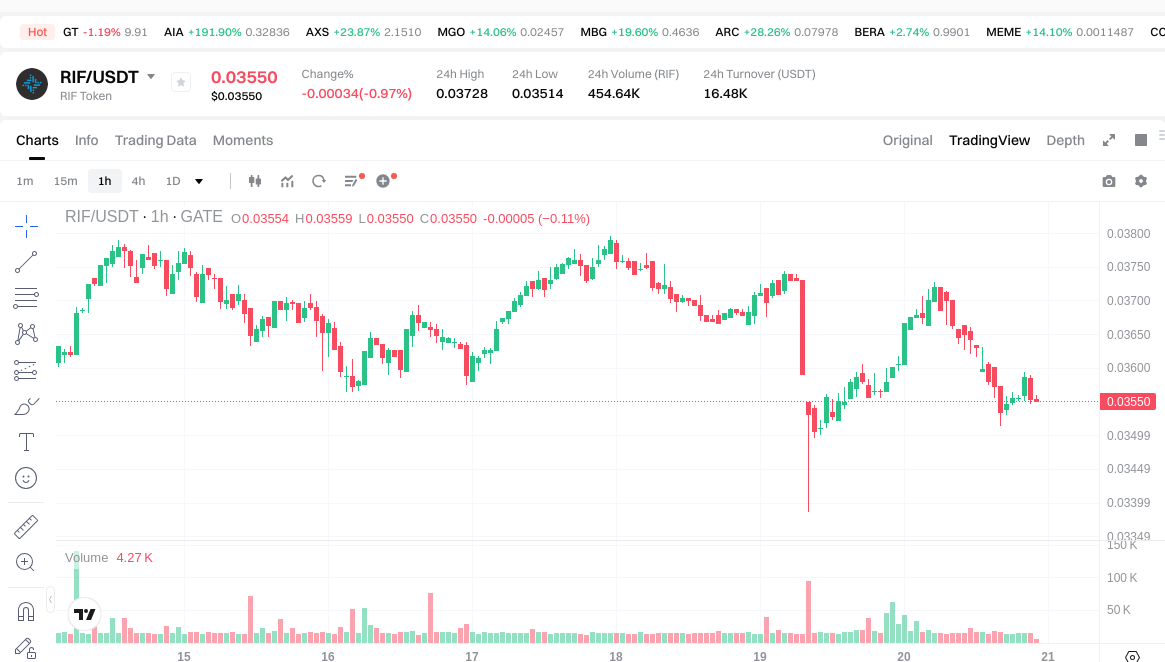
RIF Token (RIF) is a notable asset in the cryptocurrency sector, serving as a utility token within the Rootstock Infrastructure Framework ecosystem since its launch in November 2018. As of January 20, 2026, RIF maintains a market capitalization of approximately $35.59 million, with a fully circulating supply of 1 billion tokens and a current trading price around $0.03559. Positioned as an integrated blockchain infrastructure framework token, RIF has garnered attention among investors evaluating cryptocurrency opportunities. With its focus on enabling interoperable blockchain services, RIF Token presents a distinct profile within the digital asset landscape. This article provides a comprehensive analysis of RIF's investment characteristics, historical price movements, future price considerations, and associated risks to support informed decision-making.
I. Price History Review and Current Investment Value of RIF Token
- 2019: RIF Token experienced its lowest price level at $0.0091475 on June 12, 2019 → Early investors faced challenging market conditions
- 2021: The token reached a notable price point of $0.455938 on April 13, 2021 → RIF demonstrated significant price appreciation during this period
- 2025-2026: Market adjustment phase → Price declined from higher levels to current trading range around $0.03559
Current RIF Investment Market Status (January 2026)
- RIF current price: $0.03559
- Market sentiment (Fear & Greed Index): Data not available from provided materials
- 24-hour trading volume: $16,750.42
- Institutional investor positions: Information not available from provided materials
Click to view real-time RIF market price
II. Core Factors Influencing Whether RIF Token (RIF) is a Good Investment
Supply Mechanism and Scarcity (RIF Investment Scarcity)
- Fixed supply mechanism → Impacts price and investment value
- RIF Token has a maximum supply of 1,000,000,000 tokens, with 100% already in circulation
- The fully diluted market cap equals the current market cap at approximately $35.59 million, indicating complete token distribution
- Investment significance: The fixed supply cap and full circulation provide a clear supply framework, though scarcity alone does not guarantee investment returns
Institutional Investment and Mainstream Adoption (Institutional Investment in RIF)
- RIF Token is listed on 12 exchanges, providing multiple trading venues for market participants
- The project focuses on blockchain infrastructure services compatible with the Rootstock ecosystem
- Market capitalization represents 0.0011% of the total cryptocurrency market, reflecting a relatively modest market presence
Macroeconomic Environment's Impact on RIF Investment
- Monetary policy and interest rate changes → Alter investment attractiveness across risk assets
- The broader cryptocurrency market's sensitivity to macroeconomic conditions may influence RIF's performance
- Geopolitical uncertainty → May affect investor appetite for blockchain infrastructure tokens
Technology and Ecosystem Development (Technology & Ecosystem for RIF Investment)
- RIF Operating System represents an integrated, open blockchain infrastructure framework
- The token is designed as a utility token enabling holders to access services compatible with and integrated into the RIF OS architecture
- Ecosystem applications: The infrastructure framework aims to support various blockchain services, potentially contributing to long-term utility value
- DeFi, NFT, and payment applications: Broader adoption of blockchain infrastructure could support increased demand for utility tokens like RIF
III. RIF Future Investment Forecast and Price Outlook (Is RIF Token(RIF) worth investing in 2026-2031)
Short-term Investment Forecast (2026, short-term RIF investment outlook)
- Conservative forecast: $0.03408 - $0.0355
- Neutral forecast: $0.0355 - $0.04331
- Optimistic forecast: $0.04331 - $0.05112
Mid-term Investment Outlook (2027-2029, mid-term RIF Token(RIF) investment forecast)
-
Market stage expectation: During 2027-2029, RIF Token may experience gradual development as the RIF Operating System infrastructure framework continues to evolve. The project's focus on providing blockchain infrastructure services could support moderate growth trajectories.
-
Investment return forecast:
- 2027: $0.0246867 - $0.0636657
- 2028: $0.050278579 - $0.0711388405
- 2029: $0.0392574075075 - $0.090977484065
-
Key catalysts: Expansion of RIF Operating System adoption, integration of additional blockchain infrastructure services, and broader utilization of the RIF token across compatible platforms.
Long-term Investment Outlook (Is RIF Token a good long-term investment?)
- Baseline scenario: $0.043687886354775 - $0.0766454146575 (assuming steady infrastructure development and moderate ecosystem expansion)
- Optimistic scenario: $0.0766454146575 - $0.110407719814128 (assuming increased adoption of RIF Operating System services and favorable market conditions)
- Risk scenario: Below $0.03408 (under challenging market conditions or limited adoption progress)
Check RIF long-term investment and price forecast: Price Prediction
2026-2031 Long-term Outlook
- Base scenario: $0.043687886354775 - $0.0766454146575 (corresponding to steady progress and gradual mainstream application growth)
- Optimistic scenario: $0.0766454146575 - $0.110407719814128 (corresponding to large-scale adoption and favorable market environment)
- Transformative scenario: Above $0.110407719814128 (if ecosystem achieves breakthrough progress and mainstream adoption)
- 2031-12-31 predicted high: $0.110407719814128 (based on optimistic development assumptions)
Disclaimer: The above forecasts are for reference only and do not constitute investment advice. Cryptocurrency markets are highly volatile and subject to numerous risk factors. Investors should conduct thorough research and assess their own risk tolerance before making any investment decisions.
| Year |
Predicted High Price |
Predicted Average Price |
Predicted Low Price |
Price Change |
| 2026 |
0.05112 |
0.0355 |
0.03408 |
0 |
| 2027 |
0.0636657 |
0.04331 |
0.0246867 |
22 |
| 2028 |
0.0711388405 |
0.05348785 |
0.050278579 |
50 |
| 2029 |
0.090977484065 |
0.06231334525 |
0.0392574075075 |
75 |
| 2030 |
0.088142226856125 |
0.0766454146575 |
0.043687886354775 |
115 |
| 2031 |
0.110407719814128 |
0.082393820756812 |
0.056027798114632 |
132 |
IV. RIF Token Investment Strategy and Risk Management (How to invest in RIF Token)
Investment Strategy (RIF Token investment strategy)
Long-term Holding (HODL RIF Token): Suitable for Conservative Investors
Long-term holding of RIF Token may appeal to investors who believe in the development potential of the Rootstock Infrastructure Framework ecosystem. This approach involves purchasing RIF tokens and holding them through market fluctuations, with the expectation that the utility and adoption of RIF OS services will drive long-term value appreciation.
Given RIF Token's current market position with a circulating supply of 1,000,000,000 tokens (representing 100% of max supply) and a market capitalization of approximately $35.59 million, investors considering this strategy should evaluate the project's fundamental development and ecosystem growth rather than short-term price movements.
Active Trading: Technical Analysis and Swing Trading
For traders preferring active strategies, RIF Token presents opportunities through technical analysis and swing trading approaches. Recent price data shows:
- Current price: $0.03559
- 24-hour range: $0.03514 - $0.03728
- 24-hour price change: -0.72%
- 7-day performance: +0.57%
- 30-day performance: +13.48%
The token's price volatility, with differences between historical highs and lows, may provide trading opportunities for experienced market participants who can identify technical patterns and entry/exit points.
Risk Management (Risk management for RIF Token investment)
Asset Allocation Proportions
Conservative Investors: Given RIF Token's market ranking (#638) and relatively smaller market capitalization, conservative investors might consider allocating no more than 1-2% of their crypto portfolio to RIF, maintaining larger positions in more established digital assets.
Aggressive Investors: Those with higher risk tolerance and belief in the Rootstock ecosystem might allocate 5-10% of their crypto portfolio to RIF Token, while still maintaining diversification across other assets.
Professional Investors: Institutional or professional investors may approach RIF Token as part of a broader infrastructure token portfolio, with allocation decisions based on comprehensive due diligence of the RIF OS ecosystem development and adoption metrics.
Risk Hedging Approaches
- Multi-asset Portfolio: Combine RIF Token holdings with other blockchain infrastructure tokens, layer-2 solutions, and established cryptocurrencies to reduce concentration risk
- Risk Mitigation Tools: Consider using portfolio rebalancing strategies and maintaining exposure to stablecoins for liquidity management
- Correlation Analysis: Monitor RIF Token's price correlation with Bitcoin and Rootstock-related assets, as the token is deployed on the Rootstock network
Secure Storage
Cold and Hot Wallet Solutions:
- Hot wallets for active trading portions: Use reputable software wallets with strong security features for amounts needed for regular trading
- Cold storage for long-term holdings: Transfer majority holdings to cold storage solutions for enhanced security
Hardware Wallet Recommendations:
For RIF Token storage, investors should use hardware wallets that support tokens on the Rootstock network. Ensure compatibility with the contract address (0x2aCc95758f8b5F583470bA265Eb685a8f45fC9D5) before transferring funds.
V. RIF Token Investment Risks and Challenges (Risks of investing in RIF Token)
Market Risks
High Volatility
RIF Token exhibits notable price volatility characteristic of smaller-cap digital assets. The 1-year performance shows a decline of -59.34%, while the 30-day period demonstrates positive momentum of +13.48%. This volatility pattern indicates that investors should be prepared for substantial price swings in both directions.
The token's 24-hour trading volume of approximately $16,750 suggests relatively limited liquidity compared to major cryptocurrencies, which may contribute to increased price volatility and potential slippage during large transactions.
Market Manipulation Considerations
With a fully diluted market capitalization of $35.59 million and trading activity concentrated across 12 exchanges, RIF Token may be more susceptible to market manipulation risks compared to higher market cap assets. Investors should exercise caution and conduct thorough analysis before making investment decisions.
Regulatory Risks
International Policy Uncertainty
As a utility token designed to enable access to services within the RIF OS ecosystem, RIF Token faces regulatory uncertainty across different jurisdictions:
- Different countries maintain varying approaches to classifying and regulating utility tokens
- Changes in regulatory frameworks could impact token utility, trading availability, or compliance requirements
- Cross-border regulatory developments may affect the project's ability to expand services globally
Investors should monitor regulatory developments in their respective jurisdictions and assess how policy changes might impact RIF Token holdings and usage.
Technical Risks
Network Security Vulnerabilities
As RIF Token operates on the Rootstock network and integrates with the RIF OS infrastructure framework, potential technical risks include:
- Smart contract vulnerabilities in the token contract or integrated services
- Network-level security issues affecting the underlying Rootstock blockchain
- Integration risks with various RIF OS services and protocols
Investors should stay informed about security audits and any disclosed vulnerabilities in the RIF ecosystem.
Upgrade and Development Risks
- Technical upgrades to the RIF OS framework may face implementation challenges
- Compatibility issues could arise during system updates or protocol changes
- Development delays or changes in project direction may impact token utility and adoption
The success of RIF Token as a utility token depends significantly on the continued development and adoption of RIF OS services, making technical execution risks an important consideration.
VI. Conclusion: Is RIF Token a Good Investment?
Investment Value Summary
RIF Token represents an infrastructure utility token designed to enable access to services within the Rootstock Infrastructure Framework ecosystem. The token's investment profile reflects both opportunities and challenges:
The project offers exposure to blockchain infrastructure development on the Rootstock network, with RIF OS positioned as an integrated framework for blockchain services. Recent 30-day performance showing +13.48% growth suggests some positive market sentiment, while the complete token circulation (100% of max supply in circulation) eliminates concerns about future supply inflation.
However, the 1-year performance decline of -59.34% and relatively smaller market capitalization of $35.59 million indicate volatility and market uncertainty. The token's success appears closely tied to the adoption and development of RIF OS services, making fundamental ecosystem growth a critical factor for long-term value.
Investor Recommendations
✅ Beginners
- Dollar-Cost Averaging (DCA): Consider gradual accumulation rather than lump-sum investment to mitigate timing risks
- Secure Storage: Prioritize learning proper wallet security and transfer procedures before acquiring RIF tokens
- Education First: Study the RIF OS ecosystem, understand token utility, and monitor project development before investing
- Risk Limitation: Keep position sizes small relative to overall portfolio, given the token's volatility and market cap ranking
✅ Experienced Investors
- Swing Trading Opportunities: Utilize technical analysis to identify potential entry and exit points based on price patterns and volume trends
- Portfolio Diversification: Include RIF Token as part of a broader blockchain infrastructure token allocation
- Fundamental Analysis: Monitor RIF OS ecosystem development, service adoption metrics, and partnership announcements
- Risk-Adjusted Position Sizing: Calibrate holdings based on individual risk tolerance and conviction in the project's development trajectory
✅ Institutional Investors
- Strategic Evaluation: Conduct comprehensive due diligence on RIF OS architecture, development roadmap, and competitive positioning
- Long-term Allocation: Consider RIF Token within a strategic infrastructure token portfolio with appropriate risk management frameworks
- Ecosystem Engagement: Evaluate potential use cases for RIF OS services and assess alignment with institutional investment thesis
- Liquidity Planning: Account for the token's trading volume and exchange availability when structuring positions
⚠️ Important Notice
Cryptocurrency investments carry substantial risks, including the possibility of partial or total loss of invested capital. RIF Token's price volatility, market position, and dependence on ecosystem development introduce additional uncertainty factors. This article provides informational content based on available data and does not constitute financial advice, investment recommendations, or encouragement to buy or sell RIF Token. Investors should conduct independent research, assess personal risk tolerance, and consider consulting qualified financial advisors before making investment decisions. Past performance does not guarantee future results, and all investment decisions should align with individual financial circumstances and objectives.
VII. FAQ
Q1: What makes RIF Token different from other blockchain infrastructure tokens?
RIF Token is specifically designed as a utility token for the Rootstock Infrastructure Framework ecosystem, providing access to an integrated suite of blockchain services built on the Rootstock network. Unlike standalone infrastructure tokens, RIF operates within the RIF OS—an open blockchain infrastructure framework that enables interoperable services. The token's unique positioning stems from its integration with Bitcoin's security model through the Rootstock network, while offering a comprehensive infrastructure layer. With a fully circulating supply of 1 billion tokens and no future dilution risk, RIF provides transparent tokenomics compared to projects with ongoing emissions.
Q2: Is RIF Token suitable for long-term holding or short-term trading?
RIF Token can serve both investment approaches depending on individual risk tolerance and market outlook. For long-term holding, the token offers exposure to blockchain infrastructure development on Rootstock, with the fully circulated supply eliminating future inflation concerns. However, the 1-year performance decline of -59.34% suggests caution for conservative holders. For short-term traders, the token's volatility—evidenced by 30-day gains of +13.48%—presents swing trading opportunities through technical analysis. The relatively low 24-hour trading volume of $16,750 indicates that traders should be mindful of liquidity constraints when executing larger positions.
Q3: What are the primary risks associated with investing in RIF Token?
RIF Token presents several investment risks that potential investors should carefully consider. Market risks include high volatility, with historical price fluctuations from $0.0091475 to $0.455938, and current price sensitivity due to its $35.59 million market capitalization ranking at #638. The limited trading volume may increase susceptibility to price manipulation and slippage during transactions. Technical risks involve dependencies on Rootstock network security, potential smart contract vulnerabilities, and the execution success of RIF OS development. Regulatory uncertainty across jurisdictions regarding utility token classification adds another layer of risk. Additionally, the token's value is closely tied to RIF OS ecosystem adoption, making development progress a critical factor.
Q4: How should I determine the appropriate allocation for RIF Token in my portfolio?
Portfolio allocation for RIF Token should align with your investment profile and risk tolerance. Conservative investors focused on capital preservation might limit RIF to 1-2% of their cryptocurrency portfolio, maintaining larger positions in established assets like Bitcoin or Ethereum. Moderate-risk investors who believe in the Rootstock ecosystem's potential could allocate 3-5% while maintaining diversification across multiple blockchain sectors. Aggressive investors comfortable with higher volatility might consider 5-10% allocation, though this requires conviction in RIF OS development trajectory. Professional investors should base allocation decisions on comprehensive due diligence of ecosystem metrics, development milestones, and competitive positioning within the blockchain infrastructure landscape.
Q5: What factors should I monitor to assess RIF Token's investment potential?
Key factors for evaluating RIF Token investment prospects include ecosystem development metrics such as RIF OS service adoption rates, integration partnerships, and active user growth. Monitor technical development progress through GitHub activity, protocol upgrades, and new service launches within the RIF framework. Trading metrics like volume trends, exchange listings, and liquidity depth provide insights into market sentiment and accessibility. Price correlation with Rootstock-related assets and Bitcoin can indicate broader market influences. Regulatory developments affecting utility tokens in major jurisdictions may impact token usage and compliance requirements. Additionally, track competitive positioning against other blockchain infrastructure projects and assess whether the RIF OS framework is gaining market share.
Q6: When is the best time to buy RIF Token?
Timing RIF Token purchases depends on your investment strategy and market analysis approach. For dollar-cost averaging (DCA) strategies, consistent periodic purchases regardless of price help mitigate timing risks—particularly suitable for beginners and long-term holders. Technical traders might identify entry points using support levels, moving averages, and momentum indicators; the current price around $0.03559 represents a significant discount from the 2021 high of $0.455938. Fundamental-focused investors should consider purchasing during periods of positive ecosystem developments, such as major RIF OS service launches or partnership announcements. The 30-day performance of +13.48% suggests recent positive momentum, though the 1-year decline of -59.34% indicates overall downward pressure. Avoid emotional decisions during extreme market volatility.
Q7: How secure is RIF Token storage, and what are the best practices?
RIF Token security depends on proper storage practices and wallet selection. For active trading amounts, use reputable hot wallets with strong security features, two-factor authentication, and regular security updates. For long-term holdings, cold storage solutions like hardware wallets provide enhanced security against online threats. Before transferring RIF tokens, verify wallet compatibility with the Rootstock network and confirm the correct contract address (0x2aCc95758f8b5F583470bA265Eb685a8f45fC9D5). Never share private keys or seed phrases, use strong unique passwords, and enable all available security features. Consider distributing holdings across multiple wallets to reduce single-point-of-failure risk. Regularly backup wallet information and store backups securely offline.
Q8: What price levels should I consider for profit-taking or stop-loss orders?
Price level planning for RIF Token should reflect your investment timeline and risk management strategy. For short-term traders using the current price of $0.03559 as reference, consider setting stop-losses 10-15% below entry points to limit downside risk (approximately $0.0302-$0.0320). Profit-taking levels might target the neutral forecast range of $0.0355-$0.04331 for conservative gains, or the optimistic range of $0.04331-$0.05112 for higher risk-reward ratios. Long-term investors could establish tiered selling strategies: taking partial profits at $0.05-$0.07 (meeting 2027 projections), $0.07-$0.09 (2028-2029 range), and $0.09-$0.11 (2030-2031 optimistic scenarios). Adjust these levels based on ecosystem developments, market conditions, and your evolving investment thesis.
* The information is not intended to be and does not constitute financial advice or any other recommendation of any sort offered or endorsed by Gate.