This comprehensive analysis examines whether Rocket Pool (RPL) represents a sound investment in 2026. Trading at $2.064 with a $45.65 million market cap, RPL serves as decentralized Ethereum staking infrastructure, enabling individuals to participate in PoS consensus without meeting standard validator requirements. The article evaluates RPL's investment merit through multiple lenses: historical price performance showing 80.11% annual decline from $61.90 peaks, current market positioning across 33 exchanges and 11,724 holders, and supply dynamics with unlimited maximum tokens. Price forecasts range from $1.77-$2.84 (2026) to $2.04-$3.98 (2031) across conservative to optimistic scenarios. Investment strategies address different investor profiles—from dollar-cost averaging for beginners to institutional allocation frameworks. Critical risk considerations include market volatility, regulatory uncertainty around staking services, technical smart contract vulnerabilities, and competitive pressures within the Ethere
Introduction: Rocket Pool (RPL) Investment Position and Market Outlook
RPL is an important asset in the cryptocurrency space. As of 2026, Rocket Pool holds a market capitalization of approximately $45.65 million, with a circulating supply of around 22.12 million tokens, and the current price is maintained at approximately $2.064. With its positioning as an Ethereum PoS infrastructure service, RPL has gradually become a focal point for investors discussing "Is Rocket Pool (RPL) a good investment?" This article will comprehensively analyze RPL's investment value, historical trends, future price predictions, and investment risks to provide reference for investors.
Rocket Pool serves as a decentralized infrastructure that enables individuals and organizations to participate in Ethereum staking through its node operation network. The token currently ranks 555th by market capitalization, with a market dominance of 0.0013%. Over the past year, RPL has experienced significant price fluctuations, showing a 5.01% increase over the past 7 days and a 6.52% gain over the past 30 days, though the annual performance indicates an 80.11% decline from previous levels. The project's circulating supply represents 100% of the total supply, with trading activity across 33 exchanges and a holder base of 11,724 addresses.
I. Rocket Pool (RPL) Price History Review and Current Investment Value
- 2023: RPL reached a price level of $61.90 on April 17, 2023 → representing a significant valuation period for early investors
- 2018-2023: The token experienced substantial volatility → fluctuating from $0.00884718 (August 28, 2018) to the 2023 peak
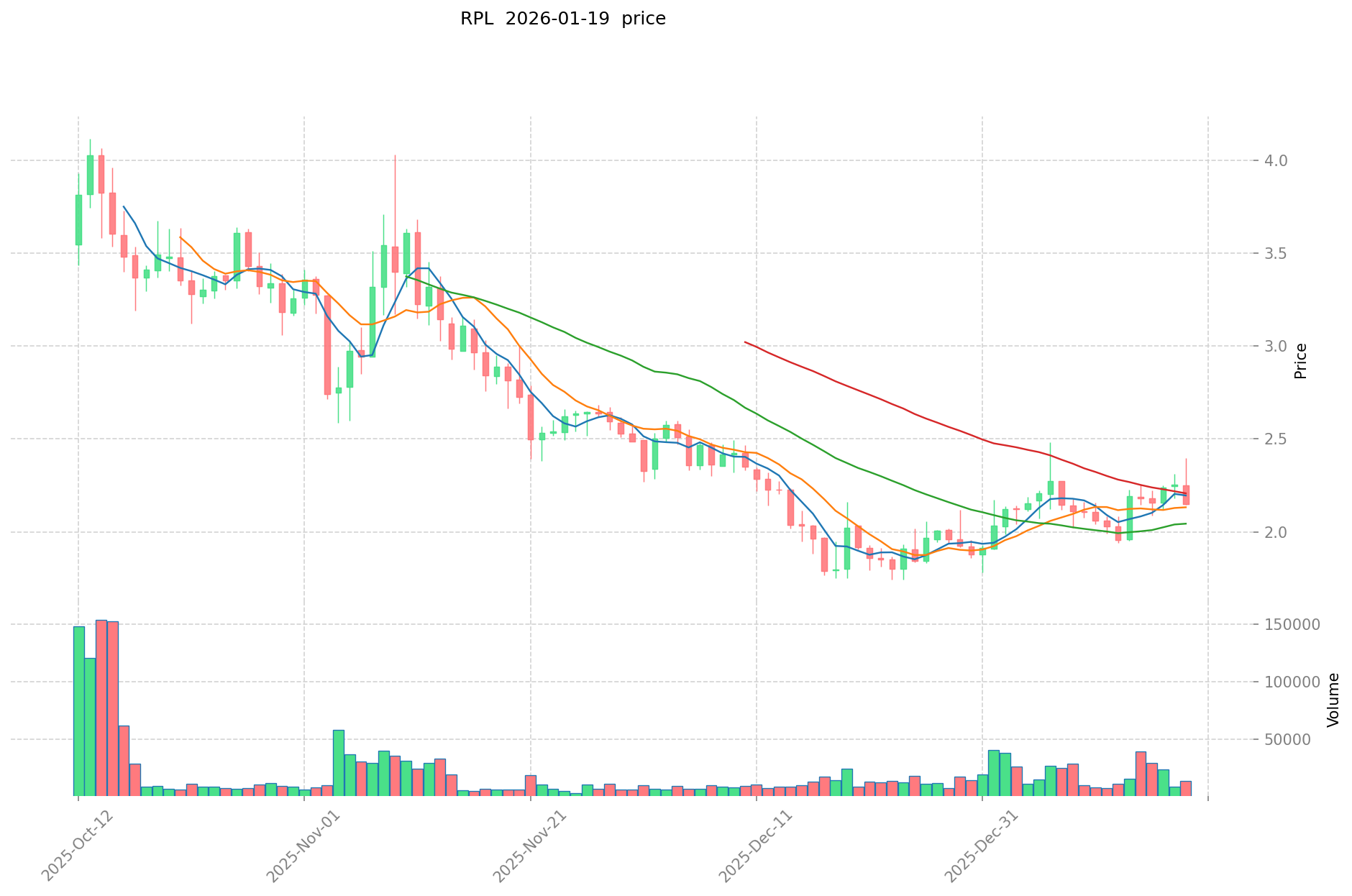
- 2023-2026: Market correction phase → price declined from the April 2023 level to $2.064 as of January 19, 2026
Current RPL Investment Market Status (January 2026)
- RPL current price: $2.064
- 24-hour trading volume: $90,934.51
- Market capitalization: $45.65 million
- Circulating supply: 22,117,293.66 RPL (100% of total supply)
- Market share: 0.0013%
Click to view real-time RPL market price
II. Core Factors Affecting Whether RPL is a Good Investment
Supply Mechanism and Scarcity (RPL Investment Scarcity)
- Supply Mechanism → Influences price and investment value
- Rocket Pool (RPL) has a circulating supply of 22,117,293.66 tokens with unlimited maximum supply (∞), which may impact long-term scarcity considerations
- The market cap to fully diluted valuation ratio stands at 100%, indicating all tokens are currently in circulation
- Investment Significance: The unlimited supply model differs from traditional scarcity-driven assets, requiring investors to evaluate value through utility and demand factors rather than supply constraints alone
Institutional Investment and Mainstream Adoption (Institutional Investment in RPL)
- Holder Trends: As of current data, RPL has 11,724 token holders, representing a decentralized distribution pattern
- Exchange Presence: RPL is listed on 33 exchanges, providing liquidity and accessibility for institutional and retail participants
- Ecosystem Position: Rocket Pool serves as Ethereum PoS infrastructure, positioning it within the growing staking economy where individuals and organizations participate in decentralized node operations
Macroeconomic Environment's Impact on RPL Investment
- Monetary Policy and Interest Rates → Changes in traditional financial conditions may affect crypto asset allocation strategies
- Staking Yield Dynamics: As an Ethereum staking infrastructure provider, RPL's value proposition correlates with staking participation rates and ETH network economics
- Market Volatility: RPL experienced significant price fluctuations, with 24-hour volatility ranging from $1.913 to $2.294, reflecting sensitivity to broader market conditions
Technology and Ecosystem Development (Technology & Ecosystem for RPL Investment)
- Decentralized Staking Infrastructure: Rocket Pool operates a decentralized node network enabling users to participate in Ethereum staking, providing utility beyond speculative value
- Ethereum PoS Integration: The project's alignment with Ethereum's consensus mechanism creates dependency on ETH network growth and staking adoption
- DeFi Applications: The staking service model contributes to the broader DeFi ecosystem, though specific application expansion data was not available in provided materials
III. RPL Future Investment Forecast and Price Outlook (Is Rocket Pool(RPL) worth investing in 2026-2031)
Short-term Investment Forecast (2026, short-term RPL investment outlook)
- Conservative forecast: $1.77 - $2.06
- Neutral forecast: $2.06 - $2.44
- Optimistic forecast: $2.44 - $2.84
Mid-term Investment Outlook (2027-2029, mid-term Rocket Pool(RPL) investment forecast)
- Market stage expectation: RPL is anticipated to experience moderate growth during this period, with price fluctuations reflecting broader market dynamics and adoption trends within the Ethereum staking ecosystem.
- Investment return forecast:
- 2027: $2.01 - $2.67
- 2028: $1.53 - $2.68
- 2029: $2.54 - $3.46
- Key catalysts: Technical developments in staking infrastructure, regulatory clarity around decentralized finance protocols, and expansion of node operator participation may influence price performance.
Long-term Investment Outlook (Is Rocket Pool a good long-term investment?)
- Base scenario: $2.04 - $3.40 (assuming steady ecosystem development and maintained market positioning)
- Optimistic scenario: $3.40 - $3.98 (assuming accelerated adoption of decentralized staking solutions and favorable market conditions)
- Risk scenario: Below $2.00 (under conditions of significant market downturns or competitive pressure)
For detailed RPL long-term investment and price forecasts, visit: Price Prediction
2026-01-19 - 2031 Long-term Outlook
- Base scenario: $2.04 - $3.40 (corresponding to steady progress and gradual mainstream application enhancement)
- Optimistic scenario: $3.40 - $3.98 (corresponding to large-scale adoption and favorable market environment)
- Transformative scenario: Above $3.98 (in case of breakthrough ecological developments and mainstream popularization)
- 2031-12-31 forecast high: $3.98 (based on optimistic development assumptions)
Disclaimer: Price forecasts are based on historical data analysis and market trend projections. Cryptocurrency markets involve substantial risk and volatility. These predictions should not be considered as investment advice, and actual future prices may differ significantly from forecasted ranges.
| Year |
Predicted High Price |
Predicted Average Price |
Predicted Low Price |
Price Change |
| 2026 |
2.8359 |
2.055 |
1.7673 |
0 |
| 2027 |
2.6655405 |
2.44545 |
2.005269 |
18 |
| 2028 |
2.6832700125 |
2.55549525 |
1.53329715 |
23 |
| 2029 |
3.45758507325 |
2.61938263125 |
2.5408011523125 |
26 |
| 2030 |
3.76771997679 |
3.03848385225 |
2.06616901953 |
47 |
| 2031 |
3.9816292399884 |
3.40310191452 |
2.041861148712 |
64 |
IV. RPL Investment Strategy and Risk Management (How to invest in Rocket Pool)
Investment Methodology (RPL investment strategy)
Long-term Holding (HODL RPL): Suitable for Conservative Investors
For investors seeking exposure to Ethereum staking infrastructure, a long-term holding strategy may align with belief in the protocol's fundamental value proposition. Rocket Pool serves as decentralized staking infrastructure for Ethereum's Proof-of-Stake network, enabling individuals and organizations to participate in staking activities. Investors adopting this approach typically focus on the protocol's utility within the Ethereum ecosystem rather than short-term price movements.
Key considerations for long-term holders include:
- Understanding Rocket Pool's role in Ethereum's staking landscape
- Monitoring protocol adoption and total value locked metrics
- Evaluating competitive positioning among staking solutions
- Assessing ongoing development activity and network upgrades
Active Trading: Technical Analysis and Swing Trading
Active traders may approach RPL through technical analysis and price action strategies. With 24-hour trading volume recorded at approximately $90,934.51 and availability across 33 exchanges, the token maintains sufficient liquidity for trading activities. Recent price movements show:
- 1-hour change: -0.53%
- 24-hour change: -8.00%
- 7-day change: +5.01%
- 30-day change: +6.52%
Traders should note the token's volatility characteristics, with 24-hour price ranging from $1.913 to $2.294. Technical traders typically employ chart patterns, volume analysis, and momentum indicators when executing swing trades or day trading strategies.
Risk Management (Risk management for RPL investment)
Asset Allocation Ratios: Conservative / Aggressive / Professional Investors
Conservative Portfolio Approach:
- Limit RPL exposure to 1-3% of total crypto portfolio
- Prioritize established assets with lower volatility
- Focus on dollar-cost averaging to mitigate timing risk
- Maintain higher allocation to traditional assets outside crypto markets
Aggressive Portfolio Strategy:
- May allocate 5-10% to RPL within crypto holdings
- Accept higher volatility for potential growth exposure
- Consider correlation with Ethereum price movements
- Regularly rebalance based on performance and risk tolerance
Professional Investor Considerations:
- Evaluate RPL within broader DeFi infrastructure thesis
- Assess protocol metrics including node operator count and staking volumes
- Monitor regulatory developments affecting staking services
- Implement systematic position sizing and risk limits
Risk Hedging Solutions: Multi-asset Portfolio and Hedging Instruments
Investors may consider several approaches to manage RPL exposure:
Portfolio Diversification:
- Balance RPL with other Ethereum ecosystem tokens
- Include liquid staking alternatives for comparative exposure
- Maintain positions in uncorrelated asset classes
- Consider stablecoin allocations for rebalancing flexibility
Hedging Considerations:
- Derivatives markets may offer limited hedging options for RPL
- Correlation with ETH suggests broader Ethereum hedging strategies
- Options strategies (where available) for downside protection
- Position sizing as primary risk control mechanism
Secure Storage: Hot and Cold Wallets and Hardware Wallet Recommendations
RPL is an ERC-20 token on the Ethereum network (contract address: 0xD33526068D116cE69F19A9ee46F0bd304F21A51f), requiring appropriate storage solutions:
Cold Storage Solutions:
- Hardware wallets provide enhanced security for long-term holdings
- Popular options include Ledger and Trezor devices supporting Ethereum tokens
- Multi-signature wallets offer additional security layers for larger holdings
- Paper wallet generation for completely offline storage
Hot Wallet Considerations:
- Software wallets (MetaMask, Trust Wallet) enable convenient access for trading
- Appropriate for smaller amounts needed for active management
- Enable interaction with DeFi protocols and exchanges
- Require careful attention to security practices (strong passwords, backup phrases)
Best Practices:
- Never store recovery phrases digitally or in cloud services
- Verify contract addresses before transactions
- Test with small amounts before large transfers
- Maintain separate wallets for trading versus long-term storage
- Enable all available security features (2FA, biometric authentication)
V. RPL Investment Risks and Challenges (Risks of investing in Rocket Pool)
Market Risks: High Volatility and Price Manipulation Concerns
RPL exhibits significant price volatility characteristic of crypto assets. Current data shows:
- Market capitalization: approximately $45.65 million (ranking #555)
- 1-year performance: -80.11%
- Trading at $2.064, substantially below all-time high of $61.90 (April 2023)
Key market risk factors include:
Volatility Exposure:
- Daily price swings can exceed 8% as demonstrated by recent 24-hour movements
- Limited market depth relative to major cryptocurrencies
- Susceptibility to broader crypto market sentiment shifts
- Correlation with Ethereum price movements given protocol dependency
Liquidity Considerations:
- With approximately 11,724 holders and trading across 33 exchanges, liquidity may be constrained during market stress
- Order book depth varies significantly across trading venues
- Large position entries or exits can impact market pricing
Market Influence Factors:
- Smaller market capitalization relative to major assets
- Concentration among holder addresses may affect price stability
- News and developments specific to Ethereum staking landscape
- Competitive dynamics among staking solution providers
Regulatory Risks: Policy Uncertainty Across Jurisdictions
Staking services face evolving regulatory scrutiny globally:
Jurisdictional Considerations:
- Different countries maintain varying approaches to staking services regulation
- Classification questions around staking rewards (income, capital gains, other)
- Potential requirements for service providers offering staking infrastructure
- Ongoing regulatory discussions about DeFi protocols and decentralization thresholds
Compliance Evolution:
- Tax treatment of staking rewards remains subject to clarification in many jurisdictions
- Securities law implications under review by multiple regulatory bodies
- Anti-money laundering (AML) and know-your-customer (KYC) requirements may extend to DeFi protocols
- Cross-border service provision raises multiple regulatory considerations
Protocol-Specific Considerations:
- Decentralized architecture may present different regulatory profile than centralized services
- Node operator responsibilities and potential liability questions
- Smart contract governance and control person determinations
Technical Risks: Network Security Vulnerabilities and Upgrade Failures
As blockchain infrastructure, Rocket Pool faces several technical risk vectors:
Smart Contract Risks:
- Protocol depends on smart contract security for user funds protection
- Complexity of staking mechanisms increases potential vulnerability surface
- Historical precedents show DeFi protocols can experience exploits despite auditing
- Upgrade processes introduce temporary risk during transition periods
Network Dependencies:
- Protocol functionality relies on Ethereum network health and performance
- Ethereum protocol changes may require Rocket Pool adaptations
- Validator operations face technical requirements and potential penalties
- Node operator technical failures could affect protocol reputation
Operational Considerations:
- Decentralized node operator network introduces coordination complexity
- Technical expertise required for node operation may limit participation
- Network upgrades require coordination across distributed infrastructure
- Oracle dependencies or external data requirements create additional risk points
Development Risks:
- Ongoing development activity necessary for protocol competitiveness
- Competition from alternative staking solutions with different technical approaches
- Resource allocation for security auditing, upgrades, and maintenance
- Community governance effectiveness in addressing emerging challenges
VI. Conclusion: Is Rocket Pool a Good Investment?
Investment Value Summary
Rocket Pool represents exposure to Ethereum's staking infrastructure through a decentralized protocol approach. The token serves specific utility within the ecosystem, enabling participation in staking activities for individuals and organizations. However, price performance has shown considerable volatility, with current valuation significantly below previous levels.
Key investment considerations include:
- Protocol role in Ethereum's Proof-of-Stake ecosystem
- Competition among various staking solution providers
- Technical execution and security track record
- Regulatory landscape evolution affecting staking services
- Market capitalization and liquidity profile relative to investment size
Investor Recommendations
✅ Beginners: Dollar-Cost Averaging with Secure Storage
- Research Rocket Pool's function within Ethereum staking before investment
- Start with small allocations to understand price behavior
- Implement regular purchase schedule to average entry prices
- Prioritize security through hardware wallet storage for holdings
- Avoid leverage or complex trading strategies initially
- Understand tax implications of crypto holdings in your jurisdiction
✅ Experienced Investors: Swing Trading and Portfolio Allocation
- Evaluate RPL within broader Ethereum ecosystem thesis
- Consider correlation with ETH when determining position sizing
- Monitor protocol metrics alongside price action
- Implement technical analysis for entry and exit timing
- Maintain diversification across multiple assets and strategies
- Review positions regularly based on fundamental and technical developments
✅ Institutional Investors: Strategic Long-term Allocation
- Assess Rocket Pool within infrastructure investment framework
- Evaluate protocol governance, development activity, and competitive positioning
- Consider regulatory compliance requirements for staking exposure
- Implement appropriate custody solutions for institutional standards
- Monitor protocol metrics, TVL trends, and adoption indicators
- Structure allocation within broader crypto asset strategy and risk parameters
⚠️ Disclaimer: Cryptocurrency investment involves substantial risk including potential complete loss of capital. Price volatility can be extreme, and past performance does not indicate future results. This content provides informational analysis only and does not constitute investment advice, financial guidance, or recommendation to buy, sell, or hold any asset. Investors should conduct independent research, consider their financial situation and risk tolerance, and consult qualified financial advisors before making investment decisions. Regulatory treatment varies by jurisdiction and may change. Technical risks, market manipulation, and liquidity constraints can affect outcomes. Never invest more than you can afford to lose.
VII. FAQ
Q1: What is Rocket Pool (RPL) and how does it function within the Ethereum ecosystem?
Rocket Pool is a decentralized staking infrastructure protocol that enables individuals and organizations to participate in Ethereum's Proof-of-Stake consensus mechanism. The protocol operates through a distributed network of node operators, allowing users to stake ETH without meeting the standard 32 ETH validator requirement or maintaining technical infrastructure themselves. RPL serves as the protocol's native utility token, used for node operator collateral, governance participation, and ecosystem incentivization. As of January 2026, the protocol maintains a market capitalization of approximately $45.65 million with 11,724 token holders across 33 exchanges.
Q2: Is RPL a good investment for beginners in 2026?
For beginners, RPL presents significant volatility and complexity considerations. The token has experienced an 80.11% decline over the past year, trading at $2.064 compared to its April 2023 peak of $61.90. Conservative approaches include limiting exposure to 1-3% of a crypto portfolio, implementing dollar-cost averaging strategies, and prioritizing secure storage through hardware wallets. Beginners should thoroughly research Rocket Pool's role in Ethereum staking, understand the unlimited supply mechanism (∞ maximum supply), and recognize correlation with broader Ethereum price movements before investment. The small market capitalization ranking (#555) indicates higher volatility risk compared to established cryptocurrencies.
Q3: What are the main risks associated with investing in Rocket Pool?
RPL investment involves multiple risk categories: (I) Market risks including high volatility demonstrated by 8% daily price swings, limited liquidity with $90,934.51 in 24-hour trading volume, and susceptibility to broader crypto market sentiment; (II) Regulatory risks as staking services face evolving scrutiny globally with unclear classification of staking rewards and potential compliance requirements for DeFi protocols; (III) Technical risks encompassing smart contract vulnerabilities, dependency on Ethereum network health, validator operation complexities, and coordination challenges across decentralized node operators. The protocol's smaller market cap and concentrated holder distribution may amplify price impact during market stress periods.
Q4: What is the price prediction for RPL through 2031?
Price forecasts based on historical data analysis and market trend projections suggest: Short-term (2026): $1.77-$2.84 range with conservative, neutral, and optimistic scenarios; Mid-term: 2027 ($2.01-$2.67), 2028 ($1.53-$2.68), 2029 ($2.54-$3.46); Long-term (2031): Base scenario $2.04-$3.40, optimistic scenario $3.40-$3.98, with predicted high of $3.98 by December 2031. These projections assume varying degrees of ecosystem development, staking adoption rates, and market conditions. However, cryptocurrency markets involve substantial volatility, and actual prices may differ significantly from forecasted ranges. Predictions should not be considered investment advice.
Q5: How should different investor types approach RPL allocation?
Conservative investors should limit RPL to 1-3% of total crypto portfolios, prioritize dollar-cost averaging, and maintain higher allocations to traditional assets. Aggressive investors may allocate 5-10% within crypto holdings, accepting higher volatility for potential growth exposure while monitoring correlation with Ethereum movements. Professional investors should evaluate RPL within broader DeFi infrastructure frameworks, assess protocol metrics including node operator count and total value locked, implement systematic position sizing with risk limits, and structure allocations within comprehensive crypto asset strategies. All investor types should utilize appropriate storage solutions: hardware wallets (Ledger, Trezor) for long-term holdings and secure software wallets for active trading amounts.
Q6: What factors influence RPL's investment value in the current market environment?
Key value drivers include: (I) Supply dynamics—unlimited maximum supply model requiring evaluation through utility and demand rather than scarcity alone; (II) Institutional adoption—presence across 33 exchanges and 11,724 holders providing liquidity and accessibility; (III) Ecosystem positioning—alignment with Ethereum PoS infrastructure and correlation with staking participation rates; (IV) Macroeconomic conditions—sensitivity to monetary policy changes and broader crypto market volatility evidenced by 24-hour price ranges of $1.913-$2.294; (V) Technical development—decentralized node network capabilities and integration with Ethereum's consensus mechanism. The 100% circulating supply ratio (all 22,117,293.66 tokens in circulation) and 0.0013% market dominance indicate specific niche positioning within the crypto landscape.
Q7: What security measures are recommended for storing RPL tokens?
As an ERC-20 token on Ethereum (contract address: 0xD33526068D116cE69F19A9ee46F0bd304F21A51f), RPL requires appropriate storage solutions. Cold storage options include hardware wallets (Ledger, Trezor) for long-term holdings, multi-signature wallets for larger amounts, and paper wallets for completely offline storage. Hot wallets (MetaMask, Trust Wallet) suit smaller amounts needed for active trading. Best practices include: never storing recovery phrases digitally or in cloud services; verifying contract addresses before transactions; testing with small amounts before large transfers; maintaining separate wallets for trading versus long-term storage; enabling all available security features including two-factor authentication and biometric authentication. Hardware wallet storage is recommended for holdings exceeding active trading needs.
Q8: How does Rocket Pool compare to other Ethereum staking solutions?
Rocket Pool differentiates itself through decentralized infrastructure enabling staking participation without the standard 32 ETH validator requirement or technical maintenance obligations. This positions the protocol within the growing staking economy alongside alternative solutions. Key competitive factors include: decentralized node operator network versus centralized service providers; specific technical architecture and security implementations; fee structures and reward distributions; regulatory compliance approaches; and total value locked metrics reflecting adoption rates. Investors evaluating RPL should assess these competitive dynamics, monitor protocol development activity, review node operator participation trends, and compare positioning against liquid staking alternatives within the broader Ethereum ecosystem. The protocol's market cap ranking (#555) reflects its positioning relative to larger staking infrastructure providers.
* The information is not intended to be and does not constitute financial advice or any other recommendation of any sort offered or endorsed by Gate.