This comprehensive analysis examines whether Safe (SAFE), an ERC20 token powering web3 account abstraction infrastructure, represents a viable investment opportunity. Safe operates as the ownership layer for Safe{Core} (full-stack account abstraction) and Safe{Wallet} (multi-signature solution), securing over $100 billion in assets. Currently trading at $0.19 with a $132.49 million market cap (ranked #311), Safe presents mixed investment signals: short-term gains of 48.15% over 30 days contrast with an 80.51% one-year decline. The analysis covers price history, supply mechanics, institutional adoption metrics, and technology development. Forecasts project 2026 prices between $0.11-$0.21, with long-term scenarios ($0.31-$0.44 optimistic) contingent on ecosystem adoption. Investment strategies vary by risk profile, from conservative 1-3% allocation to aggressive trading approaches. Key risks include market volatility, regulatory uncertainty, and technical vulnerabilities. Available on Gate and 25 other exchange
Introduction: Safe (SAFE) Investment Position and Market Outlook
Safe (SAFE) represents a notable asset in the cryptocurrency sector, functioning as the ownership layer of web3. The project encompasses Safe{Core}, a full-stack account abstraction infrastructure, and Safe{Wallet}, an industry-standard multi-signature solution. As of January 17, 2026, SAFE holds a market position ranked at 311, with a market capitalization of approximately $132.49 million and a circulating supply of 687.28 million tokens. The current trading price stands at around $0.19, reflecting recent price movements including a 10.85% increase over 24 hours and a 48.15% gain over 30 days. With its positioning in web3 security and account abstraction technology, SAFE has drawn attention from investors examining "Is Safe (SAFE) a good investment?" This analysis explores SAFE's investment characteristics, historical price patterns, future price projections, and associated investment considerations to provide reference information for market participants.
I. SAFE Price History Review and Investment Value Status
- 2024: Token launch in April → Initial trading price at $2.00, followed by significant volatility throughout the year
- 2024: Peak performance period → SAFE reached $4.48 in April 2024, representing a 124% gain from launch price
- 2025: Market correction phase → Price declined from elevated levels to $0.1189 in December 2025
Current SAFE Investment Market Status (January 2026)
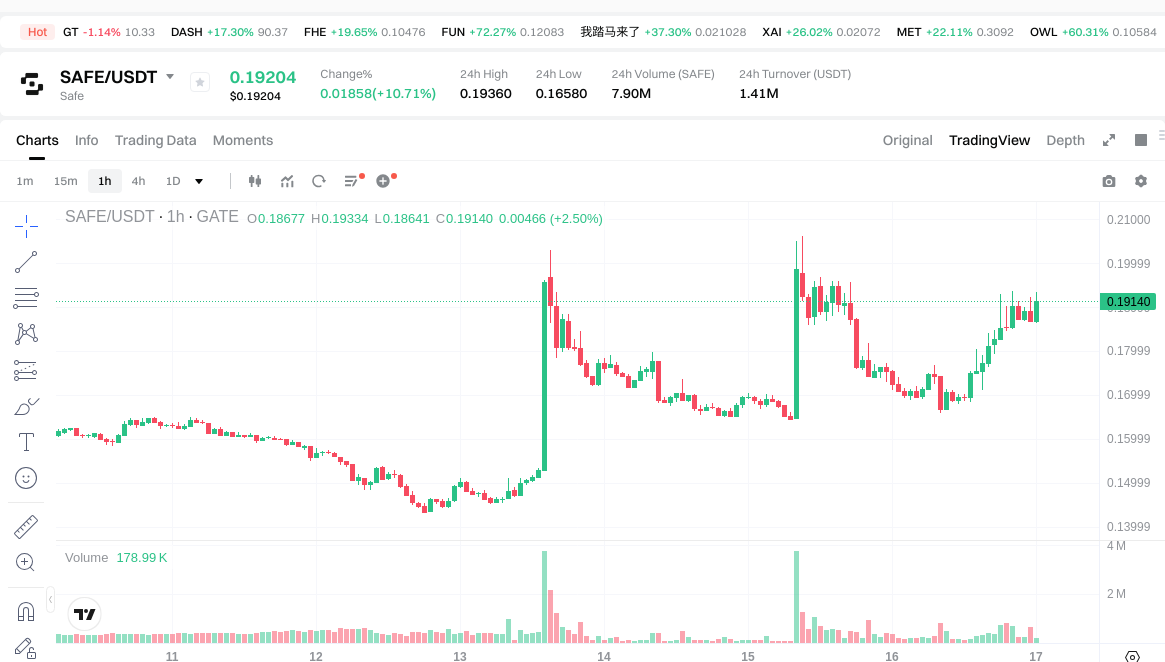
- SAFE current price: $0.19278
- 24-hour trading volume: $1,412,559.11
- Market capitalization: $132,494,267.72
- Circulating supply: 687,282,227 SAFE (68.73% of total supply)
- Price performance: +10.85% (24H), +17.82% (7D), +48.15% (30D)
Click to view real-time SAFE market price
II. Core Factors Affecting Whether SAFE is a Good Investment
Supply Mechanism and Scarcity (SAFE Investment Scarcity)
- Fixed Supply Structure → Influences Price and Investment Value
- Safe (SAFE) has a maximum supply of 1,000,000,000 tokens, with a circulating supply of 687,282,227 tokens as of January 2026, representing approximately 68.73% of the total supply.
- The token supply structure creates a defined scarcity model, which may influence long-term valuation dynamics as adoption increases.
- Historical data shows significant price volatility, with prices ranging between $0.1189 and $4.48 since launch in April 2024.
- Investment Significance: The fixed supply cap and progressive token circulation represent a fundamental factor in evaluating SAFE's investment potential, though market performance depends on multiple additional variables.
Institutional Investment and Mainstream Adoption (Institutional Investment in SAFE)
- Current Market Position: As of January 17, 2026, SAFE ranks #311 by market capitalization with a total market cap of approximately $132.49 million, representing 0.0057% of the overall crypto market.
- Holder Distribution: The token has approximately 11,924 holders, indicating a relatively early-stage adoption phase.
- Exchange Presence: SAFE is listed on 26 exchanges, including Gate.com, providing accessibility for institutional and retail investors.
- Enterprise Adoption Context: Safe positions itself as securing over $100 billion in assets through its Safe{Wallet} multi-signature solution and Safe{Core} account abstraction infrastructure, suggesting institutional-grade security applications in the web3 ecosystem.
Macroeconomic Environment Impact on SAFE Investment
- Market Volatility Context: SAFE has experienced substantial price fluctuations, with a 1-year performance showing an 80.51% decline, while shorter-term metrics show 48.15% growth over 30 days and 17.82% over 7 days as of January 2026.
- Risk Considerations: The broader cryptocurrency market faces ongoing challenges from regulatory uncertainty, macroeconomic conditions, and changing investor sentiment, all of which influence SAFE's investment profile.
- Portfolio Positioning: As with other digital assets, SAFE's investment appeal varies with risk tolerance levels and overall market conditions affecting the crypto sector.
Technology and Ecosystem Development (Technology & Ecosystem for SAFE Investment)
- Account Abstraction Infrastructure: Safe{Core} provides a full-stack account abstraction infrastructure designed to transform Ethereum accounts into smart accounts, potentially expanding use cases across multiple sectors.
- Multi-Signature Standard: Safe{Wallet} serves as an industry-standard multi-signature solution, forming a foundational element of the project's value proposition.
- Ecosystem Applications: The platform aims to enable gasless transactions, simplified authentication methods, onramp solutions, and recovery mechanisms to support applications in AI, staking, gaming, SocialFi, DeFi, and payments.
- ERC20 Standard: SAFE operates as an ERC20 token on the Ethereum blockchain (contract address: 0x5aFE3855358E112B5647B952709E6165e1c1eEEe), leveraging Ethereum's established network infrastructure and developer ecosystem.
- Development Activity: The project maintains active documentation through its whitepaper and technical specifications available via GitHub repositories.
III. SAFE Future Investment Forecast and Price Outlook (Is Safe (SAFE) worth investing in 2026-2031)
Short-term Investment Forecast (2026, Short-term SAFE Investment Outlook)
Based on available market data and analytical projections, Safe (SAFE) presents varied short-term price scenarios for 2026:
- Conservative Forecast: $0.11 - $0.14
- Neutral Forecast: $0.15 - $0.19
- Optimistic Forecast: $0.19 - $0.21
Current market indicators suggest SAFE is trading at $0.19 as of January 17, 2026. The token has demonstrated notable volatility in recent periods, with a 24-hour price movement of +10.85% and a 7-day gain of +17.82%. However, the 1-year performance shows a decline of -80.51%, reflecting broader market challenges and the token's distance from its historical high of $4.48 recorded in April 2024.
Short-term price dynamics are likely to be influenced by trading volume patterns, which currently stand at approximately $1.41 million in 24-hour volume, and ongoing market sentiment within the web3 infrastructure sector.
Mid-term Investment Outlook (2027-2028, Mid-term Safe (SAFE) Investment Forecast)
-
Market Stage Expectation: The mid-term period may witness gradual ecosystem maturation as Safe continues developing its account abstraction infrastructure and smart account solutions. Market adoption of Safe{Core} technology and Safe{Wallet} applications could influence price trajectory during this phase.
-
Investment Return Forecast:
- 2027: $0.15 - $0.27 (reflecting potential ecosystem development and market recovery scenarios)
- 2028: $0.14 - $0.33 (representing continued adoption variability and market conditions)
-
Key Catalysts: Potential price drivers include broader adoption of account abstraction technology, expansion of Safe's web3 infrastructure applications, strategic partnerships within the Ethereum ecosystem, and overall cryptocurrency market conditions. Regulatory developments affecting web3 infrastructure and smart contract platforms may also play a role.
Long-term Investment Outlook (Is Safe a Good Long-term Investment?)
Long-term investment analysis for Safe presents multiple scenarios based on different adoption and market conditions:
- Baseline Scenario: $0.21 - $0.31 (assuming steady ecosystem development and moderate adoption of smart account technology)
- Optimistic Scenario: $0.31 - $0.44 (corresponding to accelerated web3 adoption and favorable market conditions for infrastructure tokens)
- Risk Scenario: $0.11 - $0.14 (reflecting potential market downturns or slower-than-expected technology adoption)
Click to view SAFE long-term investment and price forecast: Price Prediction
2026-2031 Long-term Outlook
- Base Scenario: $0.19 - $0.38 USD (corresponding to steady progress and gradual mainstream application adoption)
- Optimistic Scenario: $0.31 - $0.44 USD (corresponding to large-scale adoption and favorable market environment)
- Transformative Scenario: Above $0.44 USD (contingent on breakthrough ecosystem developments and mainstream adoption)
- December 31, 2031 Projected High: $0.43 USD (based on optimistic development assumptions)
Disclaimer: These forecasts are based on current market data, historical patterns, and analytical projections. Cryptocurrency markets remain highly volatile and unpredictable. Price predictions should not be considered as investment advice or guarantees of future performance. Multiple factors including technological developments, regulatory changes, market sentiment, and broader economic conditions can significantly impact actual outcomes. Investors should conduct thorough independent research and consider their risk tolerance before making investment decisions.
| Year |
Predicted High Price |
Predicted Average Price |
Predicted Low Price |
Price Change |
| 2026 |
0.21054 |
0.1914 |
0.111012 |
0 |
| 2027 |
0.2692998 |
0.20097 |
0.1929312 |
4 |
| 2028 |
0.333891558 |
0.2351349 |
0.138729591 |
21 |
| 2029 |
0.34426100709 |
0.284513229 |
0.22192031862 |
47 |
| 2030 |
0.440141965263 |
0.314387118045 |
0.2137832402706 |
63 |
| 2031 |
0.4338542229021 |
0.377264541654 |
0.2074954979097 |
95 |
IV. Safe Investment Strategy and Risk Management (How to invest in Smart Account Infrastructure)
Investment Strategy (Safe investment strategy)
Long-term Holding (HODL Safe)
For conservative investors, long-term holding represents a fundamental approach to participating in the account abstraction ecosystem. This strategy involves:
- Accumulating positions during periods of market stabilization
- Focusing on the project's technological development milestones and adoption metrics
- Monitoring the growth of secured assets and wallet implementations
- Maintaining exposure through multiple market cycles to capture potential value appreciation
This approach suits investors who believe in the long-term adoption of smart account infrastructure and are willing to withstand short-term price fluctuations.
Active Trading
Active trading strategies rely on technical analysis and swing trading techniques:
- Utilizing technical indicators to identify entry and exit points
- Monitoring trading volume patterns and price momentum
- Implementing stop-loss orders to manage downside risk
- Taking advantage of short-term price movements within established trend channels
Traders employing this strategy should maintain discipline and avoid over-leveraging positions given the token's historical volatility.
Risk Management (Risk management for Safe investment)
Asset Allocation Ratio
Different investor profiles should consider varied allocation strategies:
Conservative Investors:
- Allocate 1-3% of crypto portfolio to Safe
- Prioritize capital preservation over aggressive growth
- Combine with established digital assets for portfolio stability
Aggressive Investors:
- May allocate 5-10% of crypto portfolio to Safe
- Accept higher volatility for potential returns
- Actively monitor market conditions and project developments
Professional Investors:
- Implement dynamic allocation based on market conditions
- Utilize sophisticated risk metrics and portfolio optimization tools
- Consider derivatives and hedging strategies for position management
Risk Hedging Solutions
Implementing a multi-asset portfolio approach:
- Diversify across different cryptocurrency sectors
- Maintain positions in stablecoins for liquidity management
- Consider correlation analysis when building portfolio combinations
- Utilize options or futures instruments where available for sophisticated hedging
Secure Storage
Cold Wallet Solutions:
- Hardware wallets such as Ledger or Trezor for long-term storage
- Air-gapped devices for maximum security
- Multi-signature setups for institutional holdings
Hot Wallet Considerations:
- Use reputable software wallets for active trading positions
- Enable two-factor authentication and biometric security
- Maintain only necessary amounts for trading activities
- Regular security audits and wallet updates
V. Safe Investment Risks and Challenges (Risks of investing in Smart Account Infrastructure)
Market Risk
The cryptocurrency market presents inherent volatility characteristics:
Price Volatility:
- Safe has demonstrated significant price fluctuations, with 24-hour changes reaching double-digit percentages
- Historical price movements show substantial variance between peaks and troughs
- Market sentiment can shift rapidly based on broader crypto market conditions
Market Manipulation Concerns:
- Relatively concentrated holder distribution with 11,924 holders
- Lower liquidity compared to major cryptocurrencies may increase susceptibility to large trades
- Trading volume fluctuations can impact price stability
Regulatory Risk
The evolving regulatory landscape presents ongoing challenges:
Policy Uncertainty:
- Different jurisdictions maintain varying approaches to cryptocurrency regulation
- Account abstraction and smart contract wallets may face specific regulatory scrutiny
- Compliance requirements may evolve, impacting project operations
- Cross-border transaction regulations continue to develop
Operational Implications:
- Regulatory changes could affect token utility and accessibility
- Exchange listings may be influenced by jurisdiction-specific requirements
- KYC/AML requirements may impact user adoption patterns
Technical Risk
Network Security Vulnerabilities:
- Smart contract infrastructure requires ongoing security audits
- Account abstraction implementations must maintain robust security standards
- Integration with multiple blockchain protocols increases complexity
- Potential vulnerabilities in wallet implementations could impact user funds
Upgrade Challenges:
- Protocol upgrades require careful coordination across the ecosystem
- Backward compatibility considerations may limit implementation speed
- Network consensus mechanisms for upgrades introduce execution risk
- Integration challenges with evolving Ethereum infrastructure
VI. Conclusion: Is Smart Account Infrastructure a Good Investment?
Investment Value Summary
Safe represents participation in the emerging account abstraction sector, which aims to improve blockchain user experience through smart account functionality. The project demonstrates certain technological positioning within the Ethereum ecosystem, though it operates in a competitive and evolving market environment.
The token has experienced notable price volatility, with significant percentage changes across various timeframes. This volatility pattern reflects both sector-specific dynamics and broader cryptocurrency market conditions. The circulation ratio of approximately 68.73% indicates a substantial portion of total supply is currently in circulation.
Investor Recommendations
✅ Beginner Investors:
- Consider dollar-cost averaging to mitigate timing risk
- Prioritize secure storage solutions using hardware wallets
- Educate yourself on account abstraction technology and its implications
- Start with small position sizes relative to overall portfolio
- Monitor project development updates and ecosystem adoption
✅ Experienced Investors:
- Implement swing trading strategies based on technical analysis
- Diversify across multiple sectors within the cryptocurrency market
- Utilize risk management tools including stop-loss orders
- Monitor on-chain metrics and protocol usage statistics
- Consider correlation with other DeFi and infrastructure tokens
✅ Institutional Investors:
- Evaluate strategic long-term allocation within digital asset portfolios
- Conduct comprehensive due diligence on protocol security and governance
- Implement sophisticated risk management frameworks
- Consider custodial solutions appropriate for institutional requirements
- Monitor regulatory developments affecting smart contract infrastructure
⚠️ Important Notice: Cryptocurrency investments carry substantial risk due to market volatility, regulatory uncertainty, and technical complexities. This analysis is provided for informational purposes only and does not constitute financial advice, investment recommendations, or solicitation to buy or sell any assets. Investors should conduct independent research, assess their risk tolerance, and consult with qualified financial advisors before making investment decisions. Past performance does not guarantee future results, and investors may lose some or all of their invested capital.
VII. FAQ
Q1: What is Safe (SAFE) and what makes it different from other cryptocurrency projects?
Safe (SAFE) is an ERC20 token that powers the ownership layer of web3, featuring Safe{Core} (a full-stack account abstraction infrastructure) and Safe{Wallet} (an industry-standard multi-signature solution). Unlike traditional cryptocurrency wallets, Safe transforms standard Ethereum accounts into smart accounts, enabling advanced features such as gasless transactions, simplified authentication, and recovery mechanisms. The project distinguishes itself by focusing on account abstraction technology rather than competing directly with other blockchain platforms, and claims to secure over $100 billion in assets through its wallet solutions as of January 2026.
Q2: Is Safe (SAFE) a good investment for beginners in 2026?
For beginners, Safe presents a moderate to high-risk investment opportunity that requires careful consideration. While the token has shown short-term gains (+48.15% over 30 days as of January 2026), it has also experienced significant volatility with an 80.51% decline over the 1-year period. Beginners should allocate only 1-3% of their cryptocurrency portfolio to Safe, implement dollar-cost averaging strategies to mitigate timing risk, and prioritize secure storage using hardware wallets. It is essential to understand account abstraction technology and conduct thorough research before investing, as the project operates in an emerging sector with evolving adoption patterns.
Q3: What are the realistic price predictions for Safe (SAFE) through 2031?
Based on current market analysis, Safe's price forecasts vary by scenario: For 2026, projections range from $0.11-$0.21 with a neutral forecast around $0.15-$0.19. Mid-term forecasts for 2027-2028 range from $0.14-$0.33 depending on ecosystem development and market conditions. Long-term projections through 2031 present three scenarios: baseline ($0.21-$0.31), optimistic ($0.31-$0.44), and risk scenario ($0.11-$0.14). The December 31, 2031 projected high stands at $0.43 under optimistic assumptions. However, these forecasts should not be considered guarantees, as cryptocurrency markets remain highly volatile and influenced by numerous unpredictable factors including technological developments, regulatory changes, and market sentiment.
Q4: What are the main risks associated with investing in Safe (SAFE)?
Safe investment carries three primary risk categories: Market risk includes significant price volatility (evidenced by double-digit percentage daily changes), lower liquidity compared to major cryptocurrencies, and potential market manipulation concerns due to a relatively concentrated holder distribution of 11,924 holders. Regulatory risk encompasses policy uncertainty across different jurisdictions, evolving compliance requirements for account abstraction technology, and potential impacts on token utility and exchange listings. Technical risk involves smart contract security vulnerabilities, network upgrade challenges, integration complexities with evolving Ethereum infrastructure, and potential vulnerabilities in wallet implementations that could impact user funds. Investors should carefully assess their risk tolerance and implement appropriate risk management strategies.
Q5: How should different types of investors approach Safe (SAFE) investment strategies?
Investment strategies for Safe vary by investor profile: Conservative investors should allocate 1-3% of their crypto portfolio to Safe, focus on long-term holding (HODL) strategies, and prioritize capital preservation while monitoring technological milestones and adoption metrics. Aggressive investors may allocate 5-10% of their portfolio, employ active trading strategies using technical analysis and swing trading techniques, and accept higher volatility for potential returns. Professional investors should implement dynamic allocation based on market conditions, utilize sophisticated risk metrics and portfolio optimization tools, and consider derivatives and hedging strategies where available. All investors should maintain secure storage solutions, with cold wallets (hardware wallets like Ledger or Trezor) for long-term holdings and hot wallets only for active trading positions with appropriate security measures enabled.
Q6: What factors could drive Safe's price appreciation in the future?
Several key factors may influence Safe's future price performance: Technology adoption includes broader implementation of account abstraction infrastructure, increased usage of Safe{Core} and Safe{Wallet} solutions, and expansion into applications across AI, staking, gaming, SocialFi, DeFi, and payments sectors. Market conditions such as overall cryptocurrency market recovery, favorable regulatory developments for web3 infrastructure, and increased institutional adoption of smart account solutions could provide positive catalysts. Supply dynamics feature a fixed maximum supply of 1 billion tokens with approximately 68.73% currently in circulation, creating defined scarcity. Partnership developments within the Ethereum ecosystem and mainstream adoption of smart contract platforms may also contribute to value appreciation. However, actual outcomes depend on multiple variables including technological execution, competitive landscape, and macroeconomic conditions.
Q7: Where can investors safely buy and store Safe (SAFE) tokens?
Safe (SAFE) tokens are available on 26 cryptocurrency exchanges as of January 2026, including Gate.com, which provides accessibility for both retail and institutional investors. For purchasing, investors should use reputable exchanges with strong security track records, enable two-factor authentication, and complete necessary KYC/AML verification processes. For storage, long-term holders should utilize cold wallet solutions such as hardware wallets (Ledger or Trezor) for maximum security, air-gapped devices for institutional holdings, and multi-signature setups for large positions. Active traders may use hot wallets but should maintain only necessary amounts for trading activities, enable biometric security features, and perform regular security audits and wallet updates. The token's contract address on Ethereum is 0x5aFE3855358E112B5647B952709E6165e1c1eEEe, which should be verified before any transactions.
Q8: What are the key metrics investors should monitor when evaluating Safe (SAFE)?
Investors should track several critical metrics when assessing Safe: Price performance indicators include 24-hour, 7-day, 30-day, and 1-year percentage changes to understand short and long-term trends. Market capitalization and ranking provide context for the token's position within the broader cryptocurrency market (currently ranked #311 with approximately $132.49 million market cap as of January 2026). Trading volume analysis reveals liquidity conditions and market interest levels (currently around $1.41 million in 24-hour volume). On-chain metrics such as holder distribution, circulating supply ratio (68.73%), and secured assets through Safe's wallet solutions offer insights into ecosystem adoption. Technical development activity through GitHub repositories, partnership announcements, protocol upgrades, and integration with other blockchain platforms should also be monitored to assess the project's ongoing development and ecosystem expansion.
* The information is not intended to be and does not constitute financial advice or any other recommendation of any sort offered or endorsed by Gate.