This comprehensive analysis examines Saffron Finance (SAFFRONFI) as an investment opportunity, evaluating its DeFi risk-exchange protocol mechanics and market performance. The article reviews SAFFRONFI's 680.76% one-year price appreciation from $5.55 to $164.69, while documenting substantial volatility including a 47.39% monthly decline. Core investment factors analyzed include fixed supply scarcity (100,000 token cap), institutional adoption metrics (12,324 token holders, listed on Gate), and technology developments like the upcoming V2 fee-distribution upgrade. Price predictions span 2026-2031 across conservative, neutral, and optimistic scenarios, ranging from $118.58 to $442.14. The guide provides tailored investment strategies for different investor profiles, details risk management approaches including allocation percentages (1-10% based on risk tolerance), and addresses regulatory, market, and technical risks inherent to specialized DeFi protocols.
Introduction: Saffron Finance (SAFFRONFI) Investment Position and Market Prospects
SAFFRONFI is a notable asset in the cryptocurrency space, launched in October 2020 by pseudonymous founder Psykeeper. As of January 24, 2026, SAFFRONFI maintains a market capitalization of approximately $15.17 million with a circulating supply of 92,122 tokens out of a maximum supply of 100,000. The current price stands at $164.69, reflecting a one-year performance change of 680.76%. With its positioning as a peer-to-peer risk exchange protocol serving as an intermediary between liquidity providers and lending protocols, SAFFRONFI has gradually become a focal point for investors discussing "Is Saffron Finance (SAFFRONFI) a good investment?" The protocol enables liquidity providers to customize their risk and return profiles through various pool tranches, with its native token SFI used for accessing specified tranches via staking and protocol governance. With the upcoming V2 release, SFI holders will gain future entitlement to protocol fees. This article comprehensively analyzes SAFFRONFI's investment value, historical trends, future price projections, and investment risks to provide reference for investors.
I. SAFFRONFI Price History Review and Current Investment Value
- 2020: Protocol launch in October by pseudonymous founder "Psykeeper" → Early investors experienced initial price discovery phase
- 2021: Price reached $3,496.46 on February 20, 2021 → SAFFRONFI exhibited significant appreciation during DeFi boom period
- 2025: Market correction phase → Price declined to $5.55 on February 19, 2025
- Recent period: Price recovered from lower levels → SAFFRONFI demonstrated 680.76% growth over one-year timeframe as of January 24, 2026
Current SAFFRONFI Investment Market Status (January 2026)
- SAFFRONFI current price: $164.69
- 24-hour trading volume: $14,088.34
- Market capitalization: $15,171,572.18
- Circulating supply: 92,122 tokens (92.12% of maximum supply)
- Fully diluted market cap: $16,469,000
- Price changes: +3.07% (24H), -0.21% (1H), -5.25% (7D), -47.39% (30D)
- Token holders: 12,324 addresses
- Trading availability: Listed on 1 exchange
Click to view real-time SAFFRONFI market price
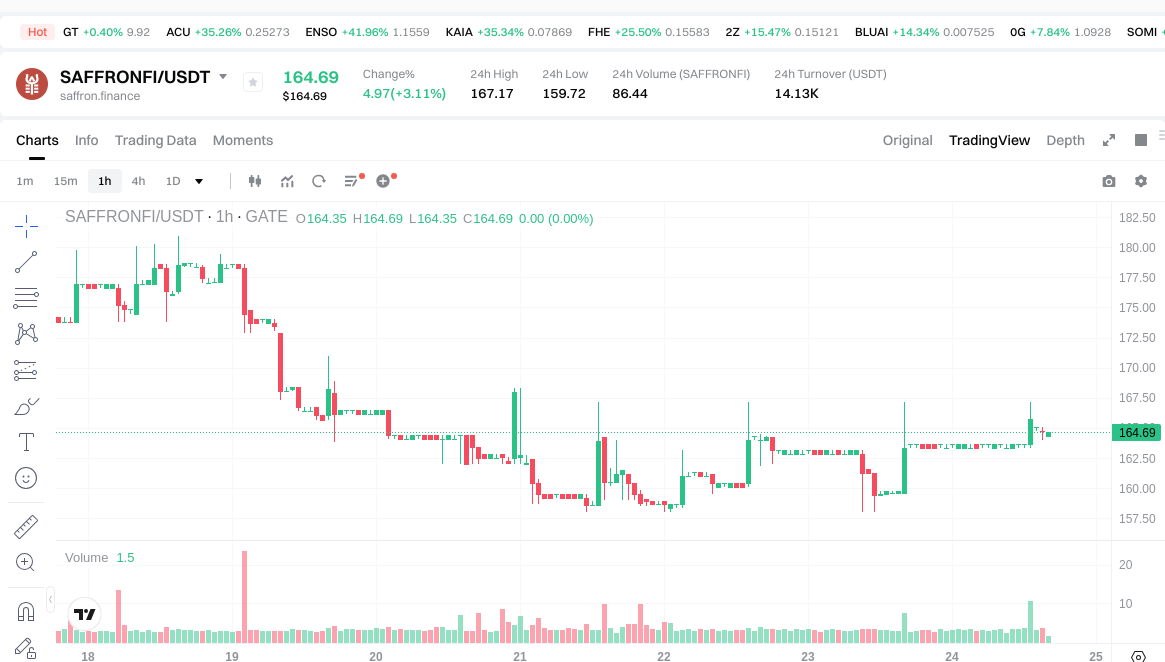
II. Core Factors Affecting Whether SAFFRONFI is a Good Investment
Supply Mechanism and Scarcity (SAFFRONFI investment scarcity)
- Fixed Maximum Supply of 100,000 Tokens → Potential impact on price and investment value through supply constraint
- Current Circulating Supply: 92,122 tokens (92.12% of maximum supply) → High circulation ratio indicates near-complete token distribution
- Historical Price Movement: The token has experienced significant price volatility, with current price at $164.69 compared to historical observations
- Investment Significance: The fixed supply cap and high circulation ratio represent structural scarcity characteristics that may support long-term investment considerations
Institutional Investment and Mainstream Adoption (Institutional investment in SAFFRONFI)
- Token Holders: Approximately 12,324 addresses hold SAFFRONFI tokens
- Trading Availability: Listed on 1 exchange platform with 24-hour trading volume of $14,088.34
- Protocol Function: Saffron Finance serves as an intermediary between liquidity providers and lending protocols, facilitating risk-adjusted exposure through pool tranches
- Market Position: The project represents a specialized niche in DeFi risk management, with its native token SFI used for tranche access via staking and protocol governance
Macroeconomic Environment's Impact on SAFFRONFI Investment
- Market Capitalization: Current market cap stands at $15.17 million with market dominance of 0.00052%
- Price Performance Trends: 1-hour change of -0.21%, 24-hour change of +3.07%, 7-day change of -5.25%, 30-day change of -47.39%, and 1-year change of +680.76%
- Volatility Characteristics: The token demonstrates substantial price fluctuations across different time periods, reflecting sensitivity to market conditions
- Investment Context: As a small-cap DeFi protocol token, SAFFRONFI may be influenced by broader cryptocurrency market sentiment and macroeconomic factors affecting risk appetite
Technology and Ecosystem Development (Technology & Ecosystem for SAFFRONFI investment)
- Protocol Mechanism: Saffron Finance operates as a peer-to-peer risk exchange protocol enabling customizable risk/reward profiles through tranched liquidity pools
- Token Utility: SFI token provides governance rights and staking-based access to specified protocol tranches
- Technical Infrastructure: Built on Ethereum blockchain utilizing ERC-20 token standard
- Development Roadmap: V2 protocol version is planned to introduce fee distribution mechanisms for SFI holders
- DeFi Integration: The protocol's core function centers on facilitating risk-adjusted exposure in lending protocols, representing a specialized application within the DeFi ecosystem
III. SAFFRONFI Future Investment Prediction and Price Outlook (Is saffron.finance(SAFFRONFI) worth investing in 2026-2031)
Short-term Investment Prediction (2026, short-term SAFFRONFI investment outlook)
- Conservative Prediction: $118.58 - $164.69
- Neutral Prediction: $164.69
- Optimistic Prediction: $164.69 - $169.63
Mid-term Investment Outlook (2027-2029, mid-term saffron.finance(SAFFRONFI) investment forecast)
-
Market Phase Expectation: The protocol may experience gradual adoption as liquidity providers seek customizable risk-return profiles in lending markets. Price movements could reflect broader DeFi sector trends and protocol development progress.
-
Investment Return Prediction:
- 2027: $127.04 - $210.62
- 2028: $170.00 - $262.56
- 2029: $144.46 - $288.93
-
Key Catalysts: V2 protocol release implementation, expansion of tranche offerings, potential fee distribution mechanisms to SFI holders, and broader integration with lending protocols.
Long-term Investment Outlook (Is SAFFRONFI a good long-term investment?)
- Base Scenario: $177.56 - $365.40 (assuming steady protocol adoption and stable DeFi lending market conditions)
- Optimistic Scenario: $311.37 - $442.14 (assuming successful V2 implementation and increased liquidity provider participation)
- Risk Scenario: Below $118.58 (under adverse DeFi market conditions or limited protocol adoption)
Click to view SAFFRONFI long-term investment and price prediction: Price Prediction
2026-01-24 - 2031 Long-term Outlook
- Base Scenario: $177.56 - $311.37 (corresponding to steady progress and gradual mainstream application enhancement)
- Optimistic Scenario: $365.40 - $442.14 (corresponding to large-scale adoption and favorable market environment)
- Transformative Scenario: Above $442.14 (if ecosystem achieves breakthrough progress and mainstream adoption)
- 2031-12-31 Predicted High: $442.14 (based on optimistic development assumptions)
Disclaimer: These predictions are based on historical data and market analysis models. Cryptocurrency markets are highly volatile and subject to numerous unpredictable factors. Past performance does not guarantee future results. Investors should conduct their own research and consider their risk tolerance before making investment decisions.
| Year |
Predicted High Price |
Predicted Average Price |
Predicted Low Price |
Price Change |
| 2026 |
169.6307 |
164.69 |
118.5768 |
0 |
| 2027 |
210.622041 |
167.16035 |
127.041866 |
1 |
| 2028 |
262.558761745 |
188.8911955 |
170.00207595 |
14 |
| 2029 |
288.9279726368 |
225.7249786225 |
144.4639863184 |
37 |
| 2030 |
365.403595394103 |
257.32647562965 |
177.5552681844585 |
56 |
| 2031 |
442.13835042686463 |
311.3650355118765 |
196.159972372482195 |
89 |
IV. SAFFRONFI Investment Strategy and Risk Management (How to invest in DeFi tokens)
Investment Strategy (SAFFRONFI investment strategy)
-
Long-term Holding (HODL SAFFRONFI): This approach may suit conservative investors who believe in the protocol's long-term development roadmap, particularly the upcoming V2 release that promises protocol fee entitlements for SFI holders. Given the token's significant price appreciation of 680.76% over the past year, patient investors might view price corrections as accumulation opportunities.
-
Active Trading: Technical traders may leverage SAFFRONFI's notable volatility characteristics. The 24-hour trading range between $159.72 and $167.17, combined with a 24-hour trading volume of approximately $14,088, suggests opportunities for experienced traders familiar with swing trading strategies in lower-liquidity DeFi tokens.
Risk Management (Risk management for SAFFRONFI investment)
-
Asset Allocation Ratios:
- Conservative investors: Consider limiting SAFFRONFI exposure to 1-2% of total crypto portfolio due to its volatility profile
- Moderate investors: May allocate 3-5% as part of a diversified DeFi exposure strategy
- Experienced DeFi investors: Could consider up to 5-10% allocation with active monitoring
-
Risk Hedging Approaches: Implement multi-asset portfolio diversification across different DeFi protocols and risk tranches. Consider balancing SAFFRONFI exposure with more established DeFi blue-chips and stablecoins to mitigate volatility impact.
-
Secure Storage: Given that SAFFRONFI operates on the Ethereum network (contract address: 0xb753428af26e81097e7fd17f40c88aaa3e04902c), investors should utilize:
- Hardware wallets such as Ledger or Trezor for long-term holdings
- Hot wallets with robust security features for active trading positions
- Multi-signature wallets for larger holdings
V. SAFFRONFI Investment Risks and Challenges (Risks of investing in DeFi tokens)
-
Market Risks: SAFFRONFI exhibits substantial price volatility, with a 30-day decline of 47.39% demonstrating significant downside potential. The token's limited exchange availability (currently listed on 1 exchange) and modest 24-hour trading volume may contribute to liquidity constraints and susceptibility to price manipulation. The circulating supply of 92,122 tokens represents 92.12% of the maximum supply of 100,000 tokens, suggesting limited additional supply pressure but also concentrated distribution among approximately 12,324 holders.
-
Regulatory Risks: As a DeFi protocol facilitating risk-adjusted liquidity provision, Saffron Finance operates in an evolving regulatory landscape. Different jurisdictions maintain varying approaches to DeFi protocols, particularly those involving structured financial products like tranches. Policy uncertainty across major markets could impact protocol operations and token utility.
-
Technical Risks: The protocol's core functionality depends on smart contract security and the stability of integrated lending protocols. Any vulnerabilities in the tranche mechanism or connected lending platforms could expose liquidity providers to unexpected losses. The upcoming V2 release, while potentially beneficial through fee distribution mechanisms, introduces upgrade execution risks that could temporarily affect protocol functionality.
VI. Conclusion: Is DeFi Risk Management Protocol a Good Investment?
-
Investment Value Summary: SAFFRONFI presents a specialized DeFi investment opportunity with notable long-term appreciation potential, evidenced by its 680.76% annual growth. However, the token experiences pronounced short-term price fluctuations, as demonstrated by the 47.39% monthly decline. The protocol's innovative approach to risk tranching and the planned V2 upgrade with fee distribution mechanisms offer differentiated value propositions within the DeFi lending sector.
-
Investor Recommendations:
✅ Beginners: Consider dollar-cost averaging strategies to mitigate entry timing risks, paired with secure hardware wallet storage. Start with minimal allocations while developing understanding of DeFi risk mechanisms.
✅ Experienced Investors: May employ swing trading strategies during volatility periods while maintaining core long-term positions. Diversify across multiple DeFi protocols to manage sector-specific risks.
✅ Institutional Investors: Could evaluate strategic allocations as part of broader DeFi lending exposure, with appropriate due diligence on smart contract audits and protocol governance mechanisms.
⚠️ Disclaimer: Cryptocurrency investments carry substantial risks due to market volatility, regulatory uncertainties, and technical complexities. This content serves informational purposes only and does not constitute investment advice. Conduct thorough independent research and consider your financial situation before making investment decisions.
VII. FAQ
Q1: What is Saffron Finance (SAFFRONFI) and how does it generate investment value?
Saffron Finance is a peer-to-peer risk exchange protocol that enables liquidity providers to customize their risk and return profiles through tranched liquidity pools. The protocol serves as an intermediary between liquidity providers and lending protocols, with its native token SFI used for accessing specified tranches via staking and protocol governance. Investment value derives from its fixed supply of 100,000 tokens (92.12% currently circulating), utility in governance and tranche access, and planned V2 upgrade that will introduce fee distribution mechanisms to SFI holders, creating potential yield generation opportunities beyond speculative appreciation.
Q2: How has SAFFRONFI performed as an investment historically?
SAFFRONFI demonstrates significant volatility with notable appreciation cycles. The token achieved an all-time high of $3,496.46 in February 2021 during the DeFi boom, subsequently correcting to $5.55 by February 2025. As of January 24, 2026, the price stands at $164.69, representing a 680.76% increase over the preceding year. However, short-term performance shows substantial fluctuations: +3.07% (24-hour), -5.25% (7-day), and -47.39% (30-day), indicating high-risk characteristics typical of specialized DeFi protocol tokens.
Q3: What are the primary risks associated with investing in SAFFRONFI?
Three major risk categories affect SAFFRONFI investments: (1) Market Risks - extreme price volatility evidenced by 47.39% monthly decline, limited liquidity with trading on only 1 exchange and $14,088 daily volume, and concentrated holder base of 12,324 addresses; (2) Regulatory Risks - evolving DeFi oversight across jurisdictions, particularly concerning structured financial products like risk tranches; (3) Technical Risks - smart contract vulnerabilities, dependency on integrated lending protocol stability, and potential execution risks during the upcoming V2 upgrade implementation.
Q4: What allocation percentage should different investor types consider for SAFFRONFI?
Investment allocation should align with risk tolerance: Conservative investors should limit exposure to 1-2% of total crypto portfolio due to volatility and liquidity constraints. Moderate investors may allocate 3-5% as part of diversified DeFi exposure alongside established protocols. Experienced DeFi investors familiar with risk tranching mechanisms could consider 5-10% allocation with active monitoring of protocol developments and market conditions. All allocations should be balanced with stablecoins and blue-chip assets to mitigate downside risk.
Q5: What catalysts could drive SAFFRONFI price appreciation in 2026-2027?
Several developments may impact price trajectory: The V2 protocol release introducing fee distribution mechanisms to SFI holders could enhance token utility and create yield opportunities. Expansion of tranche offerings across additional lending protocols may increase protocol adoption and SFI staking demand. Broader DeFi market recovery following favorable macroeconomic conditions could lift specialized protocols like Saffron Finance. Price predictions suggest potential ranges of $127.04-$210.62 for 2027, though actual performance depends on execution quality and market sentiment toward DeFi risk management solutions.
Q6: How does SAFFRONFI's tokenomics structure affect its investment potential?
SAFFRONFI features a fixed maximum supply of 100,000 tokens with 92,122 currently circulating (92.12%), creating structural scarcity as distribution nears completion. This high circulation ratio indicates limited future dilution risk compared to protocols with low circulating percentages. The token's utility encompasses governance rights and staking-based tranche access, with planned V2 enhancements adding protocol fee entitlements. The fully diluted market cap of $16.47 million versus current $15.17 million market cap suggests only 7.88% additional supply pressure, potentially supporting price stability compared to protocols with significant locked allocations.
Q7: What security measures should investors implement when holding SAFFRONFI?
Given SAFFRONFI operates on Ethereum (contract address: 0xb753428af26e81097e7fd17f40c88aaa3e04902c), implement tiered security: For long-term holdings, utilize hardware wallets (Ledger, Trezor) with offline private key storage to protect against remote attacks. Active trading positions should employ hot wallets with two-factor authentication, transaction whitelisting, and withdrawal limits. Large holdings warrant multi-signature wallet configurations requiring multiple authorization signatures. Verify contract addresses through official sources before transactions, as DeFi tokens face phishing risks through counterfeit contracts.
Q8: Is SAFFRONFI suitable for passive income generation strategies?
SAFFRONFI presents limited passive income mechanisms in its current V1 implementation, as the token primarily serves governance and tranche access functions through staking rather than generating direct yield. However, the upcoming V2 release promises to introduce protocol fee distribution to SFI holders, potentially creating yield opportunities proportional to protocol usage and trading volumes. Investors seeking immediate passive income may find current utility insufficient compared to established DeFi yield protocols, though V2 implementation could enhance this value proposition. Patient investors may position ahead of V2 launch to capture early fee distribution benefits, though execution timing remains uncertain.
* The information is not intended to be and does not constitute financial advice or any other recommendation of any sort offered or endorsed by Gate.