This comprehensive analysis examines whether Sahara AI (SAHARA) represents a sound investment opportunity within the AI-blockchain sector. Currently trading at $0.02426 with a $49.49 million market cap on Gate and 37 other exchanges, SAHARA functions as a full-stack, AI-native blockchain platform enabling users to create, contribute to, and monetize AI development. The article evaluates historical price movements from $0.06 launch price through peak $0.167 levels to current valuations, analyzing institutional support including Binance Labs backing and $50 million in funding. Core investment factors examined include token supply mechanics with 20.4% circulating ratio, macroeconomic influences, and ecosystem development potential. Price projections range from conservative to optimistic scenarios through 2031, while detailed risk assessments address market volatility, regulatory uncertainty, and technical vulnerabilities. Investment strategies tailored for beginners, experienced traders, and institutional invest
Introduction: Sahara AI (SAHARA) Investment Position and Market Outlook
SAHARA is a notable digital asset in the cryptocurrency sector, positioned within the AI and blockchain infrastructure space. As of January 19, 2026, SAHARA holds a market ranking of 525 with a market capitalization of approximately $49.49 million. The token currently trades at $0.02426, with a circulating supply of 2.04 billion tokens out of a total supply of 10 billion. The platform describes itself as a full-stack, AI-native blockchain platform designed to enable users to create, contribute to, and monetize AI development. With 38 exchanges listing the token and 1,745 holders, SAHARA has established a presence across multiple trading platforms. The token has experienced price fluctuations, declining 8.71% over 24 hours and 12.97% over 30 days as of the latest data. This analysis examines SAHARA's investment characteristics, historical price movements, future price projections, and associated risks to provide reference information for market participants considering this asset.
I. Sahara AI (SAHARA) Price History Review and Current Investment Value
- 2025: Sahara AI launched with initial offering price of $0.06, attracting institutional backing from major investors including Binance Labs, marking its entry into the blockchain+AI convergence narrative that dominated the year
- 2025: Token reached price levels around $0.167 during market expansion phases, as AI-crypto integration projects gained widespread attention alongside developments in stablecoins, RWA tokenization, and emerging DeFi infrastructure
- 2026 (January): Price adjusted from previous higher levels to current range near $0.024, reflecting broader market consolidation patterns affecting AI-focused blockchain projects
Current SAHARA Investment Market Status (January 2026)
- Current Price: $0.02426
- 24-hour Trading Volume: $275,076.61
- Market Capitalization: $49.49 million
- Circulating Supply: 2.04 billion tokens (20.4% of total supply)
- Recent Price Changes: -8.71% (24H), -9.73% (7D), -12.97% (30D)
- Total Supply: 10 billion tokens
- Contract: ERC-20 standard on Ethereum network
View real-time SAHARA market price
The project has been recognized as a high-potential initiative due to its innovative blockchain+AI integration model and institutional support, though current market conditions reflect industry-wide adjustment trends affecting similar infrastructure projects in early 2026.
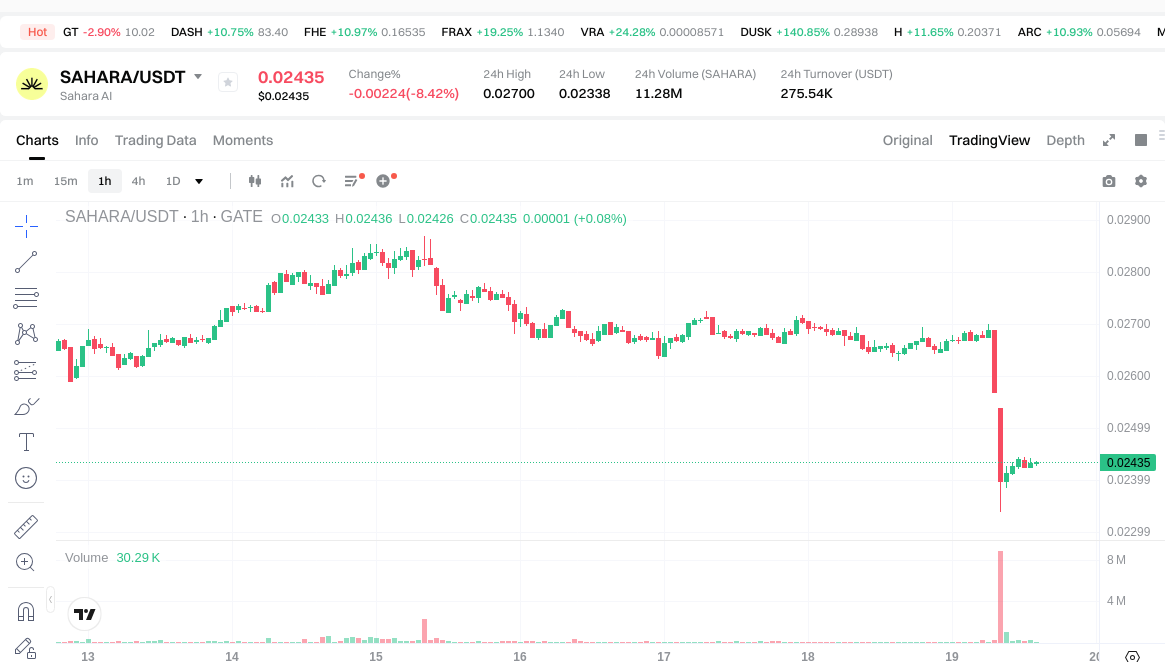
II. Core Factors Influencing Whether SAHARA is a Good Investment (Is Sahara AI(SAHARA) a Good Investment)
Supply Mechanism and Scarcity (SAHARA investment scarcity)
- Total Supply and Circulating Supply → Impact on Price and Investment Value
- SAHARA has a maximum supply of 10,000,000,000 tokens, with a circulating supply of 2,040,000,000 tokens, representing a circulating ratio of 20.4%
- The relatively low circulating ratio suggests that a significant portion of tokens remains unlocked, which may influence future supply dynamics
- Investment Significance: Scarcity as a Key Factor for Long-term Investment
- The controlled release of tokens could potentially support price stability, though future unlocks may introduce additional supply pressure
- Understanding the token release schedule is important for evaluating long-term scarcity
Institutional Investment and Mainstream Adoption (Institutional investment in SAHARA)
- Institutional Holding Trends
- SAHARA has secured over $50 million in funding from various investors, indicating institutional interest in the project
- The project is positioned as a full-stack, AI-native blockchain platform, which may attract attention from institutions focused on AI and blockchain integration
- Enhanced Investment Value through Adoption
- Listing on major exchanges, with 38 exchanges currently supporting SAHARA trading, suggests growing mainstream recognition
- The platform's focus on enabling anyone to create, contribute to, and monetize AI development may expand its adoption potential
- Policy Environment Impact
- As with other crypto assets, regulatory developments concerning AI and blockchain technologies may influence SAHARA's investment outlook
Macroeconomic Environment's Impact on SAHARA Investment
- Monetary Policy and Interest Rate Changes → Altering Investment Attractiveness
- Shifts in global monetary policy can affect risk appetite for crypto assets, including SAHARA
- Higher interest rates may reduce demand for speculative investments, while accommodative policies could support inflows
- Hedging Role in Inflationary Environments
- Crypto assets are sometimes viewed as potential hedges against inflation, though SAHARA's specific positioning focuses on AI utility rather than store of value
- Geopolitical Uncertainty → Enhanced Investment Demand
- Periods of geopolitical instability may drive investors toward decentralized assets, potentially benefiting projects like SAHARA
Technology and Ecosystem Development (Technology & Ecosystem for SAHARA investment)
- Platform Capabilities: Enhancing Network Performance → Increased Investment Appeal
- SAHARA positions itself as a full-stack, AI-native blockchain platform, designed to facilitate AI development and monetization
- The integration of AI and blockchain technologies aims to create a more accessible and equitable AI ecosystem
- Ecosystem Expansion: Supporting Long-term Value
- The platform enables users to create, contribute to, and monetize AI development, potentially driving network effects
- Growth in the number of holders (currently 1,745) may indicate increasing ecosystem participation
- Applications Driving Investment Value
- The focus on AI development and monetization distinguishes SAHARA from purely financial crypto applications
- Integration with broader blockchain use cases, such as decentralized applications and AI services, may support the token's utility and long-term value proposition
III. SAHARA Future Investment Forecast and Price Outlook (Is Sahara AI(SAHARA) worth investing in 2026-2031)
Short-term Investment Outlook (2026, short-term SAHARA investment outlook)
- Conservative Forecast: $0.0136 - $0.0166
- Neutral Forecast: $0.0243 - $0.0302
- Optimistic Forecast: $0.0317 - $0.0360
Mid-term Investment Outlook (2027-2029, mid-term Sahara AI(SAHARA) investment forecast)
-
Market Phase Expectation: The mid-term outlook reflects a gradual growth trajectory as the AI-native blockchain ecosystem continues its development phase. Market conditions may exhibit moderate volatility while the platform works toward expanding its user base and technological capabilities.
-
Investment Return Forecast:
- 2027: $0.0166 - $0.0317
- 2028: $0.0272 - $0.0378
- 2029: $0.0210 - $0.0481
-
Key Catalysts: Platform adoption growth, technological developments in AI integration, broader blockchain ecosystem expansion, and market sentiment toward AI-related crypto projects.
Long-term Investment Outlook (Is SAHARA a good long-term investment?)
- Base Scenario: $0.0346 - $0.0548 (assuming steady ecosystem development and gradual mainstream adoption progress through 2030-2031)
- Optimistic Scenario: $0.0481 - $0.0543 (contingent upon accelerated platform adoption and favorable market conditions)
- Risk Scenario: Below $0.0210 (under conditions of market downturns or significant ecosystem challenges)
For detailed SAHARA long-term investment and price forecasts, visit: Price Prediction
2026-01-19 to 2031 Long-term Outlook
- Base Scenario: $0.0243 - $0.0412 (corresponding to steady progress and gradual mainstream application growth)
- Optimistic Scenario: $0.0344 - $0.0548 (corresponding to large-scale adoption and favorable market environment)
- Transformative Scenario: Above $0.0543 (in case of breakthrough ecosystem developments and widespread mainstream adoption)
- 2031-12-31 Projected High: $0.0543 (based on optimistic development assumptions)
Disclaimer: Price predictions are speculative estimates based on available market data and historical trends. Cryptocurrency markets are highly volatile and subject to various factors beyond forecasting models. These projections should not be considered as financial advice or guarantees of future performance. Investors should conduct their own research and consider their risk tolerance before making investment decisions.
| Year |
Predicted High Price |
Predicted Average Price |
Predicted Low Price |
Price Change |
| 2026 |
0.036038 |
0.02435 |
0.013636 |
0 |
| 2027 |
0.0317037 |
0.030194 |
0.0166067 |
24 |
| 2028 |
0.037757597 |
0.03094885 |
0.027234988 |
27 |
| 2029 |
0.0480945129 |
0.0343532235 |
0.020955466335 |
41 |
| 2030 |
0.054827744706 |
0.0412238682 |
0.034628049288 |
69 |
| 2031 |
0.05426916129189 |
0.048025806453 |
0.02497341935556 |
97 |
IV. SAHARA Investment Strategy and Risk Management (How to invest in AI-native blockchain tokens)
Investment Methodology (SAHARA investment strategy)
-
Long-term Holding (HODL SAHARA): Suitable for conservative investors who believe in the long-term potential of AI-native blockchain platforms. This approach involves acquiring SAHARA tokens and holding them through market fluctuations, anticipating value appreciation as the Sahara AI ecosystem develops and adoption increases.
-
Active Trading: Relies on technical analysis and swing trading strategies. Traders may capitalize on price movements by analyzing support and resistance levels, volume patterns, and market sentiment. Given SAHARA's 24-hour volatility indicators and recent price fluctuations, active traders should employ strict entry and exit strategies with predetermined profit targets and stop-loss levels.
Risk Management (Risk management for SAHARA investment)
V. SAHARA Investment Risks and Challenges (Risks of investing in AI-native blockchain tokens)
-
Market Risks: SAHARA exhibits significant price volatility, with recent 24-hour fluctuations reaching -8.71% and 7-day movements of -9.73%. The relatively modest market capitalization and circulating supply ratio of 20.4% may contribute to price susceptibility. Trading volume variations can impact liquidity and execution prices.
-
Regulatory Risks: AI and blockchain convergence faces evolving regulatory frameworks across jurisdictions. Policy uncertainty regarding AI governance, data privacy regulations, and cryptocurrency classifications may impact platform operations and token utility. Different countries maintain varying stances on crypto assets, creating compliance complexities.
-
Technical Risks: As an AI-native blockchain platform, Sahara AI faces potential vulnerabilities including smart contract exploits, network security challenges, and integration complexities between AI and blockchain components. Platform upgrades and protocol modifications carry execution risks that may temporarily affect functionality or token economics.
VI. Conclusion: Is AI-native blockchain tokens a Good Investment?
-
Investment Value Summary: SAHARA represents an emerging sector combining artificial intelligence with blockchain infrastructure, offering exposure to innovation in decentralized AI development. The platform's positioning as a full-stack solution for AI creation and monetization suggests potential for ecosystem growth. However, investors should acknowledge the significant price movements and market volatility characteristic of newer crypto assets.
-
Investor Recommendations:
✅ Beginners: Consider dollar-cost averaging (DCA) strategies to mitigate timing risks, combined with secure wallet storage practices. Start with smaller allocations while developing understanding of the AI-blockchain sector.
✅ Experienced Investors: Employ swing trading techniques with disciplined risk parameters and diversified portfolio construction. Monitor platform development milestones and ecosystem adoption metrics.
✅ Institutional Investors: Evaluate strategic long-term positioning within AI-blockchain exposure, with comprehensive due diligence on platform architecture, tokenomics, and competitive positioning.
⚠️ Disclaimer: Cryptocurrency investments carry substantial risks including potential loss of principal. This content serves informational purposes only and does not constitute investment advice. Conduct thorough research and consider consulting financial advisors before making investment decisions.
VII. FAQ
Q1: What is the current circulating supply ratio of SAHARA tokens and what does this mean for investors?
SAHARA has a circulating supply of 2.04 billion tokens out of a total supply of 10 billion, representing a circulating ratio of 20.4%. This relatively low circulating ratio indicates that 79.6% of tokens remain unlocked, which means significant future token releases could introduce additional supply pressure on the market. Investors should understand that as more tokens enter circulation through unlock schedules, this may impact price dynamics and create potential dilution effects. The controlled release mechanism could support near-term price stability, but the substantial locked supply represents an important consideration for long-term investment planning and risk assessment.
Q2: How has SAHARA's price performed since its launch and what explains the recent decline?
SAHARA launched in 2025 at an initial offering price of $0.06 and reached approximately $0.167 during market expansion phases, but has since declined to $0.02426 as of January 2026. This represents recent negative performance of -8.71% over 24 hours, -9.73% over 7 days, and -12.97% over 30 days. The price adjustment reflects broader market consolidation patterns affecting AI-focused blockchain projects in early 2026, rather than project-specific issues. The decline aligns with industry-wide trends where speculative AI-crypto integration projects have experienced corrections following initial enthusiasm. Investors should recognize that price volatility is characteristic of emerging crypto assets with relatively modest market capitalizations.
Q3: What institutional support does SAHARA have and why is this significant?
SAHARA has secured over $50 million in funding from various investors, including backing from Binance Labs, a prominent cryptocurrency venture arm. This institutional support is significant because it demonstrates confidence from established players in the crypto ecosystem and provides financial resources for platform development. The involvement of Binance Labs specifically adds credibility and potentially facilitates exchange listings and ecosystem partnerships. Additionally, SAHARA is currently listed on 38 exchanges, suggesting growing mainstream recognition. However, institutional backing does not guarantee investment success, and investors should evaluate the project's technological progress and adoption metrics alongside funding announcements.
Q4: What are the primary use cases that differentiate SAHARA from other cryptocurrency projects?
SAHARA positions itself as a full-stack, AI-native blockchain platform designed to enable users to create, contribute to, and monetize AI development. This differentiates it from purely financial crypto applications by focusing on AI utility and democratizing access to AI technology. The platform aims to create an accessible and equitable AI ecosystem where developers and contributors can participate in AI innovation and receive compensation for their contributions. This use case addresses the growing intersection of artificial intelligence and blockchain technology, potentially creating network effects as more users engage with the platform. However, the practical adoption and real-world utility of these use cases remain developmental, and investors should monitor ecosystem growth metrics.
Q5: What are the main risks investors should consider before investing in SAHARA?
Investors face several significant risks: (1) Market Risk - SAHARA exhibits high price volatility with double-digit percentage declines observed over short periods, and the relatively modest market capitalization may amplify price swings; (2) Regulatory Risk - AI and blockchain convergence faces evolving regulatory frameworks that may impact platform operations and token utility across different jurisdictions; (3) Technical Risk - As an AI-native blockchain platform, SAHARA faces potential vulnerabilities including smart contract exploits, network security challenges, and integration complexities between AI and blockchain components; (4) Supply Risk - With only 20.4% of tokens currently circulating, future token unlocks may create downward price pressure. Conservative investors should limit SAHARA to 1-3% of their crypto portfolio.
Q6: What is the recommended investment strategy for different types of investors?
For Beginners: Employ dollar-cost averaging (DCA) strategies to mitigate timing risks, starting with smaller allocations (1-3% of crypto portfolio) while developing understanding of the AI-blockchain sector. Prioritize secure storage using hardware wallets for long-term holdings. For Experienced Investors: Consider swing trading techniques with disciplined risk parameters, allocating 5-10% of crypto portfolio while actively monitoring support and resistance levels, platform development milestones, and ecosystem adoption metrics. For Institutional Investors: Evaluate strategic long-term positioning with comprehensive due diligence on platform architecture and tokenomics, potentially allocating up to 15% with active hedging strategies through multi-asset portfolio diversification. All investors should maintain predetermined profit targets and stop-loss levels to manage the significant volatility inherent in this asset.
Q7: What are the price projections for SAHARA through 2031 and what assumptions underlie these forecasts?
Price projections vary significantly based on adoption scenarios: 2026: Conservative ($0.0136-$0.0166), Neutral ($0.0243-$0.0302), Optimistic ($0.0317-$0.0360). Long-term (2031): Base scenario ($0.0243-$0.0412), Optimistic scenario ($0.0344-$0.0548), with potential high of $0.0543 under breakthrough conditions. These forecasts assume gradual ecosystem development, technological progress in AI integration, growing platform adoption, and favorable market conditions for AI-related crypto projects. However, these projections are speculative estimates subject to high uncertainty. Cryptocurrency markets are highly volatile and influenced by factors beyond forecasting models including regulatory changes, competitive dynamics, technological challenges, and macroeconomic conditions. Investors should not rely solely on price predictions when making investment decisions.
Q8: How does SAHARA's technology stack differentiate it within the AI-blockchain sector?
SAHARA describes itself as a "full-stack, AI-native blockchain platform," suggesting comprehensive infrastructure covering multiple layers from blockchain consensus to AI development tools. This positioning aims to provide an integrated solution rather than point solutions addressing specific aspects of AI or blockchain separately. The platform's architecture theoretically enables seamless interaction between AI components and blockchain verification, creating opportunities for decentralized AI development and monetization. However, the technical details of implementation, scalability characteristics, and competitive advantages versus alternative AI-blockchain platforms require deeper technical evaluation. Investors should monitor technological development progress, platform performance metrics, and developer adoption rates to assess whether the full-stack approach delivers practical advantages in the marketplace.
* The information is not intended to be and does not constitute financial advice or any other recommendation of any sort offered or endorsed by Gate.