This comprehensive article evaluates whether Sandbox (SAND) represents a sound investment opportunity within the blockchain gaming and metaverse sectors. SAND, trading at $0.1236 as of January 2026 with a market cap of $329.68 million, offers exposure to The Sandbox platform ecosystem. The analysis covers SAND's historical price performance (reaching $8.40 in 2021 before declining 78.48% year-over-year), current market metrics across 64 exchanges on Gate and other platforms, and supply dynamics with 88.91% circulation. The article examines critical investment factors including institutional adoption, technological infrastructure, and macroeconomic conditions affecting gaming tokens. Price projections range from conservative ($0.0806-$0.110 in 2026) to optimistic scenarios reaching $0.211 by 2031. Detailed investment strategies accommodate different investor profiles—conservatives maintaining 1-3% allocation through dollar-cost averaging, while aggressive traders leverage technical analysis and volatility. Com
Introduction: Sandbox (SAND)'s Investment Position and Market Prospects
SAND is a significant asset in the cryptocurrency space, having been launched in August 2020 and establishing notable achievements in the virtual gaming and NFT sectors. As of January 2026, Sandbox (SAND) maintains a market capitalization of approximately $329.68 million with a circulating supply of around 2.67 billion tokens, trading at $0.1236. Positioned as a virtual game world powered by Ethereum-based functional tokens, SAND enables players to create, own, and monetize diverse gaming experiences through digital assets. With over 207,000 holders and availability on 64 exchanges, SAND has gradually become a focal point for investors evaluating "Is Sandbox (SAND) a good investment?" This article comprehensively analyzes SAND's investment value, historical performance trends, future price projections, and associated risks to provide reference for investors.
I. Sandbox (SAND) Price History Review and Current Investment Value
- 2021: SAND reached a notable price level of $8.4 in November, reflecting significant market interest during the metaverse narrative expansion
- 2020: Initial trading phase saw SAND starting from lower price ranges around $0.029, representing an early-stage development period
- 2021-2026: The token experienced considerable price fluctuation, moving from elevated levels to approximately $0.12, reflecting broader market cycles and evolving sector dynamics
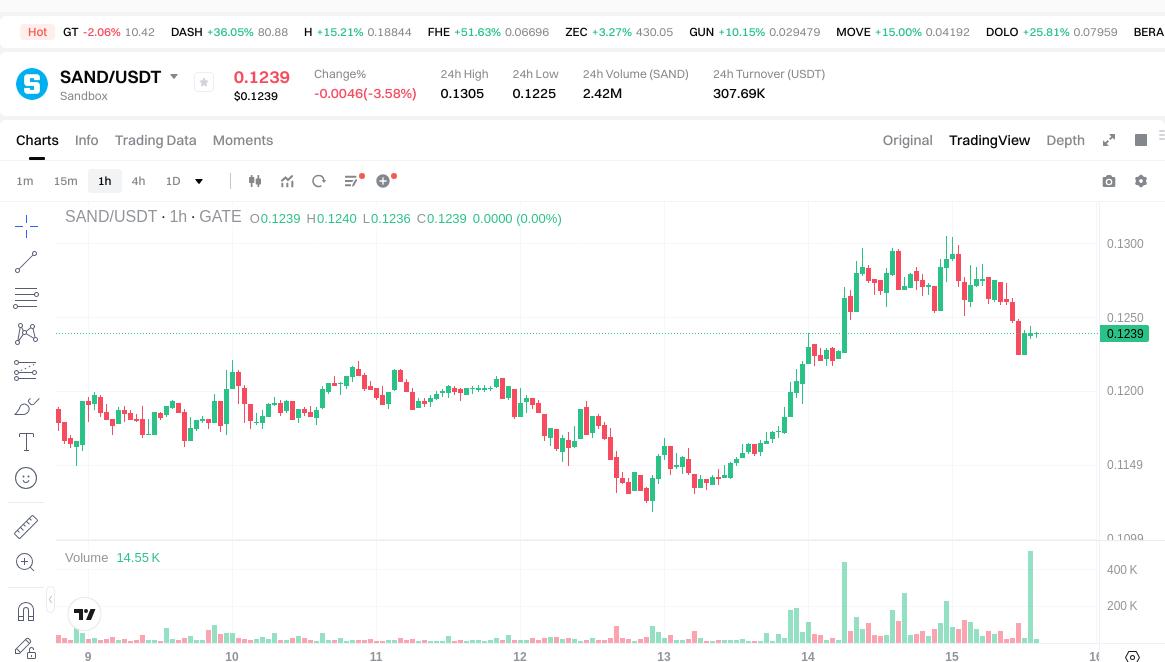
Current SAND Investment Market Status (January 2026)
- SAND current price: $0.1236
- 24-hour price change: -3.66%
- 24-hour trading volume: $310,334.89
- Circulating supply: 2,667,289,202 SAND
- Market capitalization: $329,676,945
- Circulation ratio: 88.91%
Click to view real-time SAND market price
II. Core Factors Affecting Whether SAND is a Good Investment
Supply Mechanism and Scarcity (SAND Investment Scarcity)
- Fixed Supply Cap: SAND has a maximum supply of 3,000,000,000 tokens, with approximately 2,667,289,202 tokens currently in circulation (88.91% of max supply). This predetermined supply cap creates a structured scarcity model that may influence long-term investment value.
- Circulating Supply Dynamics: With nearly 89% of the total supply already circulating as of January 2026, the remaining token releases may have limited dilutive impact on existing holders, potentially supporting price stability.
- Investment Implication: The high circulation ratio and fixed maximum supply provide transparency for investors assessing potential dilution risks, though scarcity alone does not guarantee price appreciation.
Institutional Investment and Mainstream Adoption (Institutional Investment in SAND)
- Exchange Availability: SAND is listed on 64 cryptocurrency exchanges as of January 2026, indicating broad accessibility for institutional and retail investors.
- Holder Base: The token has attracted 207,482 holders, suggesting a distributed ownership structure across the investment community.
- Market Positioning: SAND maintains a market capitalization of approximately $329.68 million with a market dominance of 0.010%, reflecting its position within the broader cryptocurrency investment landscape.
Macroeconomic Environment's Impact on SAND Investment
- Market Performance Context: SAND has experienced a 78.48% decline over the one-year period ending January 2026, reflecting the impact of broader market conditions on metaverse-focused tokens.
- Price Volatility: The token demonstrated significant historical price ranges, trading between $0.02897764 (November 2020) and $8.40 (November 2021), illustrating sensitivity to market cycles and investor sentiment.
- Current Market Conditions: As of January 15, 2026, SAND trades at $0.1236, with 24-hour volatility ranging from $0.1225 to $0.1305, reflecting ongoing market uncertainty.
Technology and Ecosystem Development (Technology & Ecosystem for SAND Investment)
- Multi-Chain Presence: SAND operates with contract deployments on Ethereum (0x3845badAde8e6dFF049820680d1F14bD3903a5d0) and Base (0xac531eb26ca1d21b85126de8fb87e80e09002dcf), expanding its technical infrastructure across blockchain networks.
- Platform Foundation: The Sandbox functions as a virtual game world built on Ethereum-based functionality, enabling creators to develop and monetize digital assets through NFT technology.
- Ecosystem Focus: The platform emphasizes community-driven content creation and voxel-based gaming experiences, with value proposition tied to user engagement and content development within the metaverse environment.
III. SAND Future Investment Prediction and Price Outlook (Is Sandbox(SAND) worth investing in 2026-2031)
Short-term Investment Prediction (2026, short-term SAND investment outlook)
Based on available market analysis, short-term price projections for SAND in 2026 present varied scenarios:
- Conservative forecast: $0.0806 - $0.110
- Neutral forecast: $0.110 - $0.124
- Optimistic forecast: $0.124 - $0.14136
Analysts suggest that SAND price may fluctuate within a relatively narrow range during 2026, with some predictions indicating potential downward pressure. Market sentiment appears mixed, with technical factors and broader market conditions likely to influence near-term performance.
Mid-term Investment Outlook (2027-2028, mid-term Sandbox(SAND) investment forecast)
- Market stage expectation: Transitional phase with potential consolidation as the project continues ecosystem development and brand partnerships
- Investment return prediction:
- 2027: $0.1114 - $0.1499
- 2028: $0.1356 - $0.1738
- Key catalysts: Integration of new intellectual property partnerships, platform tool upgrades such as Game Maker enhancements, expansion of brand collaborations with entities like Forbes and Gucci, and progression toward decentralized governance through The Sandbox DAO
The mid-term outlook reflects gradual appreciation potential, though growth rates may remain moderate compared to earlier bull market periods. Continued ecosystem enrichment efforts and strategic partnerships could support valuation stability.
Long-term Investment Outlook (Is SAND a good long-term investment?)
- Base scenario: $0.122 - $0.174 (assuming steady ecosystem development and moderate user adoption growth)
- Optimistic scenario: $0.174 - $0.211 (assuming accelerated mainstream adoption and favorable regulatory environment)
- Risk scenario: Below $0.122 (under conditions of prolonged market weakness or significant competitive pressure)
For detailed SAND long-term investment and price prediction: Price Prediction
2026-01-15 - 2031 Long-term Outlook
- Base scenario: $0.122 - $0.174 (corresponding to steady progress and gradual mainstream application enhancement)
- Optimistic scenario: $0.174 - $0.211 (corresponding to large-scale adoption and favorable market environment)
- Transformative scenario: Above $0.211 (if ecosystem achieves breakthrough developments and mainstream penetration)
- 2031-12-31 predicted high: $0.211 (based on optimistic development assumptions)
It should be noted that long-term price trajectories remain highly uncertain and dependent on multiple variables including technological advancement, competitive landscape evolution, regulatory developments, and overall cryptocurrency market cycles. Historical price volatility and the project's performance relative to major assets like BTC and ETH suggest that recovery to previous peaks may face substantial challenges.
Disclaimer: The information provided represents analytical perspectives based on available data and should not be construed as financial advice. Cryptocurrency investments carry inherent risks, and market conditions can change rapidly. Investors should conduct thorough independent research and consider their risk tolerance before making investment decisions.
| Year |
Predicted High Price |
Predicted Average Price |
Predicted Low Price |
Price Change |
| 2026 |
0.14136 |
0.124 |
0.0806 |
0 |
| 2027 |
0.1499284 |
0.13268 |
0.1114512 |
7 |
| 2028 |
0.173804166 |
0.1413042 |
0.135652032 |
14 |
| 2029 |
0.17173405947 |
0.157554183 |
0.13392105555 |
27 |
| 2030 |
0.1844014157832 |
0.164644121235 |
0.15641191517325 |
33 |
| 2031 |
0.211172549896011 |
0.1745227685091 |
0.12216593795637 |
41 |
IV. SAND Investment Strategy and Risk Management (How to invest in Gaming Tokens)
Investment Methodology (SAND investment strategy)
Long-term Holding (HODL SAND)
Long-term holding represents a prudent approach for conservative investors seeking exposure to the gaming metaverse sector. This strategy involves acquiring SAND tokens and maintaining positions through market cycles, capitalizing on the potential growth of The Sandbox platform ecosystem. Investors following this methodology typically focus on fundamental developments rather than short-term price movements.
Key considerations for long-term SAND holders include:
- Monitoring platform user growth and engagement metrics
- Tracking new partnerships and game development activities
- Evaluating the expansion of virtual land sales and NFT marketplace activity
- Assessing token utility enhancement through platform upgrades
This approach may suit investors who believe in the long-term viability of blockchain-based gaming and virtual worlds, while accepting the inherent volatility associated with cryptocurrency assets.
Active Trading
Active trading strategies for SAND rely on technical analysis and swing trading techniques to capitalize on price fluctuations. Given SAND's historical volatility, with movements ranging from an all-time high of $8.40 (November 25, 2021) to an all-time low of $0.02897764 (November 4, 2020), this approach may appeal to experienced traders.
Traders typically employ:
- Technical indicators such as moving averages, RSI, and volume analysis
- Support and resistance level identification based on historical price action
- Market sentiment monitoring through social media and community channels
- Correlation analysis with broader cryptocurrency market trends
Traders should note recent price performance, including a 24-hour decline of 3.66% and a one-year decrease of 78.48% from previous levels, which reflects both sector-specific challenges and broader market conditions.
Risk Management (Risk management for SAND investment)
Asset Allocation Ratios
Appropriate position sizing varies based on investor profile and risk tolerance:
Conservative Investors:
- Allocate 1-3% of total portfolio to SAND
- Prioritize capital preservation over high returns
- Consider SAND as a small speculative position within a diversified cryptocurrency allocation
Aggressive Investors:
- May allocate 5-10% of cryptocurrency portfolio to SAND
- Accept higher volatility in pursuit of potentially greater returns
- Maintain awareness of concentration risk within gaming token sector
Professional Investors:
- Implement dynamic allocation based on market conditions and fundamental analysis
- Utilize quantitative models for position sizing
- Consider hedging strategies for larger positions
Risk Hedging Solutions
Effective risk management for SAND investments incorporates:
Multi-asset Portfolio Construction:
- Diversification across cryptocurrency categories (Layer 1 protocols, DeFi tokens, stablecoins)
- Inclusion of non-correlated traditional assets
- Regular rebalancing to maintain target allocations
Defensive Tools:
- Stop-loss orders to limit downside exposure
- Stablecoin reserves for market dislocation opportunities
- Options strategies where available on supporting platforms
Secure Storage
Proper custody represents a critical component of SAND risk management:
Cold Storage Solutions:
- Hardware wallets (Ledger, Trezor) for long-term holdings
- Paper wallets for maximum security with proper backup procedures
- Multi-signature wallets for institutional-grade security
Hot Wallet Considerations:
- Limited amounts for active trading on exchanges
- Two-factor authentication and withdrawal whitelisting
- Regular security audits and password updates
Platform-Specific Storage:
- SAND exists as an ERC-20 token on Ethereum (contract: 0x3845badAde8e6dFF049820680d1F14bD3903a5d0)
- Also available on Base network (contract: 0xac531eb26ca1d21b85126de8fb87e80e09002dcf)
- Ensure wallet compatibility with both networks if holding cross-chain assets
V. SAND Investment Risks and Challenges (Risks of investing in Gaming Tokens)
Market Risk
High Volatility:
SAND exhibits significant price volatility characteristic of gaming and metaverse tokens. The asset has experienced substantial price swings, with historical data showing movements from $0.02897764 to $8.40, representing over 28,900% range. Recent performance shows fluctuations including a 3.66% decline in 24 hours alongside a 2.23% gain over 7 days, illustrating the unpredictable nature of short-term price movements.
Liquidity Considerations:
With 24-hour trading volume of approximately $310,334.89, investors should consider potential liquidity constraints during periods of market stress. The circulating supply represents 88.91% of maximum supply (2,667,289,202 SAND of 3,000,000,000 total), which may impact price dynamics.
Market Manipulation Concerns:
Lower-cap altcoins, including gaming tokens, may face susceptibility to coordinated trading activities. Investors should maintain awareness of unusual volume patterns or price movements that deviate from broader market trends.
Regulatory Risk
Jurisdictional Uncertainty:
Different countries maintain varying approaches to cryptocurrency regulation, particularly for gaming and NFT-related tokens. The regulatory landscape continues evolving, with potential implications for:
- Token classification (security vs. utility token)
- Taxation treatment of gaming rewards and NFT transactions
- Cross-border transaction restrictions
- Gaming-specific regulations in certain jurisdictions
Compliance Evolution:
As governments develop more comprehensive cryptocurrency frameworks, projects like The Sandbox may face additional compliance requirements regarding:
- User identity verification (KYC/AML)
- Reporting obligations for platform transactions
- Consumer protection measures for gaming applications
- Data privacy regulations affecting user information
Investors should monitor regulatory developments in their jurisdictions and in regions where The Sandbox maintains significant user bases.
Technical Risk
Network Security Vulnerabilities:
As an Ethereum-based token, SAND inherits both the security strengths and potential vulnerabilities of the underlying blockchain. Technical risks include:
- Smart contract vulnerabilities in token or platform contracts
- Bridge security for cross-chain implementations (e.g., Base network presence)
- Potential exploits in associated gaming platform infrastructure
- Wallet security threats including phishing and social engineering attacks
Upgrade and Development Risks:
The Sandbox platform's ongoing development presents technical considerations:
- Successful implementation of platform upgrades and new features
- Integration challenges with evolving blockchain infrastructure
- Competition from alternative gaming platforms with potentially superior technology
- Dependency on Ethereum network performance and transaction costs
Platform-Specific Risks:
Beyond token-level considerations, investors face risks related to The Sandbox ecosystem:
- User adoption rates and retention metrics
- Content creator engagement and quality
- Technical performance of the gaming platform
- Interoperability with other metaverse and gaming projects
VI. Conclusion: Is Gaming Tokens a Good Investment?
Investment Value Summary
SAND represents exposure to the intersection of blockchain technology, gaming, and virtual worlds through The Sandbox platform. The token has demonstrated substantial price volatility, with historical movements reflecting both the speculative nature of the metaverse sector and broader cryptocurrency market dynamics. Current market positioning shows a market capitalization of approximately $329.68 million, ranking it among established gaming tokens.
The long-term investment thesis for SAND depends on multiple factors including sustained user growth in The Sandbox platform, continued development of the virtual world ecosystem, broader adoption of blockchain gaming, and favorable market conditions for cryptocurrency assets. However, short-term price movements remain subject to significant volatility, as evidenced by recent performance metrics and the substantial decline from all-time highs.
Investor Recommendations
✅ Beginners
Approach: Conservative entry through dollar-cost averaging
- Consider small, regular purchases to average entry price over time
- Prioritize education about blockchain gaming and metaverse concepts
- Utilize secure storage solutions, preferably hardware wallets for holdings intended for long-term retention
- Limit initial allocation to 1-2% of total investment portfolio
- Avoid leverage or margin trading until gaining substantial experience
Focus Areas:
- Understanding The Sandbox platform and its utility for SAND token
- Learning basic cryptocurrency security practices
- Monitoring major platform announcements and partnerships
✅ Experienced Investors
Approach: Active portfolio management with technical analysis
- Implement swing trading strategies based on technical indicators and market cycles
- Maintain diversified cryptocurrency portfolio including multiple sectors (Layer 1, DeFi, Gaming)
- Allocate 3-7% of crypto portfolio to gaming tokens including SAND
- Employ risk management tools including stop-losses and portfolio rebalancing
- Monitor on-chain metrics and platform usage statistics
Considerations:
- Correlation analysis with broader gaming token sector
- Technical support and resistance levels for entry/exit planning
- Sector rotation strategies within cryptocurrency markets
✅ Institutional Investors
Approach: Strategic long-term allocation with comprehensive risk management
- Consider SAND as part of thematic exposure to gaming and metaverse sectors
- Implement institutional-grade custody solutions
- Conduct thorough due diligence on platform fundamentals and tokenomics
- Utilize hedging strategies where appropriate
- Maintain dynamic position sizing based on risk parameters
Strategic Considerations:
- Portfolio construction within broader digital asset allocation
- Risk-adjusted return analysis compared to alternative gaming tokens
- Regulatory compliance and reporting requirements
- Stakeholder communication regarding cryptocurrency exposure
⚠️ Important Disclaimer
Cryptocurrency investments, including SAND, carry substantial risk and may not be suitable for all investors. Digital asset prices can experience extreme volatility, and investors may lose their entire investment. This content is provided for informational purposes only and does not constitute investment advice, financial advice, trading advice, or any other type of advice. Readers should conduct their own research and consult with qualified financial advisors before making investment decisions. Past performance does not guarantee future results.
VII. FAQ
Q1: Is Sandbox (SAND) a good investment for beginners in 2026?
SAND may be suitable for beginners who accept high risk and are interested in blockchain gaming, but should represent only 1-2% of a total investment portfolio. For newcomers to cryptocurrency, SAND presents both opportunities and challenges. The token's connection to The Sandbox virtual gaming platform provides tangible utility beyond pure speculation, as it enables users to create, own, and monetize gaming experiences. However, beginners must recognize the significant volatility—SAND has declined 78.48% over the past year and currently trades at $0.1236, far below its November 2021 peak of $8.40. New investors should employ dollar-cost averaging to mitigate timing risk, prioritize secure storage through hardware wallets, and thoroughly research blockchain gaming concepts before investing. The learning curve for understanding metaverse economics and NFT integration adds complexity that requires patience and education.
Q2: What is the realistic price prediction for SAND by 2031?
Based on analytical projections, SAND may reach $0.211 in an optimistic scenario by December 2031, though base-case forecasts suggest $0.122-$0.174. Long-term price trajectories depend heavily on multiple uncertain variables including The Sandbox platform's user adoption rates, competitive positioning against emerging gaming metaverses, regulatory developments affecting blockchain gaming, and overall cryptocurrency market cycles. The projected average price for 2031 stands at $0.1745, representing modest appreciation from current levels of $0.1236. Investors should note that these projections assume continued ecosystem development, successful partnerships with brands like Forbes and Gucci, and gradual mainstream acceptance of virtual world platforms. However, the gaming token sector faces intense competition, and historical volatility suggests significant downside risk remains—SAND could trade below $0.122 in adverse scenarios involving prolonged market weakness or technological disruption from competitors.
Q3: How does SAND's token supply affect its investment value?
SAND's fixed maximum supply of 3 billion tokens with 88.91% already circulating (2.667 billion) creates moderate scarcity that limits future dilution risk. This high circulation ratio means only approximately 333 million tokens remain for future distribution, reducing the potential for significant supply-side price pressure compared to projects with lower circulation percentages. The predetermined supply cap provides transparency for investors analyzing tokenomics, unlike inflationary models with unlimited issuance. However, scarcity alone does not guarantee price appreciation—demand factors including platform usage, gaming content quality, and broader market sentiment play equally critical roles. With over 207,000 current holders and availability on 64 exchanges, SAND maintains reasonable liquidity, though concentrated ownership patterns or large token unlocks could still impact price stability. Investors should monitor the remaining token distribution schedule and assess whether supply dynamics align with anticipated demand growth from platform development.
Q4: What are the main risks of investing in SAND compared to other cryptocurrencies?
SAND faces sector-specific risks beyond general cryptocurrency volatility, including gaming platform adoption uncertainty, competition from alternative metaverses, and technology obsolescence risks. Unlike Layer 1 protocols with broad infrastructure applications, SAND's value proposition depends heavily on The Sandbox platform's success in attracting users, content creators, and brand partnerships. Recent 24-hour trading volume of only $310,334.89 suggests lower liquidity compared to major cryptocurrencies, potentially complicating large position exits during market stress. Technical risks include smart contract vulnerabilities in both the ERC-20 token (Ethereum) and cross-chain implementations (Base network), plus dependency on Ethereum's performance and transaction costs affecting user experience. Regulatory uncertainty specific to gaming tokens and NFTs adds complexity—different jurisdictions may classify gaming rewards differently for tax purposes or impose restrictions on blockchain-based gaming. Market manipulation concerns exist for mid-cap gaming tokens, and SAND's 78.48% decline over one year demonstrates correlation with broader gaming sector weaknesses during market downturns.
Q5: Should I hold SAND long-term or trade it actively?
The optimal strategy depends on investor experience, risk tolerance, and market outlook—conservative investors may prefer long-term holding with 1-3% allocation, while experienced traders can capitalize on SAND's volatility through technical analysis. Long-term holding suits investors believing in blockchain gaming's mainstream adoption trajectory, willing to weather significant price fluctuations, and focused on fundamental developments like new partnerships, platform upgrades, and user growth metrics. This approach requires patience, as recovery to previous highs faces substantial challenges given current market positioning. Active trading leverages SAND's historical volatility (ranging from $0.029 to $8.40), utilizing technical indicators, support/resistance levels, and correlation analysis with broader gaming tokens. However, traders must manage risks through stop-losses and position sizing, especially given recent price weakness and liquidity constraints. A hybrid approach may work best—maintaining a core long-term position of 1-3% while allocating 2-5% for tactical trading during periods of elevated volatility or clear technical setups.
Q6: How does The Sandbox platform development affect SAND's investment value?
Platform development directly impacts SAND's utility and demand—successful integration of Game Maker tools, brand partnerships (Forbes, Gucci), and DAO governance implementation could drive token appreciation, while stagnant user growth poses downside risk. SAND serves as the functional token enabling transactions, governance, and monetization within The Sandbox ecosystem, meaning platform success translates to increased token demand. Key developments to monitor include monthly active user metrics, virtual land sales velocity, NFT marketplace transaction volumes, and creator retention rates. The platform's multi-chain presence (Ethereum and Base) expands accessibility but adds technical complexity requiring successful cross-chain integration. Upcoming milestones such as enhanced Game Maker features, new intellectual property collaborations, and progression toward full decentralization through The Sandbox DAO represent potential catalysts. However, competition from alternative gaming metaverses (Decentraland, Otherside) and evolving user preferences toward different gaming experiences create execution risks—platform development must deliver compelling user experiences that justify continued investment in the ecosystem.
Q7: What allocation percentage should different investor types dedicate to SAND?
Conservative investors should limit SAND to 1-3% of total portfolio, aggressive investors may allocate 5-10% of cryptocurrency holdings, while professional investors implement dynamic sizing based on risk parameters and market conditions. Conservative profiles prioritize capital preservation and should treat SAND as a small speculative position within a diversified cryptocurrency allocation that itself represents a modest portion of overall wealth. This approach acknowledges gaming token volatility while maintaining exposure to potential upside from metaverse adoption. Aggressive investors accepting higher risk may increase allocation to 5-10% of crypto portfolios, recognizing that SAND could experience significant drawdowns but also participate in sector rallies if blockchain gaming gains mainstream traction. Professional investors employ quantitative models considering factors like Sharpe ratios, maximum drawdown tolerances, and correlation with other portfolio assets—typical institutional allocations might range 2-5% within thematic gaming/metaverse strategies. All investor types should implement regular rebalancing to maintain target allocations, avoid concentration risk through diversification across cryptocurrency categories (Layer 1, DeFi, gaming, infrastructure), and adjust positions based on evolving fundamentals rather than emotional responses to price movements.
Q8: What security measures should SAND investors implement?
SAND investors must prioritize secure storage through hardware wallets for long-term holdings, enable two-factor authentication on exchanges, and verify contract addresses (Ethereum: 0x3845badAde8e6dFF049820680d1F14bD3903a5d0) before transactions. Hardware wallets like Ledger or Trezor provide cold storage solutions protecting against online threats, essential for holdings exceeding trading needs. Investors should maintain only minimal amounts on exchanges for active trading, utilizing withdrawal whitelisting and strong, unique passwords. Given SAND's presence on multiple networks (Ethereum, Base), wallet compatibility verification prevents loss from sending tokens to incompatible addresses. Multi-signature wallets offer institutional-grade security for larger positions, requiring multiple approvals for transactions. Regular security audits include checking for unauthorized access, updating software/firmware, and avoiding phishing attempts through careful verification of URLs and email sources. Backup procedures should include secure storage of recovery phrases in multiple physical locations, never digital formats vulnerable to hacking. Investors holding SAND within The Sandbox platform ecosystem should also secure their platform accounts with strong credentials and understand the difference between custodial (exchange-held) and non-custodial (self-held) storage options.
* The information is not intended to be and does not constitute financial advice or any other recommendation of any sort offered or endorsed by Gate.