This comprehensive guide evaluates whether Sapien (SAPIEN) represents a viable investment opportunity in 2024-2031. As an open protocol for sourcing verified human knowledge at scale, SAPIEN operates on Base blockchain with a current price of $0.12653 and market cap of $31.63 million, serving millions of contributors across 100+ countries through its Proof of Quality validation system. The article examines SAPIEN's historical price trends, tokenomics with 250 million tokens circulating from 1 billion total supply, and core investment factors including supply scarcity and ecosystem development. Detailed price forecasts project 2031 highs between $0.1681-$0.2698 under various adoption scenarios, while identifying significant risks including market volatility, regulatory uncertainty, and token dilution potential. Recommended investment strategies span conservative long-term holding to active trading approaches, with specific allocation guidelines for different investor profiles. Essential reading for investors a
Introduction: Sapien (SAPIEN)'s Investment Position and Market Outlook
Sapien (SAPIEN) represents a notable asset in the cryptocurrency sector, operating as an open protocol for sourcing verified human knowledge at scale. As of January 21, 2026, SAPIEN maintains a market capitalization of approximately $31.63 million with a circulating supply of 250 million tokens out of a total supply of 1 billion tokens. The current trading price stands around $0.12653, with the asset listed across 29 exchanges and supported by 24,337 holders. The token serves as the incentive mechanism for a network spanning over 100 countries, connecting millions of contributors who generate AI training data validated through the platform's onchain Proof of Quality system. With a market share of 0.0040% and ranking at position 694, SAPIEN has experienced price fluctuations including a 7-day decline of 14.099% and a 30-day increase of 1.95%. As investors evaluate "Is Sapien (SAPIEN) a good investment?", this article provides a comprehensive analysis of SAPIEN's investment value, historical price trends, future price projections, and associated risks to serve as a reference for decision-making.
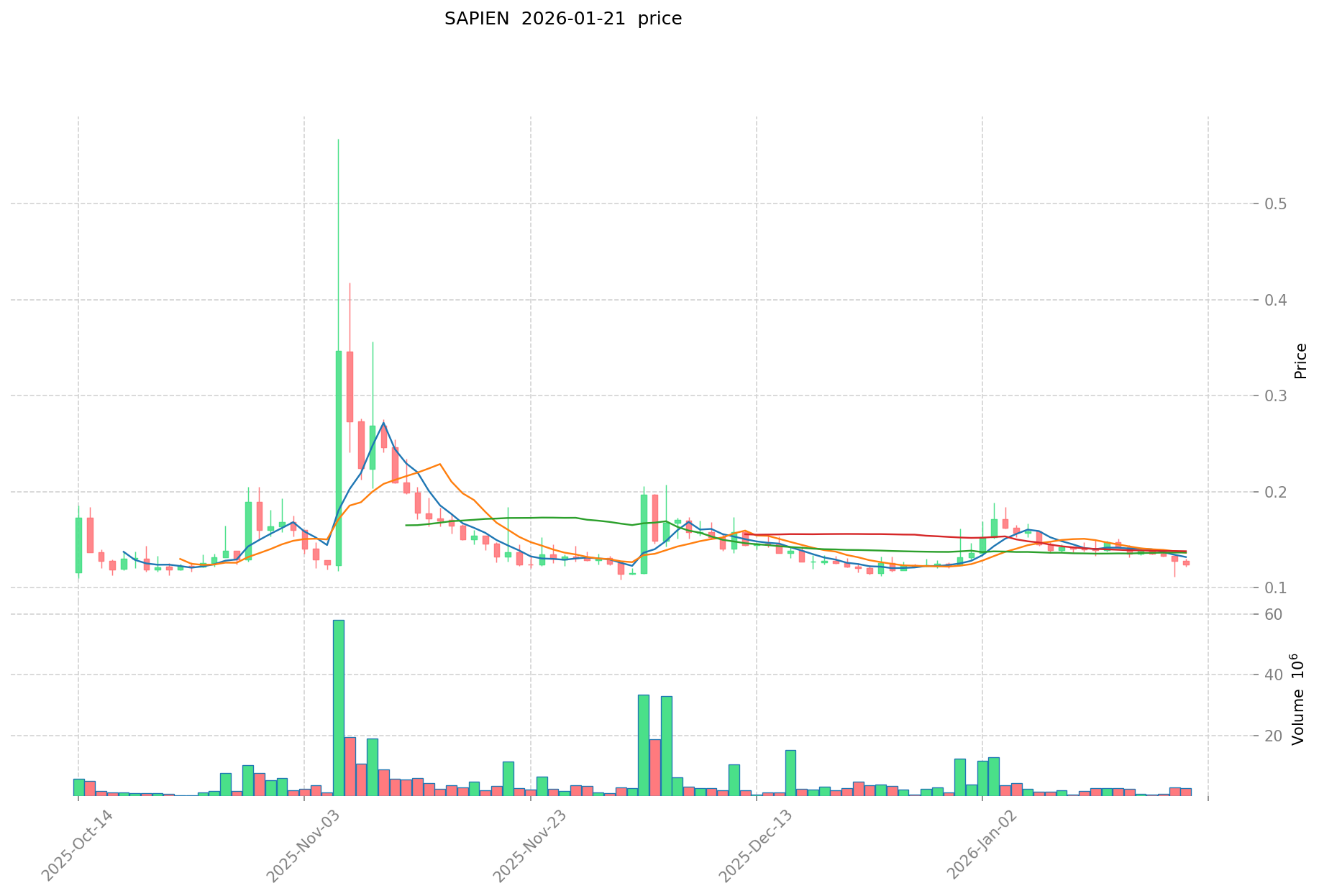
I. Sapien (SAPIEN) Price History Review and Investment Value Status
- 2025: Market debut and price fluctuation → From initial launch to early volatility phase
- October 2025: Price reached low levels → SAPIEN traded at approximately $0.03643
- November 2025: Upward momentum observed → Price climbed to around $0.56802
- Late 2025 to early 2026: Market correction → Price declined from higher levels to current range
Current SAPIEN Investment Market Status (January 2026)
- SAPIEN current price: $0.12653
- Market sentiment (Fear & Greed Index): Data not available in provided materials
- 24-hour trading volume: $347,508.67
- Institutional investor holdings: Data not available in provided materials
Click to view real-time SAPIEN market price
II. Core Factors Affecting Whether SAPIEN is a Good Investment (Is Sapien(SAPIEN) a Good Investment)
Supply Mechanism and Scarcity (SAPIEN investment scarcity)
- Fixed maximum supply mechanism → influences price and investment value
- SAPIEN implements a capped supply model with a maximum supply of 1,000,000,000 tokens, of which 250,000,000 tokens (25%) are currently in circulation. This defined supply structure creates a predictable scarcity framework that may influence long-term valuation dynamics.
- Investment significance: scarcity characteristics represent a key consideration for long-term investment evaluation
Institutional Investment and Mainstream Adoption (Institutional investment in SAPIEN)
- Network composition trends: The Sapien network comprises millions of contributors across more than 100 countries, including professionals from diverse fields such as doctors, engineers, artists, and students
- The protocol's focus on providing verified human knowledge for AI training data positions it within the growing intersection of blockchain technology and artificial intelligence development
- Token holders: As of the latest data, SAPIEN has 24,337 token holders, indicating a degree of community distribution
Macroeconomic Environment's Impact on SAPIEN Investment
- Monetary policy and interest rate changes → alter investment attractiveness across digital asset markets
- Inflation environment considerations → potential positioning within broader digital asset investment strategies
- Geopolitical uncertainty → may influence demand patterns for blockchain-based protocols
Technology and Ecosystem Development (Technology & Ecosystem for SAPIEN investment)
- Proof of Quality (PoQ) system: Sapien's onchain quality validation mechanism provides verification for AI training data, serving as a technical foundation for the protocol's value proposition
- Base blockchain deployment: As an ERC-20 token operating on Base, SAPIEN benefits from the infrastructure and ecosystem of this Layer 2 network
- Application scope: The protocol transforms fragmented online work into a reputation-based profession model, with incentive mechanisms powered by the SAPIEN token across its contributor network
- Ecosystem positioning: The protocol addresses enterprise and AI developer needs for trusted, human-in-the-loop data, potentially supporting long-term value development through practical utility
III. SAPIEN Future Investment Forecast and Price Outlook (Is Sapien(SAPIEN) worth investing in 2026-2031)
Short-term Investment Forecast (2026, short-term SAPIEN investment outlook)
- Conservative forecast: $0.1202 - $0.1265
- Neutral forecast: $0.1265 - $0.1505
- Optimistic forecast: $0.1505 - $0.1746
Mid-term Investment Outlook (2027-2028, mid-term Sapien(SAPIEN) investment forecast)
- Market stage expectations: During this period, SAPIEN may experience gradual growth as the protocol's adoption expands across its global contributor network. The emphasis on verified human knowledge and AI training data could attract increased enterprise interest.
- Investment return forecast:
- 2027: $0.1385 - $0.2122
- 2028: $0.1397 - $0.1995
- Key catalysts: Expansion of the Proof of Quality validation system, growth in the contributor base across 100+ countries, and increased demand for verified AI training data from enterprises and AI developers.
Long-term Investment Outlook (Is SAPIEN a good long-term investment?)
- Base scenario: $0.1681 - $0.2698 (assuming steady protocol adoption and sustained network growth)
- Optimistic scenario: $0.2366 - $0.2698 (assuming accelerated enterprise partnerships and expanded ecosystem development)
- Risk scenario: Below $0.1681 (under conditions of reduced market demand or competitive pressures)
View SAPIEN long-term investment and price forecast: Price Prediction
2026-01-21 - 2031 Long-term Outlook
- Base scenario: $0.1681 - $0.2085 (corresponding to steady progress and gradual mainstream application growth)
- Optimistic scenario: $0.2367 - $0.2698 (corresponding to large-scale adoption and favorable market conditions)
- Transformative scenario: Above $0.2698 (if ecosystem achieves breakthrough developments and mainstream penetration)
- 2031-12-31 predicted high: $0.2698 (based on optimistic development assumptions)
Disclaimer: The forecasts presented are analytical projections based on available market data and historical trends. Cryptocurrency markets involve substantial risk and volatility. These projections should not be construed as investment advice, and actual outcomes may differ materially from estimates provided.
| Year |
Predicted High Price |
Predicted Average Price |
Predicted Low Price |
Price Change |
| 2026 |
0.1745562 |
0.12649 |
0.1201655 |
0 |
| 2027 |
0.212237571 |
0.1505231 |
0.138481252 |
18 |
| 2028 |
0.19951836905 |
0.1813803355 |
0.139662858335 |
43 |
| 2029 |
0.22663472920725 |
0.190449352275 |
0.18092688466125 |
50 |
| 2030 |
0.264848391741228 |
0.208542040741125 |
0.20020035911148 |
64 |
| 2031 |
0.269832546514941 |
0.236695216241176 |
0.168053603531235 |
87 |
IV. Sapien Investment Strategy and Risk Management (How to invest in AI training data tokens)
Investment Methodology (Sapien investment strategy)
-
Long-term Holding (HODL Sapien): Suitable for conservative investors who believe in the long-term growth of decentralized AI training data infrastructure. This approach requires patience as the protocol expands its contributor network and establishes partnerships with AI developers and enterprises.
-
Active Trading: Relies on technical analysis and swing trading strategies. Given Sapien's relatively recent market entry (published January 2026) and price volatility patterns, active traders may seek opportunities during price fluctuations. The 24-hour trading volume of approximately $347,508 suggests moderate liquidity for tactical trading.
Risk Management (Risk management for Sapien investment)
V. Sapien Investment Risks and Challenges (Risks of investing in AI training data tokens)
-
Market Risks: High volatility characteristics are evident from Sapien's price movements. The token has experienced a 14.099% decline over 7 days and a 32.25% decline over the past year. With a relatively small market capitalization of approximately $31.6 million, the token may be susceptible to significant price swings.
-
Regulatory Risks: Policy uncertainty exists across different jurisdictions regarding cryptocurrency classification and AI data governance. The evolving regulatory landscape for decentralized work platforms and data sovereignty could impact Sapien's operational model.
-
Technical Risks: Network security vulnerabilities remain a concern for any blockchain protocol. The success of Sapien's onchain Proof of Quality system depends on continuous technical maintenance and potential protocol upgrades. Smart contract risks associated with the ERC-20 token on Base network require ongoing monitoring.
-
Market Concentration Risk: With only 25% of total supply currently in circulation (250 million out of 1 billion tokens), future token unlocks could create selling pressure. The fully diluted market cap of $126.5 million suggests significant potential dilution.
-
Liquidity Concerns: Trading across 29 exchanges with a 24-hour volume of approximately $347,508 indicates moderate but not exceptional liquidity, which may result in slippage during larger transactions.
VI. Conclusion: Is AI Training Data Infrastructure a Good Investment?
-
Investment Value Summary: Sapien demonstrates potential in addressing the growing demand for verified human-generated AI training data. The protocol's positioning within the expanding AI infrastructure sector and its reputation-based contributor model represent innovative approaches. However, the token faces significant short-term price volatility, as evidenced by recent performance metrics.
-
Investor Recommendations:
✅ Beginners: Consider dollar-cost averaging (DCA) strategy with small allocations. Prioritize secure wallet storage and thorough research into the project's development roadmap and contributor network growth.
✅ Experienced Investors: May explore swing trading opportunities during volatility periods while maintaining diversified portfolio allocation. Monitor on-chain metrics and protocol adoption indicators.
✅ Institutional Investors: Conduct comprehensive due diligence on the protocol's business model, partnerships with AI developers, and competitive positioning within the decentralized data marketplace before considering strategic allocation.
⚠️ Disclaimer: Cryptocurrency investments carry substantial risk. This content is for informational purposes only and does not constitute investment advice. Market conditions, technological developments, and regulatory changes can significantly impact investment outcomes.
VII. FAQ
Q1: What is Sapien (SAPIEN) and what makes it unique in the cryptocurrency market?
Sapien (SAPIEN) is an open protocol for sourcing verified human knowledge at scale, specifically designed to provide AI training data. The protocol operates on the Base blockchain as an ERC-20 token and connects millions of contributors across more than 100 countries through its onchain Proof of Quality (PoQ) validation system. What distinguishes Sapien from other cryptocurrencies is its focus on transforming fragmented online work into a reputation-based profession model, where contributors including doctors, engineers, artists, and students are incentivized with SAPIEN tokens for generating high-quality, verified data for AI development. This positions the protocol at the intersection of blockchain technology and artificial intelligence infrastructure development.
Q2: What is the current circulation status and tokenomics of SAPIEN?
As of January 21, 2026, SAPIEN has 250 million tokens in circulation, representing 25% of its maximum supply of 1 billion tokens. This creates a significant difference between the current market cap of approximately $31.63 million and the fully diluted market cap of $126.5 million. The token is held by 24,337 holders and trades across 29 exchanges with a 24-hour trading volume of approximately $347,508. The controlled release of tokens means that 75% of the total supply remains to be circulated, which investors should consider when evaluating potential future dilution effects on token price.
Q3: How has SAPIEN's price performed historically?
SAPIEN's price history shows significant volatility since its market debut in 2025. The token reached a low of approximately $0.03643 in October 2025, followed by a substantial rally to around $0.56802 in November 2025. Subsequently, the market experienced a correction, bringing the current price to approximately $0.12653 as of January 21, 2026. Recent performance metrics indicate a 14.099% decline over 7 days, a 1.95% increase over 30 days, and a 32.25% decline over the past year. This volatility pattern reflects both the early-stage nature of the protocol and broader market dynamics affecting cryptocurrency assets.
Q4: What are the primary risks associated with investing in SAPIEN?
Investing in SAPIEN carries several notable risks. Market risk is evident through the token's high volatility and relatively small market capitalization of $31.6 million, making it susceptible to significant price swings. Regulatory risk exists due to evolving policies around cryptocurrency classification and AI data governance across different jurisdictions. Technical risks include potential smart contract vulnerabilities on the Base network and the need for continuous maintenance of the Proof of Quality system. Market concentration risk is present with only 25% of tokens currently circulating, meaning future token unlocks could create selling pressure. Additionally, moderate liquidity levels with a 24-hour volume of approximately $347,508 may result in slippage during larger transactions.
Q5: What investment strategies are suitable for SAPIEN?
Investment strategies for SAPIEN vary based on investor profile and risk tolerance. For conservative investors, a long-term holding (HODL) strategy with 1-3% portfolio allocation is recommended, focusing on the protocol's potential growth as decentralized AI training data infrastructure expands. Experienced investors may consider active trading strategies that capitalize on price volatility, potentially allocating 5-10% of their crypto portfolio while implementing technical analysis and swing trading approaches. Dollar-cost averaging (DCA) is particularly suitable for beginners, allowing gradual position building while mitigating timing risk. Regardless of strategy, secure storage practices are essential, with hardware wallets recommended for long-term holdings and hot wallets only for active trading portions.
Q6: What factors could drive SAPIEN's future price growth?
Several catalysts could influence SAPIEN's future price trajectory. The expansion of the protocol's Proof of Quality validation system and growth of its contributor base across 100+ countries represent fundamental drivers. Increasing demand from enterprises and AI developers for verified, human-generated training data could expand the protocol's utility and adoption. The fixed supply mechanism with a maximum of 1 billion tokens creates a scarcity framework that may support long-term valuation. Additionally, the protocol's positioning within the growing AI infrastructure sector and potential partnerships with major AI development organizations could serve as positive catalysts. However, these potential drivers must be balanced against competitive pressures and broader cryptocurrency market conditions.
Q7: What is the long-term investment outlook for SAPIEN through 2031?
Long-term projections for SAPIEN suggest a range of potential outcomes based on different adoption scenarios. Under base assumptions of steady protocol adoption and sustained network growth, price forecasts range from $0.1681 to $0.2085 by 2031. An optimistic scenario, assuming accelerated enterprise partnerships and expanded ecosystem development, projects prices between $0.2367 and $0.2698. The transformative scenario, contingent on breakthrough developments and mainstream penetration, suggests potential prices above $0.2698, with the 2031 predicted high at $0.2698. These projections represent approximately 87% growth from current levels in the optimistic case. However, investors should note that cryptocurrency markets involve substantial risk, and actual outcomes may differ materially from these analytical projections.
Q8: How does SAPIEN's technology and ecosystem development support its investment value?
SAPIEN's technology foundation centers on its onchain Proof of Quality (PoQ) system, which validates AI training data and establishes the protocol's core value proposition. Operating as an ERC-20 token on the Base blockchain, SAPIEN benefits from Layer 2 infrastructure advantages including lower transaction costs and improved scalability. The protocol's ecosystem transforms fragmented online work into a structured, reputation-based profession model, with SAPIEN tokens serving as the incentive mechanism across the global contributor network. The protocol addresses specific market needs from enterprises and AI developers for trusted, human-in-the-loop data, positioning it within the expanding intersection of blockchain technology and artificial intelligence development. This practical utility framework may support long-term value development as AI training data demand continues to grow.
* The information is not intended to be and does not constitute financial advice or any other recommendation of any sort offered or endorsed by Gate.