This comprehensive analysis evaluates whether Saros (SAROS) represents a sound investment opportunity in 2024-2031. Trading at $0.002007 with a $5.27 million market cap on the Solana ecosystem, SAROS has evolved from a decentralized exchange into an integrated Web3 platform encompassing identity, DePIN, and payment solutions. The article examines historical price volatility, current market position across 18 exchanges, token supply dynamics with only 26.25% circulating, and growth forecasts ranging from conservative to optimistic scenarios through 2031. Key investment considerations include platform development execution, liquidity levels, regulatory uncertainties, and technical risks. The analysis provides strategic guidance for different investor profiles—from newcomers utilizing dollar-cost averaging to experienced traders—while emphasizing robust risk management, portfolio diversification, and secure storage solutions. Comprehensive risk assessment addresses market volatility, regulatory evolution, and So
Introduction: Saros (SAROS) Investment Position and Market Outlook
Saros (SAROS) represents an emerging asset within the cryptocurrency sector, having launched in January 2024 and positioning itself as a comprehensive Web3 application within the Solana ecosystem. As of January 29, 2026, SAROS maintains a market capitalization of approximately $5.27 million, with a circulating supply of around 2.62 billion tokens and a current trading price near $0.002007. The project initially launched as a decentralized exchange (DEX) and has evolved strategically to encompass integrated functionalities across identity, decentralized physical infrastructure networks (DePIN), and payment solutions within Solana's ecosystem. With 11,589 token holders and listing on 18 exchanges, SAROS has established a presence in the market, though it currently ranks at position 1506 by market capitalization with a 0.00063% market dominance. The token's performance trajectory shows notable volatility, including a 79.12% decline over the past year and a 37.71% decrease over the past 30 days, while demonstrating a 2.96% gain over the past week. This analysis examines SAROS's investment characteristics, historical price movements, future price outlook, and associated investment risks to provide informational context for those evaluating "Is Saros (SAROS) a good investment?"
I. Saros (SAROS) Price History Review and Investment Value Status
- 2024: SAROS experienced significant volatility during the year → Price dropped from higher levels to its historical low point of $0.001029 on August 5, 2024
- 2025: Market recovery phase → SAROS price rebounded from lows and reached $0.429 on September 14, 2025, representing a substantial increase from previous lows
- Recent Period: Market adjustment phase → Price declined from September 2025 peak levels to current trading range
Current SAROS Investment Market Status (January 2026)
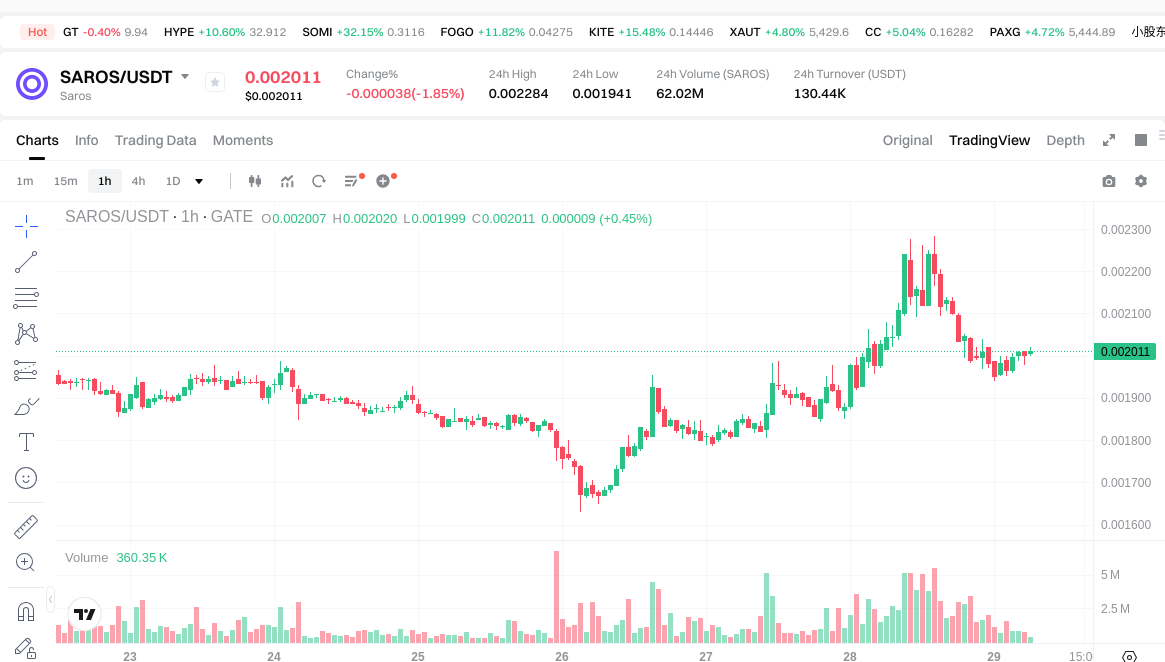
- SAROS current price: $0.002007
- Market capitalization: $5,268,374.65
- 24-hour trading volume: $130,864.27
- Circulating supply: 2,624,999,826 SAROS (26.25% of total supply)
- Price performance: +0.75% (1H), -0.09% (24H), +2.96% (7D), -37.71% (30D), -79.12% (1Y)
Click to view real-time SAROS market price
II. Core Factors Affecting Whether SAROS is a Good Investment
Supply Mechanism and Scarcity (SAROS Investment Scarcity)
- Total supply is capped at 10,000,000,000 tokens with a maximum supply of 10,000,000,000 tokens, while circulating supply stands at 2,624,999,826 tokens (26.25% of total supply)
- Market capitalization to fully diluted valuation ratio stands at 26.25%, indicating significant potential supply yet to enter circulation
- Investment significance: The controlled token release mechanism and relatively low circulating supply ratio may influence long-term price dynamics as additional tokens become available
Institutional Investment and Mainstream Adoption (Institutional Investment in SAROS)
- The token is currently available on 18 exchanges, with 11,589 holders as of January 29, 2026
- Trading volume reached $130,864.27 over the 24-hour period, indicating moderate market participation
- Market dominance stands at 0.00063%, reflecting its position as an emerging asset within the broader crypto market
Macroeconomic Environment Impact on SAROS Investment
- Broader economic factors including monetary policy adjustments and interest rate changes may influence investor appetite for digital assets
- Market volatility remains evident, with 24-hour price ranging from $0.001941 to $0.002284
- Price performance shows varied trends across timeframes: 1-hour change of +0.75%, 24-hour change of -0.09%, 7-day change of +2.96%, 30-day change of -37.71%, and 1-year change of -79.12%
Technology and Ecosystem Development (Technology & Ecosystem for SAROS Investment)
- Saros operates as a comprehensive application on the Solana blockchain, initially launched as a DEX and evolving into an integrated mobile consumer application
- The project encompasses functionalities in ID, DePIN, and Payment areas within the Solana ecosystem
- Contract address: SarosY6Vscao718M4A778z4CGtvcwcGef5M9MEH1LGL on the Solana network
- The platform aims to provide users with an integrated Web3 experience, potentially expanding use cases across decentralized finance and payment applications
III. SAROS Future Investment Forecast and Price Outlook (Is Saros(SAROS) worth investing in 2026-2031)
Short-term Investment Forecast (2026, short-term SAROS investment outlook)
- Conservative forecast: $0.001272 - $0.002019
- Neutral forecast: $0.002019 - $0.002766
- Optimistic forecast: $0.002766 - $0.003254
Mid-term Investment Outlook (2027-2029, mid-term Saros(SAROS) investment forecast)
- Market stage expectation: Based on available prediction models, SAROS may experience gradual growth during the mid-term period, with potential year-over-year increases ranging from 19% to 53%.
- Investment return forecast:
- 2027: $0.001292 - $0.003254
- 2028: $0.002343 - $0.003331
- 2029: $0.002708 - $0.003939
- Key catalysts: Market adoption rates, Solana network health, protocol development progress, and token supply dynamics may influence mid-term performance.
Long-term Investment Outlook (Is SAROS a good long-term investment?)
- Base scenario: $0.002175 - $0.003964 (assuming steady ecosystem development and moderate market conditions through 2030)
- Optimistic scenario: $0.003736 - $0.005529 (assuming enhanced adoption and favorable market environment through 2031)
- Risk scenario: Below $0.002054 (under adverse market conditions or significant challenges)
For detailed SAROS long-term investment and price forecasts: Price Prediction
2026-2031 Long-term Outlook
- Base scenario: $0.002019 - $0.003964 USD (corresponding to steady progress and gradual mainstream application growth)
- Optimistic scenario: $0.003736 - $0.005529 USD (corresponding to large-scale adoption and favorable market environment)
- Transformative scenario: Above $0.005529 USD (if ecosystem achieves breakthrough developments and mainstream popularization)
- 2031-12-31 predicted high: $0.005529 USD (based on optimistic development assumptions)
Disclaimer: The above predictions are based on historical data analysis and market forecasting models. Cryptocurrency markets are highly volatile and subject to numerous unpredictable factors. These forecasts should not be considered as investment advice. Investors should conduct their own research and assess their risk tolerance before making any investment decisions.
| Year |
Predicted High Price |
Predicted Average Price |
Predicted Low Price |
Price Change |
| 2026 |
0.00276603 |
0.002019 |
0.00127197 |
0 |
| 2027 |
0.0032538204 |
0.002392515 |
0.0012919581 |
19 |
| 2028 |
0.003331337886 |
0.0028231677 |
0.002343229191 |
40 |
| 2029 |
0.00393888357504 |
0.003077252793 |
0.00270798245784 |
53 |
| 2030 |
0.003964117047942 |
0.00350806818402 |
0.002175002274092 |
74 |
| 2031 |
0.005529417071652 |
0.003736092615981 |
0.002054850938789 |
86 |
IV. Saros Investment Strategy and Risk Management (How to invest in Saros)
Investment Methodology (Saros investment strategy)
Investors may consider different approaches when participating in the Saros market:
-
Long-term Holding (HODL Saros): This approach may be suitable for investors seeking exposure to the Solana ecosystem's ID, DePIN, and payment functionalities over an extended period. Given the project's strategic evolution from a DEX to a comprehensive mobile consumer application, long-term holders may evaluate the platform's development roadmap and adoption metrics.
-
Active Trading: Traders utilizing technical analysis might reference price movements within established ranges. As of January 29, 2026, SAROS is trading at approximately $0.002007, with a 24-hour range between $0.001941 and $0.002284. The token has experienced varied short-term performance, including a 0.75% increase over 1 hour and a 2.96% gain over 7 days, contrasted with a 37.71% decline over 30 days.
Risk Management (Risk management for Saros investment)
-
Asset Allocation Ratio: Investment positioning may vary according to risk tolerance:
- Conservative investors might limit exposure to emerging tokens like SAROS to a small percentage of their cryptocurrency portfolio
- Moderate investors may allocate a measured portion while maintaining diversification across established assets
- Experienced investors with higher risk tolerance might consider larger positions while implementing stop-loss mechanisms
-
Risk Hedging Approaches: Potential strategies include maintaining a diversified portfolio across multiple blockchain ecosystems and asset classes, rather than concentrating holdings in a single token
-
Secure Storage: Given the token operates on the Solana blockchain (contract address: SarosY6Vscao718M4A778z4CGtvcwcGef5M9MEH1LGL), investors should consider:
- Cold wallet solutions for long-term holdings
- Hardware wallets compatible with Solana's SPL token standard
- Hot wallets from reputable providers for active trading purposes
V. Saros Investment Risks and Challenges (Risks of investing in Saros)
Market Risk
-
Price Volatility: SAROS has demonstrated substantial price fluctuations. The token's price history shows a range from a low of $0.001029 (August 5, 2024) to a peak of $0.429 (September 14, 2025), representing significant volatility. The year-over-year decline of 79.12% illustrates the potential for considerable value fluctuation.
-
Liquidity Considerations: With a 24-hour trading volume of approximately $130,864 and a market capitalization of around $5.27 million as of January 29, 2026, liquidity levels may affect trade execution and price stability.
Regulatory Risk
-
Jurisdictional Uncertainty: Cryptocurrency regulations vary substantially across different jurisdictions and continue to evolve. Saros operates within the Solana ecosystem, which may face different regulatory scrutiny depending on classification of its DePIN, ID, and payment functionalities.
-
Compliance Landscape: As the project expands its scope to include identification and payment services, it may encounter regulatory requirements specific to financial services and data privacy in various markets.
Technical Risk
-
Smart Contract Vulnerabilities: As with all blockchain-based projects, the underlying smart contracts carry inherent risks related to potential security vulnerabilities or exploits.
-
Platform Evolution Risk: Saros is transitioning from its initial DEX launch to a comprehensive product offering. The successful implementation of additional functionalities in ID, DePIN, and payment areas remains subject to technical execution and market acceptance.
-
Blockchain Dependency: The project's performance is tied to the Solana network's stability, scalability, and ongoing development.
VI. Conclusion: Is Saros a Good Investment?
Investment Value Summary
Saros presents a developing proposition within the Solana ecosystem, focusing on integrating multiple functionalities including decentralized exchange, identification, DePIN, and payment services. The project's strategic evolution from a single-product DEX to a comprehensive mobile consumer application represents an ambitious development trajectory.
However, several factors warrant consideration:
- The token's market capitalization represents approximately 26.25% of its fully diluted valuation, with a circulating supply of 2.625 billion out of a maximum supply of 10 billion tokens
- Price performance has shown considerable variation, with a 79.12% decline over one year from current levels
- The project operates in a competitive space with approximately 11,589 holders as of the referenced data
Investor Considerations
✅ For Newcomers: Consider starting with modest allocations and utilizing dollar-cost averaging approaches rather than lump-sum investments. Prioritize secure storage solutions compatible with Solana's SPL token standard.
✅ For Experienced Investors: May evaluate technical indicators within the context of broader Solana ecosystem developments. Consider portfolio weighting relative to other holdings and maintain disciplined position sizing.
✅ For Institutional Participants: Conduct thorough due diligence on the project's development milestones, team execution capabilities, and competitive positioning within the Solana DeFi landscape before considering allocation.
⚠️ Important Notice: Cryptocurrency investments carry substantial risk, including the potential for total loss of capital. This content is provided for informational purposes only and does not constitute investment advice, financial guidance, or a recommendation to buy, sell, or hold any digital asset. Readers should conduct independent research and consult with qualified financial advisors before making investment decisions.
VII. FAQ
Q1: What is Saros (SAROS) and what makes it different from other Solana-based projects?
Saros is a comprehensive Web3 application on the Solana blockchain that has evolved from its initial launch as a decentralized exchange (DEX) in January 2024 into an integrated mobile consumer platform. Unlike traditional single-function DeFi protocols, Saros aims to provide a unified ecosystem encompassing multiple functionalities including identity management (ID), decentralized physical infrastructure networks (DePIN), and payment solutions. The project operates through its smart contract at address SarosY6Vscao718M4A778z4CGtvcwcGef5M9MEH1LGL on the Solana network, positioning itself as an all-in-one platform for users seeking integrated Web3 experiences rather than navigating separate applications for different services.
Q2: How has SAROS performed historically and what is its current market position?
SAROS has experienced significant price volatility since its launch. The token reached a historical low of $0.001029 on August 5, 2024, and subsequently climbed to $0.429 on September 14, 2025, before declining to its current trading level of approximately $0.002007 as of January 29, 2026. This represents a 79.12% decrease over the past year and a 37.71% decline over 30 days, though it showed a modest 2.96% gain over the past week. The project currently maintains a market capitalization of approximately $5.27 million, ranks at position 1506 by market cap, and holds a 0.00063% market dominance with 11,589 token holders across 18 exchanges.
Q3: What is the token supply structure of SAROS and how might it affect future price dynamics?
SAROS has a maximum supply of 10,000,000,000 tokens, with a current circulating supply of 2,624,999,826 tokens, representing only 26.25% of the total supply. This relatively low circulation ratio indicates that a significant portion of tokens (approximately 73.75%) has yet to enter the market. The market capitalization to fully diluted valuation ratio stands at 26.25%, suggesting potential dilution pressure as additional tokens become available over time. This controlled token release mechanism may influence long-term price dynamics, as the gradual introduction of remaining supply could affect scarcity dynamics and investor sentiment regarding value accrual.
Q4: What are the main risks associated with investing in SAROS?
Investing in SAROS carries several notable risks. Market risk is significant, evidenced by the token's substantial price volatility ranging from $0.001029 to $0.429 within a relatively short period, along with a 79.12% year-over-year decline. Liquidity concerns arise from its modest 24-hour trading volume of approximately $130,864 and limited market capitalization of $5.27 million, which may impact trade execution and price stability. Technical risks include potential smart contract vulnerabilities, the challenges of successfully transitioning from a single DEX product to a multi-functional platform, and dependency on Solana network stability. Regulatory uncertainty also exists, particularly as the project expands into identification and payment services that may face financial services and data privacy regulations across different jurisdictions.
Q5: What are the price predictions for SAROS in the near and long term?
Based on available forecasting models, SAROS price projections show varied scenarios across different timeframes. For 2026, short-term forecasts range from a conservative estimate of $0.001272-$0.002019 to an optimistic projection of $0.002766-$0.003254. Mid-term predictions for 2027-2029 suggest potential year-over-year growth ranging from 19% to 53%, with 2029 forecasts spanning $0.002708-$0.003939. Long-term projections through 2031 present a base scenario of $0.002175-$0.003964 and an optimistic scenario of $0.003736-$0.005529, assuming favorable ecosystem development and market conditions. However, these predictions are derived from historical data analysis and modeling, and given cryptocurrency market volatility and unpredictable factors, they should be considered informational rather than definitive investment guidance.
Q6: How can investors approach SAROS investment strategies and risk management?
Investors may consider different approaches based on their objectives and risk tolerance. Long-term holding (HODL) strategies may suit those seeking extended exposure to Solana ecosystem developments, particularly in ID, DePIN, and payment functionalities, while evaluating the project's evolution from DEX to comprehensive platform. Active traders might utilize technical analysis within established price ranges, noting recent performance metrics including the $0.001941-$0.002284 24-hour range. For risk management, conservative investors might limit SAROS exposure to a small percentage of their cryptocurrency portfolio, while more experienced investors could consider larger positions with stop-loss mechanisms and portfolio diversification across multiple blockchain ecosystems. Secure storage is essential, with cold wallets or hardware wallets compatible with Solana's SPL token standard recommended for long-term holdings, and reputable hot wallets for active trading purposes.
* The information is not intended to be and does not constitute financial advice or any other recommendation of any sort offered or endorsed by Gate.