This comprehensive analysis evaluates whether Seamless Protocol (SEAM) represents a viable investment opportunity, examining the governance token of Base's first native decentralized lending protocol. With a current market capitalization of $5.94 million and price of $0.1289, SEAM demonstrates mixed signals with recent 30-day gains of 10.63% against a 1-year decline of -80.69%. The article dissects core investment factors including scarcity mechanisms, institutional backing from Aave and Uniswap contributors, technological innovations in lower-collateral borrowing, and macroeconomic influences on DeFi adoption. Price projections range from $0.1292-$0.1809 for 2026 (neutral scenario) to $0.2065-$0.2581 by 2031 (optimistic scenario), contingent upon Base ecosystem expansion and protocol development. Investors must carefully balance governance token utility, liquidity constraints, regulatory uncertainty, and early-stage protocol risks through appropriate position sizing and diversification strategies.
Introduction: Seamless Protocol (SEAM) Investment Position and Market Outlook
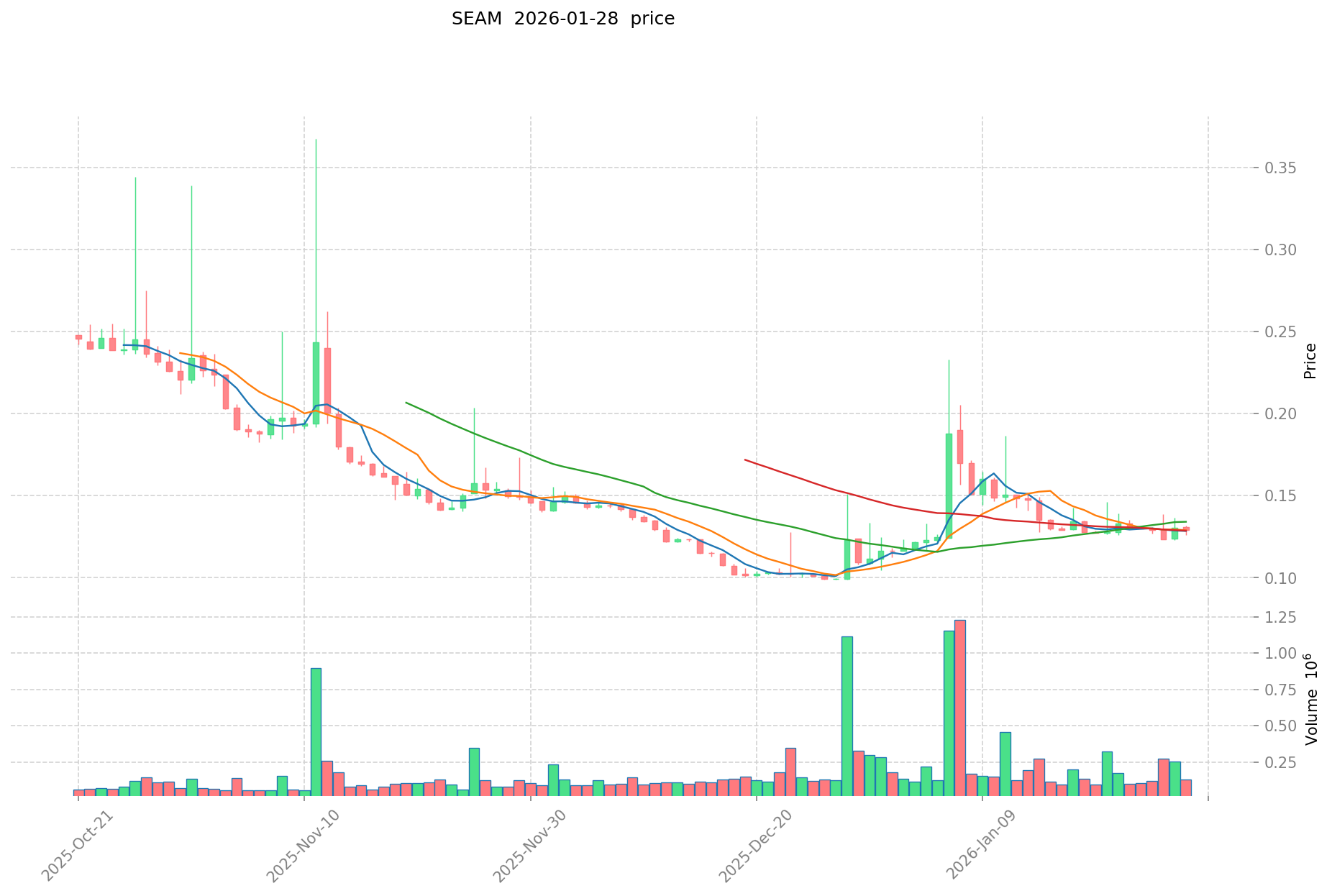
SEAM is a notable asset in the cryptocurrency sector. As the utility governance token of Seamless Protocol, the first native decentralized lending and borrowing protocol on Base, SEAM has established its presence in the DeFi ecosystem. As of January 28, 2026, SEAM holds a market capitalization of approximately $5.94 million, with a circulating supply of around 46.09 million tokens out of a total supply of 100 million. The current price stands at approximately $0.1289, representing a 1.97% increase over the past 24 hours. With its positioning as a governance token for a lower-collateral borrowing protocol aimed at improving user experience, SEAM has become a subject of interest among investors exploring "Is Seamless Protocol (SEAM) a good investment?" This article provides a comprehensive analysis of SEAM's investment value, historical performance, future price projections, and associated investment risks to offer reference for potential investors.
I. Seamless Protocol (SEAM) Price History Review and Current Investment Value
- 2023: Protocol launch and token debut → Initial price established at $12.50 with significant early volatility
- December 2023: Market peak phase → SEAM reached notable price levels during initial trading period
- 2024-2025: Market adjustment cycle → Price experienced substantial correction as DeFi sector faced broader headwinds
- December 2025: Price consolidation phase → Trading stabilized in lower price ranges following extended downward pressure
Current SEAM Investment Market Status (January 2026)
- Current SEAM price: $0.1289
- Market capitalization: $5,940,827.77
- 24-hour trading volume: $16,118.01
- Circulating supply: 46,088,656.12 SEAM (46.09% of total supply)
- Trading availability: Listed on 5 exchanges with Gate.com support
- Holder distribution: Approximately 1,600 addresses holding SEAM tokens
Click to view real-time SEAM market price
II. Core Factors Affecting Whether SEAM is a Good Investment (Is Seamless Protocol(SEAM) a Good Investment)
Supply Mechanism and Scarcity (SEAM investment scarcity)
- Supply structure influences price and investment value
- SEAM has a maximum supply of 100,000,000 tokens with a current circulating supply of approximately 46,088,656 tokens (46.09% of total supply)
- The fixed maximum supply cap provides a degree of scarcity that may support long-term investment considerations
- Investment significance: Scarcity characteristics, combined with circulating supply constraints, form part of the long-term investment evaluation framework
Institutional Investment and Mainstream Adoption (Institutional investment in SEAM)
- Project contributors have backgrounds from established web3 entities including Aave, Uniswap, CertiK, Maple Finance, and Coinbase
- SEAM serves as the utility governance token for Seamless Protocol, the first native decentralized lending and borrowing protocol on Base
- The protocol's focus on lower-collateral borrowing and improved user experience positions it within the modern DeFi ecosystem
- Market presence: SEAM is listed on 5 exchanges with approximately 1,600 holders
Macroeconomic Environment's Impact on SEAM Investment
- Monetary policy shifts and interest rate changes may alter the attractiveness of DeFi lending protocols and their associated tokens
- Broader cryptocurrency market sentiment and regulatory developments could influence SEAM's investment outlook
- Market volatility and liquidity conditions in the crypto sector may affect SEAM's price dynamics and investment risk profile
Technology and Ecosystem Development (Technology & Ecosystem for SEAM investment)
- Seamless Protocol operates as a native decentralized lending platform on Base, providing core DeFi functionality
- The protocol's emphasis on lower-collateral borrowing mechanisms represents a technical approach to expanding DeFi accessibility
- SEAM's utility governance function connects token value to protocol governance participation and ecosystem development
- Integration within the Base ecosystem and potential DeFi application expansion may provide long-term value support considerations
III. SEAM Future Investment Prediction and Price Outlook (Is Seamless Protocol(SEAM) worth investing in 2026-2031)
Short-term Investment Outlook (2026, short-term SEAM investment outlook)
- Conservative Forecast: $0.0749 - $0.1293
- Neutral Forecast: $0.1292 - $0.1809
- Optimistic Forecast: $0.1500 - $0.1809
Mid-term Investment Outlook (2027-2029, mid-term Seamless Protocol(SEAM) investment forecast)
- Market Stage Expectation: The token may experience moderate growth driven by DeFi adoption on Base network and protocol development milestones
- Investment Return Forecast:
- 2027: $0.1333 - $0.1721
- 2028: $0.1096 - $0.1979
- 2029: $0.1609 - $0.1880
- Key Catalysts: Protocol upgrades, expansion of lending services, Base ecosystem growth, and regulatory clarity in DeFi sector
Long-term Investment Outlook (Is SEAM a good long-term investment?)
- Base Scenario: $0.1548 - $0.2581 (assuming steady protocol development and moderate DeFi market expansion)
- Optimistic Scenario: $0.2064 - $0.2581 (assuming accelerated Base ecosystem adoption and significant protocol growth)
- Risk Scenario: Below $0.1548 (under adverse market conditions or significant competitive pressure)
Click to view SEAM long-term investment and price prediction: Price Prediction
2026-01-28 to 2031 Long-term Outlook
- Base Scenario: $0.1548 - $0.2065 (corresponding to steady progress and gradual mainstream application adoption)
- Optimistic Scenario: $0.2065 - $0.2581 (corresponding to large-scale adoption and favorable market conditions)
- Transformative Scenario: Above $0.2581 (if the ecosystem achieves breakthrough developments and mainstream popularization)
- 2031-12-31 Predicted High: $0.2581 (based on optimistic development assumptions)
Disclaimer: The above predictions are based on historical data analysis and market trend assessments. Cryptocurrency markets are highly volatile and unpredictable. These forecasts do not constitute financial advice, and actual prices may differ significantly from predictions. Investors should conduct thorough research and consider their risk tolerance before making investment decisions.
| Year |
Predicted High Price |
Predicted Average Price |
Predicted Low Price |
Price Change |
| 2026 |
0.18088 |
0.1292 |
0.074936 |
0 |
| 2027 |
0.1720944 |
0.15504 |
0.1333344 |
20 |
| 2028 |
0.197916312 |
0.1635672 |
0.109590024 |
26 |
| 2029 |
0.18797142624 |
0.180741756 |
0.16086016284 |
39 |
| 2030 |
0.2286021729888 |
0.18435659112 |
0.1696080638304 |
42 |
| 2031 |
0.258099227568 |
0.2064793820544 |
0.1548595365408 |
59 |
IV. SEAM Investment Strategy and Risk Management (How to invest in Seamless Protocol)
Investment Methodology (SEAM investment strategy)
Long-term Holding (HODL SEAM): Suitable for Conservative Investors
Long-term holding of SEAM may appeal to investors who believe in the fundamental value proposition of decentralized lending protocols on Base. This approach requires patience and conviction in the protocol's ability to capture market share within the DeFi lending space. Given SEAM's role as a governance token, long-term holders can participate in protocol decision-making while potentially benefiting from protocol growth over extended periods.
Active Trading: Technical Analysis and Swing Operations
Active traders may find opportunities in SEAM's price movements, considering its 24-hour trading volume of approximately $16,118 and price fluctuations between $0.126 and $0.1316 within the last day. Technical analysis can incorporate volatility patterns, with recent data showing a 1.97% increase over 24 hours but a -2.27% decline over 7 days. Traders should note the significant gap between current price ($0.1289) and the token's price range history, which requires careful position sizing and stop-loss management.
Risk Management (Risk management for SEAM investment)
Asset Allocation Ratio: Conservative / Aggressive / Professional Investors
- Conservative Investors: Given SEAM's market position (ranked #1445) and market share of 0.00040%, conservative portfolios might limit exposure to 1-3% of total crypto holdings, treating it as a speculative position within the DeFi sector.
- Aggressive Investors: Those with higher risk tolerance and conviction in Base-native protocols might allocate 5-10% of their DeFi portfolio to SEAM, while maintaining diversification across other lending protocols.
- Professional Investors: Institutional participants may approach SEAM as part of a broader DeFi infrastructure thesis, potentially incorporating hedging strategies and maintaining flexible position sizes based on protocol metrics and market conditions.
Risk Hedging Solutions: Multi-Asset Portfolio + Risk Mitigation Tools
Investors can implement several hedging approaches:
- Diversification across multiple DeFi lending protocols to reduce protocol-specific risk
- Balancing SEAM exposure with blue-chip cryptocurrencies to offset volatility
- Utilizing stablecoin positions to maintain liquidity for rebalancing opportunities
- Monitoring on-chain metrics such as Total Value Locked (TVL) and protocol utilization rates
Secure Storage: Cold and Hot Wallets + Hardware Wallet Recommendations
SEAM tokens operate on the Ethereum network (contract address: 0x6b66ccd1340c479B07B390d326eaDCbb84E726Ba) and can be stored using:
- Hardware Wallets: Ledger and Trezor devices provide secure cold storage for long-term holdings
- Hot Wallets: MetaMask and other Web3 wallets enable interaction with Seamless Protocol's lending platform while maintaining reasonable security for active positions
- Security Practices: Users should verify contract addresses, enable multi-signature features when available, and maintain separate wallets for trading versus long-term storage
V. SEAM Investment Risks and Challenges (Risks of investing in Seamless Protocol)
Market Risk: High Volatility and Price Dynamics
SEAM demonstrates substantial price volatility characteristics common to governance tokens of emerging DeFi protocols. The token's 1-year performance shows an -80.69% change, while recent 30-day data indicates a 10.63% increase, illustrating significant short-term fluctuation potential. With a circulating supply of approximately 46.09 million tokens (46.09% of max supply) and a market capitalization around $5.94 million, the token may experience liquidity-related price swings. The relatively modest 24-hour trading volume compared to market cap suggests limited liquidity that could amplify price movements during periods of increased trading activity.
Regulatory Risk: Policy Uncertainty Across Jurisdictions
As a DeFi lending protocol token, SEAM faces evolving regulatory frameworks affecting decentralized finance:
- Lending protocol regulations vary significantly across jurisdictions, with ongoing discussions about DeFi oversight in major markets
- Governance token classification remains subject to regulatory interpretation in different countries
- Base network's regulatory positioning and its relationship with traditional finance infrastructure may influence protocol operations
- Changes in crypto lending regulations could impact protocol functionality and token utility
Technical Risk: Network Security and Protocol Vulnerabilities
Several technical considerations warrant investor attention:
- Smart Contract Risk: Despite contributor backgrounds from established protocols like Aave and Uniswap, smart contract vulnerabilities could affect protocol operations and token value
- Base Network Dependency: As a Base-native protocol, SEAM's functionality depends on the Base network's performance and security
- Protocol Competition: The DeFi lending space includes established competitors, and technical innovation or failures could significantly impact market positioning
- Integration Risk: Protocol upgrades or modifications to lending mechanisms may introduce unforeseen technical challenges
VI. Conclusion: Is Seamless Protocol a Good Investment?
Investment Value Summary
SEAM represents exposure to an emerging DeFi lending protocol on the Base network, with a governance token structure that enables holder participation in protocol decisions. The project's focus on lower-collateral borrowing and user experience improvements addresses recognized pain points in DeFi lending. However, investors should weigh the protocol's early-stage position (ranked #1445 with 0.00040% market share) against the established competition in decentralized lending. Price performance shows mixed signals, with recent 30-day gains (+10.63%) contrasted by significant 1-year decline (-80.69%), reflecting both recovery potential and substantial historical drawdown.
Investor Recommendations
✅ Beginners: Approach SEAM with caution, allocating only small portions of a diversified portfolio. Consider dollar-cost averaging to mitigate timing risk, and prioritize secure storage solutions like hardware wallets. Focus on understanding DeFi lending mechanics before significant capital commitment.
✅ Experienced Investors: May consider tactical positions based on Base ecosystem development and DeFi lending sector trends. Active monitoring of protocol TVL, user growth, and competitive positioning can inform swing trading opportunities. Maintain position sizing discipline given liquidity constraints and volatility patterns.
✅ Institutional Investors: Could evaluate SEAM within a thematic DeFi infrastructure allocation, particularly for exposure to Base-native protocols. Due diligence should encompass protocol audits, team backgrounds, and competitive moat analysis. Consider staged entry strategies and ongoing governance participation to maximize information advantages.
⚠️ Disclaimer: Cryptocurrency investments carry substantial risk, including potential total loss of capital. This analysis is for informational purposes only and does not constitute financial advice. Investors should conduct independent research and consult qualified financial advisors before making investment decisions. Market conditions, regulatory landscapes, and protocol fundamentals can change rapidly, affecting investment outcomes.
VII. FAQ
Q1: What is the primary use case of SEAM tokens?
SEAM serves as the utility governance token for Seamless Protocol, the first native decentralized lending and borrowing protocol on Base. As a governance token, SEAM enables holders to participate in protocol decision-making processes, including votes on protocol upgrades, parameter adjustments, and strategic directions. The token's utility is directly tied to the protocol's focus on lower-collateral borrowing mechanisms, which aim to improve user experience in DeFi lending compared to traditional over-collateralization models. With approximately 1,600 holders and integration within the Base ecosystem, SEAM represents both governance rights and exposure to the protocol's development trajectory.
Q2: How does SEAM's circulating supply impact its investment potential?
SEAM currently has approximately 46.09 million tokens in circulation, representing 46.09% of its maximum supply of 100 million tokens. This means that approximately 53.91% of the total supply remains unlocked, which could impact future price dynamics as additional tokens enter circulation. The fixed maximum supply cap provides a degree of scarcity that may support long-term value considerations, though investors should monitor token release schedules and vesting timelines. The relatively low circulating percentage compared to maximum supply suggests potential dilution risks if the remaining tokens are released rapidly, which could pressure prices despite any demand growth from protocol adoption.
Q3: What are the main risks associated with investing in SEAM?
SEAM investment carries several significant risk categories: Market Risk includes high volatility evidenced by an -80.69% one-year decline despite recent 30-day gains of 10.63%, plus limited liquidity with only $16,118 in 24-hour trading volume; Regulatory Risk encompasses evolving DeFi lending regulations across jurisdictions and uncertainty around governance token classification; Technical Risk involves smart contract vulnerabilities, dependency on Base network security, and competition from established lending protocols like Aave and Compound; Protocol Risk includes the early-stage nature of Seamless Protocol (ranked #1445 with 0.00040% market share) and uncertainty around achieving sufficient Total Value Locked to sustain operations. The combination of these factors requires careful risk assessment and appropriate position sizing.
Q4: How does SEAM compare to other DeFi lending protocol tokens?
SEAM distinguishes itself as a Base-native protocol focusing on lower-collateral borrowing, contrasting with established multi-chain protocols like Aave or Compound. While competitor protocols benefit from years of operational history, larger TVLs, and established user bases, SEAM's Base network positioning offers potential advantages in terms of transaction costs and ecosystem integration. However, this specialization also creates concentration risk tied to Base's adoption trajectory. The token's current market capitalization of approximately $5.94 million represents a fraction of leading DeFi governance tokens, reflecting both higher risk and potentially higher growth potential if the protocol captures market share. Contributors' backgrounds from Aave, Uniswap, and other established protocols provide credibility, though execution risk remains substantial for this early-stage project.
Q5: What investment strategy is most suitable for SEAM given current market conditions?
Investment strategy selection depends on risk tolerance and market outlook. Conservative investors should limit SEAM exposure to 1-3% of crypto portfolios, treating it as a speculative DeFi position with emphasis on long-term holding and governance participation. Dollar-cost averaging can mitigate entry timing risk given historical volatility. Active traders may pursue swing strategies based on technical analysis, though limited liquidity ($16,118 daily volume) requires careful position sizing and tight stop-loss discipline. Diversification across multiple DeFi lending protocols reduces protocol-specific risk, while maintaining stablecoin positions enables rebalancing flexibility. Investors should prioritize secure storage using hardware wallets (Ledger/Trezor) and monitor on-chain metrics including protocol TVL, user growth, and Base ecosystem developments to inform position adjustments.
Q6: What factors could drive SEAM price appreciation in 2026-2027?
Several catalysts could support SEAM value growth: Protocol adoption through increased Total Value Locked and user base expansion would demonstrate market validation of the lower-collateral lending model; Base ecosystem growth could drive demand for Base-native DeFi services including Seamless Protocol; Technical developments such as protocol upgrades, new lending features, or improved capital efficiency mechanisms might enhance competitive positioning; Partnership announcements with established DeFi projects or integration with major Base applications could expand utility; Regulatory clarity providing legal certainty for DeFi lending could reduce uncertainty premiums; Token unlock schedules and supply dynamics will influence scarcity perceptions; Broader crypto market conditions including Bitcoin cycles and institutional adoption trends will affect risk appetite for smaller-cap DeFi tokens. Price forecasts suggest potential ranges of $0.1292-$0.1809 for 2026 and $0.1333-$0.1721 for 2027 under neutral scenarios.
Q7: How should investors evaluate whether SEAM fits their portfolio?
Portfolio fit assessment requires multi-dimensional analysis: Risk tolerance evaluation should consider whether the investor can sustain potential losses given SEAM's historical -80.69% drawdown; Investment horizon matters significantly—short-term traders face liquidity constraints while long-term holders bet on protocol development over years; DeFi exposure goals determine whether Base-native lending exposure aligns with broader crypto portfolio objectives; Diversification needs suggest limiting single protocol governance token positions to avoid concentration risk; Technical expertise influences ability to monitor protocol health metrics and participate meaningfully in governance; Liquidity requirements must account for limited trading volume that could impede position exits; Conviction level in Base ecosystem growth and lower-collateralization lending models should guide position sizing. Investors meeting criteria of moderate-to-high risk tolerance, multi-year horizons, and conviction in DeFi infrastructure may find SEAM suitable for small allocations (1-5% of crypto portfolios), while conservative investors should approach cautiously or avoid entirely.
Q8: What on-chain metrics should investors monitor for SEAM?
Critical metrics for ongoing investment evaluation include: Total Value Locked (TVL) in Seamless Protocol indicates user confidence and capital deployment, with growth signaling adoption traction; Active borrowers and lenders track actual protocol usage beyond speculative token trading; Utilization rates measure what percentage of supplied capital is actively borrowed, reflecting protocol efficiency; Token holder distribution changes reveal accumulation or distribution patterns among addresses; Governance participation rates show community engagement levels and token utility realization; Collateralization ratios demonstrate whether the lower-collateral model achieves its design goals; Bad debt accumulation or liquidation efficiency metrics indicate protocol risk management effectiveness; Base network activity provides context for ecosystem growth supporting protocol adoption; Exchange listings and liquidity affect price discovery and exit opportunity quality. Regular monitoring of these metrics through blockchain explorers and DeFi analytics platforms enables informed portfolio management decisions.
* The information is not intended to be and does not constitute financial advice or any other recommendation of any sort offered or endorsed by Gate.