This comprehensive analysis evaluates Seedify.fund (SFUND) as an investment opportunity in the blockchain incubator sector. The article examines SFUND's price history, revealing a dramatic decline from its $16.79 peak in November 2021 to current levels around $0.04756, representing a 96.65% year-over-year decrease. Key investment factors include the token's controlled supply of 100 million with 83 million in circulation, limited institutional adoption across 4 exchanges on Gate, and its role supporting blockchain ecosystem innovation through decentralized mechanisms. Price forecasts suggest SFUND may trade between $0.0290-$0.0571 through 2026, with potential mid-term recovery to $0.0549-$0.0827 by 2029 under favorable conditions. The analysis addresses substantial risks including extreme volatility, regulatory uncertainties, and technical dependencies while providing actionable investment strategies tailored for beginners, experienced traders, and institutional investors seeking exposure to early-stage blockc
Introduction: Seedify.fund (SFUND)'s Investment Position and Market Prospects
Seedify.fund (SFUND) represents a specialized asset in the cryptocurrency landscape, functioning as an incubator and seed fund that supports blockchain ecosystem innovation through decentralized mechanisms while rewarding experts and community participants. Launched in March 2021 with an initial price of $0.6305, the project has evolved within the blockchain incubation sector. As of January 30, 2026, SFUND maintains a market capitalization of approximately $3.95 million, with a circulating supply of 83 million tokens out of a maximum supply of 100 million. The current price stands at around $0.04756, representing a significant shift from its historical trading patterns. With its positioning in the blockchain incubation and launchpad space, SFUND has become a subject of discussion among investors exploring "Is Seedify.fund (SFUND) a good investment?" This analysis examines SFUND's investment characteristics, historical price movements, future price projections, and associated risks to provide informational reference for interested parties.
I. SFUND Price History and Investment Value Status
- 2021: Token launch and peak period → SFUND reached $16.79 in November, delivering substantial returns for early investors
- 2022-2024: Market correction phase → Price declined significantly from previous highs, reflecting broader market volatility
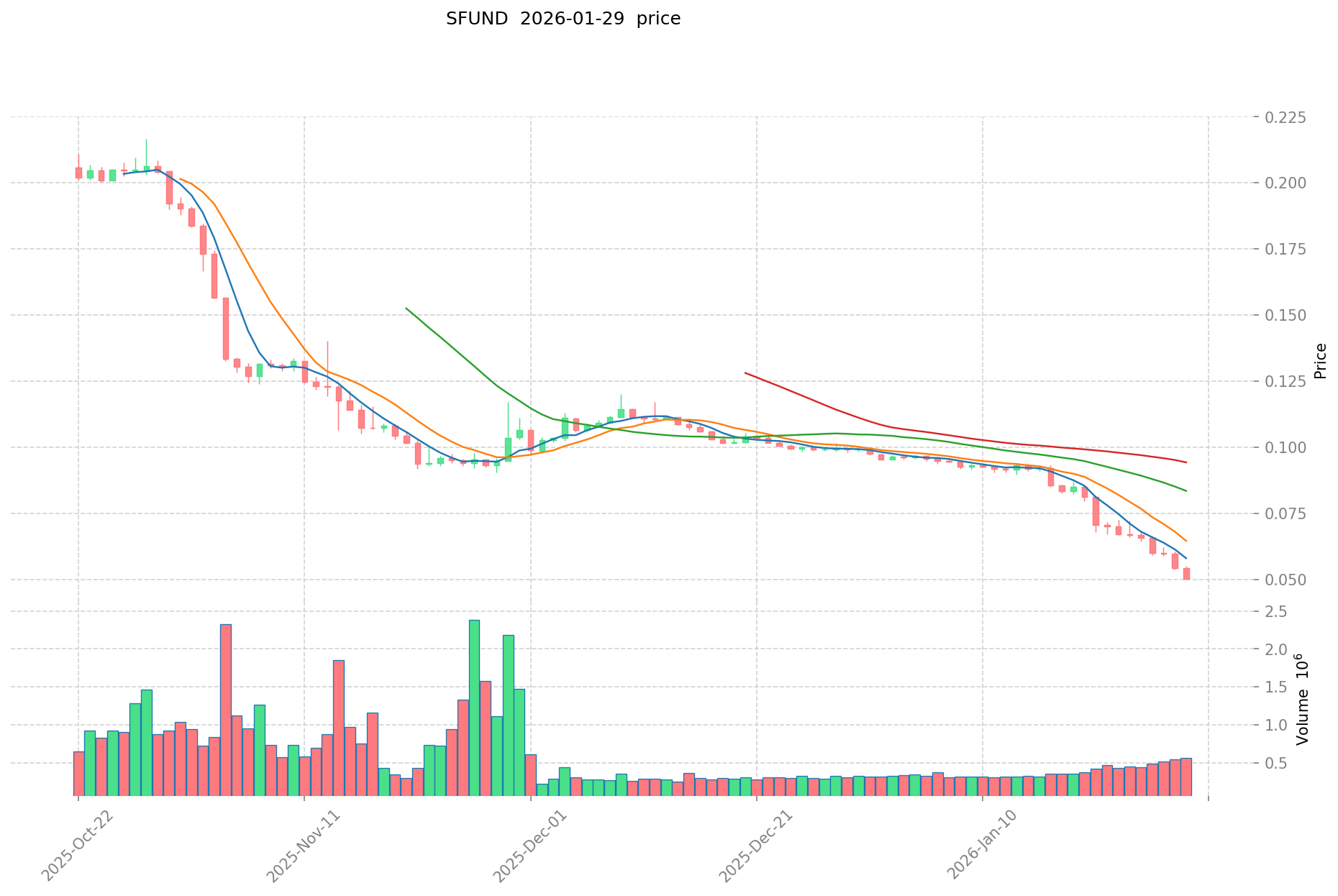
- 2025: Continued downward pressure → Price decreased approximately 96.65% year-over-year, settling around $0.04756 range
Current SFUND Investment Market Status (January 2026)
- SFUND current price: $0.04756
- 24-hour trading volume: $20,776.92
- Market capitalization: $3,947,480
- Circulating supply: 83,000,000 SFUND (83% of total supply)
- Price changes: -8.58% (24H), -32.51% (7D), -52.47% (30D)
Click to view real-time SFUND market price
II. Core Factors Influencing Whether SFUND is a Good Investment (Is Seedify.fund (SFUND) a Good Investment)
Supply Mechanism and Scarcity (SFUND Investment Scarcity)
- Token supply structure → impacts price and investment value
- SFUND has a maximum supply of 100,000,000 tokens with 83,000,000 tokens currently circulating, representing 83% of total supply
- The controlled supply mechanism may support long-term investment considerations, though market conditions remain primary determinants
Institutional Investment and Mainstream Adoption (Institutional Investment in SFUND)
- The token is held by approximately 2,812 addresses according to available data
- SFUND is listed on 4 exchanges, indicating limited but present market accessibility
- No specific institutional holding trends or major enterprise adoption information is available in the reference materials
Macroeconomic Environment's Impact on SFUND Investment
- Broader cryptocurrency market conditions influence SFUND's performance as part of the blockchain ecosystem
- Market volatility patterns show significant price fluctuations: 24-hour change of -8.58%, 7-day decline of -32.51%, and 30-day drop of -52.47%
- The token's historical performance indicates sensitivity to market cycles, with 1-year decline of -96.65%
Technology and Ecosystem Development (Technology & Ecosystem for SFUND Investment)
- Seedify.fund operates as an incubator and seed fund supporting blockchain ecosystem innovation through decentralized mechanisms
- The platform rewards experts and communities, contributing to ecosystem engagement
- Technical analysis from multiple sources suggests a bearish outlook for mid-2026, with forecasts predicting potential decline to $0.04674
- The project's role in supporting blockchain innovation may provide long-term value considerations, though near-term technical indicators show caution
III. SFUND Future Investment Forecast and Price Outlook (Is Seedify.fund (SFUND) worth investing in 2026-2031)
Short-term Investment Forecast (2026, short-term SFUND investment outlook)
Based on available market simulation data, SFUND may experience significant volatility in 2026. Conservative forecasts suggest the price could range between $0.0085 and $0.0283, while neutral scenarios estimate trading within $0.0290 to $0.0468. Optimistic projections indicate potential movement toward $0.0571, though market conditions remain subject to ongoing fluctuations.
Mid-term Investment Outlook (2027-2029, mid-term Seedify.fund (SFUND) investment forecast)
- Market Stage Expectation: The token may enter a gradual recovery phase, with projected annual growth rates around 9-42% depending on ecosystem development and market sentiment.
- Investment Return Forecast:
- 2027: $0.0447 - $0.0634
- 2028: $0.0392 - $0.0779
- 2029: $0.0549 - $0.0827
- Key Catalysts: Potential factors include broader adoption of the Seedify incubator platform, successful project launches supported by the fund, and improvements in overall blockchain ecosystem sentiment.
Long-term Investment Outlook (Is SFUND a good long-term investment?)
- Base Scenario: $0.0436 - $0.0825 (assuming steady platform development and moderate market conditions through 2030)
- Optimistic Scenario: $0.0737 - $0.1051 (contingent on significant ecosystem expansion and favorable regulatory environment through 2031)
- Risk Scenario: $0.0085 - $0.0290 (under adverse market conditions or diminished platform utility)
Click to view SFUND long-term investment and price forecast: Price Prediction
2026-2031 Long-term Outlook
- Base Scenario: $0.0436 - $0.0753 USD (corresponding to steady progress and gradual mainstream application adoption)
- Optimistic Scenario: $0.0737 - $0.1051 USD (corresponding to large-scale adoption and favorable market environment)
- Transformative Scenario: Above $0.1051 USD (contingent on breakthrough ecosystem developments and mainstream adoption)
- 2031-12-31 Forecast High: $0.1051 USD (based on optimistic development assumptions)
Disclaimer: The forecast data presented above derives from third-party analytical models and historical price simulations. Cryptocurrency markets exhibit inherent volatility and unpredictability. These projections do not constitute investment advice, and actual results may differ substantially from estimates. Investors should conduct independent research and consider their risk tolerance before making investment decisions.
| Year |
Predicted High Price |
Predicted Average Price |
Predicted Low Price |
Price Change |
| 2026 |
0.0571326 |
0.04683 |
0.0290346 |
-1 |
| 2027 |
0.063417186 |
0.0519813 |
0.044703918 |
9 |
| 2028 |
0.07789397805 |
0.057699243 |
0.03923548524 |
21 |
| 2029 |
0.0827118648405 |
0.067796610525 |
0.05491525452525 |
42 |
| 2030 |
0.0903050852193 |
0.07525423768275 |
0.043647457855995 |
58 |
| 2031 |
0.105130170042801 |
0.082779661451025 |
0.073673898691412 |
74 |
IV. SFUND Investment Strategy and Risk Management (How to invest in Seedify.fund)
Investment Methodology (SFUND investment strategy)
-
Long-term Holding (HODL SFUND): Suitable for conservative investors who believe in the long-term development of blockchain incubators and seed fund platforms. This approach requires patience to weather short-term price fluctuations and market volatility.
-
Active Trading: Relies on technical analysis and swing trading strategies. Given SFUND's high volatility, traders may capitalize on price movements by monitoring key support and resistance levels, utilizing indicators, and executing timely entries and exits.
Risk Management (Risk management for SFUND investment)
-
Asset Allocation Ratio:
- Conservative investors: Allocate 1-3% of total portfolio to SFUND
- Aggressive investors: May allocate 5-10% depending on risk tolerance
- Professional investors: Could consider higher allocations with proper hedging strategies
-
Risk Hedging Solutions: Diversify holdings across multiple digital assets, including established cryptocurrencies and stablecoins. Consider utilizing stop-loss orders and position sizing techniques to manage downside exposure.
-
Secure Storage: Store SFUND tokens in reputable wallets. Hot wallets may be used for active trading portions, while the majority of holdings should be kept in cold storage solutions. Hardware wallets from established manufacturers are recommended for long-term storage to minimize security risks.
V. SFUND Investment Risks and Challenges (Risks of investing in Seedify.fund)
-
Market Risk: SFUND has demonstrated substantial volatility, with notable price fluctuations across different timeframes. The token has experienced significant drawdowns from its previous levels, reflecting the inherent volatility of smaller market cap digital assets. Price movements can be influenced by broader market sentiment and trading volumes.
-
Regulatory Risk: As with other digital assets, SFUND faces potential regulatory uncertainties across different jurisdictions. Changes in regulatory frameworks or enforcement actions in key markets could impact the token's accessibility, trading venues, and overall adoption.
-
Technical Risk: Potential vulnerabilities in smart contract code, blockchain network congestion, or technical issues during platform upgrades could affect token functionality. As SFUND operates on the BSC network, any network-level issues could also impact token transactions and accessibility.
VI. Conclusion: Is Seedify.fund a Good Investment?
-
Investment Value Summary: SFUND represents exposure to the blockchain incubator and seed fund sector, supporting early-stage blockchain projects through a decentralized mechanism. The token has shown considerable price volatility, reflecting both opportunities and risks inherent in this market segment.
-
Investor Recommendations:
✅ Beginners: Consider dollar-cost averaging (DCA) strategies combined with secure wallet storage. Start with small allocations to understand market dynamics before increasing exposure.
✅ Experienced Investors: May employ swing trading strategies while maintaining a diversified portfolio. Monitor key metrics such as trading volumes, holder distribution, and platform developments.
✅ Institutional Investors: Could consider strategic long-term allocation as part of a broader digital asset portfolio, with appropriate risk management frameworks in place.
⚠️ Disclaimer: Cryptocurrency investments carry substantial risk. This content is for informational purposes only and does not constitute investment advice. Conduct thorough research and consider consulting with financial professionals before making investment decisions.
VII. FAQ
Q1: Is Seedify.fund (SFUND) a good investment for beginners in 2026?
SFUND presents significant risks for beginners due to high volatility and limited liquidity, requiring careful consideration. As of January 2026, the token has experienced substantial price declines, with a 96.65% decrease year-over-year and recent drops of -8.58% (24H), -32.51% (7D), and -52.47% (30D). For beginners interested in exposure to blockchain incubator platforms, a dollar-cost averaging approach with allocations of 1-3% of total portfolio is recommended. New investors should prioritize secure storage solutions, understand the project's fundamentals as a decentralized incubator supporting blockchain innovation, and prepare for continued volatility. The token's current market cap of approximately $3.95 million and trading volume of around $20,776 indicate limited market depth, which can amplify price swings.
Q2: What is the realistic price prediction for SFUND by the end of 2026?
Conservative forecasts suggest SFUND may trade between $0.0290 and $0.0571 by late 2026, with neutral scenarios estimating around $0.0468. Technical analysis from multiple sources indicates a bearish outlook for mid-2026, with some projections suggesting potential decline toward $0.0467. The wide range reflects uncertainty driven by market conditions, ecosystem development progress, and broader cryptocurrency sentiment. Optimistic scenarios depend on successful project launches supported by Seedify's incubator platform and improved market conditions. However, investors should note that these projections are based on historical patterns and analytical models, which may not accurately predict future performance in highly volatile markets.
Q3: How does SFUND's tokenomics affect its investment potential?
SFUND's supply structure includes a maximum cap of 100 million tokens with 83 million currently circulating (83% of total supply), providing a defined scarcity model. The controlled supply mechanism may support long-term value considerations, though it represents just one factor among many market determinants. With approximately 2,812 token holders and listings on 4 exchanges, the token demonstrates limited but present market accessibility. The relatively small holder base and exchange presence contribute to liquidity constraints, which can result in amplified price movements during buying or selling pressure. The platform's role in rewarding experts and community participants creates ongoing token utility within the ecosystem, though adoption rates and platform success remain critical variables.
Q4: What are the main risks associated with investing in SFUND?
SFUND faces three primary risk categories: market risk, regulatory risk, and technical risk. Market risk is evidenced by extreme volatility, with the token declining from a November 2021 peak of $16.79 to current levels around $0.0476, representing over 99% drawdown. The token's small market capitalization and limited trading volume create susceptibility to sharp price movements. Regulatory risk stems from evolving cryptocurrency regulations across jurisdictions, which could impact accessibility and adoption. Technical risk includes potential smart contract vulnerabilities, BSC network dependencies, and platform-specific challenges. The concentrated holder distribution (2,812 addresses) also presents concentration risk, where large holder actions could significantly influence price movements.
Q5: How does SFUND compare to other blockchain incubator tokens for investment purposes?
SFUND operates within the specialized blockchain incubator and launchpad sector, offering exposure to early-stage project funding mechanisms through decentralized structures. While specific comparative data is not available in the reference materials, SFUND's current market position reflects significant challenges compared to its historical performance. The token's market capitalization of $3.95 million places it in the smaller cap category within the incubator space. Its listing on 4 exchanges provides some accessibility, though this is relatively limited compared to more established platforms. The project's focus on rewarding community participants and experts represents a differentiated approach, though the effectiveness of this model depends on sustained platform activity and successful project launches within the ecosystem.
Q6: What investment strategies work best for SFUND given its volatility?
Two primary approaches suit SFUND's characteristics: long-term holding (HODL) for those believing in blockchain incubator platforms' future, and active trading for experienced participants comfortable with high volatility. Conservative investors should limit SFUND to 1-3% of total portfolio allocation, using dollar-cost averaging to mitigate timing risk. Aggressive investors with higher risk tolerance may allocate 5-10% with proper hedging strategies. Active traders can capitalize on price swings by monitoring key support and resistance levels, though this requires technical analysis skills and constant market monitoring. Essential risk management includes diversification across multiple digital assets, implementation of stop-loss orders, and secure storage practices—using cold storage for long-term holdings and hot wallets only for active trading portions.
Q7: What factors could drive SFUND price recovery in 2027-2029?
SFUND's potential recovery depends on several ecosystem and market factors. Platform development success, including the number and quality of projects launched through Seedify's incubator, could drive organic demand for the token. Broader blockchain ecosystem sentiment improvements, particularly in the launchpad and early-stage funding sectors, may lift valuations across the category. Technical forecasts suggest potential annual growth rates of 9-42% during 2027-2029, contingent on favorable conditions. Specific catalysts include mainstream adoption of decentralized incubation models, successful exits or launches of supported projects, and improvements in token utility within the platform. Mid-term projections estimate ranges of $0.0447-$0.0634 (2027), $0.0392-$0.0779 (2028), and $0.0549-$0.0827 (2029), though these remain speculative and subject to significant variance based on actual market and platform developments.
Q8: Should institutional investors consider SFUND for portfolio allocation?
Institutional consideration of SFUND requires careful evaluation of risk-reward parameters within broader digital asset strategies. The token's small market capitalization ($3.95 million), limited liquidity ($20,776 daily volume), and extreme historical volatility present challenges for institutional deployment. However, for institutions seeking exposure to blockchain incubator and early-stage project funding mechanisms, SFUND could represent a small strategic allocation within a diversified digital asset portfolio. Professional investors might consider positions as part of venture-style approaches to cryptocurrency markets, accepting high risk for potential outsized returns if the platform achieves significant ecosystem development. Proper risk management frameworks, including position sizing limits, liquidity monitoring, and exit strategies, are essential. Institutions should evaluate the project's competitive position within the incubator space, platform metrics, and team execution capability before allocation decisions.
* The information is not intended to be and does not constitute financial advice or any other recommendation of any sort offered or endorsed by Gate.