This comprehensive article examines whether SEI (SEI) represents a viable investment opportunity by analyzing its market position, historical performance, and future prospects. Launched in July 2023 as a Layer 1 blockchain within the Cosmos ecosystem, SEI currently trades at $0.1261 with a market capitalization of $818.53 million, holding a market rank of 99th. The article addresses key investment considerations including supply mechanisms, institutional adoption across 47 exchanges, and technology fundamentals, while evaluating both short-term 2026 price predictions ($0.0807-$0.140) and long-term outlooks through 2031. Critical risk factors include high price volatility (down 65.41% year-over-year), regulatory uncertainties, technical vulnerabilities, and unlimited maximum supply concerns. Designed for beginners, experienced traders, and institutional investors, this analysis presents evidence-based investment strategies combining long-term holding and active trading approaches with comprehensive risk manage
Introduction: Sei (SEI)'s Investment Position and Market Outlook
Sei is a significant asset in the cryptocurrency sector, having been launched in July 2023. Built as a Layer 1 public chain based on the Cosmos ecosystem, it aims to provide exchange services for digital assets including game assets, social networking, and NFT. As of January 14, 2026, Sei holds a market capitalization of approximately $818.53 million, with a circulating supply of about 6.49 billion tokens, and the current price maintains around $0.1261. With its positioning as a transaction-focused infrastructure, Sei has gradually become a focal point for investors discussing "Is Sei (SEI) a good investment?" Currently ranked 99th by market capitalization with a market dominance of 0.037%, the token is traded on 47 exchanges and has attracted over 33 million holders. This article will comprehensively analyze Sei's investment value, historical trends, future price predictions, and investment risks to provide reference for investors.
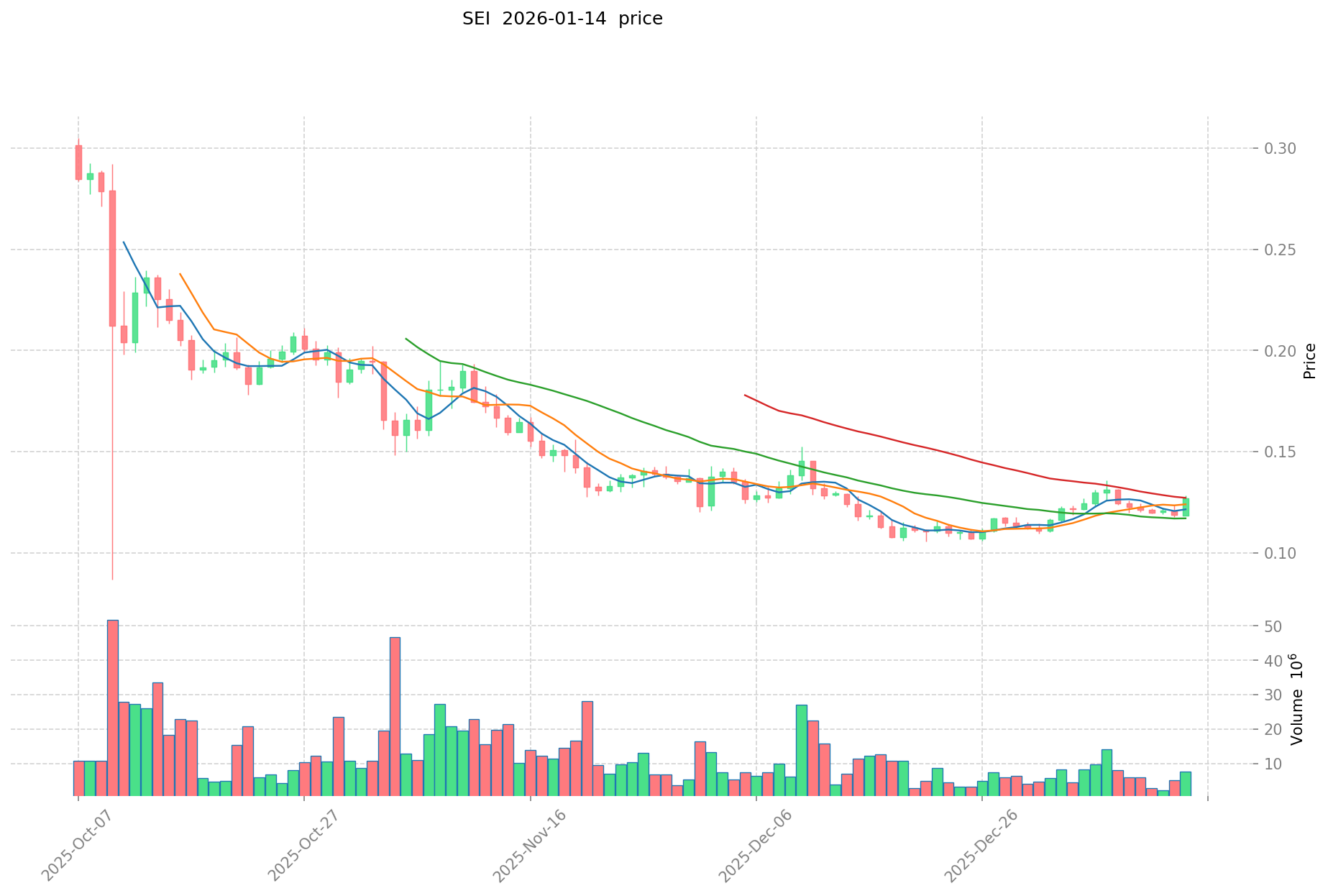
I. Sei (SEI) Price History Review and Current Investment Value
- 2023: Token Launch and Initial Trading → SEI launched at $0.175553 in August 2023, establishing its initial market presence
- 2024: Market Expansion Phase → Price increased from launch levels to $1.14463 in March 2024
- 2025: Market Correction Period → Price declined from earlier peaks to $0.0868 in October 2025
- Current Phase: Price Recovery → SEI trading at $0.1261 as of January 14, 2026
Current SEI Investment Market Status (January 2026)
- SEI Current Price: $0.1261
- 24-Hour Trading Volume: $1,213,982.90
- Market Capitalization: $818,529,111.10
- Circulating Supply: 6,491,111,111 SEI
- Total Supply: 10,000,000,000 SEI
- Price Change (24H): +3.78%
- Price Change (7D): -1.32%
- Price Change (30D): +0.96%
- Price Change (1Y): -65.41%
- Market Dominance: 0.037%
- Listed on 47 exchanges
- Token holders: 33,122,821
View real-time SEI market price
II. Core Factors Affecting Whether SEI Is a Good Investment
Supply Mechanism and Scarcity (SEI Investment Scarcity)
- Unlimited Maximum Supply Structure → Creates potential long-term dilution concerns
- Current circulation represents approximately 64.91% of total supply, with 6.49 billion SEI tokens in circulation out of 10 billion total supply
- Investment consideration: The unlimited maximum supply model differs from fixed-cap cryptocurrencies, potentially affecting long-term scarcity dynamics and investment positioning
Institutional Investment and Mainstream Adoption (Institutional Investment in SEI)
- SEI maintains presence across 47 exchanges as of January 2026, indicating established market accessibility
- The project's Layer 1 blockchain infrastructure within the Cosmos ecosystem positions it for potential institutional consideration
- Technical compatibility features, including EVM integration, may influence adoption patterns among developers and applications
Macroeconomic Environment's Impact on SEI Investment
- Broader cryptocurrency market conditions and regulatory developments affect SEI's investment landscape
- Market volatility characteristics: SEI demonstrates price fluctuations with 24-hour trading volume of approximately $1.21 million USD
- Price performance shows variation across timeframes: +3.78% (24H), -1.32% (7D), +0.96% (30D), -65.41% (1Y), reflecting sensitivity to market dynamics
Technology and Ecosystem Development (Technology & Ecosystem for SEI Investment)
- Layer 1 Architecture: SEI operates as a dedicated blockchain for digital asset exchange services, targeting scalability challenges
- Cosmos Ecosystem Integration: Built within the Cosmos network, potentially benefiting from interoperability infrastructure
- Application Focus Areas: The platform targets exchange services for game assets, social networking applications, and NFT trading
- Development activity tracked through GitHub repository (https://github.com/sei-protocol), providing transparency for technical assessment
III. SEI Future Investment Prediction and Price Outlook (Is Sei(SEI) worth investing in 2026-2031)
Short-term Investment Prediction (2026, short-term SEI investment outlook)
Based on market analysis and historical patterns, SEI's short-term price trajectory in 2026 presents varied scenarios:
- Conservative prediction: $0.0807 - $0.111
- Neutral prediction: $0.111 - $0.126
- Optimistic prediction: $0.126 - $0.140
Current trading data shows SEI at $0.1261, with 24-hour fluctuations between $0.1208 and $0.1284. The token has demonstrated a 3.78% increase over the past 24 hours, though it experienced a 1.32% decline over the past week. These short-term movements reflect ongoing market volatility and investor sentiment adjustments.
Mid-term Investment Outlook (2027-2028, mid-term Sei(SEI) investment forecast)
-
Market phase expectation: SEI is projected to enter a consolidation and gradual growth phase during 2027-2028, with price movements potentially influenced by broader crypto market trends and platform development progress.
-
Investment return prediction:
- 2027: $0.122 - $0.157
- 2028: $0.109 - $0.207
-
Key catalysts: Technical upgrades to the Sei network, expansion of ecosystem partnerships, overall cryptocurrency market sentiment, and potential regulatory developments may serve as primary drivers for price movement during this period.
The mid-term outlook suggests moderate growth potential, with price ranges indicating both consolidation phases and potential breakout scenarios depending on market conditions and project developments.
Long-term Investment Outlook (Is SEI a good long-term investment?)
Long-term projections for SEI through 2031 present multiple scenarios based on different market conditions and adoption levels:
- Baseline scenario: $0.093 - $0.219 (assuming steady development and moderate ecosystem expansion)
- Optimistic scenario: $0.176 - $0.302 (assuming accelerated adoption and favorable market conditions)
- Risk scenario: Below $0.090 (under conditions of significant market downturn or project development challenges)
For detailed SEI long-term investment and price predictions, visit: Price Prediction
2026-2031 Long-term Outlook
- Base scenario: $0.081 - $0.219 USD (corresponding to steady progress and gradual mainstream application improvement)
- Optimistic scenario: $0.176 - $0.302 USD (corresponding to large-scale adoption and favorable market environment)
- Transformative scenario: Above $0.302 USD (such as breakthrough progress in ecosystem and mainstream adoption)
- 2031-12-31 predicted high: $0.302 USD (based on optimistic development assumptions)
Disclaimer: These price predictions are based on historical data analysis, technical indicators, and market trends. Cryptocurrency markets are highly volatile and unpredictable. Past performance does not guarantee future results. These projections should not be considered as investment advice. The actual price of SEI may differ significantly from these predictions due to various factors including but not limited to: market sentiment changes, regulatory developments, technological advancements, competition, macroeconomic conditions, and unforeseen events. Investors should conduct their own thorough research and consider their risk tolerance before making any investment decisions. The cryptocurrency market carries substantial risk, and investors should only invest what they can afford to lose.
| Year |
Predicted High Price |
Predicted Average Price |
Predicted Low Price |
Price Change |
| 2026 |
0.139971 |
0.1261 |
0.080704 |
0 |
| 2027 |
0.15698189 |
0.1330355 |
0.12239266 |
5 |
| 2028 |
0.20736243385 |
0.145008695 |
0.10875652125 |
14 |
| 2029 |
0.26251649099325 |
0.176185564425 |
0.09337834914525 |
39 |
| 2030 |
0.256640702419676 |
0.219351027709125 |
0.125030085794201 |
73 |
| 2031 |
0.302254748631788 |
0.2379958650644 |
0.216576237208604 |
88 |
IV. SEI Investment Strategy and Risk Management (How to invest in SEI)
Investment Strategy (SEI investment strategy)
Long-term Holding (HODL SEI): Suitable for Conservative Investors
Long-term holding represents a fundamental investment approach for SEI token holders who focus on the project's underlying value proposition as a Layer 1 blockchain dedicated to digital asset exchange. This strategy involves acquiring SEI tokens and maintaining positions through market cycles, typically spanning multiple years. Investors adopting this methodology generally base their decisions on Sei Network's technical infrastructure, ecosystem development, and potential adoption growth rather than short-term price movements. The approach may be particularly relevant for those who believe in the network's capability to address exchange scalability challenges and its positioning within the Cosmos ecosystem.
Active Trading: Technical Analysis and Swing Trading
Active trading of SEI involves capitalizing on price fluctuations through technical analysis and market timing strategies. With a 24-hour trading volume of approximately $1.21 million and availability on 47 exchanges, SEI demonstrates sufficient liquidity for active trading strategies. The token has exhibited notable price volatility, with 24-hour ranges between $0.1208 and $0.1284. Traders utilizing this approach typically employ technical indicators, chart patterns, and market sentiment analysis to identify entry and exit points. The documented price movements show a 3.78% increase over 24 hours and a -1.32% change over 7 days, illustrating the short-term volatility that active traders seek to exploit.
Risk Management (Risk management for SEI investment)
Asset Allocation Ratios: Conservative / Aggressive / Professional Investors
Asset allocation for SEI investment should reflect individual risk tolerance and investment objectives. Conservative investors might consider limiting SEI exposure to 1-3% of their cryptocurrency portfolio, maintaining substantial positions in more established digital assets. Aggressive investors with higher risk tolerance may allocate 5-10% of their portfolio to SEI, accepting greater volatility for potential returns. Professional investors and institutions might incorporate SEI as part of a diversified blockchain infrastructure thesis, potentially allocating 3-7% within a specialized digital asset fund structure. These allocation ranges should be adjusted based on individual circumstances, market conditions, and overall portfolio composition.
Risk Hedging Solutions: Multi-asset Portfolio + Risk Management Tools
Implementing a comprehensive risk management framework for SEI investment involves diversification across multiple digital assets and blockchain ecosystems. Investors can reduce concentration risk by combining SEI holdings with tokens from different sectors, including established networks, DeFi protocols, and alternative Layer 1 platforms. Portfolio construction might include correlation analysis to identify assets with varying market behaviors. Additionally, investors may consider utilizing stablecoin positions to maintain liquidity for opportunistic rebalancing. Risk management tools such as stop-loss orders and position sizing based on volatility metrics can help protect capital during adverse market movements.
Secure Storage: Hot and Cold Wallets + Hardware Wallet Recommendations
Secure storage of SEI tokens requires a multi-layered approach combining hot wallets for active trading and cold storage solutions for long-term holdings. Hot wallets, including mobile and web-based options compatible with Cosmos-based assets, provide convenient access for frequent transactions but require robust security practices such as two-factor authentication and regular software updates. For substantial holdings intended for long-term investment, cold storage solutions offer enhanced security by keeping private keys offline. Hardware wallets that support Cosmos ecosystem tokens provide a balance of security and accessibility, allowing users to manage assets while maintaining protection against online threats. Investors should distribute holdings across multiple wallet types based on their intended use and security requirements.
V. SEI Investment Risks and Challenges (Risks of investing in SEI)
Market Risks: High Volatility and Price Dynamics
SEI demonstrates substantial price volatility characteristic of cryptocurrency markets, with the token trading at $0.1261 as of the latest data, representing approximately 89% below its recorded high of $1.14463 from March 2024. The one-year performance shows a -65.41% decline, illustrating significant price compression over extended periods. Within shorter timeframes, SEI exhibits fluctuations of 3.78% over 24 hours and -1.32% over 7 days, demonstrating the rapid price movements that characterize digital asset markets. The token's 24-hour trading range between $0.1208 and $0.1284 reflects approximately 6% intraday volatility. Such price dynamics present challenges for both short-term traders attempting to time market movements and long-term investors managing portfolio drawdowns. The circulating supply of 6.49 billion tokens represents 64.9% of the stated total supply of 10 billion, with maximum supply indicated as unlimited, which introduces considerations regarding potential future token issuance and its impact on value dynamics.
Regulatory Risks: Policy Uncertainty Across Jurisdictions
Cryptocurrency assets, including SEI, operate within an evolving regulatory landscape that varies significantly across jurisdictions. Different countries maintain distinct approaches to digital asset regulation, ranging from comprehensive frameworks to restrictive policies or regulatory ambiguity. Changes in regulatory stances can affect token accessibility, trading availability, and institutional adoption patterns. Investors in SEI face uncertainty regarding how regulatory developments might impact the token's utility, exchange listings, and overall market dynamics. The Layer 1 blockchain's focus on digital asset exchange functionality may subject it to specific regulatory considerations related to trading infrastructure and asset classification. These regulatory dynamics introduce variables that can influence token value and accessibility independent of technical or market factors.
Technical Risks: Network Security and Upgrade Implementation
As a Layer 1 blockchain built within the Cosmos ecosystem, Sei Network faces technical risks inherent to blockchain infrastructure. Network security considerations include potential vulnerabilities in protocol implementation, consensus mechanisms, and smart contract functionality. While blockchain networks employ various security measures, the possibility of undiscovered vulnerabilities exists within any complex technical system. Additionally, protocol upgrades and technical improvements, while intended to enhance network capabilities, introduce implementation risks. Upgrade processes require coordination across validator networks and may encounter technical challenges during deployment. The network's approach to addressing exchange scalability through specialized infrastructure involves technical complexity that must be maintained and evolved over time. Investors in SEI tokens should consider these technical factors as part of their risk assessment, recognizing that network functionality and security form the foundation for token utility and value.
VI. Conclusion: Is SEI a Good Investment?
Investment Value Summary: SEI presents characteristics associated with emerging blockchain infrastructure projects, featuring specialized focus on digital asset exchange within the Cosmos ecosystem. The token demonstrates notable price volatility, with significant variation from historical levels and ongoing market fluctuations.
Investor Recommendations:
✅ Beginners: Consider systematic accumulation strategies combined with secure wallet storage practices. New investors should prioritize understanding blockchain fundamentals, Sei Network's technical architecture, and proper security protocols before establishing positions. Starting with modest allocations allows for learning while managing exposure to volatility.
✅ Experienced Investors: May explore tactical trading approaches combined with portfolio diversification strategies. Those familiar with cryptocurrency markets can assess SEI within the context of Layer 1 blockchain competition and Cosmos ecosystem developments. Position sizing should reflect individual risk parameters and overall portfolio construction.
✅ Institutional Investors: Could evaluate SEI as part of strategic blockchain infrastructure allocation themes. Professional asset managers might analyze the token within broader digital asset portfolio frameworks, considering factors such as technology differentiation, ecosystem growth metrics, and correlation characteristics with other holdings.
⚠️ Important Notice: Cryptocurrency investments involve substantial risks, including potential loss of capital. This content provides informational analysis and does not constitute investment advice, financial recommendations, or solicitation to buy or sell any assets. Investors should conduct comprehensive due diligence, consider their individual circumstances and risk tolerance, and consult with qualified financial advisors before making investment decisions. Past performance does not indicate future results, and cryptocurrency markets can experience rapid and unpredictable changes.
VII. FAQ
Q1: What is SEI and what makes it different from other cryptocurrencies?
SEI is a Layer 1 blockchain built within the Cosmos ecosystem, specifically designed to provide exchange services for digital assets including game assets, social networking, and NFTs. What distinguishes SEI from other cryptocurrencies is its specialized focus on transaction-focused infrastructure, offering EVM compatibility and positioning itself as dedicated blockchain infrastructure for digital asset exchange rather than a general-purpose platform. Launched in July 2023, SEI maintains a market capitalization of approximately $818.53 million as of January 2026 and operates as an interconnected component of the broader Cosmos network, providing interoperability advantages.
Q2: Is SEI a good investment for beginners in 2026?
For beginners, SEI presents both opportunities and challenges that require careful consideration. The token currently trades at $0.1261, significantly below its March 2024 high of $1.14463, which may represent a lower entry point. However, the -65.41% one-year decline and ongoing volatility (3.78% in 24 hours) indicate substantial risk. Beginners should start with modest allocations (1-3% of cryptocurrency portfolio), prioritize learning about blockchain fundamentals and Sei Network's technical architecture, implement secure storage practices using hardware wallets, and prepare for significant price fluctuations before establishing positions.
Q3: What are the price predictions for SEI through 2031?
SEI price projections through 2031 present multiple scenarios based on different market conditions. Short-term 2026 predictions range from $0.0807-$0.140 USD, with neutral scenarios around $0.111-$0.126. Mid-term forecasts for 2027-2028 suggest ranges of $0.122-$0.157 and $0.109-$0.207 respectively. Long-term projections through 2031 indicate a base scenario of $0.081-$0.219 USD, with optimistic scenarios reaching $0.176-$0.302 USD. The 2031 predicted high stands at $0.302 USD under favorable development assumptions. However, these predictions carry significant uncertainty due to market volatility, regulatory developments, technological changes, and unforeseen events.
Q4: What are the main risks of investing in SEI?
SEI investment involves several significant risk categories. Market risks include high volatility, with the token down 89% from its March 2024 peak and demonstrating -65.41% one-year performance. Regulatory risks stem from evolving and inconsistent cryptocurrency policies across jurisdictions, which may affect token accessibility and exchange listings. Technical risks encompass potential network vulnerabilities, protocol upgrade implementation challenges, and security considerations inherent to blockchain infrastructure. Additionally, SEI's unlimited maximum supply structure creates potential long-term dilution concerns, with only 64.91% of total supply currently in circulation, which differs from fixed-cap cryptocurrencies and may affect scarcity dynamics.
Q5: How should I store my SEI tokens securely?
Secure SEI storage requires a multi-layered approach combining different wallet types based on intended use. Hot wallets (mobile and web-based options compatible with Cosmos-based assets) provide convenient access for active trading but require robust security practices including two-factor authentication and regular software updates. For substantial holdings intended for long-term investment, cold storage solutions offer enhanced security by keeping private keys offline. Hardware wallets that support Cosmos ecosystem tokens provide an optimal balance of security and accessibility, protecting assets against online threats while allowing management capabilities. Investors should distribute holdings across multiple wallet types according to their trading frequency and security requirements.
Q6: What factors influence SEI's price movements?
SEI's price movements are influenced by multiple interconnected factors. Supply mechanisms include the unlimited maximum supply structure and current 64.91% circulation rate (6.49 billion of 10 billion total supply). Institutional adoption factors involve presence across 47 exchanges and integration within the Cosmos ecosystem. Macroeconomic environment impacts include broader cryptocurrency market conditions, regulatory developments, and market sentiment shifts. Technology and ecosystem development factors encompass Layer 1 architecture improvements, application adoption in gaming, social networking, and NFT sectors, and technical upgrades tracked through the project's GitHub repository. Market liquidity with $1.21 million 24-hour trading volume also affects price stability.
Q7: What investment strategy should I use for SEI?
Investment strategies for SEI should align with individual risk tolerance and objectives. Long-term holding (HODL) suits conservative investors focusing on underlying value proposition and ecosystem development, typically maintaining positions through market cycles over multiple years. Active trading approaches work for those capitalizing on price volatility through technical analysis, utilizing the token's presence on 47 exchanges and documented price movements (3.78% in 24 hours, -1.32% over 7 days). Asset allocation should reflect risk profiles: conservative investors might limit SEI to 1-3% of cryptocurrency portfolios, aggressive investors may allocate 5-10%, while professional investors could incorporate 3-7% within specialized digital asset fund structures. All strategies should include risk management through diversification, position sizing, and secure storage practices.
Q8: How does SEI compare to other Layer 1 blockchains?
SEI differentiates itself from other Layer 1 blockchains through its specialized focus on digital asset exchange infrastructure rather than general-purpose functionality. Built within the Cosmos ecosystem, SEI benefits from interoperability advantages while targeting specific use cases in gaming assets, social networking, and NFT trading. With a current market capitalization of $818.53 million and ranking 99th by market cap, SEI operates at a smaller scale compared to established Layer 1 platforms but maintains presence across 47 exchanges with over 33 million token holders. The project's EVM compatibility enables developer accessibility, while its transaction-focused architecture aims to address exchange scalability challenges. However, competition within the Layer 1 space remains intense, with SEI's ultimate market position dependent on execution of technical roadmap and ecosystem growth.
* The information is not intended to be and does not constitute financial advice or any other recommendation of any sort offered or endorsed by Gate.