This comprehensive guide evaluates whether Serum (SRM) is a viable investment opportunity in the decentralized exchange sector. The article analyzes SRM's current market position—trading at $0.008005 with a $2.98 million market cap as of January 2026—alongside its tokenomics, featuring buyback-burn mechanisms and unique MegaSerum (MSRM) utility. It examines historical price performance, from a $13.78 peak in September 2021 to recent declines of 68.77% annually, while presenting multi-year price forecasts ranging from conservative to optimistic scenarios through 2031. The guide addresses critical investment factors including supply dynamics, institutional adoption limited to 16,835 token holders across 5 exchanges, and cross-chain protocol capabilities. It provides actionable investment strategies for different investor profiles, practical risk management frameworks, and detailed analysis of market, regulatory, and technical risks. This resource equips investors with essential data for making informed decision
Introduction: Serum (SRM)'s Investment Position and Market Prospects
SRM is a notable asset in the cryptocurrency sector, launched in August 2020 as the native token of a fully decentralized exchange protocol. As of January 2026, Serum holds a market capitalization of approximately $2.98 million, with a circulating supply of around 372.78 million tokens, and its current price is positioned at approximately $0.008005. With its designation as a decentralized exchange (DEX) platform token supporting cross-chain transactions, SRM has become a subject of discussion among investors considering "Is Serum (SRM) a good investment?" This article provides a comprehensive analysis of SRM's investment characteristics, historical price movements, future price projections, and associated investment risks to serve as a reference for market participants.
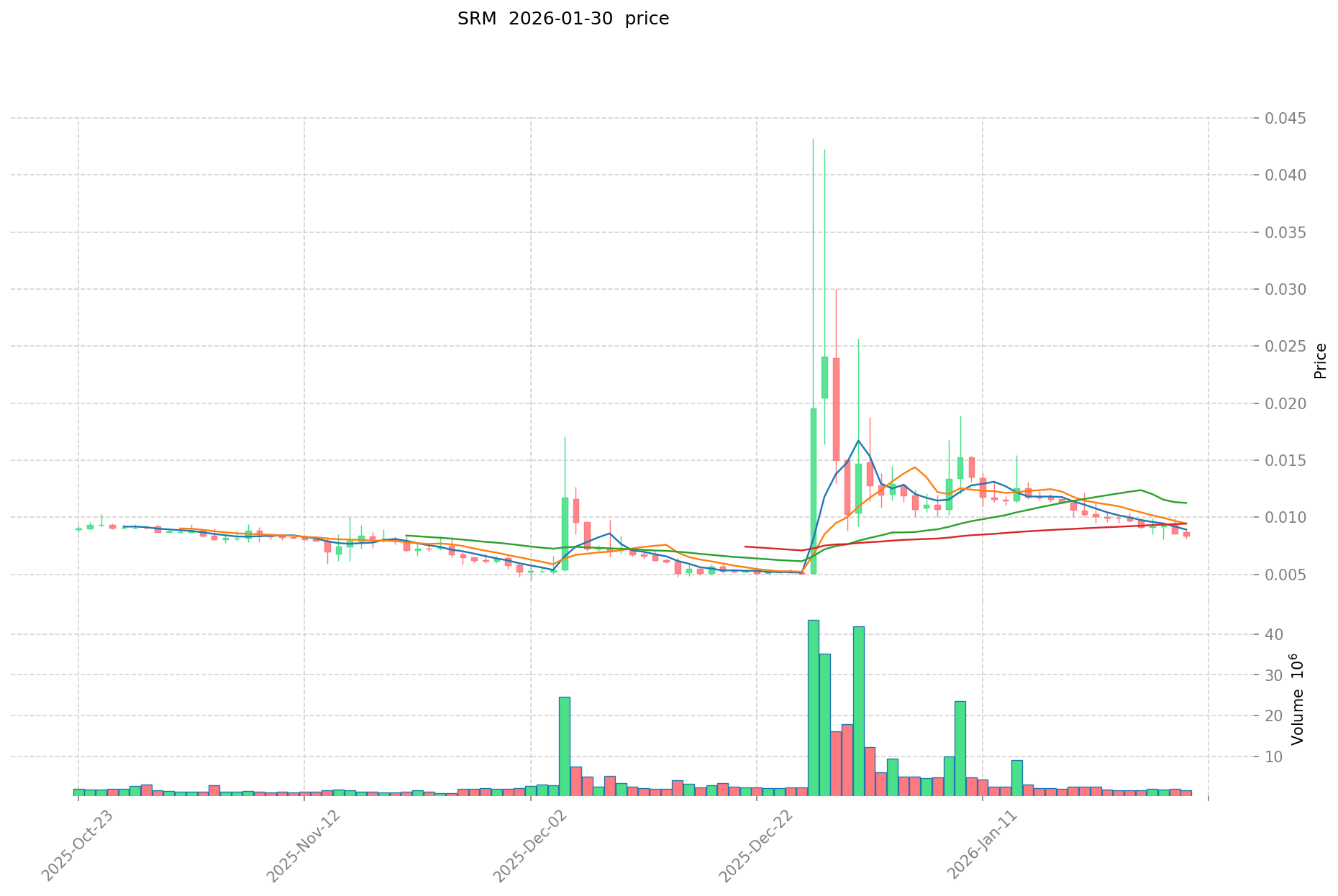
As of January 31, 2026, SRM ranks #1826 in the cryptocurrency market by market capitalization, representing a market dominance of 0.00029%. The token recorded a 24-hour trading volume of $16,904.02, with price fluctuations ranging from $0.007 to $0.008669 within the same period. Short-term price trends show a 7.59% increase over the past hour, while experiencing declines of 5.2% over 24 hours, 19.61% over 7 days, 40.44% over 30 days, and 68.77% over the past year. The token achieved its price peak at $13.78 on September 11, 2021, and recorded its lowest price of $0.00360482 on December 16, 2025. With a maximum supply of 10.16 billion tokens and a total supply of approximately 1.09 billion, the current circulating supply represents about 3.67% of the total supply, resulting in a fully diluted market valuation of approximately $8.75 million. The token is deployed on the Ethereum network with contract address 0x476c5E26a75bd202a9683ffD34359C0CC15be0fF and is currently listed on 5 exchanges, with approximately 16,835 token holders recorded.
I. Serum (SRM) Price History Review and Current Investment Value
- 2020: Initial offering at $0.11, providing significant returns for early investors
- 2021: Bull market period → SRM reached a notable price level of $13.78 on September 11, 2021
- 2025: Bear market continuation → Price declined from previous elevated levels, with the token experiencing a -66.22% change over the year
Current SRM Investment Market Status (January 2026)
- SRM current price: $0.008005
- Market sentiment: The token has experienced a -5.2% change in the past 24 hours and a -68.77% change over the past year, reflecting cautious market conditions
- 24-hour trading volume: $16,904.02
- Market capitalization: $2.98 million, representing 0.00029% market share
Click to view real-time SRM market price
II. Core Factors Affecting Whether SRM is a Good Investment (Is Serum(SRM) a Good Investment)
Supply Mechanism and Scarcity (SRM investment scarcity)
- Token supply model → impacts price and investment value
- Total supply of 1,092,844,982.31 SRM with a maximum supply of 10,161,000,000 SRM suggests a potentially inflationary supply structure
- Circulating supply of 372,782,297.01 SRM represents approximately 3.67% of total supply, indicating significant future supply expansion potential
- Buyback and burn mechanism: transaction fees are utilized by the system to repurchase and burn SRM tokens, potentially supporting long-term scarcity
- Investment significance: the combination of buyback-burn mechanics and large unreleased supply creates a complex scarcity dynamic requiring careful evaluation
Institutional Investment and Mainstream Adoption (Institutional investment in SRM)
- Limited visibility of institutional holdings in available data
- Trading volume of $16,904.02 over 24 hours suggests relatively modest liquidity levels
- Available on 5 exchanges with a market capitalization ranking of 1,826, indicating limited mainstream adoption
- Holder count of 16,835 addresses reflects a moderate but not extensive user base
Macroeconomic Environment Impact on SRM Investment
- Broader cryptocurrency market conditions continue to influence SRM price movements
- Price performance shows 24-hour decline of -5.2%, 7-day decline of -19.61%, and 30-day decline of -40.44%, reflecting sensitivity to market volatility
- One-year performance decline of -68.77% suggests vulnerability to extended bear market conditions
- Current market dominance of 0.00029% indicates limited correlation with major market movements
Technology and Ecosystem Development (Technology & Ecosystem for SRM investment)
- Decentralized exchange protocol designed to support trustless cross-chain transactions
- Validator node mechanism: requires staking of 10 million SRM plus one MSRM token to operate validation nodes, earning transaction fee revenue and staking rewards
- Fee reduction benefits: SRM holders receive 50% transaction fee reduction, with fees payable in SRM
- MegaSerum (MSRM) concept: every 1 million SRM can be synthesized into one MSRM token (and vice versa), with MSRM holders receiving 60% transaction fee reduction, particularly attractive for high-volume traders
- Cross-chain service infrastructure supports decentralized transaction solutions across multiple blockchain networks
III. SRM Future Investment Forecast and Price Outlook (Is Serum(SRM) worth investing in 2026-2031)
Short-term Investment Forecast (2026, short-term SRM investment outlook)
- Conservative forecast: $0.004511 - $0.007915
- Neutral forecast: $0.007915 - $0.009616
- Optimistic forecast: $0.009616 - $0.011318
Mid-term Investment Outlook (2027-2029, mid-term Serum(SRM) investment forecast)
- Market stage expectation: Gradual recovery phase with potential price fluctuations as the protocol seeks renewed market relevance and adoption within the evolving DeFi landscape.
- Investment return forecast:
- 2027: $0.006731 - $0.012694, representing a potential 20% increase from 2026 levels
- 2028: $0.006693 - $0.012382, indicating a potential 39% cumulative gain from 2026
- 2029: $0.008591 - $0.015299, suggesting a possible 47% increase from the 2026 baseline
- Key catalysts: Protocol technological developments, cross-chain solution adoption rates, validator network expansion, and broader DeFi market trends may influence price performance during this period.
Long-term Investment Outlook (Is Serum a good long-term investment?)
- Base scenario: $0.008932 - $0.015090 (assuming steady protocol development and maintained ecosystem relevance through 2030-2031)
- Optimistic scenario: $0.010412 - $0.017203 (contingent upon successful integration into next-generation DeFi infrastructure and expanded cross-chain functionality)
- Risk scenario: Below $0.006731 (under conditions of declining protocol adoption, intensified competitive pressure, or adverse regulatory developments)
Click to view SRM long-term investment and price forecast: Price Prediction
2026-01-31 - 2031 Long-term Outlook
- Base scenario: $0.008932 - $0.015090 (corresponding to steady progress and gradual mainstream application enhancement)
- Optimistic scenario: $0.010412 - $0.017203 (corresponding to large-scale adoption and favorable market conditions)
- Transformative scenario: Above $0.017203 (contingent upon breakthrough ecosystem developments and mainstream proliferation)
- 2031-12-31 forecast high: $0.017203 (based on optimistic development assumptions)
Disclaimer: The forecasts presented herein are derived from historical data analysis and predictive modeling. Cryptocurrency markets involve substantial volatility and uncertainty. These projections should not be construed as financial advice or guarantees of future performance. Market participants should conduct independent research and consider their risk tolerance before making investment decisions.
| Year |
Predicted High Price |
Predicted Average Price |
Predicted Low Price |
Price Change |
| 2026 |
0.01131845 |
0.007915 |
0.00451155 |
-1 |
| 2027 |
0.012694077 |
0.009616725 |
0.0067317075 |
20 |
| 2028 |
0.01238249511 |
0.011155401 |
0.0066932406 |
39 |
| 2029 |
0.0152996324715 |
0.011768948055 |
0.00859133208015 |
47 |
| 2030 |
0.016647177023797 |
0.01353429026325 |
0.008932631573745 |
69 |
| 2031 |
0.017203436353617 |
0.015090733643523 |
0.010412606214031 |
88 |
IV. Serum Investment Strategy and Risk Management (How to invest in SRM)
Investment Methodology (Serum investment strategy)
Long-term Holding (HODL SRM): Suitable for Conservative Investors
Long-term holding strategy involves purchasing SRM tokens and maintaining positions over extended periods, focusing on the protocol's fundamental value rather than short-term price fluctuations. This approach suits investors who believe in the decentralized exchange ecosystem and Serum's cross-chain trading capabilities. The token's utility features, including transaction fee discounts and staking rewards, provide ongoing benefits for long-term holders.
Active Trading: Relying on Technical Analysis and Swing Operations
Active traders may capitalize on SRM's price volatility through technical analysis and swing trading strategies. Given the token's 24-hour price fluctuation of -5.2% and weekly movement of -19.61%, traders can identify entry and exit points based on support and resistance levels. Volume analysis shows 24-hour trading volume of approximately $16,904, which traders should monitor for liquidity considerations.
Risk Management (Risk management for SRM investment)
Asset Allocation Ratio: Conservative / Aggressive / Professional Investors
- Conservative Investors: Allocate 1-3% of crypto portfolio to SRM, maintaining majority holdings in established assets
- Aggressive Investors: May allocate 5-10% to SRM as part of DeFi-focused strategy
- Professional Investors: Can consider 10-15% allocation with active position management and hedging strategies
Diversification across multiple blockchain protocols and DeFi platforms helps mitigate concentration risk. Investors should consider pairing SRM exposure with stablecoins or established cryptocurrencies. Position sizing should account for the token's volatility characteristics and correlation with broader DeFi market movements.
Secure Storage: Hot and Cold Wallets + Hardware Wallet Recommendations
SRM tokens on Ethereum network require secure storage solutions:
- Hot Wallets: Suitable for active trading amounts, enabling quick access to liquidity
- Cold Wallets: Recommended for majority of holdings, providing offline security
- Hardware Wallets: Devices supporting ERC-20 tokens offer enhanced security for long-term storage
Investors should verify contract address (0x476c5E26a75bd202a9683ffD34359C0CC15be0fF) when conducting transactions to prevent phishing attempts.
V. Serum Investment Risks and Challenges (Risks of investing in SRM)
Market Risk: High Volatility and Price Manipulation
SRM demonstrates significant price volatility, with recent data showing 30-day decline of -40.44% and 1-year decline of -68.77%. The token's current price of $0.008005 represents substantial distance from historical levels. Market capitalization of approximately $2.98 million indicates relatively lower liquidity compared to major cryptocurrencies, potentially increasing susceptibility to price swings. Trading across only 5 exchanges may concentrate liquidity and increase market impact of larger transactions.
Regulatory Risk: Policy Uncertainty Across Different Countries
Decentralized exchange protocols face evolving regulatory frameworks globally. Different jurisdictions maintain varying approaches to DeFi platforms and governance tokens. Investors should monitor regulatory developments affecting decentralized trading platforms, cross-chain protocols, and token utility features. Changes in regulatory stance could impact protocol operations and token utility.
Technical Risk: Network Security Vulnerabilities and Upgrade Failures
As a protocol facilitating cross-chain transactions, Serum faces technical considerations including:
- Smart contract security on Ethereum network
- Cross-chain bridge vulnerabilities
- Protocol upgrade implementation risks
- Validator network stability for cross-chain services
The requirement for validators to stake 10 million SRM plus one MSRM token creates significant capital requirements, potentially affecting network decentralization and security distribution.
VI. Conclusion: Is SRM a Good Investment?
Investment Value Summary
Serum presents a specialized investment opportunity within the decentralized exchange and cross-chain trading sectors. The protocol's design includes utility features through transaction fee discounts and staking mechanisms. However, recent price performance shows substantial declines across multiple timeframes, and market capitalization remains relatively modest at approximately $2.98 million. The circulating supply represents 3.67% of maximum supply, indicating significant future supply considerations.
Investor Recommendations
✅ Beginners: Consider small allocation as part of diversified crypto portfolio, use secure wallet storage, and understand protocol mechanics before investing
✅ Experienced Investors: May employ swing trading strategies based on technical analysis, maintain strict position sizing, and monitor DeFi sector developments
✅ Institutional Investors: Conduct thorough due diligence on protocol fundamentals, assess liquidity constraints, and evaluate strategic fit within broader blockchain investment thesis
⚠️ Notice: Cryptocurrency investment involves substantial risk. This content is for informational purposes only and does not constitute investment advice. Investors should conduct independent research and consider their financial situation before making investment decisions.
VII. FAQ
Q1: What is Serum (SRM) and what makes it different from other DEX tokens?
Serum (SRM) is the native token of a fully decentralized exchange protocol launched in August 2020, designed to facilitate trustless cross-chain transactions. What distinguishes SRM from other DEX tokens is its unique validator node mechanism requiring 10 million SRM plus one MSRM token to operate validation nodes, earning transaction fee revenue and staking rewards. Additionally, SRM holders receive a 50% transaction fee reduction, with fees payable in SRM. The protocol also features the MegaSerum (MSRM) concept, where every 1 million SRM can be synthesized into one MSRM token (and vice versa), with MSRM holders receiving 60% transaction fee reduction, particularly attractive for high-volume traders. This layered utility structure and cross-chain service infrastructure differentiate Serum in the competitive DEX landscape.
Q2: Why has SRM's price declined significantly from its historical peak?
SRM has experienced a substantial decline of 68.77% over the past year, currently trading at $0.008005 compared to its all-time high of $13.78 on September 11, 2021. This dramatic price reduction reflects several factors: the extended cryptocurrency bear market that began in late 2021, limited mainstream adoption as evidenced by its current market capitalization of only $2.98 million and ranking of #1826, and reduced trading activity with 24-hour volume of $16,904.02. Additionally, the token's availability on only 5 exchanges suggests limited liquidity, while the circulating supply representing just 3.67% of maximum supply indicates significant future supply expansion potential. The combination of market-wide bearish sentiment, competitive pressure in the DeFi sector, and concerns about token dilution have contributed to the prolonged downward price trajectory.
Q3: Is SRM suitable for long-term investment?
SRM's suitability for long-term investment depends on individual risk tolerance and investment objectives. For conservative investors, the recommendation is to allocate only 1-3% of a crypto portfolio to SRM, maintaining majority holdings in established assets. The token offers utility features through transaction fee discounts and staking rewards that provide ongoing benefits for long-term holders. However, significant challenges exist: the token has declined 68.77% over the past year, holds a modest market capitalization of $2.98 million, and trades on only 5 exchanges with limited liquidity. Long-term forecasts suggest potential recovery to $0.017203 by 2031 under optimistic scenarios, representing potential upside from current levels. Nevertheless, the risk scenario contemplates prices falling below $0.006731 under adverse conditions. Investors must conduct thorough due diligence on protocol fundamentals, assess liquidity constraints, and evaluate their capacity to withstand substantial volatility before committing to long-term positions.
Q4: What are the main risks associated with investing in SRM?
Investing in SRM involves multiple risk categories. Market risk is substantial, with recent data showing a 30-day decline of 40.44% and significant price volatility. The relatively small market capitalization of $2.98 million increases susceptibility to price manipulation and large price swings. Regulatory risk emerges from evolving global frameworks affecting DeFi platforms and governance tokens, with different jurisdictions maintaining varying approaches to decentralized trading platforms. Technical risk includes smart contract security vulnerabilities on the Ethereum network, cross-chain bridge vulnerabilities, protocol upgrade implementation risks, and validator network stability concerns. The requirement for validators to stake 10 million SRM plus one MSRM token creates significant capital requirements that could affect network decentralization. Additionally, supply inflation risk exists as the circulating supply represents only 3.67% of maximum supply, indicating substantial future token releases that could exert downward price pressure.
Q5: How can investors implement proper risk management when trading SRM?
Effective risk management for SRM investment requires multiple strategies. Asset allocation should be proportionate to investor experience: conservative investors should limit exposure to 1-3% of their crypto portfolio, aggressive investors may allocate 5-10% as part of a DeFi-focused strategy, while professional investors can consider 10-15% allocation with active position management. Diversification across multiple blockchain protocols and DeFi platforms helps mitigate concentration risk, with investors pairing SRM exposure with stablecoins or established cryptocurrencies. Secure storage is critical: hot wallets suit active trading amounts enabling quick liquidity access, cold wallets are recommended for majority holdings providing offline security, and hardware wallets supporting ERC-20 tokens offer enhanced security for long-term storage. Investors must verify the contract address (0x476c5E26a75bd202a9683ffD34359C0CC15be0fF) when conducting transactions to prevent phishing attempts. Position sizing should account for the token's volatility characteristics and correlation with broader DeFi market movements.
Q6: What price levels should investors monitor for SRM trading opportunities?
Key price levels for SRM trading include several important thresholds. The current price of $0.008005 serves as the baseline reference point. Recent 24-hour price fluctuations ranged from $0.007 to $0.008669, establishing immediate support and resistance zones. The historical low of $0.00360482 recorded on December 16, 2025, represents a critical support level that could signal extreme oversold conditions if approached. For 2026, conservative forecasts suggest a range of $0.004511 to $0.007915, neutral forecasts indicate $0.007915 to $0.009616, and optimistic forecasts project $0.009616 to $0.011318. Traders employing technical analysis should monitor these levels along with volume indicators, as the 24-hour trading volume of $16,904.02 suggests relatively modest liquidity that may impact execution quality. Active traders may capitalize on price volatility by identifying entry points near support levels and establishing exit strategies at resistance thresholds based on their risk-reward parameters.
Q7: How does the MegaSerum (MSRM) mechanism affect SRM's investment value?
The MegaSerum (MSRM) mechanism introduces a unique dynamic to SRM's value proposition. Every 1 million SRM can be synthesized into one MSRM token, and this process is reversible, creating an arbitrage relationship between the two tokens. MSRM holders receive enhanced benefits with 60% transaction fee reduction compared to 50% for regular SRM holders, making MSRM particularly attractive for high-volume traders. This mechanism effectively creates demand for accumulating large SRM positions to synthesize MSRM, potentially supporting price stability for SRM. However, the reversibility means MSRM can be decomposed back to SRM, which could introduce supply pressure if MSRM holders choose to liquidate positions. For investors, this mechanism suggests that SRM's value is partially tied to the utility and demand for MSRM, especially among institutional traders and high-frequency trading operations. The requirement to hold significant SRM quantities to access premium benefits creates a natural demand floor, though this benefit is most relevant to users actively engaging with the protocol rather than passive holders.
Q8: What factors could drive SRM price recovery in the future?
Several catalysts could potentially drive SRM price recovery. Protocol technological developments including enhanced cross-chain solution adoption rates and validator network expansion could increase utility and demand. The buyback and burn mechanism utilizing transaction fees to repurchase and burn SRM tokens may gradually improve scarcity dynamics if trading volumes increase substantially. Broader DeFi market trends toward next-generation infrastructure and expanded cross-chain functionality could position Serum favorably if the protocol successfully integrates these developments. Increased mainstream adoption beyond the current 5 exchanges and expansion of the holder base beyond 16,835 addresses would improve liquidity and market accessibility. Long-term forecasts under optimistic scenarios project potential recovery to $0.017203 by 2031, representing significant upside from current levels of $0.008005. However, these scenarios are contingent upon successful protocol development, favorable regulatory environments, and renewed investor interest in DeFi platforms. Investors should monitor validator network growth, cross-chain transaction volumes, and partnership announcements as leading indicators of potential price catalysts.
* The information is not intended to be and does not constitute financial advice or any other recommendation of any sort offered or endorsed by Gate.