This comprehensive analysis evaluates whether Sinverse (SIN) represents a viable investment opportunity in the blockchain gaming and metaverse sector. As of February 2026, SIN trades at $0.00035 with a market capitalization of $311,832.60, having declined significantly from its 2021 peak of $0.710213. The article examines core investment factors including supply mechanics showing 89.1% token circulation, modest trading volume of $24,089 across 2 exchanges including Gate.com, and the project's position as a BSC-based metaverse gaming platform. Price forecasts range from $0.00027-$0.00044 in 2026 to potentially $0.00099 by 2031 under optimistic scenarios. Investment strategies encompass long-term holding for conservative investors and active trading approaches, while comprehensive risk management addresses market volatility, regulatory uncertainty, and technical vulnerabilities. The analysis concludes that SIN investment carries substantial risk suitable for experienced investors with high risk tolerance and app
Introduction: Sinverse (SIN) Investment Status and Market Outlook
SIN is a digital asset in the cryptocurrency sector. Launched in 2021, it has been positioned within the blockchain-based metaverse gaming space. As of February 7, 2026, Sinverse holds a market capitalization of approximately $311,832.60, with a circulating supply of around 890.95 million tokens. The current price stands at approximately $0.00035. With its positioning as a blockchain-enabled metaverse multiplayer game focused on digital real estate and social interaction, SIN has drawn attention from investors exploring "Is Sinverse (SIN) a good investment?" This article provides a comprehensive analysis of SIN's investment characteristics, historical price movements, future price forecasts, and associated investment risks to serve as a reference for investors.
I. Sinverse (SIN) Historical Price Review and Current Investment Status
Historical Price Trends and Investment Returns of SIN
- 2021: On November 28, 2021, SIN reached a price of $0.710213 → Early investors experienced substantial gains during this period
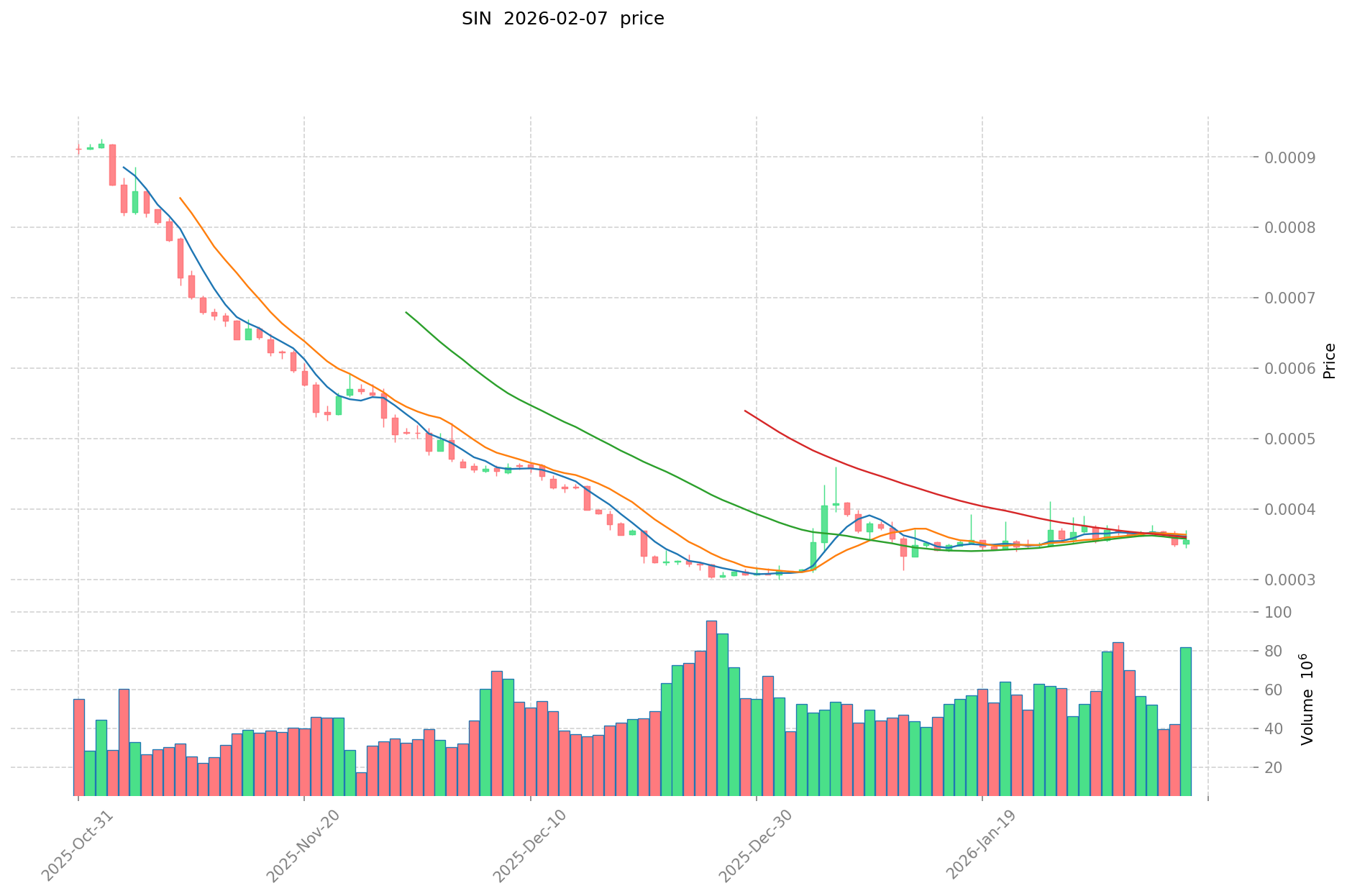
- 2025: The price declined to $0.0003024 on December 27, 2025 → SIN experienced a significant downturn from its previous elevated levels
- 2024-2025: Throughout this market cycle → The token demonstrated considerable volatility, with prices fluctuating from higher valuation zones toward notably lower ranges
Current SIN Investment Market Status (February 2026)
- SIN current price: $0.00035
- 24-hour trading volume: $24,089.26
- Market capitalization: $311,832.60
- Circulating supply: 890,950,292.13 SIN (89.10% of total supply)
- Token holders: 22,653 addresses
Click to view real-time SIN market price
II. Core Factors Influencing Whether SIN Is a Good Investment
Supply Mechanism and Scarcity
- Fixed supply structure → Potential influence on price and investment value
- Supply dynamics: SIN has a maximum supply of 1,000,000,000 tokens with a circulating supply of approximately 890,950,292 tokens (89.1% of total supply). This relatively high circulation ratio suggests limited immediate scarcity pressure compared to assets with lower circulation percentages.
- Investment consideration: The token's supply characteristics show that most tokens are already in circulation, which may reduce potential scarcity-driven price appreciation compared to projects with lower circulation ratios.
- Current market positioning: As of February 7, 2026, SIN is ranked #3499 by market capitalization, with a fully diluted market cap of $350,000 and a circulating market cap of approximately $311,833.
- Price performance analysis: The token is trading at $0.00035, representing a decline of approximately 99.95% from its initial offering price of $0.31998 in October 2021. Recent performance shows a 2% decline over 24 hours, 6.56% decline over 7 days, 10.52% decline over 30 days, and 84.17% decline over one year.
- Historical price range: The token has experienced significant volatility, with a recorded high of $0.710213 in November 2021 and a low of $0.0003024 in December 2025.
- Investment implication: The substantial decline from historical peaks and ongoing downward trends suggest elevated investment risk and limited short-term recovery momentum.
Liquidity and Market Activity
- Trading volume: 24-hour trading volume stands at approximately $24,089, which is relatively modest compared to the circulating market cap.
- Exchange availability: SIN is listed on 2 exchanges, with Gate.com being a confirmed trading platform.
- Holder distribution: The token has approximately 22,653 holders, indicating a moderate level of community participation.
- Investment consideration: Limited exchange listings and modest trading volumes may impact liquidity, potentially affecting entry and exit opportunities for investors.
Project Fundamentals and Ecosystem Development
- Project positioning: Sinverse is positioned as a blockchain-based metaverse multiplayer game, featuring digital real estate in virtual cities where users can build clubs, host events, and participate in in-game activities for rewards.
- Technical infrastructure: The token operates on the Binance Smart Chain (BSC) network, with contract address 0x6397de0F9aEDc0F7A8Fa8B438DDE883B9c201010.
- Investment assessment: The project operates in the competitive gaming and metaverse sector, where success depends on user adoption, ongoing development, and differentiation from competing platforms. The current market metrics suggest challenges in gaining significant traction relative to its initial launch period.
III. SIN Future Investment Prediction and Price Outlook (Is Sinverse(SIN) worth investing in 2026-2031)
Short-term Investment Prediction (2026, short-term SIN investment outlook)
- Conservative Prediction: $0.00027 - $0.00034
- Neutral Prediction: $0.00034
- Optimistic Prediction: $0.00035 - $0.00044
Mid-term Investment Outlook (2027-2028, mid-term Sinverse(SIN) investment forecast)
- Market Stage Expectation: Potential recovery phase with user growth driving momentum
- Investment Return Prediction:
- 2027: $0.00041 - $0.00094
- 2028: $0.00031 - $0.00062
- Key Catalysts: Ecosystem development, platform adoption, and broader metaverse gaming trends
Long-term Investment Outlook (Is SIN a good long-term investment?)
- Base Scenario: $0.00032 - $0.00086 (assuming steady platform development and moderate user growth)
- Optimistic Scenario: $0.00044 - $0.00099 (assuming accelerated ecosystem expansion and favorable market conditions)
- Risk Scenario: Below $0.00026 (in case of prolonged market downturn or project challenges)
Click to view SIN long-term investment and price prediction: Price Prediction
2026-02-07 - 2031 Long-term Outlook
- Base Scenario: $0.00026 - $0.00058 (corresponding to stable progress and steady mainstream application growth)
- Optimistic Scenario: $0.00044 - $0.00099 (corresponding to large-scale adoption and favorable market environment)
- Transformative Scenario: Above $0.0010 (if the ecosystem achieves breakthrough progress and mainstream adoption)
- 2031-12-31 Predicted High: $0.00099 (based on optimistic development assumptions)
Disclaimer: Price predictions are based on historical data and market analysis. Cryptocurrency markets are highly volatile and subject to numerous external factors. This content is for informational purposes only and should not be considered financial advice. Investors should conduct their own research and consult with financial professionals before making investment decisions.
| Year |
Predicted High Price |
Predicted Average Price |
Predicted Low Price |
Price Change |
| 2026 |
0.000440622 |
0.0003497 |
0.000258778 |
0 |
| 2027 |
0.00049395125 |
0.000395161 |
0.00022129016 |
12 |
| 2028 |
0.00061793301375 |
0.000444556125 |
0.00030674372625 |
27 |
| 2029 |
0.000632181037556 |
0.000531244569375 |
0.000371871198562 |
51 |
| 2030 |
0.000860934949129 |
0.000581712803465 |
0.000319942041906 |
66 |
| 2031 |
0.000988213710527 |
0.000721323876297 |
0.000440007564541 |
106 |
IV. Sinverse Investment Strategy and Risk Management (How to invest in Sinverse)
Investment Methodology (Sinverse investment strategy)
Long-term Holding (HODL Sinverse): Suitable for conservative investors
Long-term holding strategies focus on accumulating SIN tokens over extended periods, typically spanning multiple market cycles. This approach minimizes the impact of short-term price fluctuations and may benefit from potential project development and ecosystem expansion. Given Sinverse's current market position and price level relative to its historical data, long-term holders should establish clear investment thresholds and exit criteria.
Active Trading: Relying on technical analysis and swing trading
Active trading strategies leverage technical indicators, chart patterns, and market momentum to capture short-term price movements. SIN's 24-hour trading volume of approximately $24,089 suggests moderate liquidity levels, which may present both opportunities and challenges for active traders. Price ranges between $0.0003493 and $0.0003655 within recent 24-hour periods indicate typical intraday volatility patterns that active traders might exploit.
Risk Management (Risk management for Sinverse investment)
Asset Allocation Ratios: Conservative / Aggressive / Professional investors
- Conservative investors: Consider limiting SIN exposure to 1-3% of total crypto portfolio, given the token's market cap ranking of 3,499 and market dominance of 0.000013%
- Aggressive investors: May allocate 5-10% of speculative crypto holdings, acknowledging higher risk tolerance
- Professional investors: Institutional-level diversification strategies with position sizing based on comprehensive risk models
Risk Hedging Solutions: Multi-asset portfolios + hedging instruments
Diversification across multiple blockchain-based gaming and metaverse projects can reduce concentration risk. Investors may consider correlating SIN holdings with established cryptocurrencies to balance portfolio volatility. However, direct hedging instruments specifically for SIN may be limited given its market position.
Secure Storage: Hot/cold wallets + hardware wallet recommendations
SIN tokens exist on the BSC (Binance Smart Chain) network with contract address 0x6397de0F9aEDc0F7A8Fa8B438DDE883B9c201010. Investors should utilize:
- Hardware wallets supporting BSC network for long-term storage
- Secure software wallets compatible with BEP-20 tokens for active trading
- Multi-signature solutions for institutional holdings
- Regular security audits of wallet configurations
V. Sinverse Investment Risks and Challenges (Risks of investing in Sinverse)
Market Risk: High volatility and price manipulation concerns
SIN has experienced substantial price fluctuations, with 7-day changes of -6.56% and 30-day changes of -10.52%. The 1-year performance shows a decline of -84.17%, indicating significant downward pressure. The current price of $0.00035 represents substantial distance from its historical reference point. With a circulating market cap of approximately $311,833 and limited exchange listings (2 exchanges), the token may be susceptible to liquidity constraints and price volatility.
Regulatory Risk: Policy uncertainty across jurisdictions
As a blockchain-based metaverse gaming project, Sinverse operates in sectors subject to evolving regulatory frameworks. Different jurisdictions maintain varying approaches to virtual asset regulation, gaming tokens, and digital property rights. The lack of uniform international standards creates uncertainty regarding:
- Classification of in-game tokens and digital assets
- Tax treatment of metaverse transactions
- Securities law applicability to gaming tokens
- Cross-border transaction compliance requirements
Technical Risk: Network security vulnerabilities and upgrade failures
Key technical considerations include:
- Smart contract security on BSC network
- Potential vulnerabilities in game mechanics and tokenomics
- Dependence on underlying blockchain infrastructure
- Integration risks with third-party platforms
- Scalability challenges as user base potentially expands
With 22,653 holders and a circulation ratio of 89.1% (890,950,292.13 SIN out of 1,000,000,000 max supply), the token distribution and ecosystem stability warrant careful monitoring.
VI. Conclusion: Is Sinverse a Good Investment?
Investment Value Summary: Sinverse presents a metaverse gaming project with defined maximum supply and established contract infrastructure on BSC. The project's market position and recent price performance reflect broader challenges in the blockchain gaming sector.
Investor Recommendations:
✅ Beginners: Conduct thorough research before any allocation; prioritize secure wallet storage compatible with BSC network; understand the speculative nature of metaverse gaming tokens
✅ Experienced Investors: Implement position sizing appropriate to risk tolerance; consider technical analysis given price volatility patterns; maintain diversification across multiple metaverse and gaming projects
✅ Institutional Investors: Evaluate project fundamentals and ecosystem development metrics; assess liquidity constraints given limited exchange availability; implement comprehensive risk management protocols
⚠️ Disclaimer: Cryptocurrency investment involves substantial risk. This content is provided for informational purposes only and does not constitute investment advice. Investors should conduct independent research and consult qualified financial advisors before making investment decisions.
VII. FAQ
Q1: What is the current market position of Sinverse (SIN) and how does it compare to its historical performance?
As of February 7, 2026, SIN is ranked #3499 by market capitalization with a current price of $0.00035 and a market cap of approximately $311,832.60. The token has experienced a significant decline of approximately 99.95% from its initial offering price of $0.31998 in October 2021 and 99.95% from its all-time high of $0.710213 reached in November 2021. Recent performance metrics show declines across multiple timeframes: 2% over 24 hours, 6.56% over 7 days, 10.52% over 30 days, and 84.17% over one year, indicating sustained downward pressure and elevated investment risk.
Q2: What factors should investors consider when evaluating SIN's investment potential?
Investors should consider several critical factors: First, the token's supply dynamics show 890,950,292 tokens (89.1% of total supply) already in circulation, limiting scarcity-driven appreciation potential. Second, liquidity concerns exist with only 2 exchange listings and modest 24-hour trading volume of approximately $24,089. Third, the project operates in the highly competitive blockchain gaming and metaverse sector, where success depends on user adoption and ongoing development. Fourth, technical risks include smart contract security on BSC network and platform scalability challenges. Finally, regulatory uncertainty surrounding virtual assets and gaming tokens across different jurisdictions presents additional considerations for investment decisions.
Q3: What are the price predictions for SIN from 2026 to 2031?
Short-term predictions for 2026 range from $0.00027 to $0.00044, depending on conservative, neutral, or optimistic scenarios. Mid-term forecasts show 2027 ranging from $0.00041 to $0.00094, and 2028 from $0.00031 to $0.00062. Long-term projections through 2031 present three scenarios: Base scenario ($0.00026 - $0.00058), Optimistic scenario ($0.00044 - $0.00099), and Transformative scenario (above $0.0010). The predicted high for 2031 stands at $0.00099 under optimistic development assumptions. However, these predictions are based on historical data and market analysis, and cryptocurrency markets remain highly volatile and subject to numerous external factors.
Q4: What investment strategies are suitable for different types of SIN investors?
Long-term holding (HODL) strategies suit conservative investors who wish to minimize short-term volatility impact, though clear investment thresholds and exit criteria should be established. Active trading strategies can leverage technical indicators and intraday volatility patterns, though moderate liquidity levels ($24,089 daily volume) present both opportunities and challenges. Asset allocation recommendations vary by investor type: conservative investors should limit SIN exposure to 1-3% of total crypto portfolio, aggressive investors may allocate 5-10% of speculative holdings, while professional investors should implement institutional-level diversification strategies. All investors should utilize secure storage solutions compatible with BSC network, including hardware wallets for long-term storage and secure software wallets for active trading.
Q5: What are the primary risks associated with investing in SIN?
Market risk represents a significant concern, with SIN demonstrating high volatility and substantial price declines (-84.17% over one year). The token's small market cap ($311,833) and limited exchange listings increase susceptibility to liquidity constraints and price manipulation. Regulatory risk stems from evolving frameworks governing blockchain gaming, virtual assets, and digital property rights across jurisdictions, creating uncertainty regarding token classification, tax treatment, and compliance requirements. Technical risks include smart contract vulnerabilities on BSC network, potential issues in game mechanics, dependence on underlying blockchain infrastructure, and scalability challenges. The combination of these factors indicates that SIN investment carries substantial risk suitable primarily for investors with high risk tolerance.
Q6: How does SIN's supply mechanism affect its investment value?
SIN has a maximum supply of 1,000,000,000 tokens with approximately 890,950,292 tokens (89.1%) already in circulation. This relatively high circulation ratio suggests limited immediate scarcity pressure compared to projects with lower circulation percentages. The token's supply characteristics indicate that most tokens are already available in the market, which may reduce potential scarcity-driven price appreciation typically associated with assets having lower circulation ratios. This supply dynamic is an important consideration for investors evaluating the token's long-term value proposition, as significant future supply releases are unlikely to impact market dynamics given the high existing circulation rate.
Q7: What role does ecosystem development play in SIN's investment outlook?
Sinverse is positioned as a blockchain-based metaverse multiplayer game featuring digital real estate, virtual clubs, events, and in-game reward activities. The project's success and investment value are intrinsically linked to ecosystem development metrics including user adoption rates, platform engagement levels, and differentiation from competing metaverse projects. Current market metrics suggest challenges in gaining significant traction relative to the initial launch period. Key catalysts for potential value appreciation include successful ecosystem expansion, increased platform adoption, and alignment with broader metaverse gaming trends. However, the project operates in a highly competitive sector where numerous factors beyond token metrics influence long-term viability and investment returns.
Q8: What secure storage solutions are recommended for SIN token holders?
SIN tokens operate on the Binance Smart Chain (BSC) network with contract address 0x6397de0F9aEDc0F7A8Fa8B438DDE883B9c201010. Investors should implement secure storage practices appropriate to their holding strategy: hardware wallets supporting BSC network provide optimal security for long-term storage; secure software wallets compatible with BEP-20 tokens suit active traders requiring frequent access; institutional holdings may benefit from multi-signature solutions; and all configurations should undergo regular security audits. Proper wallet selection and security protocols are essential given the decentralized nature of blockchain assets and the absence of traditional financial institution protections for digital asset holdings.
* The information is not intended to be and does not constitute financial advice or any other recommendation of any sort offered or endorsed by Gate.