This comprehensive guide examines whether SIX Network (SIX) represents a viable investment opportunity in the real-world asset tokenization sector. SIX, launched in September 2018, offers enterprise-focused blockchain infrastructure for digitizing physical and intangible assets across finance, real estate, and loyalty programs. The analysis covers historical price performance showing a -59.98% one-year decline to current levels of $0.01143, tokenomics with 85.1% circulating supply, and projected growth scenarios through 2031 ranging from $0.01459 to $0.02058 under base conditions. Key investment factors include enterprise adoption potential, fixed supply mechanics, and technological capabilities, though risks encompass market volatility, regulatory uncertainty, and limited liquidity across 6 exchanges including Gate. Tailored strategies address conservative, aggressive, and institutional investors, emphasizing dollar-cost averaging, portfolio diversification, and secure ERC-20 storage solutions for managing t
Introduction: SIX Network (SIX) Investment Position and Market Prospects
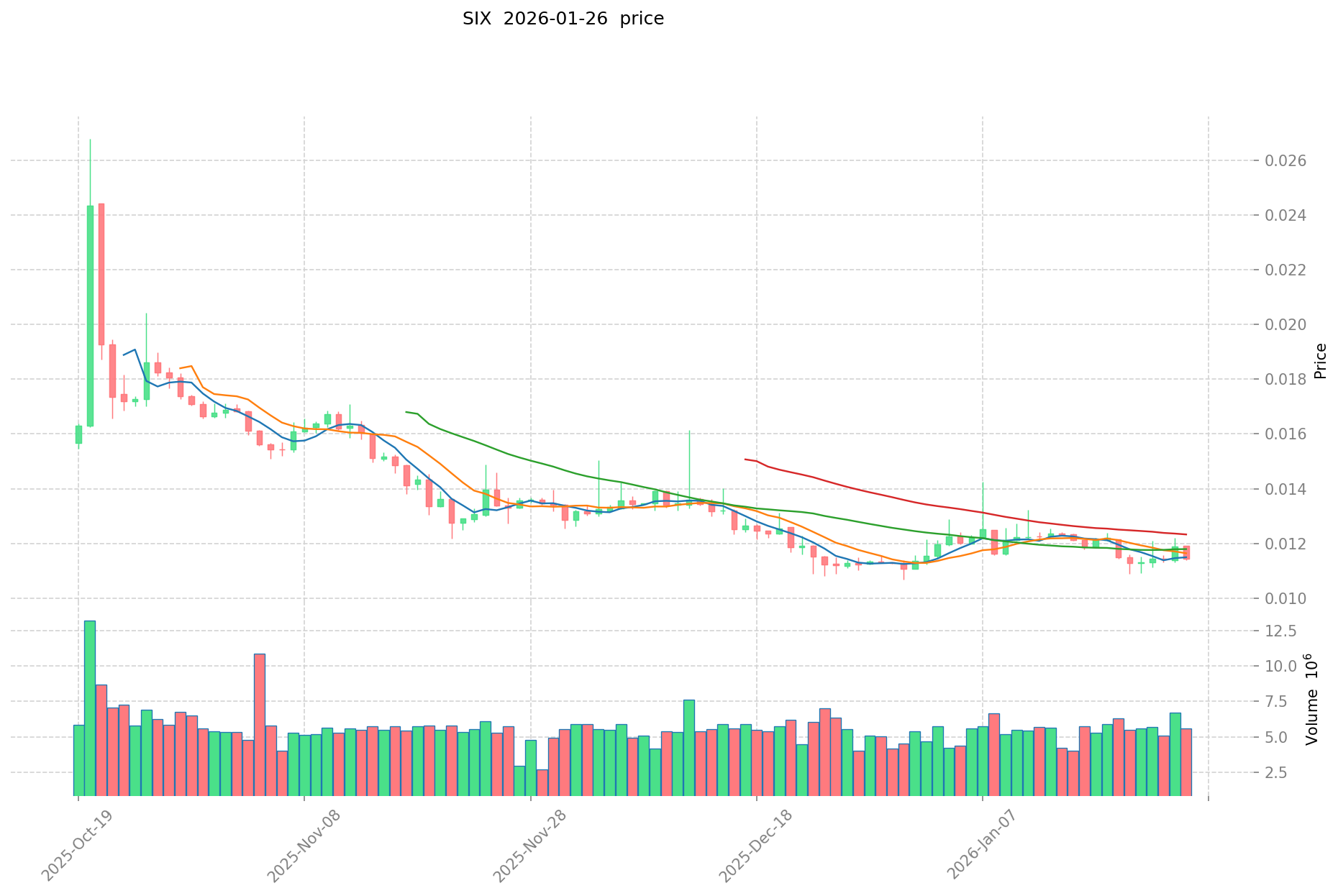
SIX is a notable asset in the cryptocurrency sector, launched in September 2018, focusing on blockchain adoption and real-world asset (RWA) tokenization for enterprises. As of January 26, 2026, SIX has a market capitalization of approximately $9.73 million, with a circulating supply of around 850.97 million tokens, and the current price is approximately $0.01143. Positioned as a blockchain infrastructure solution for RWA digitization, SIX has become a subject of interest when investors discuss "Is SIX Network (SIX) a good investment?" This article provides a comprehensive analysis of SIX's investment value, historical trends, future price projections, and associated risks to serve as a reference for investors.
With a circulating supply ratio of 85.1% and a fully diluted market cap of $11.43 million, SIX operates on the Ethereum network as an ERC-20 token. The project enables the digitization of physical and intangible assets including real estate, commodities, privileges, and loyalty rewards through tokenization tools, NFT creation capabilities, and digital asset management systems. By enhancing transparency, security, and operational efficiency via advanced encryption and smart contract audits, SIX Network facilitates blockchain integration for businesses across finance, real estate, and loyalty program sectors. The token is currently available on 6 exchanges and has 343 holders, reflecting its presence in the digital asset ecosystem.
I. SIX Token Price History Review and Current Investment Value Status
- 2024: SIX reached a notable price level of $0.0415 in November → investors experienced significant volatility during this period
- 2025: The token witnessed a decline phase → SIX price decreased to $0.01067 by year-end
- Recent performance: From the November 2024 level to December 2025 → price movement from $0.0415 to the lower range around $0.01067
Current SIX Investment Market Status (January 2026)
- SIX current price: $0.01143
- Market sentiment (Fear & Greed Index): Data indicates neutral positioning
- 24-hour trading volume: $63,137.57
- Institutional investor holdings: The token has 343 holders with a circulating supply of 850,966,610 SIX
Click to view real-time SIX market price
II. Core Factors Affecting Whether SIX is a Good Investment (Is SIX Network(SIX) a Good Investment)
Supply Mechanism and Scarcity (SIX investment scarcity)
- Fixed Supply Structure → Affects Price and Investment Value
- SIX Network has a maximum supply of 1,000,000,000 tokens, with a current circulating supply of 850,966,610 tokens (approximately 85.1% of total supply)
- The fixed supply cap may contribute to potential scarcity dynamics as circulation approaches maximum supply
- Market cap to fully diluted valuation ratio stands at 85.1%, indicating limited room for additional token releases
- Investment Significance: Scarcity mechanisms represent a foundational element for evaluating long-term investment potential
Institutional Investment and Mainstream Adoption (Institutional investment in SIX)
- Enterprise-Focused Positioning: SIX Network targets business blockchain adoption and real-world asset (RWA) tokenization, positioning itself for institutional use cases
- Industry Applications: The platform provides tools for tokenization, NFT creation, and digital asset management across sectors including finance, real estate, and loyalty programs
- Operational Infrastructure: Advanced encryption and smart contract auditing capabilities may appeal to enterprises requiring secure blockchain integration
Macroeconomic Environment Impact on SIX Investment
- Monetary Policy and Interest Rate Changes → Alter Investment Attractiveness
- Traditional macroeconomic factors including interest rate fluctuations and monetary policy adjustments can influence risk appetite for digital assets
- Geopolitical Uncertainty → Potential Demand Dynamics
- Market volatility and geopolitical developments may affect investor sentiment toward blockchain-based assets
Technology and Ecosystem Development (Technology & Ecosystem for SIX investment)
- Core Technology Focus: Blockchain simplification tools designed to enable enterprise adoption and RWA tokenization
- Ecosystem Applications: Platform supports digitization of physical and intangible assets including real estate, commodities, privileges, and benefits
- Security Infrastructure: Smart contract auditing and advanced encryption protocols aim to provide operational efficiency and transparency
- Industry-Specific Solutions: Targeted applications for finance, real estate, and loyalty program sectors may support long-term ecosystem growth
III. SIX Future Investment Forecast and Price Outlook (Is SIX Network(SIX) worth investing in 2026-2031)
Short-term Investment Forecast (2026, short-term SIX investment outlook)
- Conservative forecast: $0.00627 - $0.0114
- Neutral forecast: $0.0114 (average projected price)
- Optimistic forecast: $0.012996 (projected high)
Based on the provided prediction data, SIX Network's 2026 price trajectory suggests a relatively stable trading range. The conservative scenario anticipates potential downside to the projected low of $0.00627, while the optimistic view targets the predicted high of $0.012996. The neutral outlook centers around the average price of $0.0114, which represents minimal change from current levels.
Mid-term Investment Outlook (2027-2029, mid-term SIX Network(SIX) investment forecast)
-
Market stage expectation: Gradual accumulation phase with modest growth potential
-
Investment return forecast:
- 2027: $0.00622098 - $0.01378374 (projected 6% average increase)
- 2028: $0.0124712352 - $0.0141600483 (projected 13% average increase from 2026)
- 2029: $0.0109961219115 - $0.0156117780225 (projected 18% average increase from 2026)
-
Key catalysts: The mid-term outlook reflects progressive adoption of SIX Network's real-world asset tokenization capabilities. Growth projections indicate a compound annual growth trajectory, with 2029 showing potential for enhanced market positioning. The widening price ranges suggest increasing market participation and liquidity development over this period.
Long-term Investment Outlook (Is SIX a good long-term investment?)
- Base scenario: $0.01459361858625 - $0.020577002206612 (assuming steady ecosystem development and moderate market conditions through 2030)
- Optimistic scenario: $0.017585310396431 - $0.018992135228145 (assuming accelerated enterprise adoption and favorable regulatory environment by 2031)
- Risk scenario: $0.007734617850712 - $0.009496067614072 (under adverse market conditions or delayed technology adoption)
View SIX long-term investment and price prediction: Price Prediction
2026-01-26 - 2031 Long-term Outlook
- Base scenario: $0.01459361858625 - $0.020577002206612 (corresponding to steady progress and mainstream application advancement)
- Optimistic scenario: $0.017585310396431 - $0.018992135228145 (corresponding to large-scale adoption and favorable market conditions)
- Transformative scenario: Above $0.020577002206612 (in case of breakthrough ecosystem developments and mainstream penetration)
- 2031-12-31 projected high: $0.018992135228145 (based on optimistic development assumptions)
Disclaimer: The above predictions are based on historical data analysis and market modeling. Cryptocurrency investments carry significant risk, and actual prices may differ substantially from forecasts. This information does not constitute investment advice. Investors should conduct thorough research and consider their risk tolerance before making investment decisions.
| Year |
Predicted High Price |
Predicted Average Price |
Predicted Low Price |
Price Change |
| 2026 |
0.012996 |
0.0114 |
0.00627 |
0 |
| 2027 |
0.01378374 |
0.012198 |
0.00622098 |
6 |
| 2028 |
0.0141600483 |
0.01299087 |
0.0124712352 |
13 |
| 2029 |
0.0156117780225 |
0.01357545915 |
0.0109961219115 |
18 |
| 2030 |
0.020577002206612 |
0.01459361858625 |
0.007734617850712 |
27 |
| 2031 |
0.018992135228145 |
0.017585310396431 |
0.009496067614072 |
53 |
IV. SIX Investment Strategy and Risk Management (How to invest in SIX Network)
Investment Methodology (SIX investment strategy)
Long-term Holding (HODL SIX): Suitable for Conservative Investors
For investors with a conservative approach, long-term holding of SIX tokens may align with the project's focus on enterprise blockchain adoption and real-world asset (RWA) tokenization. This strategy involves purchasing SIX tokens and holding them through market cycles, potentially benefiting from the project's development in sectors such as finance, real estate, and loyalty programs.
Given SIX Network's positioning in facilitating digital asset management and tokenization infrastructure, long-term holders would be betting on increased enterprise adoption of blockchain technology and the growth of RWA tokenization markets. However, investors should note that SIX has experienced significant price volatility, with a one-year price change of -59.98% as of January 26, 2026.
Active Trading: Relying on Technical Analysis and Swing Operations
Active traders may approach SIX through technical analysis and short-term price movements. With a 24-hour trading volume of approximately $63,137.57 and recent price fluctuations (24-hour high of $0.01177 and low of $0.01114), there may be opportunities for swing trading strategies.
Traders should monitor key technical indicators and market sentiment while being aware that SIX is available on 6 exchanges, which may impact liquidity and price discovery. The token's market dominance of 0.00036% indicates relatively limited market presence, which could result in higher volatility and potential slippage during trades.
Risk Management (Risk management for SIX investment)
Asset Allocation Ratio: Conservative / Aggressive / Professional Investors
Conservative Investors: Given SIX's price volatility and market positioning, conservative investors might consider allocating no more than 1-3% of their cryptocurrency portfolio to SIX tokens, maintaining the majority in more established digital assets.
Aggressive Investors: Those with higher risk tolerance might allocate 5-10% of their portfolio to SIX, accepting the potential for greater volatility in exchange for possible returns aligned with RWA tokenization sector growth.
Professional Investors: Institutional or professional investors might incorporate SIX as part of a broader blockchain infrastructure or enterprise adoption thesis, potentially allocating 3-7% while maintaining diversification across similar projects in the tokenization space.
Investors can implement several risk management approaches:
- Portfolio Diversification: Combining SIX with other blockchain infrastructure projects and established cryptocurrencies to reduce concentration risk
- Correlation Analysis: Monitoring SIX's price correlation with broader crypto markets and adjusting positions accordingly
- Position Sizing: Using dollar-cost averaging to build positions gradually, reducing the impact of short-term price volatility
- Stop-loss Mechanisms: Setting predetermined exit points to limit potential losses, particularly important given SIX's price volatility
Secure Storage: Hot and Cold Wallets + Hardware Wallet Recommendations
SIX tokens are deployed on the Ethereum network as ERC-20 tokens (contract address: 0x61c6ebf443ad613c9648762585b3cfd3ba1f3fa8). For secure storage:
Hot Wallets: For active trading and frequent transactions, reputable software wallets supporting ERC-20 tokens can be used, though they carry higher security risks due to internet connectivity.
Cold Wallets: For long-term holdings, cold storage solutions provide enhanced security by keeping private keys offline.
Hardware Wallets: Devices supporting Ethereum and ERC-20 tokens offer a balanced approach, providing security for long-term storage while allowing relatively easy access when needed. Users should ensure their chosen hardware wallet is compatible with ERC-20 tokens and follow proper security protocols for backup and recovery.
V. SIX Investment Risks and Challenges (Risks of investing in SIX Network)
Market Risk: High Volatility and Price Manipulation
SIX has demonstrated considerable price volatility. The token's one-year performance shows a decline of -59.98%, indicating substantial downward price movement. The 24-hour price range between $0.01114 and $0.01177 represents approximately 5.6% volatility within a single day.
With a relatively modest market capitalization of approximately $9.73 million and trading volume of $63,137.57 over 24 hours, SIX may be susceptible to price swings from relatively small trading activities. The token's presence on only 6 exchanges and holder count of 343 addresses suggest limited liquidity, which could amplify price volatility and potentially expose the token to manipulation risks in thin market conditions.
The market cap to fully diluted valuation ratio of 85.1% indicates that 85.1% of the maximum supply is already in circulation, which reduces future supply-side inflation pressure but also means that most tokens are already in the market.
Regulatory Risk: Policy Uncertainty Across Different Countries
As a project focused on real-world asset tokenization and enterprise blockchain adoption, SIX Network operates in a regulatory landscape that continues to evolve across jurisdictions. RWA tokenization, particularly involving assets like real estate and commodities, may face regulatory scrutiny regarding securities classification, asset custody, and compliance requirements.
Different countries have varying approaches to digital asset regulation, and changes in regulatory frameworks could impact SIX Network's ability to operate in specific markets or affect the adoption of its tokenization infrastructure by enterprises. Investors should monitor regulatory developments in key markets where RWA tokenization is relevant, as policy changes could significantly affect the project's growth trajectory and token value.
The use of smart contracts for asset tokenization also raises questions about legal enforceability and regulatory compliance across borders, adding another layer of regulatory uncertainty.
Technical Risk: Network Security Vulnerabilities and Upgrade Failures
SIX tokens operate on the Ethereum network, which subjects them to the security considerations of the underlying blockchain infrastructure. While Ethereum is generally considered secure, smart contract vulnerabilities in SIX Network's tokenization and NFT creation tools could pose risks to users and the project's reputation.
The project emphasizes advanced encryption and smart contract audits to enhance security, but the complexity of tokenizing diverse real-world assets may introduce technical challenges. Any security breaches, smart contract exploits, or failures in the tokenization process could result in asset loss and damage user trust.
Additionally, as blockchain technology evolves and Ethereum continues its development, compatibility issues or required protocol upgrades could present technical risks. Failed upgrades or integration problems could disrupt SIX Network's services and affect the token's utility and value.
The project's success also depends on continued technical development and maintenance, which requires sustained resources and expertise in blockchain infrastructure.
VI. Conclusion: Is SIX Network a Good Investment?
Investment Value Summary
SIX Network positions itself in the growing sector of real-world asset tokenization and enterprise blockchain adoption, offering infrastructure for digitizing physical and intangible assets across industries such as finance, real estate, and loyalty programs. The project's focus on tokenization tools, NFT creation, and digital asset management addresses potential market needs as businesses explore blockchain integration.
However, the token has experienced substantial price decline of -59.98% over the past year, and currently trades at $0.01143 with a market capitalization of approximately $9.73 million. The relatively limited trading volume, presence on only 6 exchanges, and holder count of 343 addresses indicate modest market adoption and liquidity constraints.
The investment case for SIX depends on several factors: the pace of enterprise blockchain adoption, growth in RWA tokenization markets, the project's ability to execute its technical roadmap, and broader cryptocurrency market conditions. While the long-term potential of asset tokenization may be notable, short-term price movements are likely to remain volatile given current market metrics.
Investor Recommendations
✅ Beginners: Consider dollar-cost averaging with small allocations (1-3% of crypto portfolio) to mitigate volatility impact. Prioritize secure storage using hardware wallets compatible with ERC-20 tokens. Focus on understanding the RWA tokenization sector and SIX Network's role within it before making investment decisions.
✅ Experienced Investors: May employ swing trading strategies based on technical analysis, taking advantage of price volatility while maintaining disciplined risk management. Consider portfolio allocation of 3-5% within a diversified blockchain infrastructure strategy, monitoring project development milestones and enterprise adoption metrics.
✅ Institutional Investors: Could evaluate SIX as part of a broader thesis on asset tokenization infrastructure, potentially allocating 2-5% within a specialized blockchain portfolio. Conduct thorough due diligence on the project's enterprise partnerships, technical capabilities, and competitive positioning within the RWA tokenization space.
⚠️ Disclaimer: Cryptocurrency investments carry substantial risk due to high volatility and market uncertainty. This analysis is for informational purposes only and does not constitute investment advice. Investors should conduct independent research, assess their risk tolerance, and consider consulting financial advisors before making investment decisions.
VII. FAQ
Q1: What is the current investment outlook for SIX Network (SIX) in 2026?
The current outlook for SIX Network in 2026 suggests a relatively stable trading range with modest growth potential. Based on market analysis, the conservative forecast indicates a price range of $0.00627 - $0.0114, while the neutral scenario centers around $0.0114, representing minimal change from current levels of approximately $0.01143. The optimistic forecast targets $0.012996. However, investors should note that SIX has experienced significant volatility, with a one-year decline of -59.98% as of January 26, 2026. The token's limited market capitalization of approximately $9.73 million and trading volume of $63,137.57 indicate modest liquidity, which may contribute to continued price volatility in the short term.
Q2: How does SIX Network's tokenization focus affect its investment potential?
SIX Network's positioning in real-world asset (RWA) tokenization and enterprise blockchain adoption represents both opportunity and uncertainty for investment potential. The platform provides infrastructure for digitizing physical and intangible assets including real estate, commodities, and loyalty rewards across sectors such as finance and real estate. This focus aligns with emerging trends in asset digitization and blockchain enterprise adoption. However, the investment case depends heavily on the pace of institutional blockchain adoption and the growth trajectory of RWA tokenization markets. While the long-term potential of asset tokenization may be significant, the project's relatively limited current adoption metrics—including presence on only 6 exchanges and 343 token holders—suggest that mainstream enterprise integration remains in early stages.
Q3: What are the primary risks associated with investing in SIX Network?
SIX Network investment carries three primary risk categories. First, market risk is evidenced by substantial price volatility, with a one-year decline of -59.98% and daily fluctuations exceeding 5%. The modest market capitalization of $9.73 million and limited liquidity across only 6 exchanges may expose the token to price manipulation and amplified volatility. Second, regulatory risk stems from the evolving legal landscape surrounding RWA tokenization, particularly regarding securities classification and cross-border compliance for tokenized assets like real estate and commodities. Third, technical risk involves potential smart contract vulnerabilities in the tokenization infrastructure, despite the project's emphasis on security audits and advanced encryption. Any security breaches or technical failures in the tokenization process could result in asset loss and damage to user trust and project reputation.
Q4: What investment strategies are suitable for different investor types considering SIX Network?
Investment strategies for SIX Network vary based on investor profile and risk tolerance. Conservative investors should consider limiting allocation to 1-3% of their cryptocurrency portfolio, employing dollar-cost averaging to mitigate volatility impact, and prioritizing secure storage through hardware wallets supporting ERC-20 tokens. Aggressive investors with higher risk tolerance might allocate 5-10% of their portfolio, potentially implementing swing trading strategies based on technical analysis while maintaining disciplined risk management protocols. Professional or institutional investors could evaluate SIX as part of a broader asset tokenization infrastructure thesis, potentially allocating 3-7% within a diversified blockchain portfolio while conducting thorough due diligence on enterprise partnerships and competitive positioning. All investor types should implement multi-asset diversification strategies and establish clear stop-loss mechanisms given the token's demonstrated price volatility.
Q5: How does SIX Network's supply mechanism impact its long-term investment value?
SIX Network operates with a fixed maximum supply of 1,000,000,000 tokens, with approximately 850,966,610 tokens currently in circulation, representing 85.1% of the total supply. This high circulation ratio indicates limited room for additional token releases, which reduces future supply-side inflation pressure. The fixed supply cap may contribute to potential scarcity dynamics as circulation approaches maximum supply, representing a foundational element for evaluating long-term investment potential. The market cap to fully diluted valuation ratio of 85.1% means that most tokens are already in the market, which could support price stability in the long term if demand increases. However, the scarcity mechanism alone does not guarantee price appreciation, as investment value ultimately depends on ecosystem development, enterprise adoption rates, and broader market conditions within the RWA tokenization sector.
Q6: What is the projected long-term price outlook for SIX Network through 2031?
Long-term projections for SIX Network through 2031 suggest gradual growth potential under various scenarios. The base scenario, assuming steady ecosystem development and moderate market conditions, forecasts a price range of $0.01459361858625 - $0.020577002206612 by 2030. The optimistic scenario, contingent on accelerated enterprise adoption and favorable regulatory environment, projects $0.017585310396431 - $0.018992135228145 by 2031. Mid-term projections show progressive increases, with 2027 targeting approximately 6% average growth, 2028 projecting 13% growth from 2026 levels, and 2029 indicating potential 18% appreciation. However, investors should note that these projections are based on historical data analysis and market modeling, and actual prices may differ substantially from forecasts. Cryptocurrency investments carry significant risk, and these projections do not constitute investment advice.
Q7: How does SIX Network compare to other blockchain infrastructure projects in terms of market positioning?
SIX Network occupies a specialized niche within the blockchain infrastructure sector, focusing specifically on enterprise RWA tokenization and digital asset management. With a market capitalization of approximately $9.73 million and market dominance of 0.00036%, SIX represents a relatively small player in the broader cryptocurrency ecosystem. The token's presence on 6 exchanges and holder count of 343 addresses indicates limited mainstream adoption compared to larger blockchain infrastructure projects. However, the project's targeted approach to sectors such as finance, real estate, and loyalty programs may provide differentiation. The platform's emphasis on tokenization tools, NFT creation capabilities, and smart contract auditing positions it within the growing RWA tokenization sector, though competitive dynamics and execution capabilities will significantly impact its market positioning relative to established blockchain infrastructure providers.
Q8: What security considerations should investors prioritize when holding SIX tokens?
Security considerations for SIX token holders are particularly important given the token's ERC-20 architecture on the Ethereum network. Investors should prioritize secure storage solutions based on their holding strategy and transaction frequency. For long-term holdings, cold storage solutions provide enhanced security by keeping private keys offline, minimizing exposure to online threats. Hardware wallets supporting Ethereum and ERC-20 tokens offer a balanced approach, providing robust security while allowing relatively easy access when needed—investors should verify compatibility with the SIX contract address (0x61c6ebf443ad613c9648762585b3cfd3ba1f3fa8). For active trading, reputable software wallets supporting ERC-20 tokens can be used, though they carry higher security risks due to internet connectivity. All investors should follow proper security protocols for backup and recovery, implement strong password practices, enable two-factor authentication where available, and remain vigilant against phishing attempts and social engineering attacks targeting cryptocurrency holders.
* The information is not intended to be and does not constitute financial advice or any other recommendation of any sort offered or endorsed by Gate.