This comprehensive investment analysis examines SmarDex (SDEX), an innovative decentralized exchange protocol launched in March 2023 to address impermanent loss for liquidity providers. As of January 2026, SDEX trades at $0.005595 with a market cap of $52.33 million and ranks 509 globally. The article evaluates SDEX's investment potential through multiple dimensions: historical price performance showing a notable March 2024 peak of $0.026562 followed by market adjustment; core investment factors including 93.52% token circulation, limited mainstream adoption across 4 exchanges with 8,136 holders, and advanced algorithms developed by EPFL researchers; price forecasts ranging from conservative $0.004921 to optimistic $0.006565 for 2026; and detailed risk assessment covering market volatility, regulatory uncertainty, and technical dependencies. Tailored investment strategies address different investor profiles from beginners through institutional investors, with recommended allocations of 1-3% for conservative t
Introduction: SmarDex (SDEX) Investment Position and Market Outlook
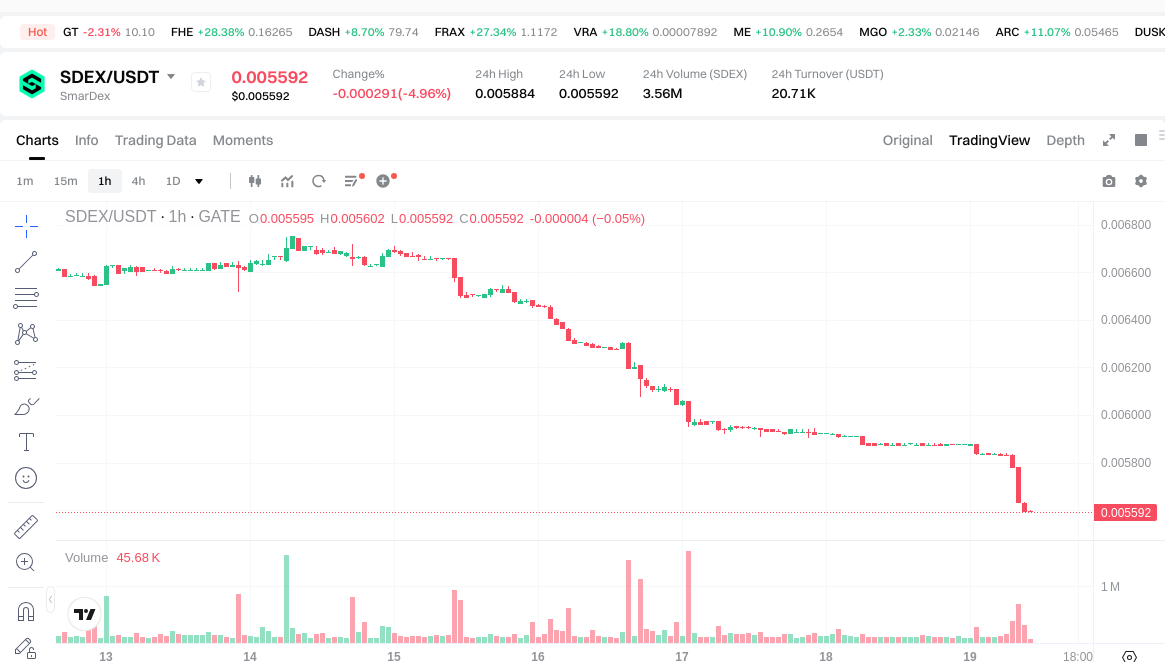
SDEX is a notable asset in the cryptocurrency sector, launched in March 2023 as an innovative decentralized exchange protocol. As of January 2026, SmarDex holds a market capitalization of approximately $52.33 million, with a circulating supply of around 9.35 billion tokens, and the current price stands at $0.005595. Positioned as a decentralized exchange platform addressing impermanent loss challenges for liquidity providers, SDEX has attracted attention from market participants. With a market ranking of 509 and a dominance of 0.0017%, the token has experienced notable price fluctuations, including a 24-hour change of -4.79% and a 7-day decline of -15.22%, while showing a 30-day gain of 12.2%. Developed by independent researchers from EPFL, SmarDex employs advanced algorithms to dynamically adjust liquidity pool ratios. This article provides a comprehensive analysis of SDEX's investment characteristics, historical price movements, future price outlook, and associated risks to serve as a reference for market participants.
I. SDEX Price History Review and Current Investment Value
- 2023: Project launched, opening early investment window → Investors gained initial access at $0.000129 offering price
- March 2024: Reached a notable price level of $0.026562 → SDEX price experienced substantial appreciation from launch levels
- 2025-2026: Market adjustment phase → Price declined from previous peak to current $0.005595 trading range
Current SDEX Investment Market Status (January 2026)
- SDEX current price: $0.005595
- Market sentiment (Fear & Greed Index): Market emotion indicator shows neutral positioning (value: 1)
- 24-hour trading volume: $20,650.70
- Token holder base: 8,136 addresses
Click to view real-time SDEX market price
II. Core Factors Influencing Whether SDEX is a Good Investment
Supply Mechanism and Scarcity (SDEX investment scarcity)
- Supply Structure: SDEX has a maximum supply of 10 billion tokens, with approximately 9.35 billion tokens currently in circulation, representing a circulating ratio of 93.52%. The relatively high circulation rate suggests limited supply-side pressure from future token releases.
- Scarcity Considerations: With the circulating supply approaching the maximum cap, SDEX exhibits characteristics of supply scarcity. However, the modest market capitalization of approximately $52.3 million and relatively low trading volume of around $20,650 indicate limited market depth, which may affect liquidity and price stability.
- Investment Implications: While scarcity can be a supporting factor for long-term investment value, the current supply dynamics should be evaluated alongside market demand and adoption metrics. The nearly complete circulation reduces concerns about future dilution but does not independently guarantee investment value.
Institutional Investment and Mainstream Adoption (Institutional investment in SDEX)
- Current Adoption Status: SDEX is traded on 4 exchanges and has approximately 8,136 token holders. The limited exchange presence and holder base suggest that mainstream institutional adoption remains in early stages.
- Market Position: With a market cap ranking of 509 and a dominance of 0.0017%, SDEX occupies a relatively small position within the broader cryptocurrency ecosystem. This indicates limited institutional interest at present.
- Adoption Outlook: The platform's academic foundation, developed through research at EPFL, may provide credibility for future institutional consideration. However, current data does not reflect significant institutional investment activity or mainstream enterprise adoption.
Macroeconomic Environment's Impact on SDEX Investment
- Market Volatility: SDEX has experienced considerable price volatility, with declines of 4.79% in 24 hours, 15.22% over 7 days, and 67.07% over the past year. Such volatility reflects sensitivity to broader market conditions and investor sentiment.
- Trading Dynamics: The relatively low 24-hour trading volume compared to market capitalization suggests limited liquidity, which may amplify price movements during periods of macroeconomic uncertainty.
- Investment Context: As a smaller-cap decentralized exchange token, SDEX may be subject to heightened risk during periods of market stress or changes in regulatory environments affecting decentralized finance platforms.
Technology and Ecosystem Development (Technology & Ecosystem for SDEX investment)
- Core Technology: SmarDex employs advanced algorithms designed to dynamically adjust liquidity pool ratios, aiming to minimize impermanent loss and potentially create impermanent gain for liquidity providers. This technology is supported by academic research from EPFL.
- Platform Features: The protocol offers a user-friendly interface intended to serve users across various experience levels, focusing on providing better incentives for liquidity providers compared to competing platforms.
- Ecosystem Scope: SDEX operates primarily on the Ethereum blockchain (contract address: 0x5de8ab7e27f6e7a1fff3e5b337584aa43961beef). The platform's focus on addressing impermanent loss represents a technical differentiation within the decentralized exchange sector.
- Development Considerations: While the underlying technology demonstrates innovation in liquidity provision mechanics, the current market presence and adoption metrics suggest the ecosystem is still developing. The long-term investment value will depend on the platform's ability to attract and retain liquidity providers and trading activity.
III. SDEX Future Investment Forecast and Price Outlook (Is SmarDex(SDEX) worth investing in 2026-2031)
Short-term Investment Forecast (2026, short-term SDEX investment outlook)
Based on available market data, SmarDex (SDEX) demonstrates moderate price volatility in the near term. The token's short-term trajectory reflects ongoing adjustments within the decentralized exchange sector.
- Conservative estimate: $0.004921 - $0.005592
- Neutral estimate: $0.005592 - $0.005983
- Optimistic estimate: $0.005983 - $0.006565
The conservative scenario assumes continued market consolidation, while the optimistic case considers potential increases in liquidity provision and trading volume on the SmarDex platform. The neutral forecast reflects moderate growth aligned with broader DeFi sector trends.
Mid-term Investment Outlook (2027-2029, mid-term SmarDex(SDEX) investment forecast)
The mid-term period presents a potential growth phase for SDEX, subject to platform development progress and market adoption rates.
- Market stage expectation: Gradual expansion phase with focus on liquidity provider incentivization and protocol optimization
- Investment return forecast:
- 2027: $0.003531 - $0.006424
- 2028: $0.003480 - $0.008182
- 2029: $0.006430 - $0.009502
- Key catalysts: Platform algorithm refinements, expansion of supported trading pairs, growth in total value locked, and broader awareness of impermanent loss mitigation features
The projected price ranges reflect varying scenarios of platform adoption and competitive positioning within the DEX landscape. Material developments in protocol functionality or strategic partnerships could influence actual performance.
Long-term Investment Outlook (Is SDEX a good long-term investment?)
Long-term projections for SDEX incorporate multiple scenarios reflecting different adoption trajectories and market conditions.
- Base scenario: $0.004578 - $0.010404 (assuming steady protocol utilization and moderate ecosystem growth)
- Optimistic scenario: $0.007865 - $0.013764 (assuming significant adoption of impermanent loss solutions and increased market share)
- Risk scenario: Below $0.003500 (reflecting adverse market conditions or competitive disadvantages)
View SDEX long-term investment and price forecast: Price Prediction
2026-01-19 to 2031 Long-term Outlook
- Base scenario: $0.004578 - $0.009363 USD (corresponding to stable progress and steady mainstream application growth)
- Optimistic scenario: $0.007865 - $0.013764 USD (corresponding to large-scale adoption and favorable market conditions)
- Transformative scenario: Above $0.015000 USD (in case of breakthrough ecosystem developments and mainstream adoption)
- 2031-12-31 projected high: $0.013764 USD (based on optimistic development assumptions)
Disclaimer: Price predictions are inherently speculative and based on historical data patterns, market trends, and available project information. Actual future prices may differ materially from forecasts due to market volatility, regulatory changes, technological developments, competitive dynamics, and unforeseen events. This analysis does not constitute investment advice. Investors should conduct independent research and consider their risk tolerance before making investment decisions.
| Year |
Predicted High Price |
Predicted Average Price |
Predicted Low Price |
Price Change |
| 2026 |
0.00598344 |
0.005592 |
0.00492096 |
0 |
| 2027 |
0.0064243692 |
0.00578772 |
0.0035305092 |
3 |
| 2028 |
0.008182099764 |
0.0061060446 |
0.003480445422 |
9 |
| 2029 |
0.00950161600206 |
0.007144072182 |
0.0064296649638 |
27 |
| 2030 |
0.010403555115037 |
0.00832284409203 |
0.004577564250616 |
48 |
| 2031 |
0.013763903417194 |
0.009363199603533 |
0.007865087666968 |
67 |
IV. SDEX Investment Strategy and Risk Management (How to invest in SmarDex)
Investment Methodology (SDEX investment strategy)
-
Long-term Holding (HODL SDEX): Suitable for conservative investors who believe in the platform's innovative approach to minimizing impermanent loss and creating impermanent gain through advanced algorithms. This strategy may benefit from the project's scientific foundation developed by EPFL research team.
-
Active Trading: Relies on technical analysis and swing trading operations. Traders may consider monitoring SDEX's price volatility, which has shown fluctuations with a 24-hour change of -4.79% and 7-day change of -15.22% as of January 19, 2026.
Risk Management (Risk management for SDEX investment)
V. SDEX Investment Risks and Challenges (Risks of investing in SmarDex)
-
Market Risk: High volatility with price fluctuations evident in recent performance. The token has experienced a 1-year decline of -67.07%, indicating substantial price movement. Trading volume of approximately $20,650 on January 19, 2026, suggests moderate liquidity levels.
-
Regulatory Risk: Decentralized exchange tokens face evolving regulatory frameworks across different jurisdictions. Policy uncertainty in various countries may impact SDEX's operations and token value.
-
Technical Risk:
- Network security vulnerabilities in smart contracts
- Potential risks associated with platform upgrades or algorithm adjustments
- Dependency on Ethereum network performance and gas fees
- Limited exchange availability with listings on 4 exchanges as of current data
VI. Conclusion: Is SmarDex a Good Investment?
-
Investment Value Summary: SDEX presents an innovative approach to decentralized finance through its scientifically-backed methodology for addressing impermanent loss. The platform's development by EPFL research team provides a unique technical foundation. However, the token has experienced notable price volatility, with significant fluctuations across different time periods.
-
Investor Recommendations:
✅ Beginners: Consider dollar-cost averaging (DCA) approach with secure wallet storage. Start with small allocations to understand platform mechanics and market behavior.
✅ Experienced Investors: May explore swing trading opportunities while maintaining core holdings. Monitor technical indicators and platform development updates for informed decision-making.
✅ Institutional Investors: Evaluate strategic long-term allocation potential based on comprehensive due diligence of the platform's technological innovation and market positioning within the DEX ecosystem.
⚠️ Disclaimer: Cryptocurrency investment carries substantial risk. This content is for informational purposes only and does not constitute investment advice. Conduct thorough research and consider consulting financial professionals before making investment decisions.
VII. FAQ
Q1: What makes SDEX different from other decentralized exchange tokens?
SDEX distinguishes itself through its scientifically-backed approach to addressing impermanent loss, a significant challenge faced by liquidity providers in decentralized exchanges. Developed by independent researchers from EPFL (École Polytechnique Fédérale de Lausanne), the platform employs advanced algorithms that dynamically adjust liquidity pool ratios to minimize impermanent loss and potentially create impermanent gain for liquidity providers. This academic foundation and innovative mechanism sets SDEX apart from conventional DEX tokens that primarily focus on trading fee distribution without addressing the core challenge of impermanent loss that discourages liquidity provision.
Q2: Is SDEX suitable for long-term investment in 2026?
SDEX may appeal to risk-tolerant investors with a long-term perspective who believe in the platform's innovative approach to DEX liquidity provision. The token has a relatively complete circulation (93.52% of maximum supply), reducing future dilution concerns, and benefits from academic research backing. However, potential investors should note the significant volatility, with a 67.07% decline over the past year and limited current adoption (8,136 holders across 4 exchanges). Long-term investment suitability depends on individual risk tolerance, portfolio diversification strategy, and belief in the platform's ability to gain market share in the competitive DEX landscape. Conservative investors should limit SDEX to 1-3% of their crypto portfolio, while more aggressive investors might consider 5-10% allocation.
Q3: What is the projected price range for SDEX by the end of 2026?
Based on current market analysis and historical trends, SDEX price projections for 2026 range from $0.004921 (conservative estimate) to $0.006565 (optimistic estimate), with a neutral forecast around $0.005592 to $0.005983. The conservative scenario assumes continued market consolidation and limited growth in platform adoption, while the optimistic case considers potential increases in liquidity provision and trading volume on the SmarDex platform. These projections are based on the assumption that the platform continues developing its unique impermanent loss mitigation features and gradually expands its user base. However, actual performance may vary significantly based on overall cryptocurrency market conditions, competitive dynamics, and the platform's success in attracting liquidity providers.
Q4: What are the main risks associated with investing in SDEX?
SDEX investment carries multiple risk categories that investors should carefully evaluate. Market risk is substantial, evidenced by high volatility with a 67.07% annual decline and limited liquidity (24-hour trading volume of approximately $20,650). Regulatory risk affects all DEX tokens as global jurisdictions continue developing cryptocurrency regulations that could impact decentralized trading platforms. Technical risks include potential smart contract vulnerabilities, dependency on Ethereum network performance and gas fees, and risks associated with platform algorithm upgrades. Additionally, SDEX faces competitive risk in the crowded DEX market and limited adoption risk, with current presence on only 4 exchanges and approximately 8,136 token holders, suggesting early-stage mainstream adoption.
Q5: How should investors approach SDEX trading strategies?
Investment strategy for SDEX should align with individual risk tolerance and investment objectives. For long-term holders (HODL strategy), SDEX may represent a position in innovative DeFi technology, suitable for investors who believe in the platform's scientific approach to impermanent loss mitigation. This strategy requires secure storage solutions such as hardware wallets and tolerance for significant price volatility. For active traders, SDEX's volatility presents swing trading opportunities, though traders should monitor technical indicators and be aware of limited liquidity that may impact execution. A dollar-cost averaging (DCA) approach is recommended for beginners to minimize timing risk and gradually build positions while learning about the platform. Regardless of strategy, investors should implement proper risk management through portfolio diversification, appropriate position sizing (1-3% for conservative, 5-10% for aggressive investors), and regular monitoring of platform development and market conditions.
Q6: What factors could drive SDEX price appreciation in the mid-term?
Several key catalysts could potentially drive SDEX price appreciation during the 2027-2029 mid-term period. Platform algorithm refinements that demonstrably reduce impermanent loss could attract more liquidity providers seeking better risk-adjusted returns. Expansion of supported trading pairs and blockchain integrations beyond Ethereum could broaden the user base and increase trading volume. Growth in total value locked (TVL) on the platform would signal increased trust and adoption among DeFi participants. Broader market awareness of the platform's unique impermanent loss mitigation features could differentiate SDEX from competing DEX platforms. Strategic partnerships with other DeFi protocols or institutional adoption could provide credibility and expanded utility. Additionally, favorable developments in the overall DeFi sector and positive cryptocurrency market conditions would create a supportive environment for SDEX price appreciation.
Q7: What security measures should SDEX investors implement?
SDEX investors should implement comprehensive security measures to protect their holdings. For long-term investors, hardware wallets such as Ledger or Trezor provide the highest security level by keeping private keys offline and protected from online threats. Cold storage solutions are recommended for substantial SDEX holdings that won't be actively traded. For active traders requiring frequent access, reputable hot wallets with strong security features and two-factor authentication should be used, though only amounts needed for trading should be kept in hot wallets. Investors must verify the correct SDEX contract address (0x5de8ab7e27f6e7a1fff3e5b337584aa43961beef) on Ethereum blockchain to avoid interacting with fraudulent tokens. Regular security audits of personal wallet security, avoiding phishing attempts, and never sharing private keys or seed phrases are essential practices. Additionally, diversifying holdings across multiple secure storage solutions can provide additional protection against single points of failure.
Q8: How does SDEX compare to major DEX platforms in terms of investment potential?
SDEX occupies a distinct position compared to established DEX platforms through its academic research foundation and focus on impermanent loss mitigation, a problem that major platforms have not adequately addressed. However, from an investment perspective, SDEX faces significant challenges in competing with established platforms. With a market cap of approximately $52.33 million and ranking at 509, SDEX represents a significantly smaller scale compared to leading DEX tokens. The platform's limited presence on 4 exchanges and approximately 8,136 holders indicates early-stage adoption compared to major platforms with millions of users and extensive exchange listings. While SDEX's innovative approach to impermanent loss provides technological differentiation, this advantage must translate into measurable adoption and liquidity provision to drive investment value. Investors considering SDEX should view it as a higher-risk, potentially higher-reward investment compared to established DEX platforms, suitable for those seeking exposure to innovative DeFi technology with appropriate risk management and portfolio allocation.
* The information is not intended to be and does not constitute financial advice or any other recommendation of any sort offered or endorsed by Gate.