Soil (SOIL) is a blockchain-based lending protocol launched in October 2023 that bridges traditional corporate finance with cryptocurrency through real-world asset-backed lending on the Polygon network. Currently trading at $0.137 with a $9.06 million market capitalization and 4,549 token holders, SOIL offers yield-generating opportunities for stablecoin lenders and financing for established companies. Price predictions suggest SOIL may trade within $0.11-$0.18 in 2026, with long-term forecasts reaching $0.17-$0.30 by 2030 under baseline to optimistic scenarios. However, the token faces substantial risks including 69.54% year-over-year decline, limited liquidity ($42,929 daily volume), regulatory uncertainties surrounding RWA-backed DeFi, and smart contract vulnerabilities. Conservative investors should allocate no more than 1-3% of crypto portfolios to SOIL, employ hardware wallet storage, and conduct thorough due diligence on protocol operations and real-world asset quality before investment decisions.
Introduction: Soil (SOIL) Investment Position and Market Outlook
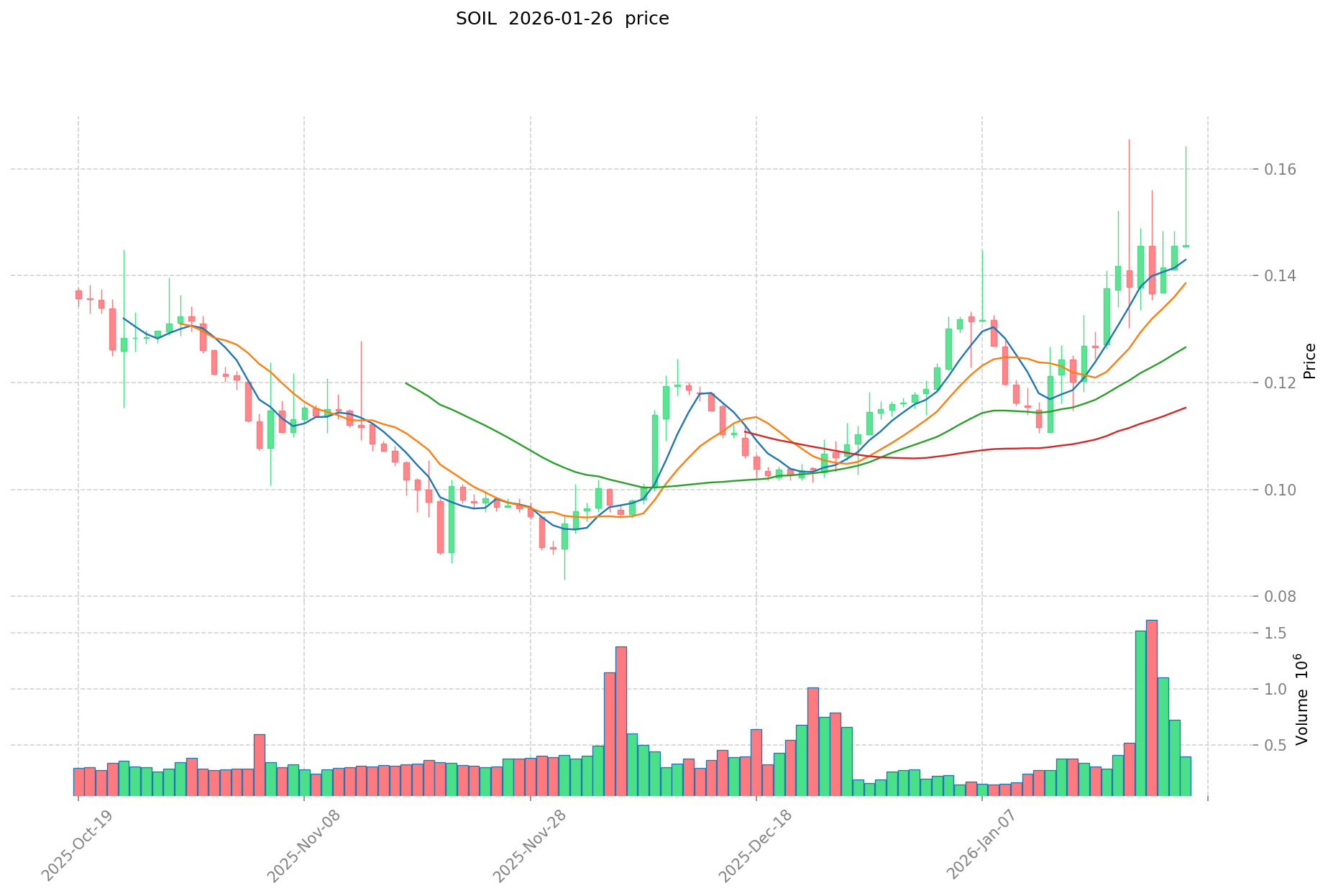
Soil (SOIL) represents a notable asset in the cryptocurrency sector, functioning as a blockchain-based lending protocol that connects traditional finance with the digital asset ecosystem. Since its launch in October 2023, Soil has positioned itself within the decentralized finance (DeFi) and real-world asset (RWA) sectors. As of January 26, 2026, SOIL maintains a market capitalization of approximately $9.06 million, with a circulating supply of around 66.05 million tokens out of a maximum supply of 100 million. The current trading price stands at $0.13723, reflecting recent market movements. With a market ranking of 1248 and holding by 4,549 addresses, Soil has established a presence in the lending protocol segment. The protocol serves as a debt marketplace where established companies can access financing while crypto investors can lend stablecoins to earn yield from off-chain real-world assets. This article provides a comprehensive analysis of SOIL's investment characteristics, historical price performance, future price considerations, and associated risks to offer investors relevant information for their evaluation process.
I. Soil (SOIL) Price History Review and Current Investment Value
- 2023: Token Launch Phase → SOIL was published on October 11, 2023, with an initial offering price of $0.18, establishing its entry point in the DeFi lending market
- 2023-2024: Initial Trading Period → Price fluctuated between $0.04 and higher levels during the establishment phase, reflecting early market discovery
- 2024: Market Expansion → On March 28, 2024, SOIL reached a notable price level of $4.00, representing significant growth from its launch price
- 2024-2026: Market Adjustment → Price experienced corrections from previous levels, with the token trading at $0.13723 as of January 26, 2026
Current SOIL Investment Market Status (January 2026)
- SOIL Current Price: $0.13723
- 24-Hour Trading Volume: $42,929.01
- Market Capitalization: $9,064,442.39
- Circulating Supply: 66,052,921.26 SOIL (66.05% of total supply)
- Fully Diluted Valuation: $13,723,000
- Total Supply: 100,000,000 SOIL
- Token Holders: 4,549
- Listed Exchanges: 3 platforms
- Recent Price Performance:
- 1H: -1.60%
- 24H: -15.31%
- 7D: -5.87%
- 30D: +23.21%
- 1Y: -69.54%
Click to view real-time SOIL market price
II. Core Factors Influencing Whether SOIL is a Good Investment
Supply Mechanism and Scarcity (SOIL Investment Scarcity)
- Fixed Supply Model → Influencing Price and Investment Value
SOIL operates with a defined supply structure, featuring a maximum supply of 100,000,000 tokens and a circulating supply of approximately 66,052,921 tokens as of January 26, 2026. This represents a circulation ratio of approximately 66.05%, indicating that a substantial portion of the total supply is already in circulation. The fixed maximum supply creates a predetermined scarcity framework that may influence long-term value dynamics.
- Historical Price Patterns: Price Fluctuations Observed
Historical data shows that SOIL experienced price movements ranging from a recorded low of $0.04 in October 2023 to a higher point of $4 in March 2024. As of January 26, 2026, the token is trading at approximately $0.13723, reflecting a decline of approximately 69.54% over a one-year period. These fluctuations demonstrate the volatility characteristics common in digital asset markets.
- Investment Consideration: Scarcity as a Foundational Element
The predetermined maximum supply of 100,000,000 tokens establishes a scarcity parameter that may serve as one of several factors investors consider when evaluating long-term investment potential. However, scarcity alone does not guarantee value appreciation, as market demand, adoption, and broader economic conditions also play significant roles.
Institutional Investment and Mainstream Adoption (Institutional Investment in SOIL)
- Institutional Holding Trends: Limited Data Available
Specific data regarding institutional investment positions in SOIL is not provided in the available materials. The token currently has approximately 4,549 holders and is listed on 3 exchanges, suggesting a relatively modest holder base compared to more widely adopted digital assets.
- Enterprise Adoption of SOIL → Potential Impact on Investment Value
SOIL positions itself as a blockchain-based lending protocol bridging traditional finance and cryptocurrency markets, focusing on corporate debt and fixed-income investments. The protocol facilitates a debt marketplace where established companies can obtain financing while cryptocurrency investors lend stablecoins to earn yield from real-world assets. This structural approach targets institutional participation through regulated DeFi mechanisms backed by real-world assets, though specific adoption metrics by named enterprises are not detailed in the available materials.
- Regulatory Environment and Policy Considerations
SOIL emphasizes its status as a fully regulated DeFi protocol, which may influence institutional confidence and adoption potential. However, specific national policies or regulatory frameworks explicitly supporting or restricting SOIL investment are not detailed in the provided materials.
Macroeconomic Environment's Impact on SOIL Investment
- Monetary Policy and Interest Rate Changes → Altering Investment Attractiveness
Broader macroeconomic factors, including monetary policy adjustments and interest rate changes by central banks, can influence investor appetite for alternative assets including digital currencies. During periods of accommodative monetary policy, investors may seek yield-generating opportunities in DeFi protocols such as SOIL. Conversely, tightening monetary conditions may redirect capital flows toward traditional fixed-income instruments.
- Inflation Environment and Hedging Potential
While some digital assets are positioned as inflation hedges, SOIL's specific utility focuses on providing yield through real-world asset-backed lending rather than serving as a store of value comparable to traditional inflation hedges. Its investment appeal may depend more on yield generation capabilities relative to inflation-adjusted returns rather than price appreciation as an inflation hedge.
- Geopolitical Uncertainty → Influencing SOIL Investment Demand
Geopolitical instability can affect investor preferences for decentralized financial instruments. SOIL's positioning as a bridge between traditional corporate finance and cryptocurrency markets may attract investors seeking alternative lending mechanisms during periods of conventional market volatility, though specific demand patterns related to geopolitical events are not documented in the available materials.
Technology and Ecosystem Development (Technology & Ecosystem for SOIL Investment)
- Contract Deployment and Technical Infrastructure: Polygon Network Implementation
SOIL's token is deployed on the Polygon (MATIC) network at contract address 0x43C73b90E0C2A355784dCf0Da12f477729b31e77. The choice of Polygon as a deployment network suggests emphasis on scalability and lower transaction costs compared to Ethereum mainnet, potentially enhancing operational efficiency for lending and borrowing activities.
- Ecosystem Application: DeFi Lending Protocol Features
SOIL functions as a debt marketplace protocol enabling corporate financing through stablecoin lending backed by real-world assets. This model combines decentralized finance infrastructure with traditional fixed-income investment characteristics, potentially attracting investors seeking yield opportunities with underlying asset backing. The protocol's focus on regulated operations and real-world asset backing distinguishes it from purely speculative DeFi platforms.
- Long-term Value Support Through Real-World Asset Integration
The integration of real-world assets as collateral for stablecoin lending represents an approach to value support distinct from purely algorithmic or speculative mechanisms. This structure aims to provide tangible backing for yield generation, though the actual performance and risk characteristics depend on the quality of underlying assets, borrower creditworthiness, and operational execution—factors not fully detailed in the available materials.
III. SOIL Future Investment Forecast and Price Outlook (Is Soil(SOIL) worth investing in 2026-2030)
Short-term Investment Forecast (2026, short-term SOIL investment outlook)
Based on various price prediction models, SOIL may exhibit moderate volatility in 2026:
- Conservative forecast: $0.1093 - $0.1457
- Neutral forecast: $0.1457 - $0.1836
- Optimistic forecast: $0.1836 - $0.4248
Multiple analytical sources suggest that SOIL could experience price growth around 6% throughout 2026, with some predictions indicating the token may exceed $0.125 by year-end. The current trading range reflects ongoing market adjustments following the token's recent performance fluctuations.
Mid-term Investment Outlook (2027-2028, mid-term Soil(SOIL) investment forecast)
- Market phase expectation: Gradual recovery and potential expansion phase, as the protocol continues developing its real-world asset-backed lending infrastructure
- Investment return forecast:
- 2027: $0.1235 - $0.1877 (projected growth of approximately 19%)
- 2028: $0.1039 - $0.1850 (projected growth of approximately 28%)
- Key catalysts: Expansion of institutional partnerships for corporate debt financing, increased adoption of stablecoin lending mechanisms, regulatory developments in RWA-backed DeFi protocols, and broader market sentiment toward real-world asset tokenization
Long-term Investment Outlook (Is SOIL a good long-term investment?)
Long-term projections for SOIL through 2030 vary considerably depending on adoption rates and market conditions:
- Baseline scenario: $0.1727 - $0.2031 (assuming steady growth in corporate borrower adoption and stable stablecoin lending demand)
- Optimistic scenario: $0.2500 - $0.2966 (assuming accelerated institutional adoption, favorable regulatory framework, and expanded real-world asset integration)
- Risk scenario: Below $0.1039 (under adverse market conditions, regulatory headwinds, or diminished demand for RWA-backed lending)
Extended forecasts suggest that by 2050, SOIL's value may reach approximately $0.49, representing potential long-term appreciation of over 250% from current levels, though such projections carry substantial uncertainty.
View SOIL long-term investment and price predictions: Price Prediction
2026-2030 Long-term Outlook
- Baseline scenario: $0.1727 - $0.2500 (corresponding to steady progress and gradual mainstream application adoption)
- Optimistic scenario: $0.2500 - $0.2966 (corresponding to large-scale adoption and favorable market environment)
- Transformative scenario: Above $0.3249 (if ecosystem achieves breakthrough developments and mainstream proliferation)
- 2030-12-31 predicted high: $0.2966 (based on optimistic development assumptions)
Disclaimer: Price predictions are inherently speculative and based on historical data, technical analysis, and market modeling. Actual results may differ substantially. Cryptocurrency investments carry significant risk, including potential loss of principal. This analysis does not constitute financial advice, and investors should conduct independent research and consult qualified professionals before making investment decisions.
| Year |
Predicted High Price |
Predicted Average Price |
Predicted Low Price |
Price Change |
| 2026 |
0.1835694 |
0.14569 |
0.1092675 |
6 |
| 2027 |
0.187677858 |
0.1646297 |
0.123472275 |
19 |
| 2028 |
0.18496146795 |
0.176153779 |
0.10393072961 |
28 |
| 2029 |
0.22569702934375 |
0.180557623475 |
0.122779183963 |
31 |
| 2030 |
0.296565896557687 |
0.203127326409375 |
0.172658227447968 |
48 |
| 2031 |
0.32480059492859 |
0.249846611483531 |
0.144911034660448 |
82 |
IV. Soil Investment Strategy and Risk Management (How to invest in DeFi Lending Tokens)
Investment Methodology (Soil investment strategy)
-
Long-term Holding (HODL Soil): Suitable for conservative investors who believe in the long-term potential of blockchain-based lending protocols bridging traditional finance and crypto. This approach focuses on accumulating SOIL tokens during market dips and holding through volatility cycles.
-
Active Trading: Relies on technical analysis and swing trading strategies. Given SOIL's 24-hour volatility of -15.31% and weekly fluctuation of -5.87%, active traders may capitalize on price movements between support levels around $0.13485 and resistance near $0.16213. However, with relatively modest daily trading volume of approximately $42,929, liquidity considerations are important.
Risk Management (Risk management for Soil investment)
-
Asset Allocation Ratios:
- Conservative investors: Allocate no more than 1-3% of crypto portfolio to SOIL
- Moderate investors: 3-7% allocation with regular rebalancing
- Aggressive investors: Up to 10% allocation with active monitoring
-
Risk Hedging Solutions: Implement multi-asset portfolio diversification across stablecoins, major cryptocurrencies, and other DeFi protocols. Consider maintaining a portion of holdings in established assets to offset the volatility inherent in mid-cap tokens like SOIL (currently ranked #1248).
-
Secure Storage:
- Hot wallets: For active trading amounts only
- Cold storage: Hardware wallets (such as Ledger or Trezor) recommended for long-term holdings
- Contract verification: Always verify the official Polygon contract address (0x43C73b90E0C2A355784dCf0Da12f477729b31e77) before transactions
V. Soil Investment Risks and Challenges (Risks of investing in DeFi Lending Tokens)
-
Market Risks: SOIL exhibits substantial price volatility, with a 1-year decline of -69.54% from previous levels. The token's market capitalization of approximately $9.06 million and relatively low trading volume may expose investors to price manipulation risks and liquidity constraints during large transactions.
-
Regulatory Risks: As a protocol bridging traditional finance and crypto through real-world asset-backed lending, SOIL operates in a regulatory gray area. Different jurisdictions maintain varying stances on DeFi lending platforms, and future regulatory changes could impact the protocol's operations or token valuation.
-
Technical Risks: Blockchain-based lending protocols face smart contract vulnerabilities, potential network security breaches, and risks associated with protocol upgrades. The integration of off-chain real-world assets introduces additional complexity and counterparty risks not present in purely on-chain protocols.
VI. Conclusion: Is DeFi Lending Token a Good Investment?
-
Investment Value Summary: Soil demonstrates potential in connecting traditional corporate debt markets with crypto lending, addressing a growing sector of real-world asset integration in DeFi. However, the token has experienced notable price declines over the past year, and its relatively small market presence (0.00044% market dominance) indicates higher risk compared to established cryptocurrencies.
-
Investor Recommendations:
✅ Beginners: Consider dollar-cost averaging with small amounts, store securely in hardware wallets, and maintain realistic expectations given the token's volatility profile
✅ Experienced Investors: Employ swing trading strategies within established support/resistance ranges, maintain diversified portfolio allocation, and monitor protocol developments and real-world asset performance
✅ Institutional Investors: Conduct thorough due diligence on the protocol's regulatory compliance, real-world asset quality, and counterparty risks before strategic allocation
⚠️ Disclaimer: Cryptocurrency investments carry substantial risk. This content is for informational purposes only and does not constitute investment advice. Always conduct independent research and consult with financial professionals before making investment decisions.
VII. FAQ
Q1: What is Soil (SOIL) and how does it differ from other DeFi lending protocols?
Soil (SOIL) is a blockchain-based lending protocol launched in October 2023 that bridges traditional corporate finance with cryptocurrency markets through real-world asset (RWA)-backed lending. Unlike purely algorithmic DeFi protocols, SOIL operates as a regulated debt marketplace where established companies can access financing while crypto investors lend stablecoins to earn yield from off-chain real-world assets. The protocol is deployed on the Polygon network (contract address: 0x43C73b90E0C2A355784dCf0Da12f477729b31e77), focusing on corporate debt and fixed-income investments backed by tangible assets rather than speculative yield farming mechanisms. This structure distinguishes SOIL by emphasizing regulatory compliance and real-world asset integration, though it also introduces counterparty risks and operational complexities not present in fully on-chain protocols.
Q2: What are the primary risks associated with investing in SOIL tokens?
SOIL investment carries multiple risk categories requiring careful consideration. Market risks include substantial price volatility, with the token declining 69.54% over the past year and currently exhibiting 24-hour fluctuations of -15.31%. The relatively small market capitalization of approximately $9.06 million and modest daily trading volume of $42,929 create liquidity constraints and potential price manipulation vulnerabilities. Regulatory risks stem from SOIL's positioning at the intersection of traditional finance and DeFi, as different jurisdictions maintain evolving stances on RWA-backed lending platforms. Technical risks encompass smart contract vulnerabilities, network security breaches, and the additional complexity introduced by integrating off-chain real-world assets, which creates counterparty risks absent in purely on-chain protocols. Conservative investors should limit SOIL allocation to 1-3% of their crypto portfolio.
Q3: How has SOIL performed historically and what factors influenced its price movements?
SOIL launched in October 2023 at an initial price of $0.18 and experienced significant price discovery volatility during its early trading phase, with prices fluctuating between $0.04 and higher levels. The token reached a notable peak of $4.00 on March 28, 2024, representing substantial growth from its launch price. However, since that peak, SOIL has undergone considerable correction, trading at $0.13723 as of January 26, 2026—a decline of approximately 96.5% from its all-time high. Recent performance shows mixed results with a 23.21% gain over 30 days but negative returns across shorter timeframes (-15.31% in 24 hours, -5.87% in 7 days). These fluctuations reflect factors including early market discovery dynamics, broader cryptocurrency market sentiment, adoption rates of the lending protocol, and general volatility characteristics common in mid-cap digital assets with relatively limited liquidity.
Q4: What are the price predictions for SOIL from 2026 to 2030?
Price forecasts for SOIL through 2030 vary considerably depending on adoption scenarios and market conditions. For 2026, conservative estimates range from $0.1093 to $0.1457, while optimistic forecasts suggest potential prices between $0.1836 and $0.4248, representing approximately 6% growth from current levels. Mid-term projections for 2027-2028 anticipate gradual recovery with 2027 estimates of $0.1235-$0.1877 (19% growth) and 2028 projections of $0.1039-$0.1850 (28% growth). Long-term forecasts through 2030 present a baseline scenario of $0.1727-$0.2031, an optimistic scenario of $0.2500-$0.2966, and a transformative scenario exceeding $0.3249. These projections assume factors including expanded institutional partnerships, increased stablecoin lending adoption, favorable regulatory developments, and broader market acceptance of RWA-backed DeFi protocols. However, these predictions are inherently speculative and actual results may differ substantially due to unpredictable market dynamics.
Q5: What investment strategies are most suitable for SOIL tokens?
Investment approaches for SOIL should align with individual risk tolerance and investment objectives. Long-term holding (HODL) strategies suit conservative investors who believe in the protocol's potential to bridge traditional finance and crypto through real-world asset integration, focusing on accumulating tokens during market dips while accepting volatility. Active trading strategies may capitalize on SOIL's price fluctuations, utilizing technical analysis around support levels near $0.13485 and resistance around $0.16213, though traders should consider the relatively modest daily trading volume of approximately $42,929 which may affect liquidity. Recommended asset allocation varies by investor profile: conservative investors should allocate 1-3% of their crypto portfolio to SOIL, moderate investors 3-7% with regular rebalancing, and aggressive investors up to 10% with active monitoring. All investors should implement risk management through multi-asset diversification, secure storage in hardware wallets for long-term holdings, and verification of the official Polygon contract address before transactions.
Q6: Is SOIL a good long-term investment compared to other DeFi protocols?
SOIL's long-term investment potential presents both opportunities and challenges relative to other DeFi protocols. The token's focus on real-world asset-backed lending and regulated operations may appeal to investors seeking tangible value backing rather than purely speculative mechanisms, potentially attracting institutional participants who prioritize compliance and asset-backed yields. However, SOIL's current market position presents notable concerns: a market capitalization of only $9.06 million, ranking at #1248, and market dominance of just 0.00044% indicate substantially higher risk compared to established DeFi protocols. The 69.54% decline over the past year demonstrates significant volatility, while the circulating supply of 66.05% suggests moderate tokenomics. Long-term success depends on factors including increased corporate borrower adoption, favorable regulatory frameworks for RWA-backed DeFi, protocol execution quality, and broader market acceptance of tokenized real-world assets. Conservative investors should view SOIL as a higher-risk, speculative position requiring thorough due diligence and appropriate portfolio allocation limits.
Q7: How does the macroeconomic environment affect SOIL investment value?
Macroeconomic conditions significantly influence SOIL's investment attractiveness through multiple channels. Monetary policy adjustments and interest rate changes by central banks directly impact investor appetite for alternative yield-generating assets like SOIL—accommodative policies may drive capital toward DeFi lending protocols seeking higher yields, while tightening monetary conditions may redirect flows toward traditional fixed-income instruments offering competitive risk-adjusted returns. Unlike cryptocurrencies positioned primarily as inflation hedges, SOIL's investment appeal depends more on its yield generation capabilities relative to inflation-adjusted returns rather than price appreciation potential. The protocol's positioning as a bridge between corporate debt markets and cryptocurrency lending may attract investors during periods of conventional market volatility or geopolitical uncertainty, as participants seek alternative financing mechanisms outside traditional banking systems. However, broader risk-off sentiment during economic downturns could negatively impact SOIL alongside other digital assets, particularly given its mid-cap status and limited liquidity profile.
Q8: What due diligence should investors conduct before investing in SOIL?
Prospective SOIL investors should undertake comprehensive due diligence across multiple dimensions before committing capital. Protocol analysis should examine the quality and verification of underlying real-world assets backing the lending mechanism, borrower creditworthiness assessment processes, default rates if available, and operational track record since the October 2023 launch. Technical evaluation should include smart contract audits, security measures, and verification of the official Polygon contract address (0x43C73b90E0C2A355784dCf0Da12f477729b31e77). Regulatory assessment requires understanding the specific compliance frameworks SOIL operates under, jurisdictional regulations affecting RWA-backed DeFi protocols, and potential regulatory changes that could impact operations. Market analysis should consider the token's liquidity profile with only $42,929 in 24-hour trading volume, holder distribution across 4,549 addresses, and listing on just 3 exchanges. Investors should also evaluate the team's background, governance mechanisms, transparency of financial reporting, and comparison with competing RWA-backed lending protocols. Only after thorough independent research and consultation with qualified financial professionals should investment decisions be made, maintaining realistic expectations given the token's volatility and risk profile.
* The information is not intended to be and does not constitute financial advice or any other recommendation of any sort offered or endorsed by Gate.