This comprehensive guide evaluates Solayer (LAYER) as an investment opportunity, analyzing the Solana-based restaking platform's market position and potential. With a current market capitalization of $29.11 million and trading at $0.1386, LAYER presents both significant volatility and growth prospects. The article examines LAYER's 87.35% price decline since launch while assessing future potential through 2031, supported by detailed price forecasts and scenario analysis. Key investment considerations include supply mechanics with 79% of tokens unreleased, institutional adoption across 41 exchanges, and technological infrastructure built on Solana blockchain. Risk management strategies are provided for conservative, aggressive, and professional investors, with allocation recommendations of 1-3%, 5-10%, and strategic positioning respectively. The guide addresses market risks, regulatory uncertainties, and technical vulnerabilities while offering practical investment methodologies and security recommendations. Su
Introduction: Solayer (LAYER) Investment Position and Market Outlook
LAYER represents a notable asset in the cryptocurrency sector, launched in 2025 as a restaking platform on the Solana blockchain. As of January 2026, LAYER maintains a market capitalization of approximately $29.11 million, with a circulating supply of 210 million tokens and a current price around $0.1386. The platform positions itself within the restaking infrastructure space, aiming to enhance security and yield opportunities for participants. With a market ranking of 726 and a presence across 41 exchanges, LAYER has attracted attention from 65,618 token holders. This article provides a comprehensive analysis of LAYER's investment characteristics, historical performance, future price considerations, and associated risks to serve as a reference for investors evaluating the question "Is Solayer (LAYER) a good investment?"
I. Token (LAYER) Price History Review and Current Investment Value
- 2025: Token launch at $1.00 in January → Price declined by 87.35% over the year
- 2025: Price reached peak level of $3.42 in early May → Subsequently experienced significant correction
- 2025: Market volatility period → Price fluctuated from higher levels to $0.0794 in October
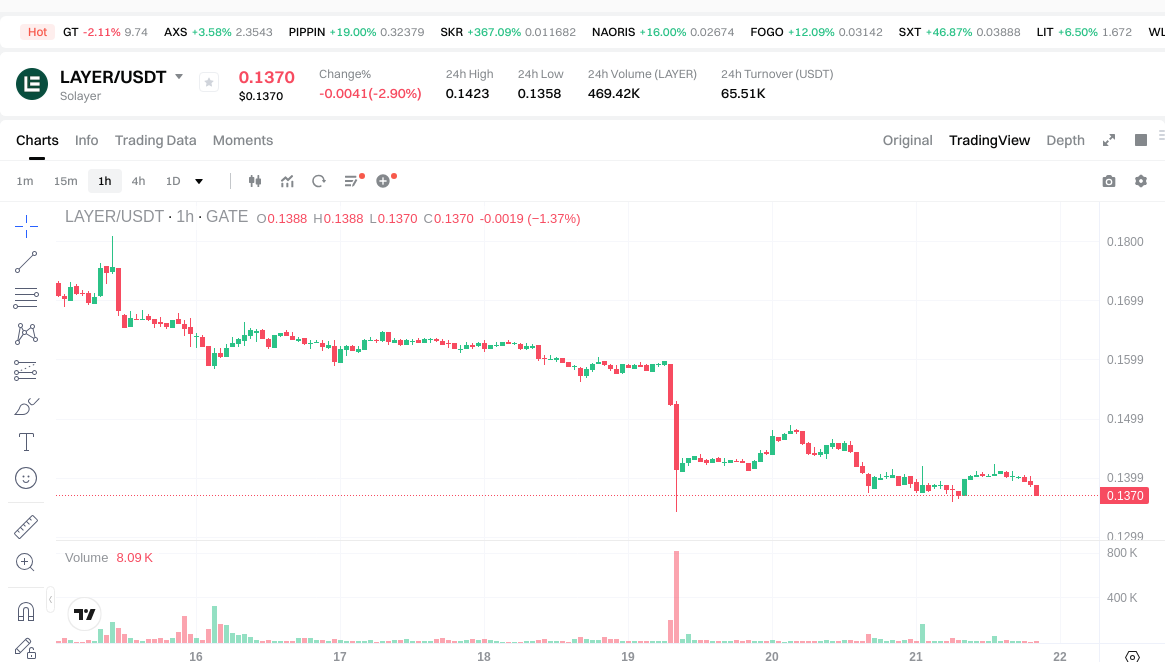
Current LAYER Investment Market Status (January 2026)
- LAYER current price: $0.1386
- 24-hour trading volume: $66,810.48
- Circulating supply: 210,000,000 LAYER (21% of total supply)
- Market capitalization: $29,106,000
Click to view real-time LAYER market price
II. Core Factors Affecting Whether LAYER is a Good Investment (Is Solayer(LAYER) a Good Investment)
Supply Mechanism and Scarcity (LAYER Investment Scarcity)
- Maximum Supply: 1,000,000,000 LAYER tokens with a current circulating supply of 210,000,000 tokens (21% of total supply) → impacts pricing dynamics and investment considerations
- Historical Price Range: LAYER has traded between $0.0794 and $3.4159, demonstrating significant volatility in its price discovery phase
- Investment Significance: The controlled supply release with approximately 79% of tokens yet to enter circulation represents a key factor for investors to monitor regarding potential dilution effects
Institutional Investment and Mainstream Adoption (Institutional Investment in LAYER)
- Current Holder Base: Approximately 65,618 holders participate in the LAYER ecosystem
- Platform Availability: Listed on 41 exchanges, indicating growing accessibility for institutional and retail participants
- Market Position: LAYER holds a market capitalization of $29.1 million with 0.0044% market dominance, representing an emerging position in the restaking sector
Macroeconomic Environment's Impact on LAYER Investment
- Cryptocurrency Market Correlation: As a Solana-based restaking platform, LAYER's investment performance may be influenced by broader crypto market trends and risk appetite
- Regulatory Landscape: The evolving regulatory framework for staking and restaking protocols could affect LAYER's operational environment and investment attractiveness
- Market Liquidity Conditions: 24-hour trading volume of $66,810 reflects current liquidity levels that investors should consider for position management
Technology and Ecosystem Development (Technology & Ecosystem for LAYER Investment)
- Core Infrastructure: Built on Solana blockchain architecture, leveraging its high-performance characteristics for restaking operations
- Platform Functionality: Focuses on enhancing security and yield generation through its restaking mechanism, potentially creating value for stakers
- Ecosystem Positioning: Operates within the Solana DeFi landscape, with potential integration opportunities across decentralized finance applications and protocols
III. LAYER Future Investment Forecast and Price Outlook (Is Solayer(LAYER) worth investing in 2026-2031)
Short-term Investment Outlook (2026, short-term LAYER investment outlook)
- Conservative Forecast: $0.1318 - $0.1373
- Neutral Forecast: $0.1373 - $0.1991
- Optimistic Forecast: $0.1991
Mid-term Investment Outlook (2027-2028, mid-term Solayer(LAYER) investment forecast)
-
Market Stage Expectation: The mid-term period may see LAYER transitioning from initial market positioning toward broader adoption within the Solana restaking ecosystem, with potential growth driven by platform development and user participation expansion.
-
Investment Return Forecast:
- 2027: $0.1480 - $0.2355
- 2028: $0.1352 - $0.2483
-
Key Catalysts: Platform security enhancements, yield optimization mechanisms, expansion of restaking participant base, Solana ecosystem growth, and broader DeFi integration opportunities.
Long-term Investment Outlook (Is Solayer a good long-term investment?)
- Base Scenario: $0.1750 - $0.3034 (assuming steady platform development and moderate ecosystem expansion through 2031)
- Optimistic Scenario: $0.2250 - $0.3034 (assuming accelerated adoption, enhanced security features, and favorable market conditions for Solana-based projects)
- Risk Scenario: $0.1318 - $0.1750 (assuming market headwinds, competitive pressures, or slower-than-expected platform adoption)
For detailed LAYER long-term investment and price forecasts: Price Prediction
2026-01-21 - 2031 Long-term Outlook
- Base Scenario: $0.1750 - $0.2693 (corresponding to steady progress and gradual mainstream application growth)
- Optimistic Scenario: $0.2250 - $0.3034 (corresponding to large-scale adoption and favorable market environment)
- Transformative Scenario: Above $0.3034 (corresponding to breakthrough ecosystem developments and mainstream adoption)
- 2031-12-31 Projected High: $0.3034 (based on optimistic development assumptions)
Disclaimer: Price forecasts are based on historical data, market analysis, and predictive modeling. Cryptocurrency markets are highly volatile and subject to numerous unpredictable factors. These projections should not be considered as financial advice. Investors should conduct their own research and consult with qualified financial advisors before making investment decisions.
| Year |
Predicted High Price |
Predicted Average Price |
Predicted Low Price |
Price Change |
| 2026 |
0.199085 |
0.1373 |
0.131808 |
0 |
| 2027 |
0.2354695 |
0.1681925 |
0.1480094 |
21 |
| 2028 |
0.24825213 |
0.201831 |
0.13522677 |
45 |
| 2029 |
0.24529530585 |
0.225041565 |
0.180033252 |
62 |
| 2030 |
0.30336728169825 |
0.235168435425 |
0.22811338236225 |
69 |
| 2031 |
0.285423930075322 |
0.269267858561625 |
0.175024108065056 |
94 |
IV. LAYER Investment Strategy and Risk Management (How to invest in cryptocurrency)
Investment Methodology (LAYER investment strategy)
-
Long-term Holding (HODL LAYER): Suitable for conservative investors
For investors seeking stable returns, long-term holding of LAYER tokens may be considered as part of a diversified portfolio. This approach reduces the impact of short-term market volatility and aligns with the project's development trajectory on the Solana ecosystem. However, investors should be aware of the significant price fluctuations, as LAYER has experienced a decline of approximately 87.35% over the past year.
-
Active Trading: Relies on technical analysis and swing trading
Active traders may leverage technical analysis tools to identify entry and exit points based on LAYER's price movements. With a 24-hour trading volume of approximately $66,810 and recent fluctuations ranging from $0.1358 to $0.1423, the token presents opportunities for short-term trading. However, this strategy requires constant market monitoring and carries higher risk exposure.
Risk Management (Risk management for LAYER investment)
-
Asset Allocation Ratio: Conservative / Aggressive / Professional investors
Conservative investors may allocate no more than 1-3% of their portfolio to LAYER, given its high volatility and relatively low market capitalization of approximately $29.1 million. Aggressive investors might consider 5-10% allocation, while professional investors with higher risk tolerance could adjust based on their trading strategies. The token's circulating supply represents 21% of the total supply, which should be factored into allocation decisions.
-
Risk Hedging Solutions: Multi-asset portfolio + hedging instruments
Diversification across multiple cryptocurrency categories and traditional assets can help mitigate LAYER-specific risks. Investors may consider pairing LAYER holdings with stablecoins or more established cryptocurrencies. Additionally, utilizing stop-loss orders and position sizing strategies can limit potential losses in volatile market conditions.
-
Secure Storage: Hot/cold wallets + hardware wallet recommendations
Given that LAYER is deployed on the Solana blockchain (contract address: LAYER4xPpTCb3QL8S9u41EAhAX7mhBn8Q6xMTwY2Yzc), investors should utilize Solana-compatible wallets. For long-term storage, hardware wallets such as Ledger or Trezor are recommended for enhanced security. For active trading, reputable exchanges with strong security measures may be used, though keeping large amounts on exchanges is not advisable. Cold storage solutions minimize exposure to online threats and hacking risks.
V. LAYER Investment Risks and Challenges (Risks of investing in cryptocurrency)
-
Market Risk: High volatility, price manipulation
LAYER has demonstrated substantial price volatility, with a historical high of $3.4159 (May 5, 2025) and a historical low of $0.0794 (October 10, 2025). The current price of approximately $0.1386 represents significant depreciation from its peak. With a relatively modest 24-hour trading volume and market capitalization, the token may be susceptible to price swings driven by large trades or market sentiment shifts. The one-year decline of 87.35% highlights the considerable downside risk.
-
Regulatory Risk: Policy uncertainty across different jurisdictions
As a cryptocurrency project, LAYER faces evolving regulatory landscapes worldwide. Different countries maintain varying stances on cryptocurrency restaking platforms and decentralized finance protocols. Changes in regulatory frameworks, particularly those affecting the Solana ecosystem or restaking mechanisms, could impact LAYER's operational viability and token valuation. Investors should monitor regulatory developments in their respective jurisdictions.
-
Technical Risk: Network security vulnerabilities, upgrade failures
As a restaking platform built on Solana, LAYER inherits both the benefits and potential risks associated with the underlying blockchain infrastructure. Network congestion, security vulnerabilities, or technical issues on the Solana network could affect LAYER's functionality. Additionally, the project's own smart contract implementations and protocol upgrades carry inherent technical risks. With approximately 65,618 holders, any technical failures could impact a substantial user base.
VI. Conclusion: Is cryptocurrency a Good Investment?
-
Investment Value Summary: LAYER presents long-term potential within the Solana restaking ecosystem, but exhibits significant short-term price volatility.
As a restaking platform on Solana, LAYER aims to enhance security and yield generation within the ecosystem. However, the token's performance over the past year, with an 87.35% decline, reflects the challenges of emerging cryptocurrency projects. The circulating supply represents only 21% of the maximum supply, which may influence future token economics. With a market cap to fully diluted valuation ratio of 21%, potential dilution from future token releases should be considered.
-
Investor Recommendations:
✅ Beginners: Dollar-cost averaging + secure wallet storage
New investors should consider periodic small investments rather than lump-sum purchases to average out price volatility. Prioritize learning about Solana wallet security and proper token storage before significant investment.
✅ Experienced Investors: Swing trading + portfolio configuration
Those familiar with cryptocurrency markets may explore trading opportunities based on technical indicators while maintaining strict risk management protocols. LAYER should comprise only a portion of a well-diversified cryptocurrency portfolio.
✅ Institutional Investors: Strategic long-term allocation
Institutional participants may evaluate LAYER as part of a broader Solana ecosystem investment thesis, considering the restaking sector's development potential while accounting for regulatory and technical risks.
⚠️ Disclaimer: Cryptocurrency investment carries high risk. This content is for informational purposes only and does not constitute investment advice. Investors should conduct thorough research and consult with financial advisors before making investment decisions.
VII. FAQ
Q1: What is Solayer (LAYER) and what makes it different from other cryptocurrency investments?
Solayer (LAYER) is a restaking platform built on the Solana blockchain, launched in January 2025. The platform distinguishes itself by focusing on enhancing security and yield generation through its restaking mechanism within the Solana ecosystem. With approximately 65,618 token holders and availability across 41 exchanges, LAYER operates in the emerging restaking infrastructure space. However, investors should note that the token has experienced significant volatility, declining 87.35% from its launch price of $1.00 to its current level around $0.1386. The platform's core value proposition centers on providing restaking services that aim to improve network security while generating returns for participants, though this comes with the inherent risks associated with early-stage cryptocurrency projects.
Q2: How volatile has LAYER's price been since launch, and what does this mean for potential investors?
LAYER has demonstrated extreme price volatility since its January 2025 launch. The token reached a peak of $3.42 in early May 2025 before declining to a low of $0.0794 in October 2025, representing a drawdown of over 97% from its all-time high. Currently trading around $0.1386 with a 24-hour trading volume of approximately $66,810, the token exhibits characteristics typical of emerging cryptocurrency projects with relatively low liquidity. This volatility pattern suggests that LAYER carries substantial short-term risk and may be unsuitable for risk-averse investors. The significant price swings indicate that both substantial gains and losses are possible within short timeframes, making proper risk management and position sizing critical for anyone considering investment in LAYER.
Q3: What percentage of my portfolio should I allocate to LAYER based on my risk tolerance?
Allocation recommendations vary significantly based on investor risk profiles. Conservative investors should limit LAYER exposure to 1-3% of their total portfolio, given its high volatility and relatively small market capitalization of approximately $29.1 million. This conservative approach helps mitigate the impact of potential losses while maintaining some exposure to the restaking sector. Aggressive investors with higher risk tolerance might consider 5-10% allocation, though this requires active monitoring and willingness to accept potential significant drawdowns. Professional traders may adjust allocations based on their specific strategies and market outlook. Importantly, investors should consider that only 21% of LAYER's total supply is currently circulating, meaning future token releases could create dilution pressure. Regardless of risk tolerance, LAYER should be part of a diversified cryptocurrency portfolio rather than a concentrated position.
Q4: What are the primary risks associated with investing in LAYER?
LAYER investment carries three major risk categories that investors must understand. First, market risk is substantial, as evidenced by the token's 87.35% decline over the past year and historical price range from $0.0794 to $3.4159. The relatively low trading volume makes the token susceptible to price manipulation and significant volatility from large trades. Second, regulatory risk stems from evolving global cryptocurrency policies that could impact restaking platforms and the broader Solana ecosystem. Different jurisdictions maintain varying stances on DeFi protocols, and regulatory changes could affect LAYER's operational viability. Third, technical risk includes potential vulnerabilities in smart contracts, Solana network issues, and protocol upgrade failures. Any technical problems could affect the platform's 65,618 holders and damage investor confidence. Additionally, with 79% of tokens yet to enter circulation, future supply releases present dilution risk that could pressure prices downward.
Q5: What is the long-term price outlook for LAYER through 2031?
Long-term price forecasts for LAYER suggest potential appreciation under favorable conditions, though significant uncertainty remains. The base scenario projects prices ranging from $0.1750 to $0.2693 through 2031, assuming steady platform development and moderate ecosystem expansion. An optimistic scenario envisions $0.2250 to $0.3034, contingent on accelerated adoption, enhanced security features, and favorable Solana ecosystem growth. Conversely, a risk scenario suggests prices between $0.1318 and $0.1750 if the platform faces competitive pressures or slower adoption. By 2031, the projected high reaches $0.3034 under optimistic assumptions, representing potential appreciation from current levels. However, investors should recognize these forecasts are highly speculative and based on numerous assumptions about market conditions, technological development, and ecosystem adoption. The cryptocurrency market's inherent unpredictability means actual outcomes could differ substantially from projections in either direction.
Q6: How should beginners approach investing in LAYER?
Beginners interested in LAYER should prioritize education and risk management over aggressive position-taking. The recommended approach is dollar-cost averaging, which involves making small, periodic purchases rather than investing a lump sum. This strategy helps smooth out the impact of LAYER's significant price volatility and reduces the risk of buying at peak prices. Before any investment, beginners must learn about Solana-compatible wallet solutions and proper security practices for storing LAYER tokens. Hardware wallets such as Ledger or Trezor are recommended for long-term storage to minimize exposure to online security threats. New investors should start with very small allocations that represent only a tiny fraction of their overall investment portfolio, perhaps 1-2%, and should be prepared to lose this entire amount given the high-risk nature of the investment. Additionally, beginners should thoroughly research the restaking concept, understand how LAYER fits within the Solana ecosystem, and stay informed about project developments before committing capital.
Q7: What factors could drive LAYER's price higher in the future?
Several catalysts could potentially drive LAYER appreciation, though none are guaranteed. Platform security enhancements and yield optimization mechanisms could attract more restaking participants, increasing demand for LAYER tokens. Expansion of the user base beyond the current 65,618 holders would demonstrate growing adoption and ecosystem health. Broader Solana ecosystem growth could benefit LAYER as a restaking infrastructure provider, particularly if Solana gains market share against competing blockchains. Integration opportunities with decentralized finance applications and protocols could expand LAYER's utility and value proposition. Additionally, the gradual release of the remaining 79% of token supply, if managed transparently and strategically, could support price stability rather than create selling pressure. Favorable regulatory developments for restaking platforms and the broader cryptocurrency sector could also provide tailwinds. However, investors should recognize that these potential catalysts face significant execution and market risks, and their realization is uncertain.
Q8: Is LAYER suitable as a long-term investment compared to established cryptocurrencies?
LAYER represents a higher-risk, higher-potential-reward investment compared to established cryptocurrencies like Bitcoin or Ethereum. As an emerging project with a market capitalization of approximately $29.1 million and ranking around #726, LAYER carries substantially more risk than large-cap cryptocurrencies. The token's 87.35% decline since launch and significant volatility make it unsuitable as a core long-term holding for most investors. However, for those seeking exposure to the Solana restaking sector with appropriate risk tolerance, LAYER could serve as a speculative component within a broader cryptocurrency portfolio. The platform's long-term viability depends on successful execution of its restaking technology, sustained Solana ecosystem growth, and competitive positioning against other restaking solutions. Investors considering LAYER for long-term holding should maintain realistic expectations, allocate only capital they can afford to lose, and regularly reassess their investment thesis based on project developments and market conditions. Unlike established cryptocurrencies with proven track records, LAYER remains an unproven project whose long-term success is uncertain.
* The information is not intended to be and does not constitute financial advice or any other recommendation of any sort offered or endorsed by Gate.