This comprehensive analysis evaluates whether Solayer (LAYER), a Solana-based restaking protocol launched in 2025, represents a viable investment opportunity. The article examines LAYER's market fundamentals including its current price of $0.1403, market cap of $29.46 million, and circulating supply of 210 million tokens across 65,618 holders on 41 exchanges. It analyzes key investment factors such as token scarcity, institutional adoption, and ecosystem development within Solana's infrastructure. The guide provides detailed price forecasts ranging from $0.091195 to $0.232302 through 2031, actionable investment strategies tailored for different investor profiles, and comprehensive risk management frameworks. Additionally, it addresses critical concerns including extreme price volatility, limited liquidity, and regulatory uncertainties while offering practical guidance for secure token storage on Gate and other platforms.
Introduction: Solayer (LAYER)'s Investment Position and Market Outlook
LAYER is a notable asset in the cryptocurrency sector, launched in 2025 as a restaking platform on Solana, aiming to enhance security and yield. As of January 2026, Solayer holds a market capitalization of approximately $29.46 million, with a circulating supply of 210 million tokens, and the current price is around $0.1403. Trading on 41 exchanges and holding 65,618 holders, LAYER has positioned itself within the Solana ecosystem's staking infrastructure. With its focus on restaking mechanisms, Solayer has become a subject of discussion among investors evaluating "Is Solayer (LAYER) a good investment?" This article comprehensively analyzes LAYER's investment value, historical trends, future price forecasts, and investment risks to provide reference for investors.
I. Historical Price Review and Current Investment Value of LAYER Token
Based on available data, LAYER has experienced significant price volatility since its launch:
- 2025: Token launch in October → Initial price started at $1.00, with subsequent price discovery
- 2025: Market volatility period → Price fluctuated between $0.0794 and $3.4159 during the early trading phase
- Late 2025 to early 2026: Market adjustment → Price declined from elevated levels to current trading range
Current LAYER Investment Market Status (January 2026)
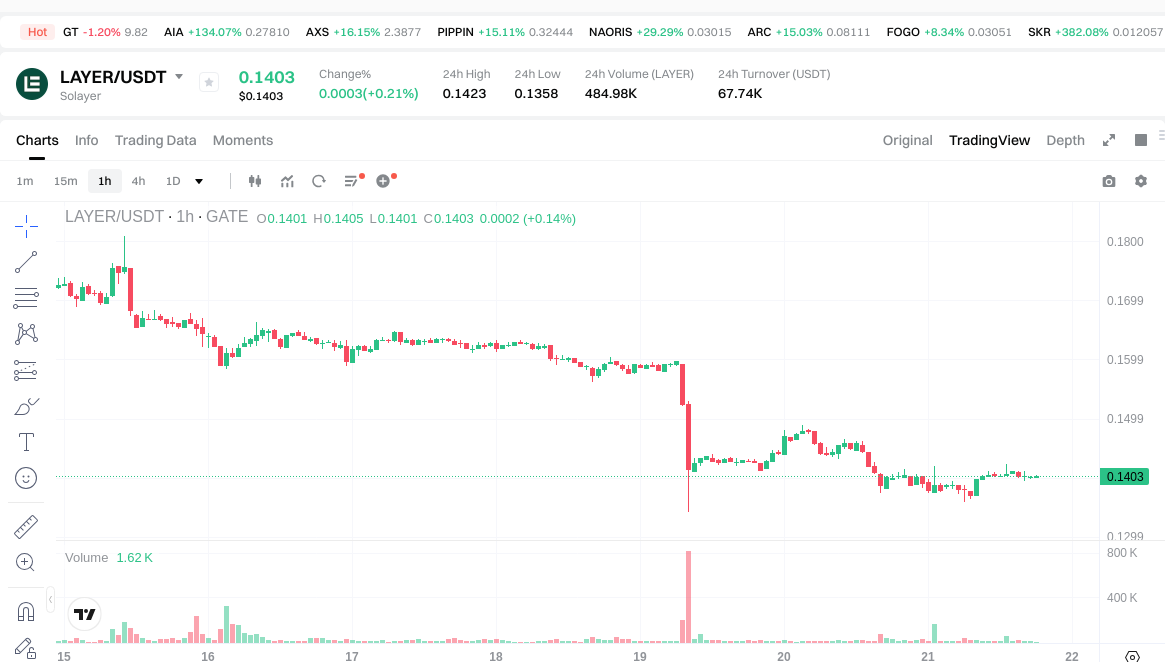
- LAYER current price: $0.1403
- 24-hour trading volume: $68,990.35
- Circulating supply: 210,000,000 LAYER (21% of total supply)
- Market capitalization: $29,463,000
- Fully diluted valuation: $140,300,000
- Total supply: 1,000,000,000 LAYER
- Token holders: 65,618
- Listed on 41 exchanges
Click to view real-time LAYER market price
II. Core Factors Affecting Whether LAYER is a Good Investment
Supply Mechanism and Scarcity (LAYER investment scarcity)
- Maximum supply capped at 1,000,000,000 LAYER tokens → influences price dynamics and investment value
- Current circulating supply stands at 210,000,000 tokens, representing 21% of total supply → indicates controlled token release
- Investment significance: Limited supply structure provides potential scarcity-driven value support for long-term investment considerations
Institutional Investment and Mainstream Adoption (Institutional investment in LAYER)
- Holder base expansion: Current holder count reaches 65,618 addresses → reflects growing community participation
- Trading availability: Listed on 41 exchanges → demonstrates market accessibility and liquidity options
- Platform positioning: Solayer operates as a restaking platform on Solana → aims to enhance security and yield mechanisms
Macroeconomic Environment's Impact on LAYER Investment
- Monetary policy and interest rate changes → may alter investment attractiveness in the crypto asset space
- Inflationary environment considerations → potential role in diversified portfolio strategies
- Geopolitical uncertainties → could influence demand for alternative digital assets
Technology and Ecosystem Development (Technology & Ecosystem for LAYER investment)
- Core functionality: Restaking platform built on Solana infrastructure → designed to improve security and yield generation
- Ecosystem integration: Operates within Solana's blockchain environment → benefits from underlying network performance
- DeFi applications and staking mechanisms → provide utility-driven value propositions for investment evaluation
III. LAYER Future Investment Prediction and Price Outlook (Is Solayer(LAYER) worth investing in 2026-2031)
Short-term Investment Prediction (2026, short-term LAYER investment outlook)
- Conservative forecast: $0.091195 - $0.1403
- Neutral forecast: $0.1403 - $0.150
- Optimistic forecast: $0.150 - $0.166957
Mid-term Investment Outlook (2027-2028, mid-term Solayer(LAYER) investment forecast)
-
Market stage expectation: During this period, LAYER may experience gradual recovery as the restaking platform develops its ecosystem on Solana. The token could benefit from increased adoption of restaking mechanisms and broader DeFi integration.
-
Investment return prediction:
- 2027: $0.08910453 - $0.19049934
- 2028: $0.146254332 - $0.2185211784
-
Key catalysts: Platform security enhancements, yield optimization features, Solana ecosystem growth, and potential partnerships within the restaking infrastructure space.
Long-term Investment Outlook (Is LAYER a good long-term investment?)
- Baseline scenario: $0.137 - $0.216 (assuming steady platform development and moderate adoption of restaking services)
- Optimistic scenario: $0.195 - $0.232 (assuming successful ecosystem expansion and increased market share in the Solana restaking sector)
- Risk scenario: $0.089 - $0.138 (under adverse market conditions or limited platform adoption)
Click to view LAYER long-term investment and price prediction: Price Prediction
2026-01-21 - 2031 Long-term Outlook
- Baseline scenario: $0.137 - $0.206 USD (corresponding to steady progress and gradual mainstream application enhancement)
- Optimistic scenario: $0.195 - $0.232 USD (corresponding to large-scale adoption and favorable market conditions)
- Transformational scenario: Above $0.232 USD (if ecosystem achieves breakthrough progress and mainstream adoption)
- 2031-12-31 predicted high: $0.232302928430265 USD (based on optimistic development assumptions)
Disclaimer: The above predictions are based on historical data analysis and market trend assessments. Cryptocurrency investments carry significant risks, and actual prices may vary substantially due to market volatility, regulatory changes, technological developments, and other unpredictable factors. This information does not constitute investment advice, and investors should conduct thorough research and risk assessment before making any investment decisions.
| Year |
Predicted High Price |
Predicted Average Price |
Predicted Low Price |
Price Change |
| 2026 |
0.166957 |
0.1403 |
0.091195 |
0 |
| 2027 |
0.19049934 |
0.1536285 |
0.08910453 |
9 |
| 2028 |
0.2185211784 |
0.17206392 |
0.146254332 |
22 |
| 2029 |
0.216774729612 |
0.1952925492 |
0.101552125584 |
39 |
| 2030 |
0.2163353213763 |
0.206033639406 |
0.13804253840202 |
46 |
| 2031 |
0.232302928430265 |
0.21118448039115 |
0.137269912254247 |
50 |
IV. LAYER Investment Strategy and Risk Management (How to invest in Solayer)
Investment Methodology (LAYER investment strategy)
-
Long-term Holding (HODL LAYER): Suitable for conservative investors
Long-term holding strategy involves purchasing LAYER tokens and maintaining the position through market cycles. Given LAYER's current circulating supply of 210,000,000 tokens (21% of total supply) and its role as a restaking platform on Solana, this approach may suit investors who believe in the long-term value proposition of restaking solutions within the Solana ecosystem. However, investors should note the significant price volatility, with the token experiencing an 87.22% decline over the past year.
-
Active Trading: Relies on technical analysis and swing operations
Active traders can leverage LAYER's price movements, which have shown varied performance across different timeframes (1H: +0.13%, 24H: +0.35%, 7D: -16.96%, 30D: -15.26%). The 24-hour trading volume of approximately $68,990 provides opportunities for short-term position entries and exits. Technical traders should monitor the 24-hour price range between $0.1358 and $0.1423 to identify potential support and resistance levels.
Risk Management (Risk management for LAYER investment)
-
Asset Allocation Ratio: Conservative / Aggressive / Professional investors
- Conservative investors: Consider allocating no more than 2-5% of crypto portfolio to LAYER
- Aggressive investors: May allocate 5-10% with strict stop-loss mechanisms
- Professional investors: Can consider up to 10-15% allocation with active hedging strategies
Given LAYER's market capitalization of approximately $29.46 million and ranking of 722, position sizing should reflect its mid-to-small cap risk profile.
-
Risk Hedging Solutions: Multi-asset portfolio + hedging instruments
Investors can consider diversifying across other Solana ecosystem tokens and major cryptocurrencies to reduce concentration risk. For those with access to derivatives markets, hedging strategies using correlated assets may help manage downside exposure. Portfolio rebalancing on a regular basis can help maintain target allocations amid LAYER's price volatility.
-
Secure Storage: Hot and cold wallets + hardware wallet recommendations
LAYER tokens are deployed on the Solana blockchain (contract address: LAYER4xPpTCb3QL8S9u41EAhAX7mhBn8Q6xMTwY2Yzc). For secure storage:
- Cold storage: Hardware wallets that support Solana, such as Ledger or Trezor with Solana integration
- Hot wallets: Phantom, Solflare, or other reputable Solana-compatible wallets for active trading
- Security practice: Never share private keys, enable two-factor authentication, and verify contract addresses before transactions
V. LAYER Investment Risks and Challenges (Risks of investing in Solayer)
-
Market Risk: High volatility, price manipulation
LAYER has demonstrated substantial price volatility, with a historical high of $3.4159 (May 5, 2025) and historical low of $0.0794 (October 10, 2025). The current price of $0.1403 represents a decline of approximately 95.89% from its peak. With a relatively modest 24-hour trading volume of $68,990, the token may be susceptible to lower liquidity conditions, which could amplify price swings. The market cap to fully diluted valuation ratio of 21% suggests significant future token unlocks may create additional selling pressure.
-
Regulatory Risk: Policy uncertainty across different jurisdictions
As a restaking platform operating within the cryptocurrency sector, Solayer faces evolving regulatory frameworks globally. Different countries maintain varying approaches to cryptocurrency regulation, staking activities, and DeFi protocols. Changes in regulatory policies regarding staking rewards, token classifications, or platform operations could impact LAYER's utility and value proposition. Investors should monitor regulatory developments in their respective jurisdictions and in key markets where Solana-based projects operate.
-
Technical Risk: Network security vulnerabilities, upgrade failures
As a platform built on Solana, LAYER inherits both the benefits and potential risks of the underlying blockchain infrastructure. Technical considerations include:
- Smart contract vulnerabilities that could affect the restaking protocol
- Network congestion or downtime on Solana that could impact platform operations
- Potential bugs or issues during protocol upgrades
- Security risks associated with managing staked assets
The project's security measures and audit history should be reviewed by investors as part of due diligence.
VI. Conclusion: Is Solayer a Good Investment?
-
Investment Value Summary: LAYER presents opportunities within the Solana restaking ecosystem, though its price performance has shown considerable volatility with sharp short-term fluctuations.
-
Investor Recommendations:
✅ Beginners: Consider dollar-cost averaging (DCA) strategy combined with secure wallet storage. Start with small allocations to understand market dynamics before increasing exposure.
✅ Experienced Investors: May employ swing trading strategies combined with portfolio diversification. Technical analysis of price trends across multiple timeframes can inform entry and exit decisions.
✅ Institutional Investors: Could consider strategic long-term allocation as part of a broader Solana ecosystem or DeFi restaking thesis, with appropriate risk management frameworks.
⚠️ Disclaimer: Cryptocurrency investments carry substantial risk. This content is for informational purposes only and does not constitute investment advice. Investors should conduct thorough research and consider their risk tolerance before making investment decisions.
VII. FAQ
Q1: Is Solayer (LAYER) a good investment for beginners in 2026?
LAYER may be suitable for beginners only with proper risk management and a dollar-cost averaging approach, given its high volatility and relatively small market cap of $29.46 million. For beginners considering LAYER investment, it's crucial to understand that the token has experienced significant price fluctuations, declining 87.22% over the past year from its peak of $3.4159 to the current price of $0.1403. A conservative allocation of no more than 2-5% of your crypto portfolio, combined with secure wallet storage and gradual position building through DCA strategy, can help mitigate downside risks while gaining exposure to Solana's restaking ecosystem.
Q2: What is the predicted price range for LAYER by the end of 2026?
Based on technical analysis and market trends, LAYER's predicted price range for 2026 spans from $0.091195 (conservative scenario) to $0.166957 (optimistic scenario), with an average forecast around $0.1403. The short-term investment outlook suggests that conservative estimates place the lower bound at $0.091195, while neutral forecasts center around $0.1403, and optimistic projections reach up to $0.166957. These predictions account for factors including the platform's restaking mechanism development, Solana ecosystem growth, and current market capitalization of approximately $29.46 million. However, investors should note that cryptocurrency prices are highly volatile and actual performance may differ significantly from forecasts.
Q3: How does LAYER's tokenomics affect its investment value?
LAYER's tokenomics feature a maximum supply of 1 billion tokens with only 21% (210 million) currently in circulation, creating potential scarcity-driven value but also significant unlock risk. The current circulating supply represents just 21% of the total token supply, which means 79% of tokens remain locked or unvested, potentially creating substantial selling pressure in the future as tokens are released. The fully diluted valuation stands at $140.3 million compared to the current market cap of $29.46 million, indicating a market cap to FDV ratio of approximately 21%. This controlled token release mechanism can support price stability in the near term, but investors should monitor the token unlock schedule carefully as future releases could impact supply-demand dynamics and investment returns.
Q4: What are the main risks associated with investing in LAYER?
The primary risks include extreme price volatility (95.89% decline from peak), limited liquidity with $68,990 daily trading volume, and regulatory uncertainty surrounding restaking platforms. Market risk is particularly pronounced, as LAYER has demonstrated substantial price swings between its historical high of $3.4159 and low of $0.0794. The relatively modest 24-hour trading volume suggests lower liquidity conditions that could amplify price movements and make it difficult to execute large trades without significant slippage. Additionally, as a restaking platform operating within the cryptocurrency sector, LAYER faces evolving regulatory frameworks globally, with different jurisdictions maintaining varying approaches to staking activities and DeFi protocols. Technical risks related to smart contract vulnerabilities and dependencies on Solana's network performance also require careful consideration.
Q5: How does LAYER compare to other restaking platforms as an investment?
LAYER distinguishes itself through its Solana-based infrastructure, offering potentially faster transaction speeds compared to Ethereum-based restaking alternatives, though it operates with a smaller market cap and holder base. With 65,618 token holders and listings on 41 exchanges, LAYER has established notable market presence within the Solana ecosystem. However, its market capitalization of $29.46 million and ranking of 722 position it as a mid-to-small cap asset, which typically carries higher risk compared to larger, more established platforms. The platform's focus on enhancing security and yield generation through restaking mechanisms provides utility-driven value propositions, but investors should compare LAYER's technical features, total value locked (TVL), and yield rates against competitors in the restaking sector before making investment decisions.
Q6: What investment strategy works best for LAYER in current market conditions?
A dollar-cost averaging (DCA) strategy combined with strategic position sizing based on risk tolerance offers the most balanced approach for LAYER investment in 2026. Given the token's significant volatility (-16.96% over 7 days, -15.26% over 30 days) and recovery potential within the Solana restaking ecosystem, DCA allows investors to build positions gradually while reducing the impact of short-term price fluctuations. Conservative investors should limit LAYER allocation to 2-5% of their crypto portfolio with strict stop-loss mechanisms, while more experienced investors might consider 5-10% allocation combined with active trading strategies during high-volatility periods. The 24-hour price range between $0.1358 and $0.1423 can serve as reference points for technical traders seeking entry opportunities, though all positions should be secured in appropriate wallets (hardware wallets for long-term holdings, Solana-compatible hot wallets like Phantom or Solflare for active trading).
Q7: Will LAYER benefit from Solana's ecosystem growth in the long term?
Yes, LAYER is positioned to potentially benefit from Solana's ecosystem expansion, though success depends on the platform's ability to capture market share in the restaking infrastructure sector and deliver on its security and yield optimization features. As a restaking platform built on Solana, LAYER inherits advantages from the underlying blockchain's high throughput and growing DeFi ecosystem. The long-term investment outlook (2027-2031) suggests potential price appreciation ranging from $0.137 to $0.232 under baseline to optimistic scenarios, assuming steady platform development and increased adoption of restaking services. Key catalysts include platform security enhancements, successful ecosystem partnerships, and broader integration within Solana's DeFi landscape. However, long-term investment value ultimately depends on the project's execution, competitive positioning against alternative restaking solutions, and overall cryptocurrency market conditions during this period.
Q8: Where can I safely buy and store LAYER tokens?
LAYER tokens can be purchased on 41 listed exchanges with secure storage options including hardware wallets and Solana-compatible software wallets. For purchasing, investors should use reputable cryptocurrency exchanges that list LAYER (contract address: LAYER4xPpTCb3QL8S9u41EAhAX7mhBn8Q6xMTwY2Yzc on Solana). When selecting an exchange, prioritize platforms with strong security measures, adequate liquidity, and regulatory compliance in your jurisdiction. For secure storage, long-term holders should utilize cold storage solutions such as hardware wallets (Ledger or Trezor with Solana integration), while active traders may opt for hot wallets like Phantom or Solflare that offer convenient access for trading. Essential security practices include never sharing private keys, enabling two-factor authentication, verifying contract addresses before transactions, and conducting small test transactions before transferring larger amounts. Diversifying storage across multiple secure locations can further reduce risk of total asset loss.
* The information is not intended to be and does not constitute financial advice or any other recommendation of any sort offered or endorsed by Gate.