This comprehensive article evaluates whether Solv Protocol (SOLV) represents a viable investment opportunity within the Bitcoin staking and DeFi infrastructure sector. Launched in January 2025 as a Bitcoin staking protocol, SOLV currently trades at $0.01314 with a market capitalization of $19.48 million, having experienced an 82.6% annual decline from its all-time high. The analysis examines SOLV's tokenomics, with only 15.35% circulating supply and 127,466 active holders across 33 exchanges including Gate, revealing both growth potential and dilution risks. Price forecasts range from $0.0098-$0.0153 through 2026 to $0.0222-$0.0377 by 2031, contingent on protocol adoption and Bitcoin DeFi ecosystem expansion. Investment strategies align with risk tolerance levels: beginners should limit exposure to 1-3%, while experienced investors may allocate 3-5% for diversified portfolios. Substantial risks including high volatility, regulatory uncertainty, technical vulnerabilities, and limited liquidity require careful
Introduction: Solv Protocol (SOLV) Investment Position and Market Outlook
SOLV is an emerging asset in the cryptocurrency space, operating as a Bitcoin staking protocol since its launch in January 2025. The protocol focuses on unlocking liquidity and maximizing the utility of idle Bitcoin assets within a Bitcoin-centric financial ecosystem. As of January 23, 2026, SOLV holds a market capitalization of approximately $19.48 million, with a circulating supply of 1,482,600,000 tokens and a current price around $0.01314. With its positioning as a Bitcoin liquidity solution, SOLV has gradually attracted attention from investors exploring "Is Solv Protocol (SOLV) a good investment?" This article provides a comprehensive analysis of SOLV's investment value, historical price movements, future price projections, and associated investment risks to serve as a reference for market participants.
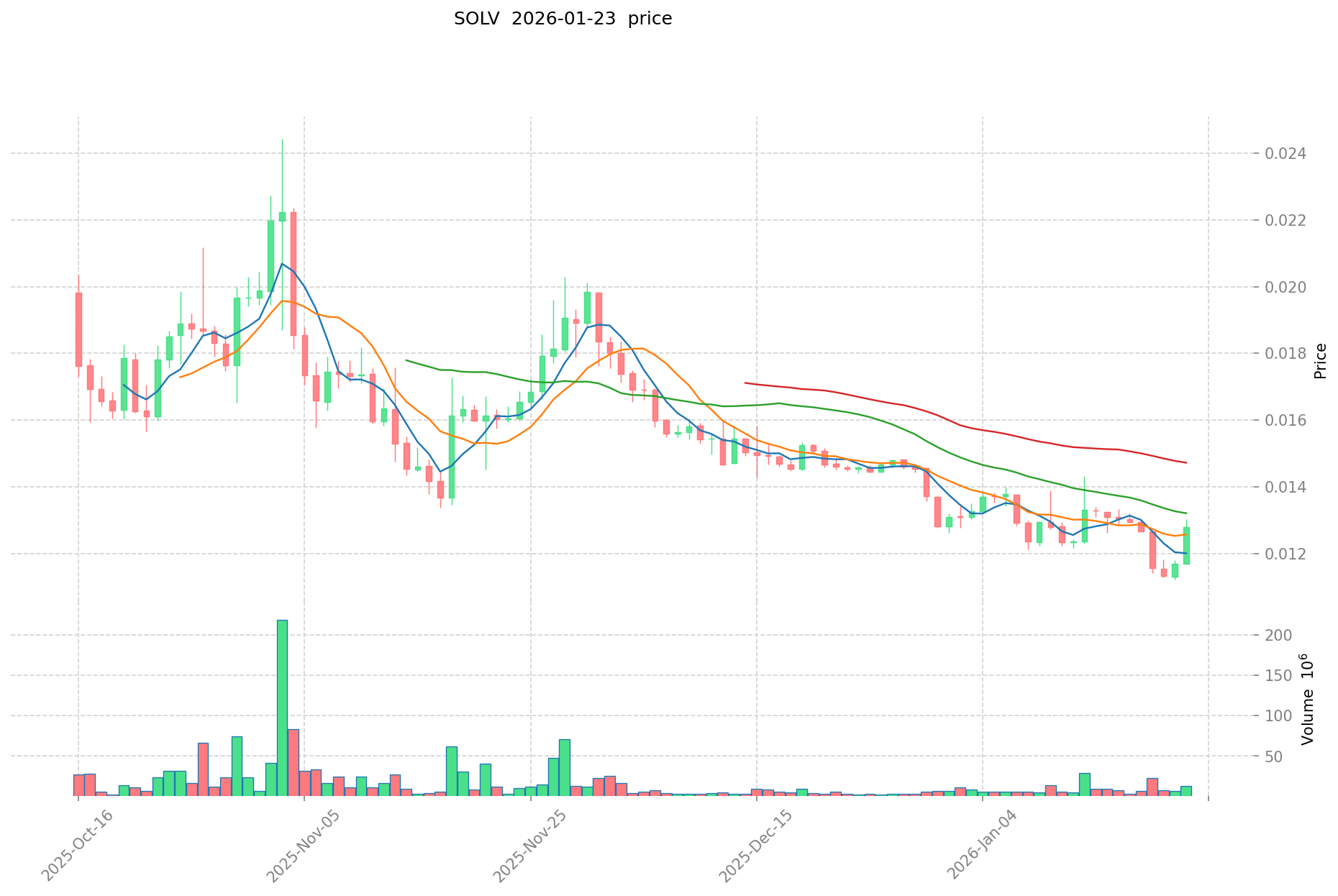
I. Historical Price Review and Current Investment Value of SOLV Token
- 2025: Token launched at $0.03 on January 17, reaching a high of $0.1737 on the same day → Early investors experienced significant price volatility
- 2025: Price declined from initial levels → SOLV experienced downward pressure throughout the year
- Market cycle dynamics: Price movement from higher levels to $0.00278 in October 2025 → Substantial price adjustment occurred during market fluctuations
Current SOLV Investment Market Status (January 2026)
- Current SOLV price: $0.01314 USD
- 24-hour trading volume: $240,035.80
- Circulating supply: 1,482,600,000 SOLV (15.35% of total supply)
- Market capitalization: $19,481,364
- Token holder count: 127,466 addresses
- Available on 33 exchanges globally
Click to view real-time SOLV market price
II. Core Factors Affecting Whether SOLV is a Good Investment (Is Solv Protocol(SOLV) a Good Investment)
Supply Mechanism and Scarcity (SOLV Investment Scarcity)
- Total Supply: 9,660,000,000 SOLV tokens with a maximum supply cap of 9,660,000,000
- Circulating Supply: 1,482,600,000 SOLV (approximately 15.35% of total supply)
- Market Cap to Fully Diluted Valuation Ratio: 15.35%, indicating significant tokens yet to enter circulation
- Supply Distribution Impact: The relatively low circulating ratio suggests potential future supply pressure, which investors should consider when evaluating long-term investment value
- Investment Implication: The large portion of uncirculated tokens may influence price dynamics and dilution risks over time
Institutional Investment and Mainstream Adoption (Institutional Investment in SOLV)
- Holder Base: 127,466 holders as of January 23, 2026
- Exchange Presence: Listed on 33 exchanges, indicating growing accessibility and market acceptance
- Adoption Trend: The increasing number of exchanges supporting SOLV trading pairs suggests expanding institutional and retail interest
- Investment Consideration: Broader exchange coverage typically correlates with enhanced liquidity and reduced investment friction
Macroeconomic Environment's Impact on SOLV Investment
- Market Performance Context: SOLV has experienced significant volatility with a 1-year decline of 82.6%
- Price Range: Trading between historical low of $0.00278 (October 10, 2025) and historical high of $0.1737 (January 17, 2025)
- Market Conditions: Short-term price movements show 11.56% increase over 24 hours but 9.08% decline over 30 days, reflecting broader market sentiment shifts
- Investment Risk Profile: The substantial price volatility indicates exposure to macroeconomic factors and overall cryptocurrency market cycles
Technology and Ecosystem Development (Technology & Ecosystem for SOLV Investment)
- Core Protocol Function: Solv Protocol operates as a Bitcoin staking protocol designed to unlock liquidity for idle Bitcoin assets
- Ecosystem Focus: Building a Bitcoin-centric financial ecosystem that maximizes utility of previously dormant Bitcoin holdings
- Technical Infrastructure: Deployed on BSC (BEP-20 standard) with contract address 0xabe8e5cabe24cb36df9540088fd7ce1175b9bc52
- DeFi Integration: The protocol's focus on Bitcoin liquidity solutions positions it within the growing decentralized finance landscape
- Investment Perspective: The protocol's ability to bridge Bitcoin liquidity with broader DeFi applications may provide long-term value drivers for investors considering ecosystem growth potential
III. SOLV Future Investment Forecast and Price Outlook (Is Solv Protocol (SOLV) worth investing in 2026-2031)
Short-term Investment Forecast (2026, short-term SOLV investment outlook)
- Conservative forecast: $0.0098 - $0.0112
- Neutral forecast: $0.0131 - $0.0138
- Optimistic forecast: $0.0145 - $0.0153
Mid-term Investment Outlook (2027-2029, mid-term Solv Protocol (SOLV) investment forecast)
- Market stage expectation: The protocol may continue developing its Bitcoin staking infrastructure while navigating market cycles and adoption trends in the Bitcoin DeFi ecosystem.
- Investment return forecast:
- 2027: $0.0112 - $0.0179
- 2028: $0.0108 - $0.0223
- 2029: $0.0115 - $0.0284
- Key catalysts: Evolution of Bitcoin staking mechanisms, broader adoption of Bitcoin-centric financial products, regulatory developments affecting cryptocurrency staking protocols, and competitive positioning within the Bitcoin DeFi landscape.
Long-term Investment Outlook (Is SOLV a good long-term investment?)
- Base scenario: $0.0222 - $0.0286 (assuming continued protocol development and moderate ecosystem expansion)
- Optimistic scenario: $0.0286 - $0.0377 (assuming accelerated adoption of Bitcoin staking solutions and favorable market conditions)
- Risk scenario: Below $0.0098 (considering potential market downturns, increased competition, or technical challenges)
View SOLV long-term investment and price forecast: Price Prediction
2026-2031 Long-term Outlook
- Base scenario: $0.0115 - $0.0286 USD (corresponding to steady progress and gradual mainstream application growth)
- Optimistic scenario: $0.0284 - $0.0377 USD (corresponding to large-scale adoption and favorable market environment)
- Transformative scenario: Above $0.0377 USD (if the ecosystem achieves breakthrough developments and mainstream adoption)
- 2031-12-31 projected high: $0.0377 USD (based on optimistic development assumptions)
Disclaimer: Price predictions are based on historical data analysis and market trends. Cryptocurrency investments carry significant risks, and actual prices may differ materially from forecasts due to market volatility, regulatory changes, technological developments, and other unpredictable factors. This information should not be considered investment advice.
| Year |
Predicted High Price |
Predicted Average Price |
Predicted Low Price |
Price Change |
| 2026 |
0.0153387 |
0.01311 |
0.0098325 |
0 |
| 2027 |
0.017922681 |
0.01422435 |
0.0112372365 |
8 |
| 2028 |
0.022342186545 |
0.0160735155 |
0.010769255385 |
22 |
| 2029 |
0.0284276195133 |
0.0192078510225 |
0.0115247106135 |
46 |
| 2030 |
0.02858128232148 |
0.0238177352679 |
0.022150493799147 |
81 |
| 2031 |
0.037727292664353 |
0.02619950879469 |
0.023579557915221 |
99 |
IV. SOLV Investment Strategy and Risk Management (How to invest in SOLV)
Investment Methodology (SOLV investment strategy)
Long-term Holding (HODL SOLV): This approach is suitable for conservative investors who believe in the long-term value proposition of Bitcoin-centric financial ecosystems. Given SOLV's role as a Bitcoin staking protocol that aims to unlock liquidity for idle Bitcoin assets, long-term holders may benefit from the potential growth of Bitcoin DeFi infrastructure. However, investors should note that SOLV has experienced significant price volatility, with a one-year decline of 82.6%, indicating substantial price fluctuations that require patience and risk tolerance.
Active Trading: This strategy relies on technical analysis and swing trading techniques. Traders can leverage SOLV's price movements, with 24-hour trading volume of approximately $240,036 USD. The token has shown notable intraday volatility, with a 24-hour range between $0.01174 and $0.01345. Active traders should monitor key support and resistance levels, though the relatively low liquidity compared to major cryptocurrencies may present challenges for larger position sizes.
Risk Management (Risk management for SOLV investment)
Asset Allocation Ratios:
- Conservative investors: Limit SOLV exposure to 1-3% of crypto portfolio, given the high volatility and early-stage nature of the protocol
- Moderate investors: Consider 3-5% allocation as part of a diversified DeFi holdings strategy
- Experienced investors: May allocate 5-10% based on thorough due diligence and higher risk tolerance
Risk Hedging Strategies: Implement multi-asset portfolio diversification by combining SOLV with established cryptocurrencies, stablecoins, and traditional assets. Consider using stop-loss orders to limit downside risk, particularly given the token's significant drawdown from its all-time high of $0.1737 reached on January 17, 2025.
Secure Storage:
- Hot wallets: Suitable for active trading positions, using reputable exchanges like Gate.com or mobile wallets for smaller amounts
- Cold storage: Recommended for long-term holdings, utilizing hardware wallets such as Ledger or Trezor to minimize security risks
- Multi-signature wallets: Advanced option for larger holdings requiring enhanced security protocols
Note: SOLV operates on the BEP-20 standard (BSC chain), so ensure wallet compatibility before transferring tokens.
V. SOLV Investment Risks and Challenges (Risks of investing in SOLV)
Market Risks: SOLV exhibits high volatility characteristics common in crypto assets. The token has declined 82.6% over the past year, demonstrating substantial price fluctuation risks. With a relatively low market capitalization of approximately $19.48 million and limited exchange listings (33 exchanges), the token may be susceptible to price manipulation and low liquidity conditions. The 24-hour trading volume of $240,036 suggests moderate trading activity that could result in significant slippage for larger orders.
Regulatory Risks: As a Bitcoin staking protocol operating across multiple jurisdictions, SOLV faces regulatory uncertainty. Different countries maintain varying stances on cryptocurrency staking services and DeFi protocols. Policy changes regarding cryptocurrency taxation, staking classifications, or cross-border crypto transactions could impact the protocol's operations and token value. The regulatory landscape for Bitcoin-related financial services continues to evolve, creating ongoing compliance challenges.
Technical Risks: Network security vulnerabilities represent a significant concern for DeFi protocols. Smart contract bugs, protocol exploits, or security breaches could result in loss of user funds and damage to the protocol's reputation. Additionally, protocol upgrades or modifications carry implementation risks that could temporarily disrupt services. The relatively low circulating supply ratio of 15.35% (1.48 billion out of 9.66 billion total supply) indicates potential future dilution risks as more tokens enter circulation.
VI. Conclusion: Is SOLV a Good Investment?
Investment Value Summary: SOLV represents a specialized investment opportunity within the Bitcoin staking and DeFi infrastructure sector. While the protocol addresses the real market need for Bitcoin liquidity solutions, the token has experienced severe price depreciation, falling 82.6% over the past year and currently trading at $0.01314, significantly below its all-time high of $0.1737. The low market capitalization of $19.48 million and limited circulation ratio of 15.35% present both growth potential and substantial risk factors.
Investor Recommendations:
✅ Beginners: Consider dollar-cost averaging with small amounts (not exceeding 1-2% of total crypto portfolio) and prioritize secure storage using hardware wallets compatible with BSC. Focus on understanding the Bitcoin staking ecosystem before committing significant capital.
✅ Experienced Investors: May explore swing trading opportunities based on technical analysis, while maintaining strict position sizing and stop-loss disciplines. Consider SOLV as a speculative allocation within a diversified DeFi portfolio, limiting exposure to 3-5% of crypto holdings.
✅ Institutional Investors: Conduct thorough due diligence on protocol mechanics, team background, and competitive positioning within the Bitcoin DeFi sector before considering strategic allocation. The limited liquidity and high volatility may present challenges for larger position sizes.
⚠️ Disclaimer: Cryptocurrency investments carry substantial risk, including potential total loss of capital. This analysis is for informational purposes only and does not constitute investment advice. Investors should conduct independent research and consult with financial advisors before making investment decisions.
VII. FAQ
Q1: What is Solv Protocol (SOLV) and what problem does it solve?
Solv Protocol is a Bitcoin staking protocol launched in January 2025 that enables Bitcoin holders to unlock liquidity from their idle Bitcoin assets. The protocol addresses a fundamental challenge in the cryptocurrency ecosystem: most Bitcoin remains dormant in wallets without generating yield or providing liquidity to the broader financial system. By creating a Bitcoin-centric financial infrastructure, SOLV allows Bitcoin owners to maximize the utility of their holdings through staking mechanisms while maintaining exposure to Bitcoin. The protocol operates on the BSC (BEP-20) standard and aims to bridge Bitcoin liquidity with decentralized finance applications.
Q2: How has SOLV's price performed since its launch?
SOLV experienced extreme volatility since launching at $0.03 on January 17, 2025, immediately spiking to an all-time high of $0.1737 on the same day. However, the token subsequently declined significantly, reaching a low of $0.00278 in October 2025—representing an 82.6% decrease over the year. As of January 23, 2026, SOLV trades at approximately $0.01314, with a market capitalization of $19.48 million and 24-hour trading volume of $240,036. This price trajectory reflects both the initial speculative interest and subsequent market correction typical of newly launched cryptocurrency projects with limited trading history.
Q3: What are the main investment risks associated with SOLV?
SOLV presents several significant investment risks. First, the token exhibits high volatility with an 82.6% annual decline, indicating substantial price fluctuation potential. Second, regulatory uncertainty surrounding cryptocurrency staking protocols across different jurisdictions could impact operations. Third, technical risks include potential smart contract vulnerabilities and security exploits common in DeFi protocols. Fourth, the low circulating supply ratio of 15.35% (1.48 billion out of 9.66 billion total supply) suggests potential future dilution as more tokens enter circulation. Finally, the relatively low market capitalization of $19.48 million and limited liquidity may result in price manipulation risks and significant slippage for larger trading orders.
Q4: What is the investment outlook for SOLV from 2026 to 2031?
Price forecasts for SOLV vary significantly based on adoption scenarios. For 2026, projections range from $0.0098 (conservative) to $0.0153 (optimistic). By 2031, base-case scenarios project $0.0222-$0.0286, while optimistic forecasts reach $0.0286-$0.0377, assuming successful protocol development and favorable market conditions. These predictions depend on several factors including Bitcoin DeFi ecosystem growth, staking mechanism adoption, regulatory developments, and competitive positioning. However, investors should recognize that cryptocurrency price predictions carry substantial uncertainty, and actual performance may differ materially due to market volatility, technological developments, and macroeconomic factors.
Q5: How should different types of investors approach SOLV investment?
Investment strategies should align with investor experience and risk tolerance. Beginners should limit SOLV exposure to 1-2% of their crypto portfolio, focusing on dollar-cost averaging with small amounts and prioritizing secure storage using BSC-compatible hardware wallets. Experienced investors may allocate 3-5% for swing trading opportunities based on technical analysis, implementing strict position sizing and stop-loss disciplines. Institutional investors should conduct comprehensive due diligence on protocol mechanics, team credentials, and competitive positioning before considering strategic allocation, noting that limited liquidity and high volatility may challenge larger position management. All investors should recognize SOLV as a high-risk, speculative investment within the Bitcoin DeFi sector.
Q6: Where can investors buy and store SOLV tokens?
SOLV is available on 33 exchanges globally, with Gate.com being a prominent trading platform offering SOLV trading pairs. Investors can purchase SOLV using various cryptocurrencies or fiat currencies depending on the exchange. For storage, investors have multiple options: hot wallets (exchange accounts or mobile wallets) are suitable for active trading but carry higher security risks; cold storage solutions like hardware wallets (Ledger or Trezor) provide enhanced security for long-term holdings; and multi-signature wallets offer advanced security for larger holdings. Since SOLV operates on the BEP-20 standard (BSC chain), investors must ensure their chosen wallet supports Binance Smart Chain before transferring tokens. Always verify the contract address (0xabe8e5cabe24cb36df9540088fd7ce1175b9bc52) when adding SOLV to wallets.
Q7: What factors could drive SOLV's future value appreciation?
Several catalysts could potentially drive SOLV value growth. First, increased adoption of Bitcoin staking solutions as the Bitcoin DeFi ecosystem matures could expand SOLV's user base and protocol utility. Second, successful protocol development and infrastructure improvements may enhance SOLV's competitive positioning within the Bitcoin liquidity sector. Third, broader exchange listings beyond the current 33 platforms could improve liquidity and accessibility for retail and institutional investors. Fourth, favorable regulatory clarity regarding cryptocurrency staking services could reduce operational uncertainty. Fifth, strategic partnerships or integrations with major Bitcoin holders or DeFi platforms could accelerate ecosystem growth. However, these potential catalysts face significant execution risks and market uncertainties that investors should carefully evaluate.
Q8: What is the current holder distribution and liquidity situation for SOLV?
As of January 23, 2026, SOLV has 127,466 token holders across various addresses, indicating a relatively broad distribution base for an early-stage protocol. However, the circulating supply represents only 15.35% of the total supply (1.48 billion out of 9.66 billion tokens), suggesting that a substantial portion remains locked or held by team members, early investors, or protocol reserves. The 24-hour trading volume of approximately $240,036 across 33 exchanges indicates moderate trading activity but relatively limited liquidity compared to established cryptocurrencies. This liquidity profile means larger orders may experience significant price impact, and investors should exercise caution with position sizing, particularly for entry and exit strategies involving substantial capital.
* The information is not intended to be and does not constitute financial advice or any other recommendation of any sort offered or endorsed by Gate.