This comprehensive analysis evaluates whether Sonic (S) represents a viable investment opportunity in 2026. Currently trading at $0.08507 with a $245 million market cap, Sonic functions as an EVM Layer 1 platform delivering 10,000 transactions per second with sub-second finality for DeFi applications. The article examines Sonic's price history, noting a dramatic decline from $1.03 in January 2025 to current levels, alongside market sentiment and technical fundamentals. Key sections address tokenomics with unlimited supply implications, institutional adoption through NASDAQ PIPE allocation, and ecosystem strength via Sonic Gateway bridge to Ethereum. Price forecasts range from conservative $0.051-$0.085 to optimistic $0.095-$0.109 for 2026, with long-term projections reaching $0.170-$0.202 by 2031. The analysis provides investment strategies including dollar-cost averaging and position sizing, risk management frameworks, and detailed risk assessment covering market volatility, regulatory uncertainty, and compe
Introduction: Sonic (S) Investment Position and Market Outlook
Sonic (S) represents a notable asset in the cryptocurrency sector. As of January 2026, Sonic maintains a market capitalization of approximately $245 million with a circulating supply of 2.88 billion tokens, while the current price stands around $0.085. Positioned as an EVM Layer 1 platform designed for DeFi applications, Sonic has garnered attention among investors examining whether Sonic (S) presents a viable investment opportunity. The platform offers infrastructure supporting 10,000 transactions per second with sub-second finality, alongside the Sonic Gateway bridge connecting to Ethereum. This article provides a comprehensive analysis of Sonic's investment characteristics, historical price movements, future price projections, and associated investment risks for consideration by market participants.
I. Sonic (S) Price History Review and Current Investment Value
- January 2025: S token reached a notable price level of approximately $1.03 on January 5, 2025 → representing a significant milestone in early trading activity
- December 2025: The token experienced a substantial price adjustment, declining to approximately $0.067 on December 24, 2025 → reflecting increased market volatility and adjustment pressures
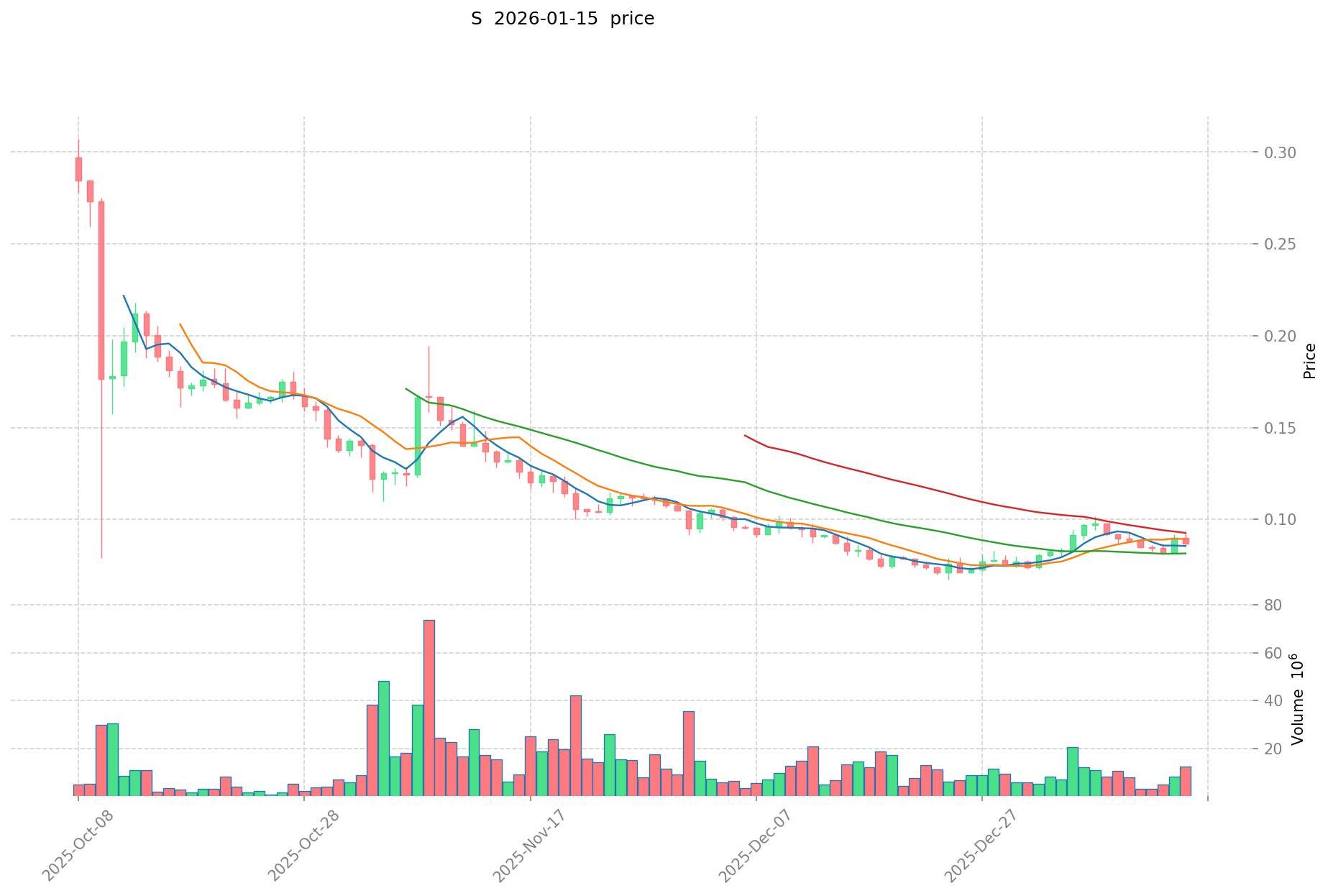
- January 2026: As of January 15, 2026, the token has shown recovery signs, with the current price stabilizing at $0.08507 → demonstrating resilience following the earlier decline
Current S Investment Market Status (January 2026)
- Current S Price: $0.08507 (as of January 15, 2026)
- Market Sentiment (Fear & Greed Index): Data indicates a score of 1, suggesting cautious market sentiment
- 24-Hour Trading Volume: $1,173,017.83
- Recent Price Movements: The token shows a 24-hour change of -3.51%, with 1-hour performance at +0.24%, 7-day performance at -2.19%, 30-day performance at +3.49%, and 1-year performance at -89.07%
- Market Capitalization: Circulating market cap stands at $245,001,600 with a fully diluted valuation of $274,148,708.75
- Supply Metrics: Circulating supply of 2.88 billion tokens represents approximately 74.04% of total supply (3.22 billion tokens)
Click to view real-time S market price
II. Core Factors Influencing Whether S is a Good Investment (Is Sonic(S) a Good Investment)
Supply Mechanism and Scarcity (S investment scarcity)
- Total supply of 3,222,625,000 S tokens with infinite maximum supply → affects price dynamics and investment value
- Circulating supply represents 74.04% of total supply (2.88 billion tokens), indicating substantial token availability in the market
- Investment significance: The unlimited supply model differs from deflationary assets, requiring investors to consider potential dilution effects on long-term value
Institutional Investment and Mainstream Adoption (Institutional investment in Sonic)
- Governance proposal passed in September 2025 allocated 150M $S tokens and $100M for NASDAQ Private Investment in Public equity development
- Trading availability across 55 exchanges indicates growing market accessibility and institutional interest
- Investment value enhanced through Sonic Gateway, providing secure bridge to Ethereum for improved liquidity and asset security
Macroeconomic Environment's Impact on S Investment
- Post-BTC halving momentum expected to drive broader crypto market sentiment, potentially benefiting S token demand
- DeFi ecosystem growth amid evolving monetary policies may increase attractiveness of Layer 1 platforms like Sonic
- Market volatility reflected in price fluctuations between $0.0673 and $1.03 throughout its trading history suggests sensitivity to broader economic conditions
Technology and Ecosystem Development (Technology & Ecosystem for S investment)
- High-performance infrastructure: 10,000 TPS capacity with sub-second finality → enhances platform competitiveness and investment appeal
- EVM compatibility: Facilitates developer migration and dApp deployment → expands ecosystem utility and long-term value proposition
- DeFi-focused incentive structure and Sonic Gateway bridge technology → strengthens cross-chain interoperability and attracts liquidity, supporting sustained ecosystem growth
III. S Future Investment Forecast and Price Outlook (Is Sonic(S) worth investing in 2026-2031)
Short-term Investment Forecast (2026, short-term S investment outlook)
Based on current market data and technical indicators, short-term price projections for Sonic (S) in 2026 present varied scenarios:
- Conservative forecast: $0.051 - $0.085
- Neutral forecast: $0.085 - $0.095
- Optimistic forecast: $0.095 - $0.109
The conservative range reflects potential market consolidation following recent price movements, while the optimistic scenario assumes sustained network growth and increased DeFi adoption within the Sonic ecosystem.
Mid-term Investment Outlook (2027-2029, mid-term Sonic(S) investment forecast)
- Market stage expectation: Ecosystem expansion phase with focus on developer adoption and DeFi protocol integration
- Investment return forecast:
- 2027: $0.062 - $0.105 (estimated 13% growth)
- 2028: $0.089 - $0.134 (estimated 18% growth)
- 2029: $0.111 - $0.161 (estimated 37% growth)
- Key catalysts: EVM compatibility advantages, Fee Monetization (FeeM) program effectiveness, Sonic Gateway bridging solutions, and strategic partnerships with infrastructure providers including Chainlink and Pyth
Long-term Investment Outlook (Is Sonic a good long-term investment?)
- Base scenario: $0.071 - $0.170 (assuming steady ecosystem development and moderate DeFi market growth)
- Optimistic scenario: $0.112 - $0.202 (assuming accelerated developer adoption and strong network utilization)
- Risk scenario: Below $0.070 (under conditions of intensified Layer 1 competition or significant market downturns)
For detailed S long-term investment and price forecasts: Price Prediction
2026-01-15 to 2031 Long-term Outlook
- Base scenario: $0.071 - $0.170 (corresponding to steady progress and gradual mainstream application improvement)
- Optimistic scenario: $0.112 - $0.202 (corresponding to large-scale adoption and favorable market environment)
- Transformative scenario: Above $0.202 (in case of ecosystem breakthrough developments and mainstream popularization)
- 2031-12-31 projected high: $0.198 (based on optimistic development assumptions)
Disclaimer: Price predictions are speculative and based on current market analysis. Cryptocurrency investments involve substantial risk. The forecasts presented reflect technical analysis and ecosystem fundamentals but cannot guarantee future performance. Market volatility, regulatory changes, and competitive dynamics may significantly impact actual outcomes. Investors should conduct thorough research and consider their risk tolerance before making investment decisions.
| Year |
Predicted High Price |
Predicted Average Price |
Predicted Low Price |
Price Change |
| 2026 |
0.1087488 |
0.08496 |
0.050976 |
0 |
| 2027 |
0.104602752 |
0.0968544 |
0.061986816 |
13 |
| 2028 |
0.13396900608 |
0.100728576 |
0.08864114688 |
18 |
| 2029 |
0.1607678437248 |
0.11734879104 |
0.111481351488 |
37 |
| 2030 |
0.20163456020448 |
0.1390583173824 |
0.070919741865024 |
63 |
| 2031 |
0.19760186900039 |
0.17034643879344 |
0.11242864960367 |
100 |
IV. Sonic Investment Strategy and Risk Management (How to invest in L1 blockchain tokens)
Investment Methodology (Sonic investment strategy)
-
Long-term Holding (HODL Sonic): Suitable for conservative investors who believe in the long-term development of EVM-compatible Layer 1 platforms. Given Sonic's infrastructure advantages including 10,000 TPS and sub-second finality, a long-term holding strategy may align with the platform's ecosystem growth trajectory.
-
Active Trading: Relies on technical analysis and swing trading strategies. With a 24-hour trading volume of approximately $1.17 million and observable price volatility (24-hour range: $0.08351 - $0.09091), active traders may find opportunities in short-term price movements. Technical analysis tools and market sentiment indicators can be utilized for entry and exit timing.
Risk Management (Risk management for Sonic investment)
-
Asset Allocation Ratios:
- Conservative investors: Allocate 1-3% of portfolio to L1 tokens like Sonic
- Moderate investors: Consider 3-7% allocation based on risk tolerance
- Professional investors: May adjust allocation based on comprehensive market analysis and portfolio strategy
-
Risk Hedging Solutions: Implement diversified portfolio strategies including multiple crypto assets and traditional risk management instruments. Consider pairing L1 token investments with established cryptocurrencies to balance exposure.
-
Secure Storage: Utilize cold wallet solutions for long-term holdings and hot wallets for active trading positions. Hardware wallet options from reputable manufacturers are recommended for enhanced security of Sonic tokens.
V. Sonic Investment Risks and Challenges (Risks of investing in L1 blockchain tokens)
-
Market Risk: The cryptocurrency market exhibits high volatility. Sonic has experienced significant price fluctuations, with a 1-year change of -89.07% from its historical high of $1.03 (recorded on January 5, 2025) to current levels. The 24-hour price change of -3.51% demonstrates ongoing volatility characteristics.
-
Regulatory Risk: Policy uncertainty varies across different jurisdictions. The regulatory framework for Layer 1 blockchain platforms continues to evolve globally, which may impact token valuation and trading accessibility.
-
Technical Risk: As a blockchain platform providing high-throughput infrastructure, Sonic faces potential network security vulnerabilities and technical upgrade challenges. The Sonic Gateway bridge to Ethereum introduces additional smart contract risk factors that require ongoing security audits.
VI. Conclusion: Is L1 blockchain token a Good Investment?
-
Investment Value Summary: Sonic demonstrates technical advantages as an EVM Layer 1 platform with high-performance infrastructure (10,000 TPS, sub-second finality), which may support long-term development potential. However, market data indicates substantial short-term price volatility, with the token currently trading at $0.08507, significantly below its historical peak.
-
Investor Recommendations:
✅ Beginners: Consider dollar-cost averaging (DCA) strategies combined with secure wallet storage to mitigate timing risk and enhance asset security
✅ Experienced Investors: May employ swing trading strategies with diversified portfolio allocation to manage exposure to L1 platform tokens
✅ Institutional Investors: Evaluate strategic long-term positioning based on comprehensive due diligence of platform fundamentals and ecosystem development
⚠️ Notice: Cryptocurrency investments involve substantial risk. This content is for informational purposes only and does not constitute investment advice. Investors should conduct independent research and consult professional financial advisors before making investment decisions.
VII. FAQ
Q1: Is Sonic (S) a good investment for beginners in 2026?
For beginners, Sonic presents both opportunities and challenges. Given the token's high volatility—currently trading at $0.08507 after experiencing an 89.07% decline from its January 2025 peak of $1.03—beginners should approach with caution. The platform's technical fundamentals are solid, featuring 10,000 TPS capacity and EVM compatibility, which supports long-term ecosystem growth. However, the substantial price fluctuations and market sentiment score of 1 (indicating extreme fear) suggest significant risk. Beginners should consider dollar-cost averaging (DCA) strategies, allocating only 1-3% of their portfolio to Sonic, and prioritizing secure cold wallet storage for any holdings.
Q2: What is the realistic price forecast for Sonic (S) by the end of 2026?
Based on current market analysis and technical indicators, Sonic's 2026 price outlook presents three scenarios. The conservative forecast ranges from $0.051 to $0.085, reflecting potential market consolidation. The neutral forecast suggests $0.085 to $0.095, representing modest growth from current levels. The optimistic scenario projects $0.095 to $0.109, contingent on sustained network growth and increased DeFi adoption. The predicted high for 2026 stands at approximately $0.109, with an average price around $0.085. These projections assume continued ecosystem development, successful implementation of the Fee Monetization program, and favorable broader cryptocurrency market conditions.
Q3: How does Sonic's unlimited supply affect its investment value?
Sonic's unlimited maximum supply structure represents a critical consideration for long-term investors. Unlike deflationary assets such as Bitcoin, Sonic's tokenomics allow for continuous token creation, which introduces potential dilution effects. Currently, 2.88 billion tokens are in circulation (74.04% of the 3.22 billion total supply), indicating substantial availability in the market. This supply mechanism differs fundamentally from scarcity-driven value models and requires investors to focus on demand-side factors—such as network utilization, DeFi protocol adoption, and transaction volume growth—to support price appreciation. The unlimited supply model may limit upward price pressure compared to fixed-supply cryptocurrencies during market upswings.
Q4: What are the main risks of investing in Sonic compared to other Layer 1 platforms?
Sonic faces several specific risk factors within the competitive Layer 1 landscape. Market risk is substantial, evidenced by the 89.07% decline over the past year and ongoing volatility with 24-hour fluctuations of -3.51%. Technical risks include potential vulnerabilities in the Sonic Gateway bridge to Ethereum, which introduces smart contract exposure requiring continuous security audits. Regulatory uncertainty affects Layer 1 platforms globally, with evolving policy frameworks potentially impacting token valuation and trading access. Additionally, Sonic competes with established platforms like Ethereum, Solana, and Avalanche, facing adoption challenges despite its technical advantages. The relatively low 24-hour trading volume of $1.17 million also indicates limited liquidity compared to major competitors.
Q5: Should I hold Sonic long-term or trade it actively?
The optimal strategy depends on your risk profile and investment objectives. Long-term holding (HODL) suits conservative investors who believe in Sonic's infrastructure advantages—10,000 TPS, sub-second finality, and EVM compatibility—supporting ecosystem growth over years. Long-term price projections suggest potential appreciation to $0.170-$0.202 by 2031 under optimistic scenarios, representing substantial upside from current levels. Active trading may appeal to experienced traders who can capitalize on short-term volatility, with observable price swings providing opportunities for swing trading strategies. However, active trading requires technical analysis expertise and risk management discipline. For most investors, a hybrid approach—holding a core position long-term while trading a smaller allocation actively—may balance growth potential with risk mitigation.
Q6: How does the institutional investment proposal affect Sonic's future value?
The September 2025 governance proposal allocating 150 million S tokens and $100 million for NASDAQ Private Investment in Public Equity (PIPE) development represents a significant institutional validation signal. This proposal demonstrates Sonic's strategic focus on attracting institutional capital and mainstream adoption, which could enhance liquidity and market credibility. Institutional involvement typically brings professional market-making, reduced volatility, and increased trading volume—all positive factors for price stability and long-term appreciation. However, the token allocation also introduces potential selling pressure if institutions distribute tokens in the market. The success of this initiative depends on execution quality and actual institutional participation rates, which remain to be observed throughout 2026-2027.
Q7: What role does the Sonic Gateway play in the investment thesis?
The Sonic Gateway bridge to Ethereum serves as a critical infrastructure component supporting Sonic's investment value proposition. This bridge enables secure cross-chain asset transfers, enhancing liquidity and expanding the addressable user base by connecting Sonic's high-performance environment to Ethereum's established DeFi ecosystem. For investors, the Gateway reduces isolated network risk by ensuring capital mobility between chains, potentially attracting liquidity providers and DeFi protocols seeking lower transaction costs and faster settlement times. However, bridge technology introduces additional smart contract risks and security considerations that require ongoing audits and monitoring. The Gateway's success in facilitating meaningful asset flows will be a key metric for evaluating Sonic's ecosystem development progress throughout 2026.
Q8: How should I allocate Sonic within a diversified cryptocurrency portfolio?
Portfolio allocation for Sonic should reflect individual risk tolerance and investment experience. Conservative investors should limit Sonic exposure to 1-3% of their cryptocurrency portfolio, treating it as a speculative position within a broader diversified strategy including established assets like Bitcoin and Ethereum. Moderate investors with higher risk tolerance may allocate 3-7% based on conviction in Layer 1 platform growth and Sonic's technical advantages. Professional investors may adjust allocations dynamically based on market conditions, technical analysis, and ecosystem development milestones. Regardless of allocation percentage, investors should implement risk management through position sizing, stop-loss strategies, and regular portfolio rebalancing. Pairing Sonic with uncorrelated assets and maintaining adequate stablecoin reserves for opportunistic rebalancing enhances overall portfolio resilience.
* The information is not intended to be and does not constitute financial advice or any other recommendation of any sort offered or endorsed by Gate.