This comprehensive guide evaluates whether Sonic SVM (SONIC), the first SVM network extension on Solana targeting gaming and Web3 applications, represents a viable investment opportunity. As of January 2026, SONIC trades at $0.05957 with a $21.45 million market cap. The analysis examines historical price volatility—ranging from $1.225 in January 2025 to $0.03238 in October 2025—alongside technological infrastructure built on Sonic HyperGrid for coordinating optimistic Solana rollups. Price forecasts span conservative ($0.053-$0.060 in 2026) to optimistic scenarios (reaching $0.136 by 2031). The article addresses critical investment considerations including supply mechanics (360 million circulating tokens of 2.4 billion maximum), institutional adoption factors, macroeconomic influences, and regulatory uncertainties. Risk management strategies tailored for conservative, aggressive, and institutional investors are provided, alongside comprehensive risk assessments covering market volatility, regulatory challenge
Introduction: Sonic SVM (SONIC) Investment Position and Market Outlook
Sonic SVM (SONIC) represents a notable asset in the cryptocurrency sector as the first SVM network extension launched on Solana, targeting gaming and application use cases. As of January 23, 2026, SONIC maintains a market capitalization of approximately $21.45 million, with a circulating supply of 360 million tokens and a current price around $0.05957. The project positions itself as infrastructure supporting Web3 applications aimed at scaling to billion-user adoption through its Sonic HyperGrid framework for coordinating optimistic Solana rollups. With a market ranking of 844 and presence across 30 exchanges, SONIC has attracted attention from investors examining "Is Sonic SVM (SONIC) a good investment?" This article provides a comprehensive analysis of SONIC's investment characteristics, historical price performance, future price projections, and associated investment risks to serve as reference material for market participants.
I. Historical Price Review and Current Investment Value of SONIC
- 2025: On January 8, SONIC reached a notable price level of $1.225, representing a significant milestone in its trading history
- October 2025: The token experienced substantial price volatility, declining from higher levels to $0.03238
- 2025-2026: Following market cycles, SONIC's price fluctuated from earlier peaks to current trading ranges, reflecting broader market conditions
Current SONIC Investment Market Status (January 2026)
- Current SONIC Price: $0.05957
- 24-Hour Trading Volume: $2,725,907.53
- Market Capitalization: $21,445,200
- Circulating Supply: 360,000,000 SONIC (15% of total supply)
- Fully Diluted Valuation: $142,968,000
- Number of Holders: 44,302
Click to view real-time SONIC market price
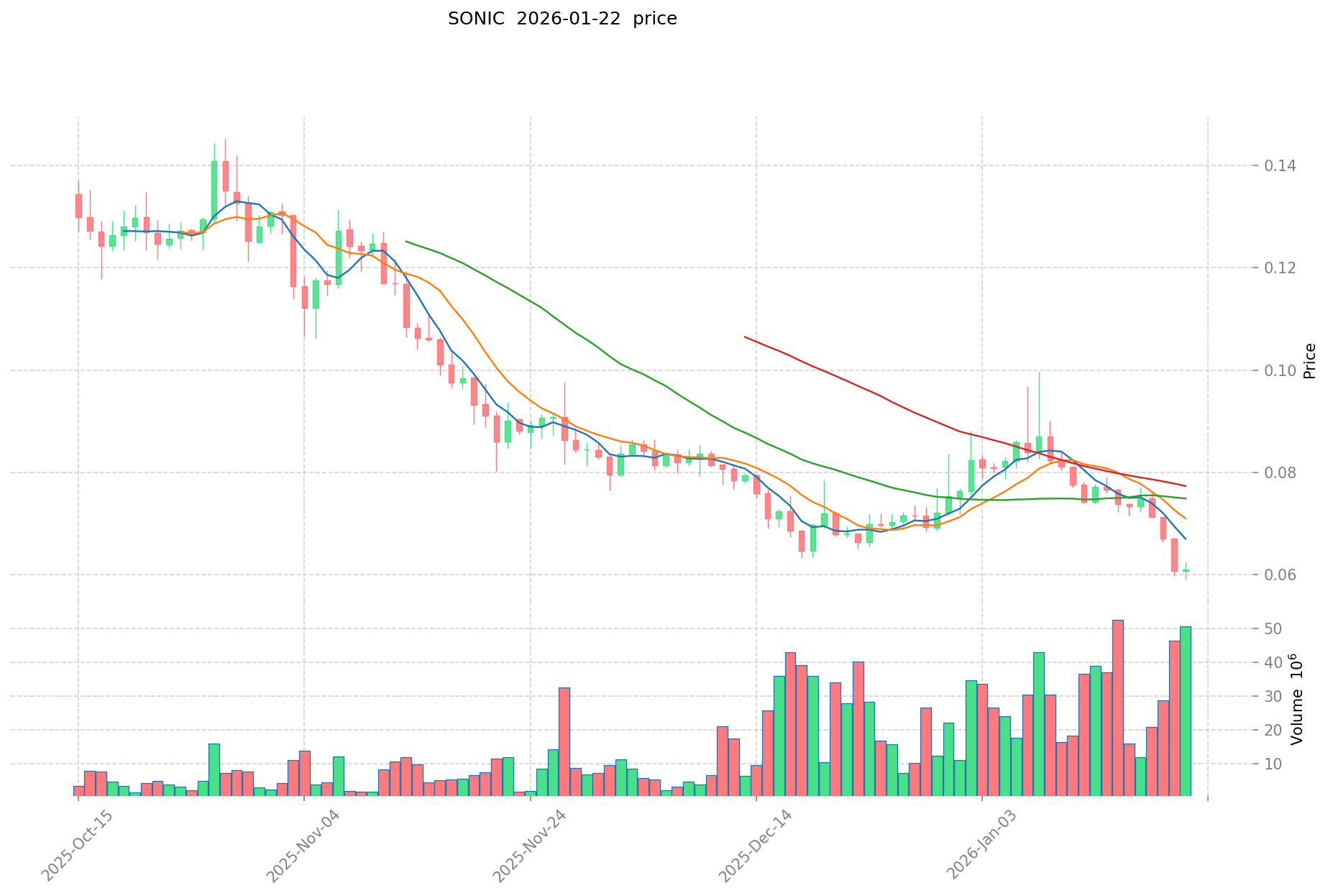
II. Core Factors Affecting Whether SONIC is a Good Investment (Is Sonic SVM(SONIC) a Good Investment)
Supply Mechanism and Scarcity (SONIC investment scarcity)
- Supply mechanism: SONIC has a maximum supply of 2,400,000,000 tokens, with a current circulating supply of 360,000,000 tokens, representing 15% of the total supply → impacts price dynamics and investment value assessment
- Historical context: SONIC's price reached $1.225 in early January 2025, while experiencing a lower price point of $0.03238 in October 2025, demonstrating significant price volatility related to supply circulation patterns
- Investment implications: The controlled circulation ratio and defined maximum supply may contribute to potential scarcity considerations for long-term investment evaluation
Institutional Investment and Mainstream Adoption (Institutional investment in SONIC)
- Adoption context: SONIC positions itself as infrastructure for Web3 applications, specifically targeting gaming and social media-style applications through its SVM network extension on Solana
- Holder base: The project has attracted 44,302 holders as of January 2026, indicating a certain level of community participation
- Market presence: SONIC is available on 30 exchanges with Gate.com trading support, suggesting a degree of liquidity and accessibility for investors
Macroeconomic Environment's Impact on SONIC Investment
- Market positioning: As a blockchain infrastructure token, SONIC's investment appeal may be influenced by broader cryptocurrency market sentiment and monetary policy trends
- Volatility considerations: The token has experienced an 89.47% decline over a one-year period, reflecting the impact of market conditions on Layer-2 and gaming-focused blockchain projects
- Risk factors: Macroeconomic uncertainty and shifting interest rate environments may affect investor appetite for speculative blockchain infrastructure investments
Technology and Ecosystem Development (Technology & Ecosystem for SONIC investment)
- Core technology: SONIC is built with Sonic HyperGrid, a framework designed for orchestrating optimistic Solana rollups, aiming to enhance scalability for gaming and application-layer use cases
- Target applications: The platform focuses on powering Web3 social applications and onboarding users at scale, which may influence long-term value proposition if adoption materializes
- Ecosystem positioning: As the first SVM network extension on Solana, SONIC's investment value may be tied to the growth of Solana-based gaming, DeFi, and application ecosystems
III. SONIC Future Investment Forecast and Price Outlook (Is Sonic SVM(SONIC) worth investing in 2026-2031)
Short-term Investment Forecast (2026, short-term SONIC investment outlook)
- Conservative Forecast: $0.053 - $0.060
- Neutral Forecast: $0.060 - $0.070
- Optimistic Forecast: $0.070 - $0.087
Mid-term Investment Outlook (2027-2028, mid-term Sonic SVM(SONIC) investment forecast)
-
Market Stage Expectation: The mid-term period may witness gradual adoption of Sonic's SVM network extension on Solana, with potential growth driven by gaming and application development within the ecosystem.
-
Investment Return Forecast:
- 2027: $0.046 - $0.098
- 2028: $0.069 - $0.101
-
Key Catalysts: Expansion of Web3 applications, increased developer activity on Sonic HyperGrid, and broader Solana ecosystem growth.
Long-term Investment Outlook (Is SONIC a good long-term investment?)
- Baseline Scenario: $0.064 - $0.112 (assuming steady ecosystem development and moderate market conditions)
- Optimistic Scenario: $0.112 - $0.136 (assuming accelerated adoption, successful gaming and application launches, and favorable market sentiment)
- Risk Scenario: $0.046 - $0.064 (under conditions of market downturns, competitive pressure, or slower-than-expected ecosystem growth)
Click to view SONIC long-term investment and price forecast: Price Prediction
2026-01-23 - 2031 Long-term Outlook
- Baseline Scenario: $0.064 - $0.112 (corresponding to steady progress and gradual mainstream application adoption)
- Optimistic Scenario: $0.112 - $0.136 (corresponding to large-scale adoption and favorable market environment)
- Transformative Scenario: Above $0.136 (in case of breakthrough ecosystem developments and mainstream popularization)
- 2031-12-31 Forecast High: $0.136 (based on optimistic development assumptions)
Disclaimer: The information provided is for reference purposes only and does not constitute investment advice. Cryptocurrency markets are highly volatile, and past performance does not guarantee future results. Investors should conduct their own research and assess risks before making investment decisions.
| Year |
Predicted High Price |
Predicted Average Price |
Predicted Low Price |
Price Change |
| 2026 |
0.0870306 |
0.05961 |
0.0530529 |
0 |
| 2027 |
0.097515999 |
0.0733203 |
0.046191789 |
23 |
| 2028 |
0.10079341641 |
0.0854181495 |
0.069188701095 |
43 |
| 2029 |
0.1005542455914 |
0.093105782955 |
0.08472626248905 |
56 |
| 2030 |
0.127815618840624 |
0.0968300142732 |
0.066812709848508 |
62 |
| 2031 |
0.135910608033863 |
0.112322816556912 |
0.064024005437439 |
88 |
IV. SONIC Investment Strategy and Risk Management (How to invest in Sonic SVM)
Investment Methodology (SONIC investment strategy)
Long-term Holding (HODL SONIC): Suitable for Conservative Investors
Long-term holding represents a passive investment approach where investors acquire SONIC tokens and maintain positions over extended periods, typically measured in years rather than months. This strategy may be appropriate for investors who believe in the long-term value proposition of Sonic SVM as the first SVM network extension on Solana for games and applications.
For SONIC holders, the HODL strategy involves:
- Accumulating tokens during market corrections
- Ignoring short-term price fluctuations
- Focusing on fundamental development milestones
- Rebalancing positions periodically based on portfolio targets
Given SONIC's current circulating supply of 360,000,000 tokens (15% of total supply) and maximum supply of 2,400,000,000 tokens, investors should consider potential dilution effects as additional tokens enter circulation.
Active Trading: Relying on Technical Analysis and Swing Trading
Active trading strategies involve frequent position adjustments based on market movements and technical indicators. For SONIC traders, this approach requires:
- Monitoring 24-hour trading volume (approximately $2.73 million as of recent data)
- Analyzing price ranges (24-hour high: $0.06195, low: $0.05856)
- Identifying support and resistance levels
- Utilizing chart patterns and momentum indicators
Traders should note SONIC's significant price volatility, with the token demonstrating substantial fluctuations across different timeframes. The 7-day performance shows considerable movement, suggesting opportunities for swing trading strategies.
Risk Management (Risk management for SONIC investment)
Asset Allocation Ratio: Conservative / Aggressive / Professional Investors
Conservative Investors:
- SONIC allocation: 1-3% of total cryptocurrency portfolio
- Focus on established cryptocurrencies (70-80% allocation)
- Limited exposure to newer network extensions
Aggressive Investors:
- SONIC allocation: 5-10% of cryptocurrency portfolio
- Higher tolerance for volatility
- Active position management and rebalancing
Professional Investors:
- SONIC allocation: 3-15% based on risk models
- Sophisticated hedging strategies
- Institutional-grade custody solutions
Investors should consider SONIC's market position (ranked #844) and market dominance (0.0045%) when determining appropriate allocation percentages within their portfolios.
Effective risk hedging for SONIC investments may include:
- Portfolio Diversification: Combining SONIC with other Solana ecosystem tokens and non-correlated assets
- Position Sizing: Limiting individual position exposure to prevent catastrophic losses
- Stop-Loss Orders: Implementing automated exit points to limit downside risk
- Correlation Analysis: Understanding SONIC's price relationship with SOL and broader market movements
The token's volatility characteristics suggest that hedging strategies should account for rapid price movements in both directions.
Secure Storage: Hot and Cold Wallets + Hardware Wallet Recommendations
Cold Storage Solutions:
- Hardware wallets compatible with Solana SPL tokens
- Multi-signature wallet configurations for larger holdings
- Paper wallet solutions for long-term storage
Hot Wallet Considerations:
- Mobile and desktop wallets for active trading
- Exchange wallets for short-term holdings only
- Two-factor authentication and security protocols
Hardware Wallet Recommendations:
Investors should select hardware wallets that support Solana network tokens, ensuring compatibility with SONIC's SPL20 standard. Regular firmware updates and secure backup procedures are essential components of proper custody practices.
Given SONIC's presence on the Solana blockchain, investors must ensure their storage solutions support Solana network tokens and understand the specific requirements for SPL token management.
V. SONIC Investment Risks and Challenges (Risks of investing in Sonic SVM)
Market Risk: High Volatility and Price Manipulation
SONIC exhibits substantial price volatility across multiple timeframes. The token's price movements demonstrate significant fluctuations, with notable variations between different measurement periods. This volatility presents both opportunities and risks for investors.
Key volatility indicators include:
- Intraday price ranges showing considerable percentage swings
- Multi-day performance variations indicating market uncertainty
- Trading volume relative to market capitalization suggesting liquidity considerations
The token's relatively small market capitalization (approximately $21.45 million) may contribute to increased susceptibility to large trades impacting price discovery. Lower liquidity environments can facilitate more pronounced price movements from concentrated buying or selling activity.
Investors should recognize that tokens with smaller market capitalizations and lower trading volumes may experience amplified price movements compared to more established cryptocurrencies. Market depth analysis becomes particularly important when planning entry and exit strategies.
Regulatory Risk: Policy Uncertainty Across Different Countries
Cryptocurrency regulatory frameworks continue evolving globally, creating uncertainty for token holders. SONIC investors face potential regulatory challenges across multiple jurisdictions:
Jurisdictional Considerations:
- Varying cryptocurrency classification schemes across countries
- Evolving securities law interpretations
- Tax treatment differences for digital assets
- Reporting requirements for cryptocurrency transactions
Platform-Specific Regulatory Factors:
- Solana network regulatory status in different jurisdictions
- Gaming and application token regulatory treatment
- Cross-border transaction compliance requirements
The regulatory landscape for blockchain gaming platforms and application layers remains particularly uncertain. Changes in regulatory approaches toward gaming tokens, virtual assets, or application-layer protocols could impact SONIC's utility and market acceptance.
Investors should monitor regulatory developments in their jurisdiction and understand their compliance obligations regarding cryptocurrency investments. Regulatory changes can occur rapidly and may significantly affect token valuations and trading accessibility.
Technical Risk: Network Security Vulnerabilities and Upgrade Failures
As a network extension built on Solana, SONIC faces multiple technical risk vectors:
Smart Contract Risks:
- Potential vulnerabilities in token contract code (Contract address: SonicxvLud67EceaEzCLRnMTBqzYUUYNr93DBkBdDES)
- Security audit completeness and findings
- Upgrade mechanisms and governance processes
Network Dependency Risks:
- Reliance on Solana network stability and performance
- Base layer network outages or degradation
- Consensus mechanism vulnerabilities
Technology Integration Risks:
- HyperGrid framework implementation challenges
- Rollup coordination complexity
- Interoperability issues with Solana ecosystem
SONIC's positioning as the first SVM network extension on Solana introduces pioneering technology risks. Novel implementations may encounter unforeseen technical challenges or require significant adjustments during development phases.
Upgrade and Development Risks:
- Protocol upgrade coordination difficulties
- Backward compatibility issues
- Testing and deployment processes
- Community consensus for protocol changes
Investors should understand that technical risks extend beyond immediate security concerns to encompass long-term development execution and technology maturation processes.
VI. Conclusion: Is Sonic SVM a Good Investment?
Investment Value Summary
SONIC represents a network extension project built on the Solana blockchain, targeting gaming and application use cases. The token's investment characteristics include:
Fundamental Considerations:
- Early-stage network extension with developing ecosystem
- Positioning in gaming and application infrastructure
- Integration with Solana network architecture
- Current circulation represents 15% of maximum supply
Market Positioning:
- Market rank #844 with market dominance of 0.0045%
- Trading availability across 30 exchanges
- Token holder base of approximately 44,302 addresses
The token demonstrates characteristics typical of earlier-stage blockchain projects, including substantial volatility and evolving market position. Price movements across various timeframes suggest dynamic market conditions with significant fluctuation potential.
Investor Recommendations
✅ Beginners: Dollar-Cost Averaging + Secure Wallet Storage
For New Cryptocurrency Investors:
- Implement systematic purchasing strategies rather than lump-sum investments
- Prioritize security through proper wallet selection and management
- Start with minimal allocations to understand market dynamics
- Focus on education regarding Solana ecosystem and SPL tokens
- Utilize reputable exchanges with strong security records
- Maintain detailed transaction records for tax purposes
New investors should recognize SONIC's volatility profile and limit exposure accordingly. Understanding basic blockchain concepts, wallet security, and Solana network operations represents essential prerequisite knowledge.
✅ Experienced Investors: Swing Trading + Portfolio Allocation
For Investors with Cryptocurrency Experience:
- Develop specific entry and exit criteria based on technical analysis
- Implement risk management through position sizing and stop-losses
- Monitor Solana ecosystem developments affecting SONIC
- Utilize portfolio rebalancing strategies based on performance
- Consider correlation with other Solana ecosystem tokens
- Evaluate liquidity conditions before position establishment
Experienced investors may leverage SONIC's volatility for active trading strategies while maintaining appropriate risk controls. Understanding broader Solana ecosystem dynamics becomes important for informed decision-making.
✅ Institutional Investors: Strategic Long-term Allocation
For Institutional and Professional Investors:
- Conduct comprehensive due diligence on technology architecture
- Evaluate token economics and supply distribution schedules
- Assess team credentials and development roadmap execution
- Implement institutional-grade custody solutions
- Consider regulatory implications across operating jurisdictions
- Monitor network metrics and adoption indicators
- Develop thesis-driven investment frameworks
Institutional participants should evaluate SONIC within broader portfolio construction frameworks, considering correlation characteristics, liquidity requirements, and strategic positioning objectives.
⚠️ Disclaimer
Cryptocurrency investments carry substantial risk, including potential complete loss of invested capital. This analysis provides educational information and should not be construed as financial advice, investment recommendation, or encouragement to purchase SONIC tokens.
Investors should:
- Conduct independent research and due diligence
- Consult qualified financial advisors regarding personal circumstances
- Understand risk tolerance and investment objectives
- Never invest more than they can afford to lose
- Recognize that past performance does not indicate future results
The cryptocurrency market remains highly speculative, with prices influenced by numerous factors including market sentiment, technological developments, regulatory changes, and broader economic conditions. SONIC's price behavior demonstrates significant volatility, and future performance cannot be predicted with certainty.
VII. FAQ
Q1: What is the current market position of Sonic SVM (SONIC) and its trading availability?
SONIC is currently ranked #844 in the cryptocurrency market with a market capitalization of approximately $21.45 million and a market dominance of 0.0045%. The token is available for trading across 30 exchanges, with Gate.com providing trading support. As of January 23, 2026, SONIC maintains a price around $0.05957 with a 24-hour trading volume of $2,725,907.53. The token has attracted 44,302 holders and operates on the Solana blockchain as the first SVM network extension targeting gaming and application use cases. The current circulating supply represents 360 million tokens (15% of the maximum supply of 2.4 billion tokens).
Q2: How has SONIC's historical price performance demonstrated volatility risks?
SONIC has exhibited substantial price volatility throughout its trading history. In early January 2025, the token reached a notable high of $1.225, while by October 2025 it declined to $0.03238, demonstrating significant downward movement. Over a one-year period, SONIC experienced an 89.47% decline, reflecting considerable market volatility. This price behavior indicates that SONIC carries high volatility risk typical of smaller market capitalization tokens. The token's intraday trading ranges and multi-day performance variations suggest dynamic market conditions with significant fluctuation potential, making it important for investors to implement appropriate risk management strategies.
Q3: What technical infrastructure differentiates SONIC from other blockchain projects?
SONIC positions itself as the first SVM network extension on Solana, built with Sonic HyperGrid framework designed for orchestrating optimistic Solana rollups. The platform specifically targets gaming and Web3 social applications, aiming to scale applications for billion-user adoption. This technical architecture creates dependency on Solana network stability and introduces pioneering technology risks associated with novel implementations. The HyperGrid framework handles rollup coordination complexity and requires integration with the broader Solana ecosystem. As an early-stage network extension, SONIC faces technical challenges including smart contract security, protocol upgrade coordination, and backward compatibility considerations that investors should understand when evaluating long-term viability.
Q4: What investment allocation strategies are appropriate for different investor types holding SONIC?
Conservative investors should limit SONIC allocation to 1-3% of their total cryptocurrency portfolio, focusing primarily on established cryptocurrencies (70-80% allocation) with minimal exposure to newer network extensions. Aggressive investors with higher volatility tolerance may allocate 5-10% to SONIC with active position management and rebalancing strategies. Professional and institutional investors might consider 3-15% allocation based on sophisticated risk models, implementing institutional-grade custody solutions and thesis-driven investment frameworks. Given SONIC's market position and volatility characteristics, all investor types should implement proper risk management through position sizing, stop-loss orders, and portfolio diversification strategies to prevent catastrophic losses.
Q5: What are the primary regulatory and security risks facing SONIC investors?
SONIC investors face evolving regulatory uncertainty across multiple jurisdictions, as cryptocurrency classification schemes and securities law interpretations continue developing globally. Gaming and application tokens face particularly uncertain regulatory treatment, with varying tax requirements and reporting obligations across countries. From a technical security perspective, SONIC carries smart contract risks associated with token contract code (Contract address: SonicxvLud67EceaEzCLRnMTBqzYUUYNr93DBkBdDES), network dependency on Solana's stability, and technology integration challenges related to HyperGrid framework implementation. The token's relatively small market capitalization ($21.45 million) increases susceptibility to market manipulation and liquidity constraints. Investors must maintain secure storage using hardware wallets compatible with Solana SPL tokens and understand compliance obligations in their jurisdictions.
Q6: What price forecasts exist for SONIC through 2031?
Short-term 2026 forecasts suggest conservative estimates of $0.053-$0.060, neutral forecasts of $0.060-$0.070, and optimistic scenarios of $0.070-$0.087. Mid-term projections indicate 2027 prices ranging from $0.046-$0.098 and 2028 prices of $0.069-$0.101, contingent on Web3 application adoption and developer activity on Sonic HyperGrid. Long-term baseline scenarios project $0.064-$0.112 by 2031 assuming steady ecosystem development, while optimistic scenarios suggest $0.112-$0.136 under accelerated adoption conditions. Risk scenarios forecast $0.046-$0.064 during market downturns or competitive pressure. These projections carry substantial uncertainty and should not be interpreted as guaranteed outcomes, as cryptocurrency markets remain highly volatile and unpredictable.
Q7: How should beginners approach investing in SONIC?
Beginners should implement dollar-cost averaging strategies rather than lump-sum investments, systematically purchasing small amounts over time to mitigate timing risk. New investors must prioritize security through proper wallet selection, utilizing hardware wallets compatible with Solana SPL tokens and implementing two-factor authentication protocols. Starting with minimal allocations (1-3% of cryptocurrency portfolio) allows beginners to understand market dynamics while limiting exposure. Essential prerequisites include education on Solana ecosystem fundamentals, blockchain security concepts, and SPL token management. Beginners should utilize reputable exchanges with strong security records, maintain detailed transaction records for tax purposes, and recognize that SONIC's volatility profile requires conservative position sizing and never investing more than they can afford to lose completely.
Q8: What ecosystem developments could influence SONIC's long-term investment value?
SONIC's investment value correlates with several ecosystem factors including adoption of Web3 applications, increased developer activity on Sonic HyperGrid framework, and broader Solana ecosystem growth. The platform's success depends on attracting gaming and social application developers who leverage the SVM network extension capabilities. Key catalysts include successful application launches demonstrating billion-user scalability, integration with major gaming platforms, and mainstream adoption of Solana-based decentralized applications. Competition from other Layer-2 solutions and gaming-focused blockchain platforms presents challenges. Long-term value realization requires SONIC to demonstrate technological advantages in rollup coordination, maintain network security, and achieve meaningful application adoption beyond speculative trading interest. Market sentiment toward gaming tokens and infrastructure investments will significantly influence SONIC's trajectory through 2031.
* The information is not intended to be and does not constitute financial advice or any other recommendation of any sort offered or endorsed by Gate.