This comprehensive guide evaluates whether Sovryn (SOV) represents a viable investment opportunity within the Bitcoin DeFi ecosystem. As of January 2026, SOV trades at $0.05927 with a $2.91 million market capitalization, positioning itself as a non-custodial smart contract system for Bitcoin-based lending and margin trading. The article examines SOV's volatile price history—peaking at $43.98 in October 2021 before declining over 99%—alongside key investment factors including fixed supply mechanics (100M token cap, 49.18% circulating), ecosystem adoption across 2,355 holders, and macroeconomic influences. Mid-term forecasts (2027-2029) project potential recovery to $0.06-$0.11, while long-term outlooks (2031) suggest $0.07-$0.12 under favorable conditions. The analysis provides risk management strategies, categorized investment recommendations for beginners through institutional investors, and addresses major concerns including market volatility, regulatory uncertainty, technical vulnerabilities, and limited t
Introduction: Sovryn (SOV)'s Investment Position and Market Prospects
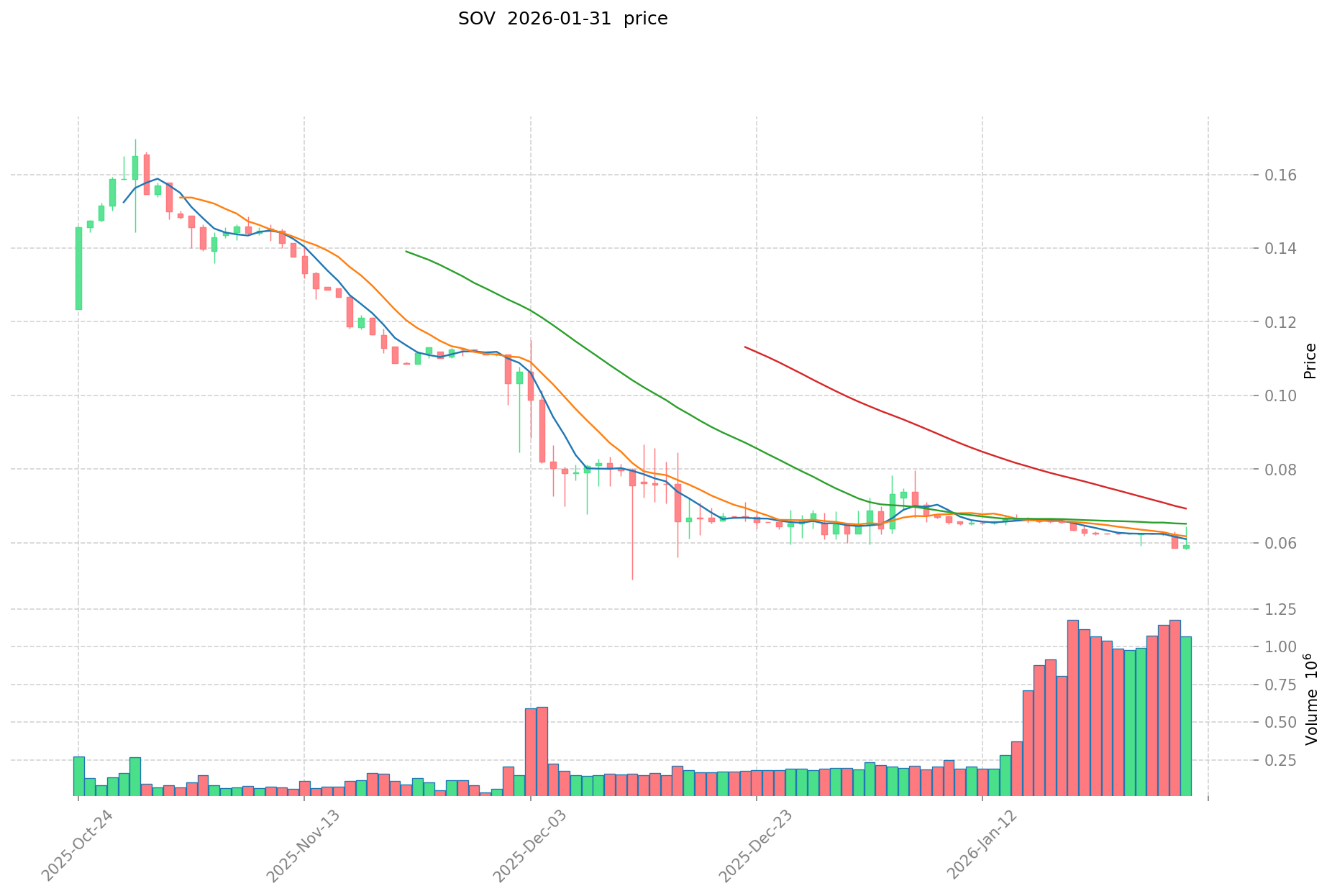
SOV is a notable asset in the cryptocurrency field. As of January 31, 2026, Sovryn has a market capitalization of approximately $2.91 million, with a circulating supply of about 49.18 million tokens, and the current price is around $0.05927. With its positioning as a non-custodial and permissionless smart contract system for Bitcoin lending and margin trading, SOV has gradually become a focal point for investors discussing "Is Sovryn (SOV) a good investment?" This article will comprehensively analyze SOV's investment value, historical trends, future price predictions, and investment risks to provide reference for investors.
I. Sovryn (SOV) Price History Review and Current Investment Status
- 2021: SOV experienced notable price activity following its launch in September 2021, with the token priced at $12.52 at inception. During October 2021, the asset reached a price level of $43.98, reflecting early market interest in the Bitcoin-based DeFi protocol.
- 2025: The token underwent a significant downward adjustment throughout the year. In November 2025, SOV was trading at approximately $0.10913, with the market capitalization standing at $5,432,373. Over a one-week period during this time, the price declined by 15.65%.
- 2025-2026: By December 2025, SOV touched $0.01002593, representing a substantial decline from previous levels. As of January 31, 2026, the token was priced at $0.05927, demonstrating some recovery from the December lows but remaining well below earlier valuations.
Current SOV Investment Market Status (January 2026)
- SOV current price: $0.05927
- Market sentiment (Fear & Greed Index): Data not available in provided materials
- 24-hour trading volume: $64,105.95
- Institutional investor holdings: Data not available in provided materials
Click to view real-time SOV market price
II. Core Factors Influencing Whether SOV is a Good Investment (Is Sovryn(SOV) a Good Investment)
Supply Mechanism and Scarcity (SOV Investment Scarcity)
-
Fixed Supply Model → Influencing Price and Investment Value
Sovryn has established a maximum supply cap of 100,000,000 SOV tokens, with approximately 49.18% currently in circulation (49,181,069 tokens as of January 31, 2026). This controlled supply mechanism creates a structural scarcity framework that may impact long-term valuation dynamics.
-
Historical Patterns: Supply Dynamics and Price Movements
Historical data indicates that SOV experienced significant price volatility, with recorded prices ranging from $0.01002593 to $43.98 across different periods. The token's circulating supply has gradually increased from its initial distribution, which has corresponded with various price adjustment phases in the market.
-
Investment Significance: Scarcity as a Long-term Support Factor
The defined maximum supply ceiling represents a fundamental characteristic that may influence investor assessment of potential value preservation over extended time horizons. The fixed cap mechanism limits future token dilution, which some market participants consider when evaluating long-term holding strategies.
Institutional Investment and Mainstream Adoption (Institutional Investment in SOV)
-
Platform Adoption and User Base
As of the reference date, Sovryn's ecosystem includes approximately 2,355 token holders. The platform operates as a non-custodial smart contract system focused on Bitcoin-based lending and margin trading services, which positions it within a specific segment of the decentralized finance landscape.
-
Factors Affecting Investment Assessment
Multiple elements influence SOV's investment profile, including market demand dynamics, the adoption rate of the Sovryn platform's core services, broader cryptocurrency market trends, and macroeconomic conditions such as interest rate environments and inflation patterns. The platform's integration with Bitcoin-related financial services creates exposure to both DeFi protocol adoption trends and Bitcoin market movements.
Macroeconomic Environment Impact on SOV Investment
-
Monetary Policy and Interest Rate Dynamics → Investment Attractiveness Shifts
Changes in global monetary policy frameworks and interest rate adjustments can influence capital allocation decisions within cryptocurrency markets. Economic conditions that affect risk appetite and liquidity preferences may impact trading volumes and price discovery mechanisms for tokens like SOV.
-
Cryptocurrency Market Correlation Effects
As a DeFi protocol token, SOV's performance may exhibit correlation with broader cryptocurrency market sentiment, Bitcoin price movements (given its Bitcoin-centric service offering), and overall risk asset allocation trends during varying macroeconomic conditions.
Technology and Ecosystem Development (Technology & Ecosystem for SOV Investment)
-
Multi-Chain Deployment Strategy
SOV tokens are deployed across multiple blockchain networks, with contract addresses on Ethereum (0xbdab72602e9ad40fc6a6852caf43258113b8f7a5) and RSK/Rootstock (0xefc78fc7d48b64958315949279ba181c2114abbd). This multi-chain presence provides users with different network options for interacting with the token.
-
Platform Service Expansion
The Sovryn platform's core functionality centers on Bitcoin lending and margin trading services within a non-custodial framework. The platform's development roadmap and service expansion in areas such as decentralized finance applications may influence long-term ecosystem growth and utility value considerations.
-
DeFi Integration and Use Case Development
As a DeFi-focused protocol, Sovryn's value proposition is connected to the adoption and utilization of its lending and trading services. The development of additional financial primitives, improvements in user experience, and integration with broader Bitcoin-based DeFi infrastructure may affect long-term ecosystem sustainability and token utility dynamics.
III. SOV Future Investment Forecast and Price Outlook (Is Sovryn(SOV) worth investing in 2026-2031)
Short-term Investment Forecast (2026, short-term SOV investment outlook)
- Conservative forecast: $0.0527414 - $0.05926
- Neutral forecast: $0.05926 - $0.06
- Optimistic forecast: $0.06 - $0.065186
Mid-term Investment Outlook (2027-2029, mid-term Sovryn(SOV) investment forecast)
- Market stage expectation: SOV may experience gradual recovery phase with moderate volatility. The token showed relative stability in 2026 baseline, followed by potential expansion in ecosystem development during 2027-2029.
- Investment return forecast:
- 2027: $0.06035631 - $0.08524551
- 2028: $0.0471899232 - $0.10986403995
- 2029: $0.05783346290925 - $0.11658491729325
- Key catalysts: Platform adoption rates, DeFi sector developments, Bitcoin-related lending market dynamics, and smart contract ecosystem maturation.
Long-term Investment Outlook (Is Sovryn a good long-term investment?)
- Base scenario: $0.068766741373522 - $0.104192032384125 (assuming steady platform development and moderate market conditions)
- Optimistic scenario: $0.104192032384125 - $0.118174603130074 (assuming enhanced adoption and favorable regulatory environment)
- Risk scenario: Below $0.068766741373522 (under adverse market conditions or significant competitive pressures)
View SOV long-term investment and price prediction: Price Prediction
2026-01-31 - 2031 Long-term Outlook
- Base scenario: $0.068766741373522 - $0.104192032384125 (corresponding to steady progress and gradual mainstream application growth)
- Optimistic scenario: $0.104192032384125 - $0.118174603130074 (corresponding to large-scale adoption and favorable market environment)
- Transformative scenario: Above $0.118174603130074 (contingent on breakthrough ecosystem developments and mainstream penetration)
- 2031-12-31 predicted high: $0.118174603130074 (based on optimistic development assumptions)
Disclaimer: Price predictions are based on historical data analysis and market trends. Cryptocurrency markets involve substantial risks, and actual prices may differ significantly from forecasts. This information is for reference purposes only and does not constitute investment advice.
| Year |
Predicted High Price |
Predicted Average Price |
Predicted Low Price |
Price Change |
| 2026 |
0.065186 |
0.05926 |
0.0527414 |
0 |
| 2027 |
0.08524551 |
0.062223 |
0.06035631 |
4 |
| 2028 |
0.10986403995 |
0.073734255 |
0.0471899232 |
24 |
| 2029 |
0.11658491729325 |
0.091799147475 |
0.05783346290925 |
54 |
| 2030 |
0.11669507627022 |
0.104192032384125 |
0.068766741373522 |
75 |
| 2031 |
0.118174603130074 |
0.110443554327172 |
0.071788310312662 |
86 |
IV. SOV Investment Strategy and Risk Management (How to invest in Sovryn)
Investment Strategy (SOV investment strategy)
-
Long-term Holding (HODL SOV): This approach may suit conservative investors who believe in the long-term potential of decentralized finance protocols built on Bitcoin. Given SOV's non-custodial and permissionless smart contract system for Bitcoin lending and margin trading, patient investors may consider accumulating positions during market corrections.
-
Active Trading: Traders relying on technical analysis and swing trading strategies should note SOV's price volatility. Recent data shows 1-hour price changes of 0.42%, 24-hour declines of 2.85%, and 7-day decreases of 5.21%, indicating opportunities for short-term position adjustments based on technical indicators.
Risk Management (Risk management for SOV investment)
V. SOV Investment Risks and Challenges (Risks of investing in Sovryn)
-
Market Risks: SOV demonstrates significant volatility with a 1-year decline of 75.66%. The token trades at $0.05927, considerably below its all-time high of $43.98 recorded in October 2021. The 24-hour trading volume of approximately $64,106 suggests relatively limited liquidity, which may amplify price fluctuations.
-
Regulatory Risks: DeFi platforms face evolving regulatory frameworks across jurisdictions. As a non-custodial protocol for Bitcoin-based lending and margin trading, Sovryn may encounter varying legal interpretations regarding financial services regulations.
-
Technical Risks: Smart contract vulnerabilities remain a concern for DeFi protocols. With only 2 exchanges listing SOV and approximately 2,355 token holders, the ecosystem's concentration may present additional security and decentralization considerations. Network upgrades or protocol modifications could impact functionality.
VI. Conclusion: Is Sovryn a Good Investment?
-
Investment Value Summary: SOV represents exposure to Bitcoin DeFi infrastructure through its lending and margin trading platform. With a market capitalization of approximately $2.91 million and a circulating supply of 49.18 million tokens (49.18% of maximum supply), the project maintains operational status across Ethereum and RSK networks. However, the significant distance from historical price peaks and limited trading activity warrant careful evaluation.
-
Investor Recommendations:
✅ Beginners: Consider dollar-cost averaging with strict position sizing limits; prioritize secure wallet storage and thorough research before investing
✅ Experienced Investors: Monitor technical indicators for swing trading opportunities; maintain diversified DeFi exposure across multiple protocols
✅ Institutional Investors: Evaluate protocol fundamentals, audit reports, and Bitcoin DeFi market trends before strategic allocation
⚠️ Disclaimer: Cryptocurrency investments carry substantial risks including total loss of capital. This analysis provides information only and does not constitute financial, investment, or trading advice. Conduct independent research and consult qualified professionals before making investment decisions.
VII. FAQ
Q1: What is SOV and what makes it unique in the DeFi space?
SOV is the native token of Sovryn, a non-custodial and permissionless smart contract system designed specifically for Bitcoin-based lending and margin trading. What distinguishes Sovryn from other DeFi protocols is its focus on bringing decentralized finance functionality directly to the Bitcoin ecosystem. The platform operates across multiple blockchain networks, including Ethereum (contract: 0xbdab72602e9ad40fc6a6852caf43258113b8f7a5) and RSK/Rootstock (contract: 0xefc78fc7d48b64958315949279ba181c2114abbd), allowing users to access DeFi services while maintaining Bitcoin as the underlying asset. This Bitcoin-centric approach differentiates SOV from Ethereum-based DeFi protocols and positions it within a specialized niche of decentralized lending and trading services.
Q2: How has SOV performed historically, and what is its current market position?
SOV has experienced significant volatility since its launch in September 2021 at $12.52. The token reached its all-time high of $43.98 in October 2021, reflecting early market enthusiasm for Bitcoin-based DeFi solutions. However, the asset underwent substantial price corrections, declining to $0.01002593 in December 2025—representing a decrease of over 99% from its peak. As of January 31, 2026, SOV trades at $0.05927 with a market capitalization of approximately $2.91 million, 24-hour trading volume of $64,105.95, and approximately 2,355 token holders. The 1-year performance shows a decline of 75.66%, indicating challenging market conditions and limited liquidity with only 2 exchanges listing the token.
Q3: What are the key factors that could influence SOV's investment value?
Several factors may impact SOV's investment potential: (1) Supply Mechanism: SOV has a fixed maximum supply of 100,000,000 tokens with 49.18% currently in circulation, creating a scarcity framework that limits future dilution. (2) Platform Adoption: The growth of Sovryn's core services—Bitcoin lending and margin trading—directly affects token utility and demand. (3) DeFi Sector Trends: Overall adoption of decentralized finance protocols and Bitcoin-based financial services influences market sentiment toward SOV. (4) Macroeconomic Conditions: Interest rate environments, monetary policy shifts, and broader cryptocurrency market trends affect capital allocation to DeFi tokens. (5) Technical Development: Multi-chain deployment, smart contract upgrades, and ecosystem expansion may enhance long-term value proposition.
Q4: What are realistic price predictions for SOV in the near and long-term?
Short-term (2026): Conservative forecasts range from $0.0527414 to $0.065186, with neutral scenarios around $0.05926. Mid-term (2027-2029): Projections show gradual recovery with 2027 estimates between $0.06035631 and $0.08524551, expanding to $0.05783346 - $0.11658492 by 2029, representing potential gains of 4% to 54% from 2026 levels. Long-term (2031): Base scenario projects $0.068766741 - $0.104192032, while optimistic forecasts reach $0.118174603, suggesting potential 86-99% increases from current levels under favorable conditions. However, these projections assume steady platform development, increasing adoption rates, and supportive market environments. Given SOV's significant historical volatility and current limited liquidity, actual outcomes may differ substantially from these estimates.
Q5: What investment strategies are suitable for SOV, and what are the associated risks?
Investment strategies vary by risk tolerance: (1) Long-term Holding (HODL): Conservative investors may consider accumulating positions during market corrections, limiting SOV to 1-3% of crypto portfolios. (2) Active Trading: Experienced traders can leverage SOV's volatility (recent 7-day decline of 5.21%, 24-hour drop of 2.85%) for swing trading opportunities, allocating 7-15% with active monitoring. (3) Risk Management: Implement diversification across multiple DeFi protocols, use cold storage for long-term holdings, and verify contract addresses through official explorers. Major risks include: significant market volatility (75.66% 1-year decline), limited liquidity ($64,106 daily volume), regulatory uncertainty for DeFi platforms, smart contract vulnerabilities, and ecosystem concentration with only 2,355 holders across 2 exchanges.
Q6: Is SOV suitable for different types of investors?
SOV's suitability depends on investor profile and risk tolerance: Beginners: Should approach with extreme caution, utilizing dollar-cost averaging with strict position limits (maximum 1-3% of portfolio), prioritizing secure wallet storage, and conducting thorough research before investing. The significant price decline from all-time highs and limited liquidity present substantial risks for newcomers. Experienced Investors: May find opportunities through technical analysis and swing trading strategies, maintaining diversified DeFi exposure while monitoring platform adoption metrics and Bitcoin DeFi market trends. Institutional Investors: Should conduct comprehensive due diligence including protocol fundamentals review, smart contract audits, regulatory compliance assessment, and Bitcoin DeFi sector analysis before considering strategic allocation. Given SOV's current market position—$2.91 million market cap and limited exchange listings—all investor categories should recognize the speculative nature of this investment.
Q7: How does SOV's fixed supply mechanism affect its long-term investment potential?
SOV implements a fixed maximum supply cap of 100,000,000 tokens, with approximately 49,181,069 tokens (49.18%) currently in circulation as of January 31, 2026. This controlled supply mechanism creates structural scarcity by limiting future token dilution—a fundamental characteristic that some market participants consider when evaluating long-term holding strategies. Unlike inflationary token models, SOV's supply ceiling means no additional tokens can be created beyond the maximum cap, potentially supporting value preservation during periods of increasing demand. However, the token's historical price pattern—declining from $43.98 to current levels of $0.05927—demonstrates that supply scarcity alone does not guarantee price appreciation. Investment value ultimately depends on demand dynamics driven by platform utility, adoption rates of Sovryn's lending and trading services, and broader market conditions rather than supply mechanics alone.
Q8: What security measures should investors take when holding SOV tokens?
Secure storage of SOV requires multi-layered approaches: (1) Cold Storage Solutions: For long-term holdings, use hardware wallets (Ledger, Trezor) to minimize exposure to online threats and maintain private key control. (2) Hot Wallet Management: Use web-based or mobile wallets only for active trading with minimal balances; never store significant holdings in exchange wallets. (3) Contract Verification: Always verify SOV contract addresses through official sources—Ethereum: 0xbdab72602e9ad40fc6a6852caf43258113b8f7a5; RSK: 0xefc78fc7d48b64958315949279ba181c2114abbd—and cross-reference with blockchain explorers before transactions. (4) Risk Diversification: Given SOV's limited exchange listings (only 2 platforms) and relatively small holder base (approximately 2,355), avoid concentrating holdings on single platforms. (5) Regular Monitoring: Track platform announcements regarding smart contract upgrades, network migrations, or protocol modifications that may require user action to maintain asset security.
* The information is not intended to be and does not constitute financial advice or any other recommendation of any sort offered or endorsed by Gate.