Sperax (SPA) is a governance token for a decentralized finance ecosystem, currently trading at $0.004274 with a market capitalization of $10.41 million as of January 2026. This comprehensive analysis examines whether SPA represents a viable investment by evaluating its price performance since August 2020, ecosystem development including the USDs stablecoin and Sperax Play mobile application with 600,000 users, and supply mechanics with 2.44 billion tokens in circulation from a 5 billion maximum supply. The article explores SPA's core investment factors including institutional adoption across 10 Gate-listed exchanges, blockchain technology using BDLS consensus protocol, and macroeconomic influences on DeFi assets. Long-term price projections suggest potential ranges from $0.0075 to $0.0103 by 2031 under optimistic scenarios. Investment strategies span conservative long-term holding to active trading approaches, with comprehensive risk management addressing market volatility, regulatory uncertainty, and technic
Introduction: Sperax (SPA) Investment Position and Market Outlook
SPA is a token within the cryptocurrency sector, having been launched in August 2020 as part of the Sperax project focused on decentralized finance infrastructure. As of January 2026, SPA holds a market capitalization of approximately $10.41 million with a circulating supply of around 2.44 billion tokens, currently trading at approximately $0.004274. Positioned as a governance token for the Sperax ecosystem, which includes the hybrid stablecoin Sperax USD (USDs) and the Sperax Play mobile application serving over 600,000 users, SPA has become a point of discussion among investors evaluating "Is Sperax (SPA) a good investment?" This article provides a comprehensive analysis of SPA's investment characteristics, historical price movements, future price projections, and associated investment risks to serve as a reference for potential investors.
I. SPA Price History Review and Current Investment Value
- 2020: Token launch in August → Initial trading price established at approximately $0.02732
- 2022: Market expansion phase → SPA price experienced volatility, reaching notable levels in March before subsequent corrections
- 2023: Market adjustment period → Price movements reflected broader market conditions, with fluctuations observed throughout the year
- Recent period: Price consolidation phase → SPA has shown varied performance across different timeframes, with notable declines over extended periods
Current SPA Investment Market Status (January 2026)
- SPA current price: $0.004274
- 24-hour trading volume: $15,164.03
- Market capitalization: $10,408,849.01
- Circulating supply: 2,435,388,163.69 SPA (48.71% of total supply)
- Number of holders: 11,137
- Trading availability: Listed on 10 exchanges
Click to view real-time SPA market price
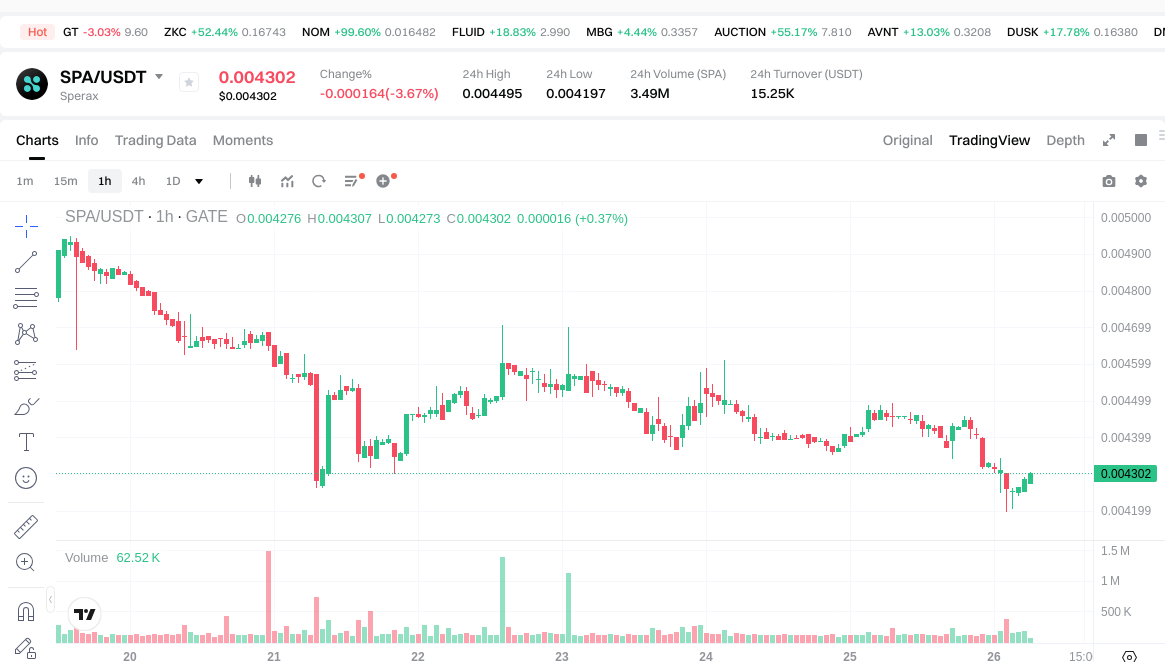
II. Core Factors Affecting Whether SPA is a Good Investment (Is Sperax(SPA) a Good Investment)
Supply Mechanism and Scarcity (SPA investment scarcity)
- Supply Mechanism → Influences price and investment value
- Maximum Supply: The maximum supply of SPA is capped at 5,000,000,000 tokens, with a current circulating supply of approximately 2,435,388,163 tokens, representing around 48.71% of the total supply. The defined maximum supply provides a theoretical scarcity model, which may support long-term valuation considerations.
- Investment Significance: Scarcity remains a key factor in supporting long-term investment interest, as limited supply frameworks can influence market dynamics under varying demand conditions.
Institutional Investment and Mainstream Adoption (Institutional investment in SPA)
- Holder Distribution: As of the latest data, SPA has approximately 11,137 holders, indicating a relatively dispersed ownership structure.
- Exchange Listings: SPA is listed on 10 exchanges, which may facilitate liquidity and accessibility for investors.
- Adoption Context: Sperax has developed the Sperax Play mobile application, which has attracted over 600,000 users since its launch in April 2021, suggesting some level of user engagement within its ecosystem.
Macroeconomic Environment's Impact on SPA Investment
- Monetary Policy and Interest Rate Changes → Broader monetary conditions can alter the attractiveness of digital assets as investment vehicles, as shifts in interest rates may influence capital flows between traditional and crypto markets.
- Inflation Environment: In periods of elevated inflation, certain digital assets have been positioned as potential hedging tools, though the effectiveness of this narrative varies across different asset categories.
- Geopolitical Uncertainty → Instances of geopolitical instability may drive demand for alternative assets, including select cryptocurrencies, as investors seek diversification.
Technology and Ecosystem Development (Technology & Ecosystem for SPA investment)
- Blockchain Consensus Protocol: Sperax is built on the BDLS (Byzantine Deterministic Leaderless Consensus) protocol, which aims to provide security and efficiency in real-world internet environments, distinguishing it from other consensus mechanisms such as Tendermint, GRANDPA, and Casper FFG.
- Stablecoin Product: The Sperax Foundation has launched a native multi-currency stablecoin, Sperax USD (USDs), designed to bridge internet users and decentralized financial applications, potentially expanding the utility of the SPA ecosystem.
- DeFi Ecosystem: Founded in late 2019, Sperax focuses on building a full-stack DeFi ecosystem and promoting financial inclusivity. Future product plans include Sperax Synthetic Assets and Derivatives, which may contribute to ecosystem expansion and long-term value support.
- Application Ecosystem: The Sperax Play mobile application has demonstrated user adoption, which may enhance network effects and support the broader investment thesis for SPA.
III. SPA Future Investment Forecast and Price Outlook (Is Sperax(SPA) worth investing in 2026-2031)
Short-term Investment Forecast (2026, short-term SPA investment outlook)
- Conservative forecast: $0.0034224 - $0.004278
- Neutral forecast: $0.004278
- Optimistic forecast: $0.004278 - $0.00517638
Mid-term Investment Outlook (2027-2029, mid-term Sperax(SPA) investment forecast)
-
Market phase expectation: Based on the provided data, the mid-term outlook suggests a potential gradual recovery phase, with price ranges expanding from 2027 to 2029. The predicted average price shows an upward trend from $0.00472719 in 2027 to $0.005853679377 in 2029, indicating possible market stabilization and moderate growth momentum.
-
Investment return forecast:
- 2027: $0.0025999545 - $0.0048690057
- 2028: $0.004222326108 - $0.006909260904
- 2029: $0.00368781800751 - $0.00790246715895
-
Key catalysts: Factors that may influence mid-term performance include broader DeFi ecosystem development, potential expansion of the Sperax USD (USDs) stablecoin adoption, and continued user growth on the Sperax Play mobile application platform.
Long-term Investment Outlook (Is SPA a good long-term investment?)
- Baseline scenario: $0.004401966891504 - $0.009010275981047 (assuming steady ecosystem development and maintained user engagement through 2030)
- Optimistic scenario: $0.007546965893285 - $0.010327427011864 (assuming accelerated adoption of Sperax products and favorable market conditions through 2031)
- Risk scenario: Below $0.0034224 (under adverse market conditions or significant competitive pressure)
Check SPA long-term investment and price forecast: Price Prediction
2026-01-26 - 2031 Long-term Outlook
- Base scenario: $0.004401966891504 - $0.009010275981047 (corresponding to steady progress and gradual mainstream application enhancement)
- Optimistic scenario: $0.007546965893285 - $0.010327427011864 (corresponding to large-scale adoption and favorable market environment)
- Transformational scenario: Above $0.010327427011864 (if ecosystem achieves breakthrough developments and mainstream popularization)
- 2031-12-31 predicted high: $0.010327427011864 (based on optimistic development assumptions)
Disclaimer: The above forecasts are based on historical data and market analysis models, and do not constitute investment advice. Cryptocurrency markets are highly volatile, and actual prices may differ significantly from predictions. Investors should conduct independent research and consider their own risk tolerance before making investment decisions.
| Year |
Predicted High Price |
Predicted Average Price |
Predicted Low Price |
Price Change |
| 2026 |
0.00517638 |
0.004278 |
0.0034224 |
0 |
| 2027 |
0.0048690057 |
0.00472719 |
0.0025999545 |
10 |
| 2028 |
0.006909260904 |
0.00479809785 |
0.004222326108 |
12 |
| 2029 |
0.00790246715895 |
0.005853679377 |
0.00368781800751 |
36 |
| 2030 |
0.009010275981047 |
0.006878073267975 |
0.004401966891504 |
60 |
| 2031 |
0.010327427011864 |
0.007944174624511 |
0.007546965893285 |
85 |
IV. SPA Investment Strategy and Risk Management (How to invest in SPA)
Investment Methodology (SPA investment strategy)
Long-term Holding (HODL SPA)
Long-term holding is generally considered suitable for conservative investors who prefer to minimize active trading and focus on potential value appreciation over extended periods. This approach involves purchasing SPA tokens and holding them through market fluctuations, based on confidence in the project's fundamental technology and ecosystem development.
Active Trading
Active trading strategies rely on technical analysis and timing market movements. Traders may utilize chart patterns, volume indicators, and price action to identify entry and exit points for short to medium-term positions in SPA.
Risk Management (Risk management for SPA investment)
Asset Allocation Ratios
- Conservative investors: May consider allocating a smaller percentage of their portfolio to SPA, maintaining majority holdings in established assets
- Moderate investors: Could balance SPA holdings with other digital assets and traditional investments
- Professional investors: May implement more sophisticated allocation strategies based on risk tolerance and market analysis
Risk Hedging Solutions
Diversification across multiple asset classes and cryptocurrency categories can help manage exposure to SPA-specific risks. Investors may consider combining SPA with other digital assets, stablecoins, or traditional hedging instruments to balance portfolio volatility.
Secure Storage
SPA tokens can be stored using various wallet solutions:
- Hot wallets: Convenient for frequent transactions but require careful security practices
- Cold wallets: Offline storage solutions that provide enhanced security for long-term holdings
- Hardware wallets: Physical devices designed to store private keys securely, offering a balance between accessibility and security
V. SPA Investment Risks and Challenges (Risks of investing in SPA)
Market Risk
SPA exhibits price volatility, with recorded fluctuations including a 4.09% decline over 24 hours and a 10.97% decrease over 7 days as of the reference date. The token's price history shows variation between recorded levels, reflecting the inherent volatility characteristic of cryptocurrency markets. Market liquidity and trading volume can influence price stability.
Regulatory Risk
Cryptocurrency regulatory frameworks vary across jurisdictions and continue to evolve. Changes in regulatory approaches, compliance requirements, or legal classifications in different countries could impact SPA's accessibility, trading, and overall market dynamics. Investors should monitor regulatory developments in their respective jurisdictions.
Technical Risk
As with blockchain-based projects, technical considerations include:
- Smart contract vulnerabilities that could affect token functionality or security
- Network performance issues that might impact transaction processing
- Protocol upgrade challenges that could introduce temporary disruptions
- Integration risks associated with the broader DeFi ecosystem
The project's reliance on its underlying blockchain infrastructure and smart contract architecture means technical developments require ongoing attention from both the development team and the investor community.
VI. Conclusion: Is SPA a Good Investment?
Investment Value Summary
SPA presents characteristics common to DeFi-focused cryptocurrency projects, including exposure to both technological development potential and market volatility. The token's performance has varied across different time frames, with observed price movements reflecting broader market conditions and project-specific factors. The project's ecosystem includes a stablecoin component (Sperax USD) and reported user adoption through its mobile application.
Investor Recommendations
✅ Beginners: Consider gradual accumulation strategies combined with secure wallet storage practices. Focus on understanding the project's fundamentals and risk factors before making investment decisions.
✅ Experienced Investors: May evaluate opportunities for strategic position management based on technical analysis and market conditions, while maintaining diversified portfolio allocation.
✅ Institutional Investors: Could assess SPA as part of broader DeFi sector exposure, conducting thorough due diligence on the project's technology, team, and competitive positioning.
⚠️ Disclaimer: Cryptocurrency investments carry substantial risk, including the potential for complete loss of capital. This content is provided for informational purposes only and does not constitute financial, investment, or trading advice. Individuals should conduct independent research and consult with qualified financial advisors before making investment decisions.
VII. FAQ
Q1: What is the current market position of SPA, and is it suitable for investment?
As of January 2026, SPA trades at approximately $0.004274 with a market capitalization of $10.41 million and 11,137 holders across 10 exchanges. SPA functions as a governance token within the Sperax DeFi ecosystem, which includes the USDs stablecoin and Sperax Play mobile application serving over 600,000 users. The token's suitability as an investment depends on individual risk tolerance, investment horizon, and understanding of DeFi market dynamics. Conservative investors may consider limited allocation as part of a diversified portfolio, while experienced traders might evaluate technical patterns for shorter-term positioning. The relatively modest market capitalization and trading volume indicate this is a smaller-cap asset with corresponding volatility characteristics.
Q2: What are the primary risks associated with investing in SPA?
The main risks include market volatility (with recorded declines of 4.09% over 24 hours and 10.97% over 7 days), regulatory uncertainty across different jurisdictions, and technical risks inherent to blockchain-based projects such as smart contract vulnerabilities and protocol upgrade challenges. Additionally, SPA's relatively low trading volume of approximately $15,164 over 24 hours may present liquidity constraints during periods of market stress. The token's price has declined significantly from its launch level of approximately $0.02732 in August 2020, reflecting both project-specific factors and broader market conditions. Investors should consider these factors alongside their investment objectives and maintain appropriate risk management strategies including diversification and position sizing.
Q3: What is the projected price outlook for SPA through 2031?
Based on quantitative modeling, the short-term forecast for 2026 ranges from $0.0034224 to $0.00517638, with a neutral scenario around $0.004278. Mid-term projections show gradual expansion, with 2029 estimates ranging from $0.00368781800751 to $0.00790246715895. Long-term projections for 2031 suggest a potential range of $0.007546965893285 to $0.010327427011864 under optimistic conditions, assuming successful ecosystem development and favorable market environments. However, these projections are derived from historical data patterns and do not account for unforeseen market events, regulatory changes, or competitive pressures. Cryptocurrency markets exhibit high volatility, and actual price movements may differ substantially from model-based predictions. Investors should treat these forecasts as reference points rather than guaranteed outcomes.
Q4: How does SPA's supply mechanism affect its investment characteristics?
SPA has a maximum supply capped at 5 billion tokens, with approximately 2.44 billion tokens currently in circulation, representing 48.71% of the total supply. This defined supply ceiling creates a theoretical scarcity framework that may influence valuation dynamics under varying demand conditions. Unlike assets with unlimited supply, the fixed maximum provides predictability regarding future token availability, though the substantial portion of tokens not yet in circulation (approximately 51.29%) represents potential future supply pressure if released into the market. The supply mechanism's impact on investment value depends on the interaction between circulating supply increases, token utility within the Sperax ecosystem, and overall market demand for DeFi governance tokens.
Q5: What role does the Sperax ecosystem play in SPA's investment thesis?
The Sperax ecosystem comprises several components that may influence SPA's value proposition: the BDLS consensus protocol providing the underlying infrastructure, the USDs stablecoin bridging users to DeFi applications, and the Sperax Play mobile application demonstrating user adoption with over 600,000 users. Future planned developments include Sperax Synthetic Assets and Derivatives, which could expand ecosystem utility. The strength of this ecosystem affects SPA's investment case through network effects, as increased platform usage may drive demand for the governance token. However, the competitive DeFi landscape requires continuous innovation and user retention to maintain relevance, making ecosystem development progress a critical factor for long-term investment evaluation.
Q6: What investment strategies are appropriate for different investor profiles considering SPA?
Conservative investors might consider limited allocation (potentially 1-5% of crypto portfolio) focused on long-term holding through market cycles, utilizing cold storage wallets for security. Moderate investors could implement dollar-cost averaging to build positions gradually while maintaining diversification across multiple DeFi projects and asset classes. Active traders may employ technical analysis strategies, identifying support and resistance levels based on price history and volume patterns for shorter-term positions. Institutional investors should conduct comprehensive due diligence on the project's technology stack, team credentials, competitive positioning, and regulatory compliance before determining allocation size. All investor categories should implement stop-loss mechanisms appropriate to their risk tolerance and maintain awareness of liquidity constraints given the token's relatively modest trading volume.
Q7: How do macroeconomic conditions influence SPA as an investment?
Macroeconomic factors impact SPA through multiple channels: monetary policy shifts affecting capital flows between traditional and crypto markets, with tightening conditions potentially reducing speculative capital available for smaller-cap digital assets; inflation dynamics that may enhance or diminish cryptocurrency appeal as alternative stores of value; and geopolitical uncertainty that can drive both risk-seeking and risk-averse behaviors among investors. As a smaller-cap DeFi token, SPA may exhibit heightened sensitivity to macroeconomic shifts compared to larger-cap cryptocurrencies, as investor capital typically flows toward established assets during periods of economic stress. Understanding these broader economic contexts helps investors position SPA holdings appropriately within overall portfolio construction and risk management frameworks.
Q8: What technical and fundamental factors should investors monitor when evaluating SPA?
Key technical factors include on-chain metrics such as active addresses, transaction volume, and token holder distribution patterns; exchange liquidity across the 10 listed platforms; and smart contract activity within the Sperax ecosystem. Fundamental factors encompass USDs stablecoin adoption metrics, Sperax Play user growth and engagement rates, development progress toward planned products like synthetic assets and derivatives, partnership announcements that expand ecosystem utility, and competitive positioning relative to other DeFi protocols. Investors should also monitor the project's GitHub activity for development momentum, community engagement on social platforms, and any updates to tokenomics or governance structures. Regular assessment of these factors provides insight into whether the project is meeting developmental milestones and maintaining user traction necessary to support long-term investment thesis.
* The information is not intended to be and does not constitute financial advice or any other recommendation of any sort offered or endorsed by Gate.