The article "Is Squid Game (SQUID) a good investment? A Comprehensive Analysis of Risks, Market Potential, and Expert Recommendations" examines the investment viability of SQUID, a meme coin inspired by Netflix's series. It addresses the token's historical volatility, community recovery efforts, and current market standing on Binance Smart Chain. Readers will gain insights into risks, projections, and potential returns of investing in SQUID, equipped with factual data and expert evaluations. This piece is ideal for informed investors seeking high-risk opportunities within the digital currency landscape.
Introduction: Squid Game (SQUID) Investment Position and Market Prospects
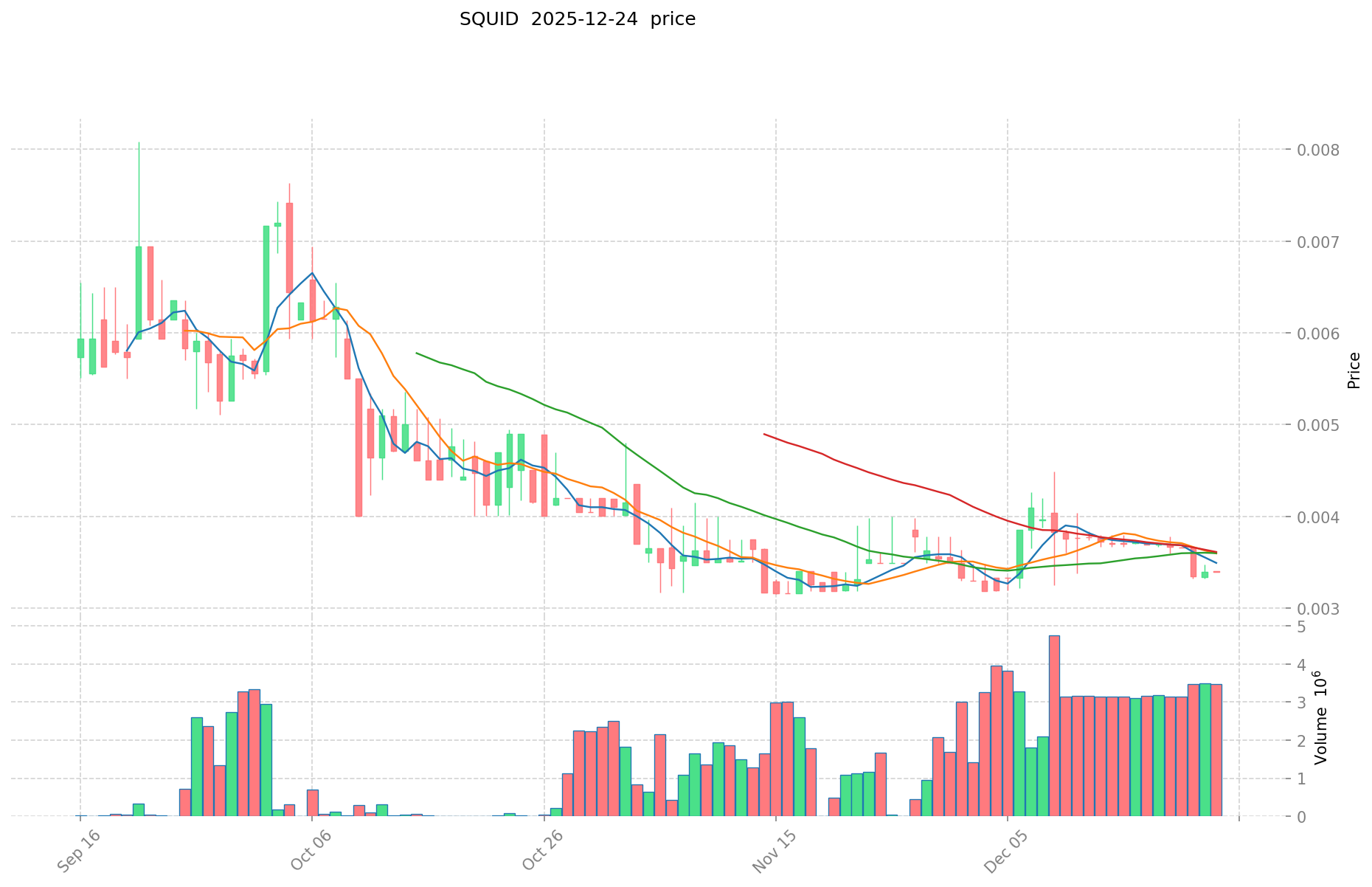
SQUID is a meme coin on the Binance Smart Chain (BSC) that has garnered significant attention in the cryptocurrency market. Since its launch in October 2021, SQUID has experienced dramatic price volatility, reaching an all-time high of $0.251228 on November 19, 2021, before subsequently declining. As of December 25, 2025, SQUID maintains a market capitalization of $2,723,200 with a circulating supply of 800,000,000 tokens at a price of approximately $0.003404. The token currently ranks at position 1,941 by market cap, representing 0.000086% of the total cryptocurrency market.
Originally inspired by the popular Netflix series of the same name, SQUID was initially positioned as a play-to-earn gaming token incorporating concepts from entertainment media. Following a significant collapse, the SQUID community initiated a recovery initiative, with the token undergoing a restructuring process. The new SQUID token maintains its trading symbol while operating under updated smart contract architecture provided by SquidDAO.
With approximately 101,953 token holders and relatively modest 24-hour trading volumes of $12,044.23, SQUID exemplifies the characteristics of lower-liquidity, speculative assets in the cryptocurrency space. Recent price action shows a decline of 0.23% over the past 24 hours, 8.54% over seven days, and notably 86.63% over the past year, reflecting significant bearish pressure.
This article provides a comprehensive analysis of SQUID's investment fundamentals, historical price movements, future price projections, and associated risks to assist investors in making informed decisions regarding this volatile cryptocurrency asset.
Squid Game (SQUID) Crypto Asset Research Report
I. Price History Review and Current Investment Status
-
2021 (Launch Period): Token launched on October 23, 2021, with opening price at $0.00007 USD, then surged to $2,800 USD on the first trading day—an extraordinary gain. However, the price crashed to below $0.001 USD within 5 minutes, with market value evaporating by millions of dollars.
-
2021 (Peak to Collapse): All-time high (ATH) reached $0.251228 USD on November 19, 2021. Subsequently experienced severe volatility characteristic of meme coins.
-
2025 (Current Period): All-time low (ATL) of $0.00000896 USD recorded on March 24, 2025. Year-to-date performance shows -86.63% decline.
Current SQUID Investment Market Status (December 25, 2025)
- Current Price: $0.003404 USD
- 24-Hour Price Change: -0.23%
- 24-Hour Trading Volume: $12,044.23 USD
- Total Market Capitalization: $2,723,200 USD
- Fully Diluted Valuation (FDV): $2,723,200 USD
- Circulating Supply: 800,000,000 SQUID (100% of total supply)
- Market Dominance: 0.000086%
- Number of Holders: 101,953
Price Trend Data
| Time Period |
Change Percentage |
Change Amount |
| 1 Hour |
-0.24% |
-$0.000008189 |
| 24 Hours |
-0.23% |
-$0.000007847 |
| 7 Days |
-8.54% |
-$0.000317846 |
| 30 Days |
-2.64% |
-$0.000092302 |
| 1 Year |
-86.63% |
-$0.022055985 |
Note: Real-time SQUID market data available at Gate SQUID Price
II. Project Overview
Project Description
Squid Game (SQUID) is a meme coin built on the Binance Smart Chain (BSC) network, inspired by the popular Netflix series of the same name. The token was originally designed with promises of launching a play-to-earn gaming platform inspired by the television series.
Technical Specifications
- Blockchain Network: Binance Smart Chain (BSC)
- Token Standard: BEP-20
- Contract Address: 0x87230146E138d3F296a9a77e497A2A83012e9Bc5
- Token Symbol: SQUID
- Total Supply: 800,000,000 SQUID
- Max Supply: 800,000,000 SQUID
- Launch Date: October 23, 2021
- Initial Price: $0.01306 USD
Following the initial collapse, SQUID token holders initiated a "community self-rescue" program. The exchange Gate supported this recovery through a restructuring scheme, where original SQUID tokens were converted to new SQUID tokens on a 1:1 basis. The new token adopts contract code provided by SquidDAO.org.
Official Resources
III. Market Assessment
Risk Factors
- Extreme Volatility: The token demonstrates characteristics of high-risk meme coins with dramatic price swings from inception to present
- Collapsed Initial Promise: Original play-to-earn gaming platform never materialized as promised
- Low Market Capitalization: Current market cap of $2.7M indicates limited market depth
- Recovery Uncertainty: Despite community rescue efforts, token has not recovered to meaningful levels
- Year-over-Year Decline: -86.63% loss over the past 12 months demonstrates sustained downward pressure
Market Position
SQUID currently ranks 1,941st by market capitalization within the broader cryptocurrency ecosystem, with minimal market share (0.000086%) relative to the total crypto market.
Report Date: December 25, 2025
Data Source: Gate Crypto Asset Database
Disclaimer: This report provides factual data and analysis. It does not constitute investment advice, financial recommendations, or endorsements. Cryptocurrency investments carry substantial risk. Conduct thorough independent research before making any investment decisions.
Squid Game (SQUID) Investment Analysis Report
I. Executive Summary
Squid Game (SQUID) is a meme coin launched on the Binance Smart Chain (BSC), inspired by the popular Netflix series of the same name. As of December 25, 2025, the token trades at $0.003404 with a market capitalization of $2,723,200 and ranks 1,941 among cryptocurrencies. The token experienced significant volatility, with an all-time high of $0.251228 (November 19, 2021) and an all-time low of $0.00000896 (March 24, 2025), representing an 86.63% decline over the past year.
II. Core Factors Affecting SQUID Investment Assessment
Supply Mechanism and Tokenomics
The token operates under the following specifications:
- Total supply: 800,000,000 SQUID
- Circulating supply: 800,000,000 SQUID
- Circulating ratio: 100%
- Fully diluted valuation: $2,723,200
With 100% of tokens already in circulation, there is no inflation mechanism through new token issuance. This fixed supply structure provides theoretical scarcity support, though the established market cap and current price levels indicate limited appreciation potential from supply dynamics alone.
Token Recovery and Community Initiative
The original SQUID token underwent a critical restructuring event. Following a dramatic collapse from previous highs, token holders initiated a "community self-rescue" program. This restructuring involved:
- 1:1 conversion of original SQUID tokens to new SQUID tokens
- Adoption of new token contract code provided by SquidDAO.org
- Support from exchanges including Gate for the recovery scheme
- Current implementation on BSC blockchain with contract address: 0x87230146E138d3F296a9a77e497A2A83012e9Bc5
Recent Price Trends:
- 1-hour change: -0.24%
- 24-hour change: -0.23%
- 7-day change: -8.54%
- 30-day change: -2.64%
- 1-year change: -86.63%
Market Metrics:
- 24-hour trading volume: $12,044.23
- Market dominance: 0.000086%
- Active holders: 101,953
The consistently negative price trends across multiple timeframes indicate sustained bearish market sentiment. The low trading volume relative to market capitalization suggests limited liquidity and difficulty in executing large trades without significant price impact.
Project Background and Objectives
Squid Game was launched with promises to develop a play-to-earn gaming platform inspired by the Netflix series and themed around the television concept of "House of Cards." However, the token's history includes an initial rug pull incident where anonymous creators rapidly sold their holdings, causing the price to collapse. The subsequent community recovery represents an attempt to resurrect the project.
III. Investment Outlook Assessment
Technical Analysis Indicators
Multiple forecasting models present divergent outlooks:
Bearish Sentiment: Multiple technical quantitative indicators suggest a bearish forecast for SQUID throughout 2025, indicating downward price pressure based on current market structure and momentum indicators.
Optimistic Scenario: One experimental price prediction model forecasts potential 35.02% growth to $0.000154 by end of 2025 under favorable conditions, though this represents a limited upside from current levels.
Long-term Projections: Extended forecasts for 2026 suggest potential price ranges between $0.0249 (minimum) and $0.0603 (maximum), indicating significant volatility expectations.
Risk Factors
-
Historical Scam Concerns: The original token's collapse through a rug pull event by anonymous developers represents significant reputational damage. While the community recovery initiative demonstrates resilience, it does not eliminate the historical risk profile associated with this asset class.
-
Limited Liquidity: The low 24-hour trading volume relative to market capitalization indicates thin order books and potential slippage on larger transactions.
-
Meme Coin Classification: As a meme coin without substantial utility differentiation, SQUID's value proposition depends primarily on community sentiment and social media momentum rather than fundamental technological advancement or adoption metrics.
-
Extreme Volatility: The 86.63% one-year decline and historical price ranges demonstrate extreme volatility unsuitable for conservative investment strategies.
Official Channels:
Technical Specifications:
- Blockchain: Binance Smart Chain (BSC)
- Token Standard: BEP-20
- Token Symbol: SQUID
V. Conclusion
Squid Game (SQUID) represents a high-risk speculative asset characterized by extreme volatility, limited trading liquidity, and a complex history involving community recovery from a significant collapse event. Current technical indicators predominantly suggest bearish momentum through 2025, with modest optimistic scenarios requiring favorable external conditions. The token's classification as a meme coin without differentiated utility mechanisms means its valuation depends substantially on community engagement and social sentiment rather than fundamental development metrics or institutional adoption.
Report Date: December 25, 2025
Data Currency: December 25, 2025, 02:16:10 UTC
III. SQUID Future Investment Prediction and Price Outlook (Is Squid Game(SQUID) worth investing in 2025-2030)
Short-term Investment Prediction (2025, short-term SQUID investment outlook)
- Conservative forecast: $0.002683 - $0.003016
- Neutral forecast: $0.003396
- Optimistic forecast: $0.003532
Mid-term Investment Outlook (2026-2028, mid-term Squid Game(SQUID) investment forecast)
- Market phase expectation: The token shows potential gradual recovery following community restructuring initiatives and contract migration from the original SQUID collapse. Trading volumes remain modest at approximately $12,044 in 24-hour volume, reflecting limited but stabilizing market interest.
- Investment return forecast:
- 2026: $0.002944 - $0.004815 (+42% potential upside)
- 2028: $0.002725 - $0.005826 (+71% potential upside)
- Key catalysts: Community self-rescue initiatives, new SquidDAO governance implementation, increased retail adoption on BSC network, and broader meme coin market sentiment trends.
Long-term Investment Outlook (Is SQUID a good long-term investment?)
- Base case scenario: $0.005500 - $0.006100 (assuming stable community governance and gradual ecosystem development through 2030)
- Optimistic scenario: $0.006500 - $0.007500 (assuming successful gamification feature launch and increased institutional meme token recognition)
- Risk scenario: $0.001500 - $0.002000 (extreme downside reflecting potential loss of community support or regulatory challenges)
Click to view SQUID long-term investment and price forecast: Price Prediction
2025-12-31 - 2030-12-31 Long-term Outlook
- Base case: $0.005577 - $0.006080 USD (corresponding to stable community governance and continued BSC ecosystem participation)
- Optimistic case: $0.006500 - $0.008000 USD (corresponding to successful mainstream meme token adoption and positive market environment)
- Transformative case: $0.010000 USD and above (if breakthrough ecosystem developments occur and broader mainstream adoption materializes)
- 2030-12-31 predicted peak: $0.006080 USD (based on optimistic development assumptions)
Disclaimer: This analysis is based on available market data and prediction models. Price forecasts are inherently uncertain and subject to significant market volatility. Past performance does not guarantee future results. Investors should conduct thorough due diligence and assess their own risk tolerance before making investment decisions.
| 年份 |
预测最高价 |
预测平均价格 |
预测最低价 |
涨跌幅 |
| 2025 |
0.00353184 |
0.003396 |
0.00268284 |
0 |
| 2026 |
0.0048148488 |
0.00346392 |
0.002944332 |
1 |
| 2027 |
0.005257018188 |
0.0041393844 |
0.003187325988 |
21 |
| 2028 |
0.00582576960456 |
0.004698201294 |
0.00272495675052 |
38 |
| 2029 |
0.005893423703193 |
0.00526198544928 |
0.004577927340873 |
54 |
| 2030 |
0.006079697988098 |
0.005577704576236 |
0.003681285020316 |
63 |
Squid Game (SQUID) Cryptocurrency Research Report
Report Date: December 25, 2025
Data Source: Gate Cryptocurrency Database
I. Project Overview
Squid Game (SQUID) is a meme coin deployed on the Binance Smart Chain (BSC) network, inspired by the popular Netflix series of the same name. The token was originally launched with promises to develop a play-to-earn gaming platform inspired by the television drama.
| Metric |
Value |
| Current Price |
$0.003404 |
| Market Capitalization |
$2,723,200 |
| Circulating Supply |
800,000,000 SQUID |
| Total Supply |
800,000,000 SQUID |
| Market Ranking |
#1941 |
| Token Standard |
BEP-20 |
| Holders |
101,953 |
- All-Time High (ATH): $0.251228 (November 19, 2021)
- All-Time Low (ATL): $0.00000896 (March 24, 2025)
- Current Price Change (24H): -0.23%
- Year-over-Year Performance: -86.63%
II. Market Analysis
Price Trends and Volatility
The SQUID token demonstrates significant volatility across multiple timeframes:
| Time Period |
Price Change |
| 1 Hour |
-0.24% |
| 24 Hours |
-0.23% |
| 7 Days |
-8.54% |
| 30 Days |
-2.64% |
| 1 Year |
-86.63% |
Trading Activity
- 24-Hour Volume: $12,044.23
- 24-Hour High/Low: $0.003404 / $0.003396
- Market Dominance: 0.000086%
III. Project History and Recovery Plan
Following a significant price collapse after an initial surge, the SQUID token community initiated a self-rescue program. The restructuring involved:
- 1:1 Token Conversion: Original SQUID tokens were converted to new SQUID tokens at a 1:1 ratio
- New Contract Implementation: The new token utilizes an updated contract code from SquidDAO org
- Exchange Support: Gate actively supported the recovery through the restructuring scheme, maintaining the SQUID trading symbol
IV. Investment Risks and Challenges
Market Risk
- Extreme Volatility: The token has experienced a -86.63% decline over one year, demonstrating significant price instability
- Meme Coin Characteristics: As a meme-based cryptocurrency, SQUID is susceptible to sentiment-driven trading and speculation
- Liquidity Concerns: Daily trading volume of approximately $12,044 indicates relatively low liquidity
Historical Precedent
The project's history includes a dramatic collapse from its all-time high of $0.251228, raising questions regarding project sustainability and community trust recovery following restructuring efforts.
Regulatory and Technical Considerations
- Blockchain Network Risk: Dependence on BSC network infrastructure
- Smart Contract Risk: Reliance on updated but relatively new contract code following restructuring
V. Conclusion: Is SQUID a Good Investment?
Investment Summary
Squid Game (SQUID) represents a high-risk, speculative cryptocurrency investment. While the community-led recovery initiative demonstrates organizational resilience, the token's history of significant depreciation (-86.63% annually), minimal market capitalization ($2.72M), and characteristics typical of meme coins present substantial challenges.
Investment Considerations
- Not Suitable For: Conservative investors, retirement portfolios, or risk-averse individuals
- High Risk Profile: Extreme volatility and limited liquidity characterize this asset
- Speculative Nature: Investment should only be considered with capital allocation designated specifically for high-risk exploration
⚠️ Disclaimer: Cryptocurrency investments carry substantial risk of total loss. This report is provided for informational purposes only and does not constitute investment advice. Individuals should conduct independent research and consult with financial advisors before making investment decisions.
Last Updated: December 25, 2025
Sources: Gate Data, BSCscan, Official Channels
Squid Game (SQUID) Frequently Asked Questions (FAQ)
I. What is Squid Game (SQUID) and when was it launched?
Answer: Squid Game (SQUID) is a meme coin built on the Binance Smart Chain (BSC) network, inspired by the popular Netflix series of the same name. The token was launched on October 23, 2021, with an initial price of $0.01306 USD. It was originally designed with promises to develop a play-to-earn gaming platform inspired by the television series, though this platform never materialized as originally promised.
II. What is the current price and market capitalization of SQUID as of December 25, 2025?
Answer: As of December 25, 2025, SQUID trades at $0.003404 USD with a market capitalization of $2,723,200 USD. The token has a circulating supply of 800,000,000 SQUID tokens (100% of total supply) and ranks 1,941st by market capitalization within the cryptocurrency ecosystem, representing only 0.000086% of the total crypto market.
III. What happened to the original SQUID token and how did the community recovery initiative work?
Answer: The original SQUID token experienced a dramatic collapse following a rug pull event where anonymous developers rapidly sold their holdings, causing the price to crash from highs above $0.25 to near zero. Subsequently, the token community initiated a "community self-rescue" program supported by exchanges like Gate. This restructuring involved converting original SQUID tokens to new SQUID tokens on a 1:1 basis, with the new token adopting updated smart contract code provided by SquidDAO.org while maintaining the SQUID trading symbol.
IV. What is the price forecast for SQUID through 2030?
Answer: Price projections vary by timeframe and scenario. For 2025, forecasts range from $0.002683 (conservative) to $0.003532 (optimistic). For 2026-2028, projections suggest potential ranges of $0.002944-$0.004815 and $0.002725-$0.005826 respectively. Long-term forecasts through 2030 estimate base case scenarios of $0.005500-$0.006100, optimistic scenarios of $0.006500-$0.007500, and risk scenarios of $0.001500-$0.002000. These forecasts carry substantial uncertainty and should not be treated as guarantees.
V. What are the major risks associated with investing in SQUID?
Answer: SQUID presents multiple significant risks: (1) Extreme volatility with an 86.63% decline over the past year; (2) Low market liquidity with only $12,044.23 in daily trading volume; (3) Meme coin classification dependent on sentiment rather than fundamental utility; (4) Historical scam concerns from the original rug pull incident; (5) Limited trading depth that may result in substantial slippage on larger transactions; (6) Reliance on community support following restructuring rather than established institutional backing.
VI. How many holders does SQUID have and what is the liquidity situation?
Answer: SQUID has approximately 101,953 token holders as of December 25, 2025. The 24-hour trading volume stands at $12,044.23 USD, which is relatively modest compared to the market capitalization of $2,723,200 USD. This low volume-to-market-cap ratio indicates thin order books and limited liquidity, making it difficult to execute large trades without significant price impact.
VII. Is SQUID suitable for conservative investors?
Answer: No, SQUID is not suitable for conservative investors. The token is classified as a high-risk, speculative asset characterized by extreme price volatility, meme coin dynamics driven by social sentiment, and a complex history involving community recovery from near-total collapse. Investors should only consider SQUID with capital specifically designated for high-risk exploration and should avoid allocating retirement funds or essential capital to this asset. Thorough independent research and consultation with financial advisors is strongly recommended before any investment decision.
VIII. What blockchain network does SQUID operate on and what is its token standard?
Answer: SQUID operates on the Binance Smart Chain (BSC) network using the BEP-20 token standard. The smart contract address is 0x87230146E138d3F296a9a77e497A2A83012e9Bc5. The token has a total supply of 800,000,000 SQUID with 100% currently in circulation, meaning no additional tokens will be issued through inflation mechanisms, providing theoretical scarcity support.
Disclaimer: This FAQ is provided for informational purposes only and does not constitute investment advice, financial recommendations, or endorsements. Cryptocurrency investments carry substantial risk of total loss. Conduct thorough independent research and consult with qualified financial advisors before making any investment decisions.
* The information is not intended to be and does not constitute financial advice or any other recommendation of any sort offered or endorsed by Gate.