This comprehensive guide evaluates SSV Network (SSV) as an investment opportunity in 2024-2026, analyzing its market positioning as a decentralized Ethereum staking infrastructure token. The article examines SSV's current valuation at $4.177 with $61.4 million market capitalization, reviewing its price history from $28.68 at launch to a peak of $65.82 in March 2024, followed by correction to $2.65. Key investment factors analyzed include token supply mechanics (100% circulating, unlimited cap), institutional adoption across 28 exchanges including Gate, and technology based on Secret Shared Validators. Price forecasts range from $3.85-$6.11 (2026 conservative to optimistic) with long-term targets reaching $8.50 by 2031. The analysis addresses market risks from 80.97% annual decline, regulatory uncertainties, and technical complexity, while providing investment strategies suited for beginners, experienced traders, and institutions seeking exposure to Ethereum staking infrastructure development.
Introduction: SSV Network (SSV)'s Investment Position and Market Prospects
SSV Network (SSV) represents a notable asset in the cryptocurrency sector, serving as the native token of a decentralized validator infrastructure protocol. As of January 19, 2026, SSV maintains a market capitalization of approximately $61.40 million, with a circulating supply of 14.70 million tokens and a current price around $4.18. Originally launched as Blox (CDT) and rebranded to SSV Network through a 100 CDT = 1 SSV conversion, the project focuses on Secret Shared Validator technology that enables validator key distribution across non-custodial nodes for ETH staking operations.
Positioned within the Ethereum staking infrastructure landscape, SSV serves dual functions: facilitating operator compensation for validator management services and enabling governance participation in protocol decisions and treasury allocation. With 7,150 token holders and availability across 28 exchanges, the asset currently ranks 479th by market capitalization, representing 0.0018% of the total crypto market. The token's fully diluted valuation matches its market cap at 100%, indicating complete circulation of the current supply against an unlimited maximum supply.
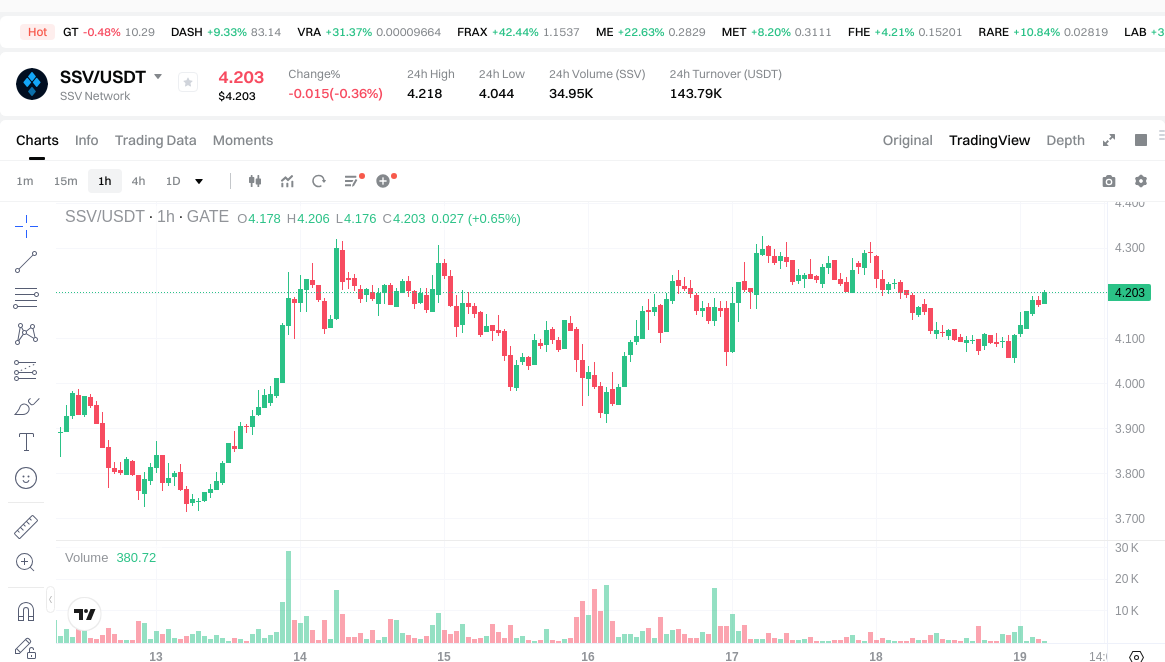
Recent price dynamics show mixed signals: while the token experienced a 5.76% increase over the past seven days and an 11.84% gain over 30 days, it declined 0.9% in the last 24 hours and faced an 80.97% decrease over the past year from previous levels. Trading between $4.04 and $4.22 in the recent 24-hour period, SSV has recorded significant historical volatility, with its price ranging from $2.65 to $65.82 since inception. This article examines SSV Network's investment characteristics, historical price patterns, future projections, and associated risks to provide analytical context for market participants evaluating the asset.
I. SSV Price History Review and Investment Value Status
- 2021: SSV token entered the market on October 19, reaching $28.68 within days on October 22 → Early investors experienced rapid gains followed by subsequent price corrections
- 2024: Price reached $65.82 on March 25 → SSV demonstrated significant volatility with subsequent downward pressure
- 2025: Price declined to $2.65 on October 11 → Market experienced a notable correction from previous levels
Current SSV Investment Market Status (January 2026)
- SSV current price: $4.177
- 24-hour trading volume: $143,593.35
- Market capitalization: $61,398,446.04
- Circulating supply: 14,699,173.1 SSV (representing 100% of total supply)
Click to view real-time SSV market price
II. Core Factors Influencing Whether SSV Is a Good Investment (Is SSV Network(SSV) a Good Investment)
Supply Mechanism and Scarcity (SSV investment scarcity)
- SSV Network has a total supply of 14,699,173.1 SSV tokens with 100% in circulation as of January 19, 2026, indicating no inflationary pressure from future token releases
- The token does not have a maximum supply cap (listed as ∞), which may present considerations for long-term scarcity dynamics
- Investment significance: The complete circulation of available supply may influence price stability, though the lack of a hard cap requires careful evaluation for long-term scarcity expectations
Institutional Investment and Mainstream Adoption (Institutional investment in SSV)
- SSV Network currently has approximately 7,150 holders according to available data
- The project is listed on 28 cryptocurrency exchanges as of January 2026, indicating moderate platform accessibility
- Adoption trends: SSV Network focuses on Ethereum staking infrastructure through its Secret Shared Validators technology, serving validators and staking operators
Macroeconomic Environment's Impact on SSV Investment
- Market conditions: SSV's price performance shows -80.97% change over the past year, reflecting sensitivity to broader cryptocurrency market dynamics
- The token's market capitalization represents 0.0018% market dominance, positioning it as a smaller-cap asset susceptible to macroeconomic shifts
- Cryptocurrency sector volatility and regulatory developments may impact SSV's investment attractiveness
Technology and Ecosystem Development (Technology & Ecosystem for SSV investment)
- Core technology: SSV (Secret Shared Validators) provides a method for splitting validator keys across non-trusted nodes or operators for ETH staking security
- Primary use cases: Payment mechanism for compensating operators managing validators, and governance participation in network decisions
- Ecosystem positioning: SSV Network operates within the Ethereum staking infrastructure space, with smart contracts deployed on the Ethereum blockchain (contract address: 0x9D65fF81a3c488d585bBfb0Bfe3c7707c7917f54)
III. SSV Future Investment Forecast and Price Outlook (Is SSV Network(SSV) worth investing in 2026-2031)
Short-term Investment Forecast (2026, short-term SSV investment outlook)
- Conservative forecast: $3.85 - $4.19
- Neutral forecast: $4.19 - $5.15
- Optimistic forecast: $5.15 - $6.11
Mid-term Investment Outlook (2027-2029, mid-term SSV Network(SSV) investment forecast)
- Market stage expectation: SSV may experience gradual growth with potential volatility as the network matures and adoption patterns evolve
- Investment return forecast:
- 2027: $3.14 - $5.67
- 2028: $4.60 - $6.87
- 2029: $3.32 - $7.06
- Key catalysts: Network expansion, validator adoption rates, Ethereum staking ecosystem development
Long-term Investment Outlook (Is SSV a good long-term investment?)
- Base scenario: $6.07 - $8.71 (assuming steady network growth and maintained market positioning)
- Optimistic scenario: $7.66 - $8.50 (assuming accelerated adoption and favorable market conditions)
- Risk scenario: $3.32 - $4.44 (under challenging market environment or reduced network utilization)
Check SSV long-term investment and price forecast: Price Prediction
2026-01-19 - 2031 Long-term Outlook
- Base scenario: $6.07 - $8.71 (corresponding to steady progress and gradual mainstream application expansion)
- Optimistic scenario: $7.66 - $8.71 (corresponding to large-scale adoption and favorable market environment)
- Transformational scenario: Above $8.71 (if ecosystem achieves breakthrough progress and mainstream popularization)
- 2031-12-31 forecast high: $8.50 (based on optimistic development assumptions)
Disclaimer: The above forecasts are derived from analytical models and historical data patterns. Cryptocurrency markets involve high volatility and uncertainty. These projections should not be considered as investment advice, and actual results may differ materially from forecasted ranges.
| Year |
Predicted High Price |
Predicted Average Price |
Predicted Low Price |
Price Change |
| 2026 |
6.11448 |
4.188 |
3.85296 |
0 |
| 2027 |
5.666364 |
5.15124 |
3.1422564 |
23 |
| 2028 |
6.86917854 |
5.408802 |
4.5974817 |
29 |
| 2029 |
7.0598388105 |
6.13899027 |
3.3150547458 |
46 |
| 2030 |
8.71122719313 |
6.59941454025 |
6.07146137703 |
57 |
| 2031 |
8.4974061620259 |
7.65532086669 |
4.4400861026802 |
83 |
IV. SSV Investment Strategy and Risk Management (How to invest in SSV Network)
Investment Methodology (SSV investment strategy)
Investors considering SSV Network tokens may adopt different approaches based on their risk tolerance and investment horizon:
-
Long-term Holding (HODL SSV): This strategy suits conservative investors who believe in the long-term potential of distributed validator technology in Ethereum staking. Given SSV's focus on infrastructure for ETH staking, holders may benefit from the network's growth as Ethereum's staking ecosystem expands. This approach requires patience through market cycles and focuses on fundamental value rather than short-term price movements.
-
Active Trading: Traders utilizing technical analysis and swing trading strategies may capitalize on SSV's price volatility. With a 24-hour price change of -0.9% and weekly gains of 5.76%, the token exhibits movement patterns that may present opportunities for those skilled in reading market signals and managing entry/exit points effectively.
Risk Management (Risk management for SSV investment)
-
Asset Allocation Ratios: Conservative investors might allocate 1-3% of their crypto portfolio to SSV, balanced investors 3-7%, and aggressive investors up to 10-15%, depending on their overall risk profile and belief in the project's technology.
-
Risk Hedging Solutions: Investors should consider diversifying across multiple assets rather than concentrating in a single token. Combining SSV with established cryptocurrencies and potentially using stablecoins for liquidity management can help mitigate volatility risks.
-
Secure Storage: For SSV token holders, security practices are essential. Cold wallets (offline storage) are recommended for long-term holdings, while hot wallets may be used for smaller amounts intended for active trading. Hardware wallets from reputable manufacturers provide an additional security layer against online threats.
V. SSV Investment Risks and Challenges (Risks of investing in SSV Network)
-
Market Risk: SSV exhibits significant price volatility, with an annual decline of -80.97% from its peak. The token reached a high of $65.82 in March 2024 but dropped to a low of $2.65 in October 2025, demonstrating substantial price swings that can impact investor portfolios. The current market capitalization of approximately $61.4 million represents a relatively small market share of 0.0018%, which may contribute to higher volatility compared to larger-cap assets.
-
Regulatory Risk: As with most crypto assets, SSV faces uncertainty regarding regulatory frameworks across different jurisdictions. Changes in policies governing staking services, distributed infrastructure, or token classifications could affect the network's operations and token value. Investors should monitor regulatory developments in their respective countries.
-
Technical Risk: The SSV Network's technology involves splitting validator keys across non-trusting nodes, which, while innovative, introduces technical complexity. Potential risks include network security vulnerabilities, smart contract bugs, or challenges in protocol upgrades. With 7,150 holders and availability on 28 exchanges, the network's adoption remains in early stages, and technical challenges during scaling could impact performance.
VI. Conclusion: Is SSV Network a Good Investment?
-
Investment Value Summary: SSV Network presents an interesting proposition for those interested in Ethereum staking infrastructure. The project addresses a genuine need in the staking ecosystem through its Secret Shared Validators technology. However, the token has experienced substantial price decline over the past year, and its relatively small market presence suggests continued development is needed for broader adoption.
-
Investor Recommendations:
✅ Beginners: Consider dollar-cost averaging (DCA) with small allocations and prioritize secure wallet storage. Research the technology thoroughly before investing.
✅ Experienced Investors: May explore swing trading opportunities given the token's volatility, while maintaining a diversified portfolio that limits SSV exposure to an appropriate percentage.
✅ Institutional Investors: Could consider strategic long-term positioning if the validator infrastructure aligns with broader Ethereum staking strategies, while carefully assessing technical and market maturity.
⚠️ Disclaimer: Cryptocurrency investments carry substantial risk, and prices can be highly volatile. This content is for informational purposes only and does not constitute investment advice. Investors should conduct their own research and consult with financial professionals before making investment decisions.
VII. FAQ
Q1: What is SSV Network and how does it work?
SSV Network is a decentralized validator infrastructure protocol for Ethereum staking that utilizes Secret Shared Validator (SSV) technology. The protocol splits validator keys across multiple non-trusting nodes or operators, enabling distributed and more secure ETH staking operations. Originally launched as Blox (CDT) and rebranded through a 100 CDT = 1 SSV token conversion, the network serves two primary functions: facilitating operator compensation for validator management services and enabling governance participation in protocol decisions. The smart contract operates on the Ethereum blockchain (contract address: 0x9D65fF81a3c488d585bBfb0Bfe3c7707c7917f54), with the SSV token acting as both a payment mechanism and governance tool within the ecosystem.
Q2: What is the current market status of SSV token as of January 2026?
As of January 19, 2026, SSV token is trading at approximately $4.177 with a market capitalization of $61.40 million, ranking 479th by market cap and representing 0.0018% of the total cryptocurrency market. The token has a circulating supply of 14.70 million SSV (100% of total supply), with approximately 7,150 holders and availability across 28 exchanges. Recent performance shows mixed signals: a 5.76% increase over seven days and 11.84% gain over 30 days, but an 80.97% decline over the past year from previous highs. The 24-hour trading volume stands at $143,593.35, with daily price movement between $4.04 and $4.22.
Q3: What are the price predictions for SSV Network from 2026 to 2031?
Short-term forecasts for 2026 range from $3.85 (conservative) to $6.11 (optimistic). Mid-term projections show potential growth: 2027 ($3.14-$5.67), 2028 ($4.60-$6.87), and 2029 ($3.32-$7.06). Long-term outlook for 2030-2031 suggests a base scenario of $6.07-$8.71, with an optimistic scenario reaching $7.66-$8.50 by late 2031. The 2031 predicted high stands at $8.50, representing potential 103% growth from current levels. However, these projections carry significant uncertainty and should not be considered investment advice, as cryptocurrency markets involve high volatility and actual results may differ materially from forecasted ranges based on market conditions, adoption rates, and ecosystem development.
Q4: What are the main risks associated with investing in SSV Network?
SSV Network presents three primary risk categories. Market risk is substantial, evidenced by the 80.97% annual decline and historical volatility ranging from $2.65 to $65.82, with the relatively small $61.4 million market cap contributing to price swings. Regulatory risk exists as changes in policies governing staking services, distributed infrastructure, or token classifications could affect operations and token value across different jurisdictions. Technical risk stems from the complexity of splitting validator keys across non-trusting nodes, including potential smart contract vulnerabilities, network security issues, or scaling challenges. With only 7,150 holders and early-stage adoption, the network faces maturity challenges that may impact performance and investor returns.
Q5: What investment strategies are recommended for SSV Network tokens?
Investment approaches vary by risk tolerance and time horizon. Long-term holding (HODL) suits conservative investors believing in distributed validator technology's potential within Ethereum's expanding staking ecosystem, requiring patience through market cycles. Active trading appeals to those with technical analysis skills who can capitalize on SSV's volatility patterns, such as the recent 5.76% weekly gain despite short-term fluctuations. Asset allocation recommendations suggest 1-3% for conservative portfolios, 3-7% for balanced approaches, and up to 10-15% for aggressive investors. Risk management should include diversification across multiple assets, combining SSV with established cryptocurrencies and stablecoins, plus secure storage using cold wallets for long-term holdings and hardware wallets for enhanced security against online threats.
Q6: How does SSV Network's supply mechanism affect its investment potential?
SSV Network currently has 14,699,173.1 tokens with 100% in circulation as of January 2026, eliminating inflationary pressure from future token releases. However, the token lacks a maximum supply cap (listed as ∞), which presents considerations for long-term scarcity dynamics compared to fixed-supply cryptocurrencies. The complete circulation of available supply may contribute to price stability in the near term, as there are no scheduled unlocks or vesting periods that could create selling pressure. Investors evaluating long-term scarcity expectations should weigh this unlimited supply potential against the project's adoption trajectory and burn mechanisms, if any. This supply structure differs from deflationary models and requires careful consideration when assessing SSV's investment characteristics relative to other crypto assets.
Q7: Is SSV Network suitable for different types of investors?
SSV Network's suitability varies significantly by investor profile. Beginners should approach cautiously, considering dollar-cost averaging (DCA) with small allocations (1-3% of crypto portfolio), prioritizing secure wallet storage, and thoroughly researching the validator infrastructure technology before investing. Experienced investors may explore swing trading opportunities given the token's demonstrated volatility, while maintaining diversified portfolios that limit SSV exposure to appropriate percentages (3-7%). Institutional investors could consider strategic long-term positioning if the distributed validator infrastructure aligns with broader Ethereum staking strategies, carefully assessing both technical maturity and market development stages. All investor types must recognize the substantial price fluctuations (80.97% annual decline) and early-stage nature of the network (7,150 holders), requiring risk management appropriate to their investment objectives and financial capacity.
Q8: What factors should investors monitor when evaluating SSV Network's future prospects?
Key monitoring factors include Ethereum staking ecosystem development, as SSV's value proposition directly correlates with ETH staking growth and validator demand. Network adoption metrics such as holder count (currently 7,150), validator onboarding rates, and smart contract activity indicate real-world utilization. Technical developments including protocol upgrades, security audits, and integration with major staking platforms affect network competitiveness. Market conditions encompassing cryptocurrency sector trends, regulatory developments affecting staking services, and institutional adoption of distributed infrastructure solutions provide context for price movements. Exchange listings (currently 28 platforms) and trading volume ($143,593.35 daily) reflect liquidity conditions. Finally, governance decisions regarding treasury allocation and protocol parameters may influence token utility and long-term sustainability within the competitive Ethereum staking infrastructure landscape.
* The information is not intended to be and does not constitute financial advice or any other recommendation of any sort offered or endorsed by Gate.